
Korean Directions Vocabulary at a Glance
This list has 40 words in five groups of eight: turns, position, near and far, compass points and landmarks. It sits in Places and Travel, next to Hotel, and it supplies the nouns for the sentences on the asking directions page.
| Group | Words | Use |
|---|---|---|
| Left, right and straight | 8 | Turns and moving direction |
| Above, below, in front of and behind | 8 | Position of one thing relative to another |
| Near and far | 8 | Distance, corners and entrances |
| Cardinal directions | 8 | Compass points and the centre |
| Landmarks and getting there | 8 | Maps, signals and shortcuts |
Position words are nouns in Korean, not prepositions, which is the biggest difference from English. A group of them is also covered in position words. The next section picks what to learn first.
Which Direction Words Should You Learn First?
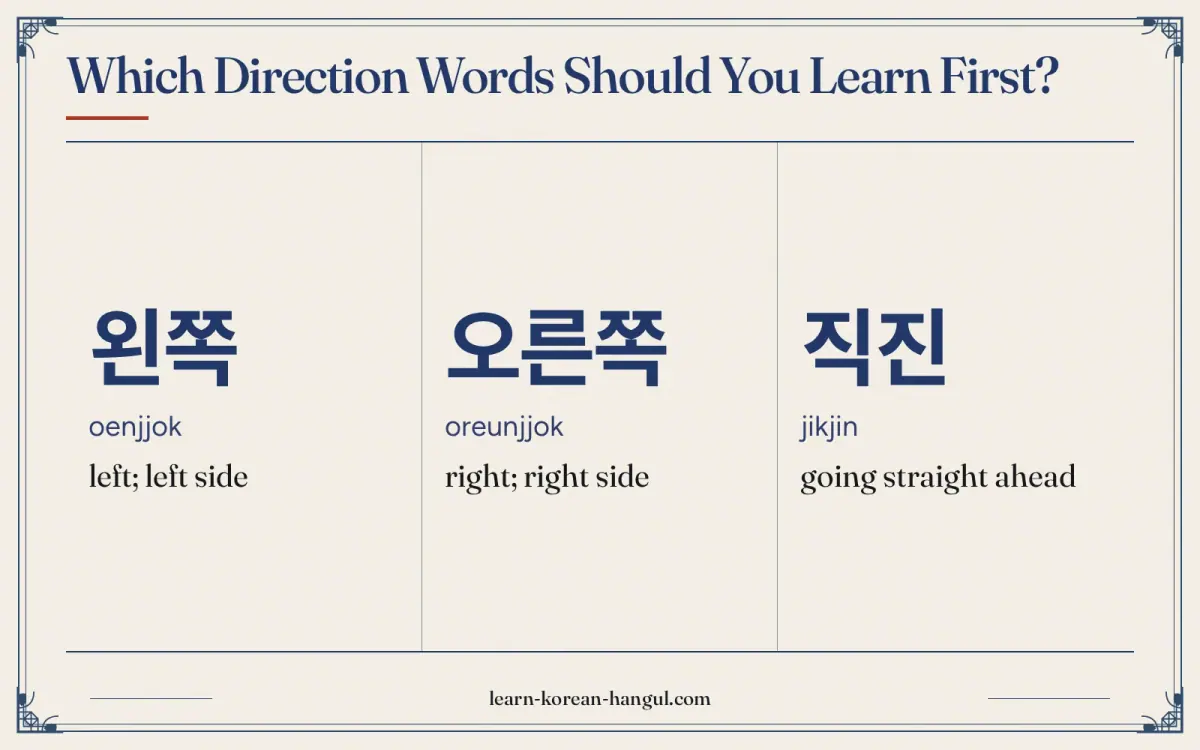
Learn 왼쪽 (left), 오른쪽 (right), 앞 (front), 뒤 (back), 옆 (side) and 근처 (nearby) first. These six answer most directions you will hear: 오른쪽으로 가세요 (go to the right), 은행 옆에 있어요 (it is next to the bank). Add 직진 (straight ahead) and 건너편 (opposite side) next.
- Words to understand when someone points the way. 왼쪽, 오른쪽, 직진, 좌회전, 우회전, 건너편.
- Words to ask with. 근처, 어디, 지도, 출구, 입구.
- Words to read on signs. 입구, 출구, 층, 동쪽, 서쪽, 남쪽, 북쪽.
Korean directions rely more on landmarks than on street names or compass points. A passer-by is more likely to say 편의점 앞에서 오른쪽으로 가세요 (turn right at the convenience store) than to name the road. That is why position nouns and landmarks are in the same list.
Word · 8
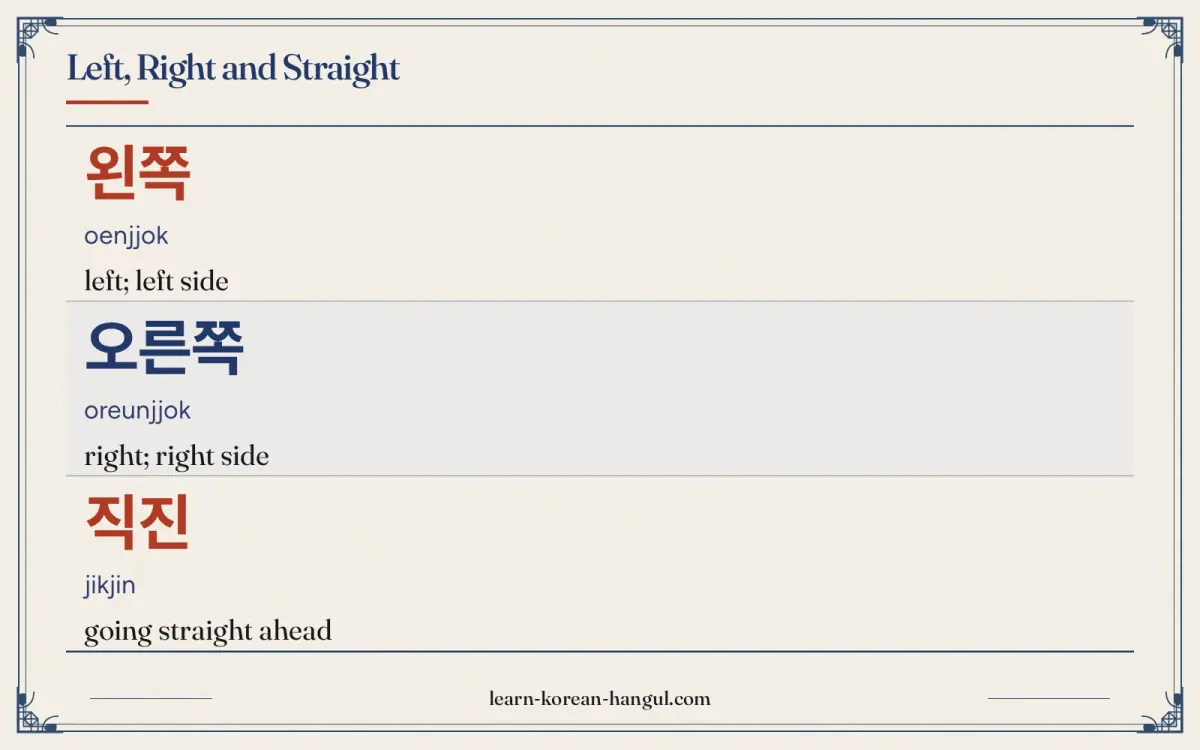
- 1
왼쪽
oenjjok
left; left side
- 2
오른쪽
oreunjjok
right; right side
- 3
직진
jikjin
going straight ahead
- 4
앞
ap
front; in front of
- 5
뒤
dwi
back; behind
- 6
옆
yeop
side; next to
- 7
건너편
geonneopyeon
opposite side; across the street
- 8
사거리
sageori
four-way intersection
Left, Right and Straight
These eight words tell someone where to go. The first two are the pair every learner knows, and the rest name the turns and the way forward.
| No. | Hangul | Revised Romanization | Meaning and note | Example sentence | Audio assetId |
|---|---|---|---|---|---|
| 1 | 왼쪽 | oenjjok | left; left side. 쪽 means side, so 왼쪽 is the left side. | 왼쪽으로 가세요. (Please go to the left.) | au-pg-vocabulary-places-directions-1; example: au-pg-vocabulary-places-directions-2 |
| 2 | 오른쪽 | oreunjjok | right; right side. The right side. | 오른쪽에 은행이 있어요. (The bank is on the right.) | au-pg-vocabulary-places-directions-3; example: au-pg-vocabulary-places-directions-4 |
| 3 | 직진 | jikjin | going straight ahead. 직 means straight and 진 means advance. Common in navigation apps and spoken directions. | 신호등까지 직진하세요. (Go straight to the traffic light.) | au-pg-vocabulary-places-directions-5; example: au-pg-vocabulary-places-directions-6 |
| 4 | 똑바로 | ttokbaro | straight; directly. An adverb for going straight. Casual and common. In directions, 쭉 가세요 (keep going straight) is just as common. | 똑바로 가면 역이 나와요. (If you go straight, you will reach the station.) | au-pg-vocabulary-places-directions-7; example: au-pg-vocabulary-places-directions-8 |
| 5 | 좌회전 | jwahoejeon | left turn. 좌 means left and 회전 means turn. Used for cars and in apps. | 다음 신호에서 좌회전하세요. (Turn left at the next signal.) | au-pg-vocabulary-places-directions-9; example: au-pg-vocabulary-places-directions-10 |
| 6 | 우회전 | uhoejeon | right turn. 우 means right. Pairs with 좌회전. | 우회전해서 직진하세요. (Turn right and go straight.) | au-pg-vocabulary-places-directions-11; example: au-pg-vocabulary-places-directions-12 |
| 7 | 유턴 | yuteon | U-turn. A loanword from English "U-turn". Often seen on road signs. | 여기서 유턴하세요. (Make a U-turn here.) | au-pg-vocabulary-places-directions-13; example: au-pg-vocabulary-places-directions-14 |
| 8 | 방향 | banghyang | direction. The general word for a direction. Used for both a way and a heading. | 어느 방향이에요? (Which direction is it?) | au-pg-vocabulary-places-directions-15; example: au-pg-vocabulary-places-directions-16 |
The words 왼쪽 and 오른쪽 take the particle 으로 to show the way you move: 왼쪽으로 means to the left. The simple form 왼쪽에 means on the left. Compare 오른쪽으로 가세요 (go to the right) with 오른쪽에 있어요 (it is on the right). The first marks movement, the second marks position. The Sino-Korean pair 좌 and 우 appears in 좌회전 and 우회전, which are the words you hear in a car or on a navigation voice.
Above, below, in Front of and Behind
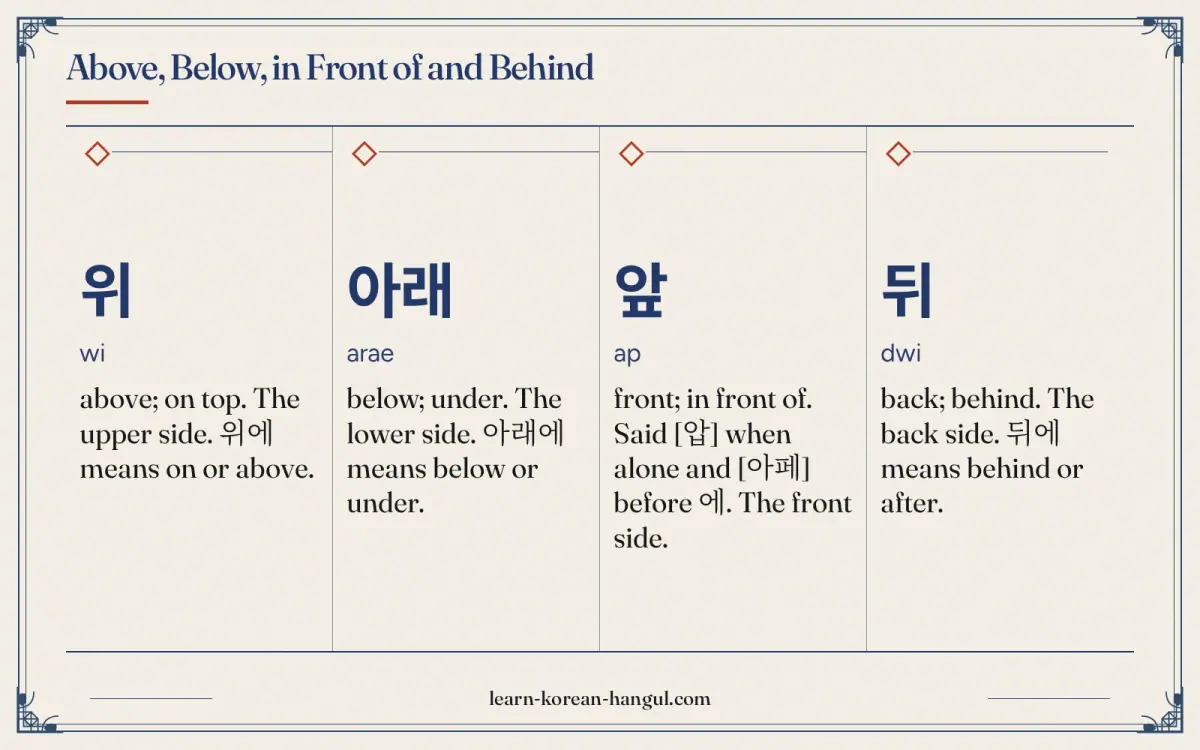
Korean position words are nouns that follow the thing you measure from. These eight are the core set, and place + position + 에 is the frame: 은행 앞에 (in front of the bank).
| No. | Hangul | Revised Romanization | Meaning and note | Example sentence | Audio assetId |
|---|---|---|---|---|---|
| 9 | 위 | wi | above; on top. The upper side. 위에 means on or above. | 책상 위에 있어요. (It is on the desk.) | au-pg-vocabulary-places-directions-17; example: au-pg-vocabulary-places-directions-18 |
| 10 | 아래 | arae | below; under. The lower side. 아래에 means below or under. | 의자 아래에 있어요. (It is under the chair.) | au-pg-vocabulary-places-directions-19; example: au-pg-vocabulary-places-directions-20 |
| 11 | 앞 | ap | front; in front of. Said [압] when alone and [아페] before 에. The front side. | 학교 앞에서 만나요. (Let's meet in front of the school.) | au-pg-vocabulary-places-directions-21; example: au-pg-vocabulary-places-directions-22 |
| 12 | 뒤 | dwi | back; behind. The back side. 뒤에 means behind or after. | 건물 뒤에 주차장이 있어요. (There is a parking lot behind the building.) | au-pg-vocabulary-places-directions-23; example: au-pg-vocabulary-places-directions-24 |
| 13 | 옆 | yeop | side; next to. Said [엽] when alone and [여페] before 에. Right beside something. | 은행 옆에 있어요. (It is next to the bank.) | au-pg-vocabulary-places-directions-25; example: au-pg-vocabulary-places-directions-26 |
| 14 | 안 | an | inside. The inner side. 안에 means inside. Not the same as the negative 안. | 가방 안에 있어요. (It is inside the bag.) | au-pg-vocabulary-places-directions-27; example: au-pg-vocabulary-places-directions-28 |
| 15 | 밖 | bak | outside. Said [박] when alone and [바께] before 에. The outer side. | 밖에서 기다려요. (I wait outside.) | au-pg-vocabulary-places-directions-29; example: au-pg-vocabulary-places-directions-30 |
| 16 | 사이 | sai | between; gap. Between two things: A와 B 사이에 means between A and B. | 은행과 약국 사이에 있어요. (It is between the bank and the pharmacy.) | au-pg-vocabulary-places-directions-31; example: au-pg-vocabulary-places-directions-32 |
Use the pattern place + position + 에, then 있어요: 은행 앞에 있어요 (It is in front of the bank). Korean normally puts no 의 between the two nouns here; 은행의 앞에 is possible in stiff writing but sounds unnatural in speech. The position words are nouns, so they take particles like any noun: 앞에, 앞에서, 앞으로. The table in the next section shows the pattern in one frame.
Near and Far
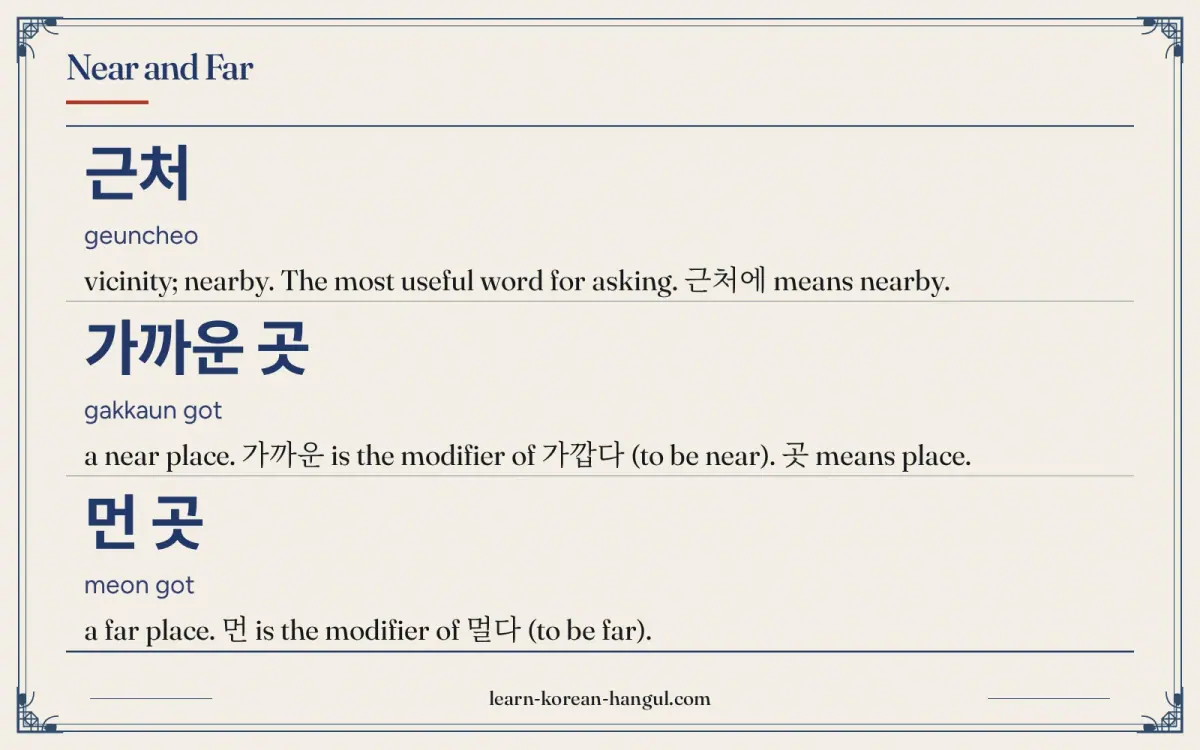
Distance in Korean is a matter of nouns and the adjectives 가깝다 (to be near) and 멀다 (to be far). These eight words name nearby places and the landmarks you use to point to them.
| No. | Hangul | Revised Romanization | Meaning and note | Example sentence | Audio assetId |
|---|---|---|---|---|---|
| 17 | 근처 | geuncheo | vicinity; nearby. The most useful word for asking. 근처에 means nearby. | 근처에 약국이 있어요? (Is there a pharmacy nearby?) | au-pg-vocabulary-places-directions-33; example: au-pg-vocabulary-places-directions-34 |
| 18 | 가까운 곳 | gakkaun got | a near place. 가까운 is the modifier of 가깝다 (to be near). 곳 means place. | 가까운 곳에 있어요. (It is in a nearby place.) | au-pg-vocabulary-places-directions-35; example: au-pg-vocabulary-places-directions-36 |
| 19 | 먼 곳 | meon got | a far place. 먼 is the modifier of 멀다 (to be far). | 먼 곳에서 왔어요. (I came from a far place.) | au-pg-vocabulary-places-directions-37; example: au-pg-vocabulary-places-directions-38 |
| 20 | 건너편 | geonneopyeon | opposite side; across the street. 건너다 means to cross, and 편 means side. | 건너편에 카페가 있어요. (There is a cafe across the street.) | au-pg-vocabulary-places-directions-39; example: au-pg-vocabulary-places-directions-40 |
| 21 | 맞은편 | majeunpyeon | directly opposite. Said [마즌편]. Directly facing something. | 은행 맞은편에 있어요. (It is directly opposite the bank.) | au-pg-vocabulary-places-directions-41; example: au-pg-vocabulary-places-directions-42 |
| 22 | 모퉁이 | motungi | corner (of a street or building). The point where two streets meet. | 모퉁이를 돌면 있어요. (If you go around the corner, it is there.) | au-pg-vocabulary-places-directions-43; example: au-pg-vocabulary-places-directions-44 |
| 23 | 입구 | ipgu | entrance. Said [입꾸]. The way in. Seen on gates and doors. | 입구에서 만나요. (Let's meet at the entrance.) | au-pg-vocabulary-places-directions-45; example: au-pg-vocabulary-places-directions-46 |
| 24 | 출구 | chulgu | exit. The way out. Subway exits are numbered: 출구 번호. | 삼 번 출구로 나오세요. (Come out of exit number 3.) | au-pg-vocabulary-places-directions-47; example: au-pg-vocabulary-places-directions-48 |
Subway exits are the most used landmark in Korea. People say 2번 출구 앞에서 만나요 (let's meet in front of exit 2). The number before 번 uses a Sino-Korean numeral. Distance is then given in walking time: 걸어서 오 분 (five minutes on foot). The extras section below explains the pattern.
Cardinal Directions
Compass directions are used less often than landmarks, but they appear on maps, in weather reports and in building names. The group also holds the words for the centre.
| No. | Hangul | Revised Romanization | Meaning and note | Example sentence | Audio assetId |
|---|---|---|---|---|---|
| 25 | 동쪽 | dongjjok | east. 동 is east and 쪽 is side. | 해는 동쪽에서 떠요. (The sun rises in the east.) | au-pg-vocabulary-places-directions-49; example: au-pg-vocabulary-places-directions-50 |
| 26 | 서쪽 | seojjok | west. 서 is west. | 서쪽으로 가요. (I go west.) | au-pg-vocabulary-places-directions-51; example: au-pg-vocabulary-places-directions-52 |
| 27 | 남쪽 | namjjok | south. 남 is south. | 남쪽은 더워요. (The south is hot.) | au-pg-vocabulary-places-directions-53; example: au-pg-vocabulary-places-directions-54 |
| 28 | 북쪽 | bukjjok | north. 북 is north. | 북쪽은 추워요. (The north is cold.) | au-pg-vocabulary-places-directions-55; example: au-pg-vocabulary-places-directions-56 |
| 29 | 동서남북 | dongseonambuk | east, west, south and north. The four directions in Korean order: east, west, south, north. | 동서남북을 알아요. (I know the four directions.) | au-pg-vocabulary-places-directions-57; example: au-pg-vocabulary-places-directions-58 |
| 30 | 가운데 | gaunde | middle; centre. The point in the middle. Also 한가운데 for the exact centre. | 광장 가운데에 나무가 있어요. (There is a tree in the middle of the square.) | au-pg-vocabulary-places-directions-59; example: au-pg-vocabulary-places-directions-60 |
| 31 | 중앙 | jungang | centre; central. A formal word for the centre. Seen in names like 중앙 도서관 (central library). | 중앙에 서세요. (Please stand in the centre.) | au-pg-vocabulary-places-directions-61; example: au-pg-vocabulary-places-directions-62 |
| 32 | 반대 | bandae | opposite; reverse. Used for opposite directions and opposing views. 반대쪽 is the opposite side. | 반대 방향이에요. (It is the opposite direction.) | au-pg-vocabulary-places-directions-63; example: au-pg-vocabulary-places-directions-64 |
The Korean compass order is 동서남북 (east, west, south, north), not the English "north, south, east, west". The order matters when you read a map or a weather report. The ending 쪽 is the same as in 왼쪽 and 오른쪽, so you can add it to any direction to mean that side.
Landmarks and Getting There
The last group collects the words you use to make a direction concrete. Landmarks such as a crossing or a traffic light are what Koreans point to when they give a route.
| No. | Hangul | Revised Romanization | Meaning and note | Example sentence | Audio assetId |
|---|---|---|---|---|---|
| 33 | 지도 | jido | map. A paper or phone map. 지도 앱 is a map app. | 지도를 봐요. (I look at the map.) | au-pg-vocabulary-places-directions-65; example: au-pg-vocabulary-places-directions-66 |
| 34 | 층 | cheung | floor; storey. Counts floors with Sino-Korean numbers: 2층 (이 층) is the second floor. | 화장실은 삼 층에 있어요. (The toilet is on the third floor.) | au-pg-vocabulary-places-directions-67; example: au-pg-vocabulary-places-directions-68 |
| 35 | 사거리 | sageori | four-way intersection. 사 is four and 거리 is street. A common meeting landmark. | 사거리에서 왼쪽으로 가세요. (Turn left at the intersection.) | au-pg-vocabulary-places-directions-69; example: au-pg-vocabulary-places-directions-70 |
| 36 | 삼거리 | samgeori | T-junction; three-way intersection. 삼 is three. Where three roads meet. | 삼거리에서 오른쪽이에요. (It is on the right at the T-junction.) | au-pg-vocabulary-places-directions-71; example: au-pg-vocabulary-places-directions-72 |
| 37 | 신호등 | sinhodeung | traffic light. Used as a landmark: 신호등 앞에서 우회전. | 신호등 앞에서 기다려요. (I wait in front of the traffic light.) | au-pg-vocabulary-places-directions-73; example: au-pg-vocabulary-places-directions-74 |
| 38 | 횡단보도 | hoengdanbodo | crosswalk. The marked place to cross the road. | 횡단보도를 건너세요. (Please cross the crosswalk.) | au-pg-vocabulary-places-directions-75; example: au-pg-vocabulary-places-directions-76 |
| 39 | 지름길 | jireumgil | shortcut. Said [지름낄]. The quick way. | 지름길로 가요. (I take the shortcut.) | au-pg-vocabulary-places-directions-77; example: au-pg-vocabulary-places-directions-78 |
| 40 | 길치 | gilchi | person with a bad sense of direction. A casual and friendly word. 길 is road and 치 marks a person lacking an ability. | 저는 길치예요. (I am bad with directions.) | au-pg-vocabulary-places-directions-79; example: au-pg-vocabulary-places-directions-80 |
Use the landmarks as hooks. 신호등, 횡단보도 and 사거리 are the three that appear in almost every set of directions. Learn them together with 왼쪽 and 오른쪽, and you can follow most of what a passer-by says.
How Do Position Nouns Work in a Sentence?
English puts "on", "under" and "next to" before the noun. Korean places a position noun after the thing you measure from, then adds the particle 에. The frame is [thing] + [position] + 에 + 있어요, with no particle between the two nouns.
| Position | Pattern | Example | Meaning |
|---|---|---|---|
| on / above | [thing] 위에 | 책상 위에 있어요 | It is on the desk. |
| under | [thing] 아래에 | 의자 아래에 있어요 | It is under the chair. |
| in front of | [thing] 앞에 | 학교 앞에 있어요 | It is in front of the school. |
| behind | [thing] 뒤에 | 건물 뒤에 있어요 | It is behind the building. |
| next to | [thing] 옆에 | 은행 옆에 있어요 | It is next to the bank. |
| inside | [thing] 안에 | 가방 안에 있어요 | It is inside the bag. |
| outside | [thing] 밖에 | 건물 밖에 있어요 | It is outside the building. |
| between | A와 B 사이에 | 은행과 약국 사이에 있어요 | It is between the bank and the pharmacy. |
The frame works with any noun, so a single sentence pattern gives you dozens. The location particles page explains 에 and 에서. The related page on position words gives more examples.
How Do Koreans Give Directions with Landmarks?
Koreans give a route by naming a landmark and then the turn. The usual frame is [landmark] + 에서 + [direction] + 으로/로 + 가세요. The 에서 marks the point where the action happens, and the 으로 or 로 marks the direction you move.
A short route might be: 편의점 앞에서 오른쪽으로 가세요. 신호등에서 왼쪽으로 도세요. 은행 건너편에 있어요. (At the convenience store, go to the right. At the traffic light, turn left. It is across from the bank.) The verbs here are 가다 (to go), 돌다 (to turn) and 건너다 (to cross). Their honorific polite forms, which a speaker uses with a stranger, are 가세요, 도세요 and 건너세요. The verb 돌다 drops its ㄹ before 세요.
When you need to ask, use the question words: 어디예요? (Where is it?) and 어떻게 가요? (How do I get there?). The words from this page then fill the answer. For the full question-and-answer set, see asking directions.
How Do You Say Distance and Walking Time?
Distance in everyday talk is given in minutes on foot or by transport. The pattern is 걸어서 [number] 분 걸려요 (it takes [number] minutes on foot). The number is Sino-Korean: 오 분 is five minutes and 십 분 is ten minutes. The verb 걸리다 means to take (time) and its polite form is 걸려요.
| Sentence | Meaning |
|---|---|
| 걸어서 오 분 걸려요. | It takes five minutes on foot. |
| 버스로 십 분 걸려요. | It takes ten minutes by bus. |
| 여기에서 가까워요. | It is close to here. |
| 여기에서 멀어요. | It is far from here. |
The last two use the adjectives 가깝다 and 멀다, whose polite forms are 가까워요 and 멀어요. The form 가까워요 follows the ㅂ-irregular pattern. The pair 가까운 곳 and 먼 곳 in this page's list are the modifier forms of the same two adjectives. Say them aloud to practise the sounds.
How Do You Pronounce Korean Direction Words?
Position words are short, but several change sound before the particle 에. The Revised Romanization of Korean records the spelling and ignores many of these changes. The standard pronunciation rules published by the National Institute of Korean Language (국립국어원) give the spoken form.
| Spelling | Sounds like | What changes |
|---|---|---|
| 앞에 | [아페] | The final ㅍ links to the vowel of 에. |
| 옆에 | [여페] | The final ㅍ links to the vowel of 에. |
| 밖에 | [바께] | The final ㄲ links to the vowel of 에. |
| 입구 | [입꾸] | After a final ㅂ, the ㄱ of 구 becomes tense [ㄲ]. |
| 맞은편 | [마즌편] | The final ㅈ of 맞 links to the next vowel. |
| 지름길 | [지름낄] | After ㅁ in this compound, the ㄱ of 길 becomes tense [ㄲ]. |
The links in 앞에, 옆에 and 밖에 are the ones you hear in every set of directions. The spelling keeps the final consonant, but the speaker moves it onto 에. Listen to the slow clips and copy the rhythm before you speed up.
Audio and Slow Playback
Each headword and each example sentence has its own audio clip. The clips below replay the trickiest words at a slower pace. Play one, repeat it aloud, then play it again and compare.
What Mistakes Do Learners Make with Direction Words?
These five mistakes come up most when learners give or follow directions.
- Putting position words before the noun. Korean says 은행 옆에, not 옆에 은행. The thing you measure from comes first.
- Confusing 으로 and 에. 오른쪽으로 가세요 marks movement, and 오른쪽에 있어요 marks position.
- Mixing 안 (inside) with the negative 안. In 가방 안에 있어요 it means inside. In 안 가요 it means do not go.
- Saying north, south, east, west in English order. Korean uses 동서남북.
- Writing 앞에 as it sounds. The spelling is 앞에, but you hear [아페].
If you remember only one, remember that the reference noun comes first, because every direction sentence depends on it.
Practice: Flashcards and Worksheet
Study in three steps. First, run the flashcard deck in recognition mode until you know each of the 40 words. Second, switch to listening mode and answer from the audio alone. Third, take the quiz. The deck covers all 40 words with audio, and your progress stays in your browser. The vocabulary flashcard decks page lists the other decks.
Practice · 85
- 01왼쪽
Show answer
headword 1: left; left side
- 02왼쪽으로 가세요.
Show answer
example sentence for 왼쪽: Please go to the left.
- 03오른쪽
Show answer
headword 2: right; right side
- 04오른쪽에 은행이 있어요.
Show answer
example sentence for 오른쪽: The bank is on the right.
- 05직진
Show answer
headword 3: going straight ahead
- 06신호등까지 직진하세요.
Show answer
example sentence for 직진: Go straight to the traffic light.
- 07똑바로
Show answer
headword 4: straight; directly
- 08똑바로 가면 역이 나와요.
Show answer
example sentence for 똑바로: If you go straight, you will reach the station.
- 09좌회전
Show answer
headword 5: left turn
- 10다음 신호에서 좌회전하세요.
Show answer
example sentence for 좌회전: Turn left at the next signal.
- 11우회전
Show answer
headword 6: right turn
- 12우회전해서 직진하세요.
Show answer
example sentence for 우회전: Turn right and go straight.
- 13유턴
Show answer
headword 7: U-turn
- 14여기서 유턴하세요.
Show answer
example sentence for 유턴: Make a U-turn here.
- 15방향
Show answer
headword 8: direction
- 16어느 방향이에요?
Show answer
example sentence for 방향: Which direction is it?
- 17위
Show answer
headword 9: above; on top
- 18책상 위에 있어요.
Show answer
example sentence for 위: It is on the desk.
- 19아래
Show answer
headword 10: below; under
- 20의자 아래에 있어요.
Show answer
example sentence for 아래: It is under the chair.
- 21앞
Show answer
headword 11: front; in front of
- 22학교 앞에서 만나요.
Show answer
example sentence for 앞: Let's meet in front of the school.
- 23뒤
Show answer
headword 12: back; behind
- 24건물 뒤에 주차장이 있어요.
Show answer
example sentence for 뒤: There is a parking lot behind the building.
- 25옆
Show answer
headword 13: side; next to
- 26은행 옆에 있어요.
Show answer
example sentence for 옆: It is next to the bank.
- 27안
Show answer
headword 14: inside
- 28가방 안에 있어요.
Show answer
example sentence for 안: It is inside the bag.
- 29밖
Show answer
headword 15: outside
- 30밖에서 기다려요.
Show answer
example sentence for 밖: I wait outside.
- 31사이
Show answer
headword 16: between; gap
- 32은행과 약국 사이에 있어요.
Show answer
example sentence for 사이: It is between the bank and the pharmacy.
- 33근처
Show answer
headword 17: vicinity; nearby
- 34근처에 약국이 있어요?
Show answer
example sentence for 근처: Is there a pharmacy nearby?
- 35가까운 곳
Show answer
headword 18: a near place
- 36가까운 곳에 있어요.
Show answer
example sentence for 가까운 곳: It is in a nearby place.
- 37먼 곳
Show answer
headword 19: a far place
- 38먼 곳에서 왔어요.
Show answer
example sentence for 먼 곳: I came from a far place.
- 39건너편
Show answer
headword 20: opposite side; across the street
- 40건너편에 카페가 있어요.
Show answer
example sentence for 건너편: There is a cafe across the street.
- 41맞은편
Show answer
headword 21: directly opposite
- 42은행 맞은편에 있어요.
Show answer
example sentence for 맞은편: It is directly opposite the bank.
- 43모퉁이
Show answer
headword 22: corner (of a street or building)
- 44모퉁이를 돌면 있어요.
Show answer
example sentence for 모퉁이: If you go around the corner, it is there.
- 45입구
Show answer
headword 23: entrance
- 46입구에서 만나요.
Show answer
example sentence for 입구: Let's meet at the entrance.
- 47출구
Show answer
headword 24: exit
- 48삼 번 출구로 나오세요.
Show answer
example sentence for 출구: Come out of exit number 3.
- 49동쪽
Show answer
headword 25: east
- 50해는 동쪽에서 떠요.
Show answer
example sentence for 동쪽: The sun rises in the east.
- 51서쪽
Show answer
headword 26: west
- 52서쪽으로 가요.
Show answer
example sentence for 서쪽: I go west.
- 53남쪽
Show answer
headword 27: south
- 54남쪽은 더워요.
Show answer
example sentence for 남쪽: The south is hot.
- 55북쪽
Show answer
headword 28: north
- 56북쪽은 추워요.
Show answer
example sentence for 북쪽: The north is cold.
- 57동서남북
Show answer
headword 29: east, west, south and north
- 58동서남북을 알아요.
Show answer
example sentence for 동서남북: I know the four directions.
- 59가운데
Show answer
headword 30: middle; centre
- 60광장 가운데에 나무가 있어요.
Show answer
example sentence for 가운데: There is a tree in the middle of the square.
- 61중앙
Show answer
headword 31: centre; central
- 62중앙에 서세요.
Show answer
example sentence for 중앙: Please stand in the centre.
- 63반대
Show answer
headword 32: opposite; reverse
- 64반대 방향이에요.
Show answer
example sentence for 반대: It is the opposite direction.
- 65지도
Show answer
headword 33: map
- 66지도를 봐요.
Show answer
example sentence for 지도: I look at the map.
- 67층
Show answer
headword 34: floor; storey
- 68화장실은 삼 층에 있어요.
Show answer
example sentence for 층: The toilet is on the third floor.
- 69사거리
Show answer
headword 35: four-way intersection
- 70사거리에서 왼쪽으로 가세요.
Show answer
example sentence for 사거리: Turn left at the intersection.
- 71삼거리
Show answer
headword 36: T-junction; three-way intersection
- 72삼거리에서 오른쪽이에요.
Show answer
example sentence for 삼거리: It is on the right at the T-junction.
- 73신호등
Show answer
headword 37: traffic light
- 74신호등 앞에서 기다려요.
Show answer
example sentence for 신호등: I wait in front of the traffic light.
- 75횡단보도
Show answer
headword 38: crosswalk
- 76횡단보도를 건너세요.
Show answer
example sentence for 횡단보도: Please cross the crosswalk.
- 77지름길
Show answer
headword 39: shortcut
- 78지름길로 가요.
Show answer
example sentence for 지름길: I take the shortcut.
- 79길치
Show answer
headword 40: person with a bad sense of direction
- 80저는 길치예요.
Show answer
example sentence for 길치: I am bad with directions.
- 81앞에
Show answer
slow playback of 앞에
- 82옆에
Show answer
slow playback of 옆에
- 83밖에
Show answer
slow playback of 밖에
- 84횡단보도
Show answer
slow playback of 횡단보도
- 85오른쪽
Show answer
slow playback of 오른쪽
Practice · 5
What does 왼쪽 (oenjjok) mean?
Show answer
left; left side
왼쪽 means left; left side. Example: 왼쪽으로 가세요. (Please go to the left.)
What does 건너편 (geonneopyeon) mean?
Show answer
opposite side; across the street
건너편 means opposite side; across the street. Example: 건너편에 카페가 있어요. (There is a cafe across the street.)
What does 동서남북 (dongseonambuk) mean?
Show answer
east, west, south and north
동서남북 means east, west, south and north. Example: 동서남북을 알아요. (I know the four directions.)
What does 출구 (chulgu) mean?
Show answer
exit
출구 means exit. Example: 삼 번 출구로 나오세요. (Come out of exit number 3.)
What does 사이 (sai) mean?
Show answer
between; gap
사이 means between; gap. Example: 은행과 약국 사이에 있어요. (It is between the bank and the pharmacy.)
Korean Directions Vocabulary Worksheet (PDF)
A printable worksheet for these words (word list, matching, writing practice, fill-in-the-blank exercises and answer key) is available in A4 and US Letter from the download card on this page. For practice, copy the 40 words by hand and write the meaning next to each. Draw a map of your route home and write the directions in Korean.
Where to Go Next
After this page, continue with Hotel, the last list in the section, or asking directions for the full sentences. For the position nouns in other contexts, see position words. To move up a level, return to Places and Travel.
Frequently Asked Questions
How Do You Say Left in Korean?
Left is 왼쪽 (oenjjok). It means the left side. Use 왼쪽으로 가세요 to say go to the left, and 왼쪽에 있어요 to say it is on the left. The matching word for right is 오른쪽.
How Do You Say Right in Korean?
Right is 오른쪽 (oreunjjok), the right side. Say 오른쪽으로 가세요 for go to the right, and 오른쪽에 있어요 for it is on the right. The Sino-Korean word 우회전 means a right turn and is what drivers and navigation apps say.
How Do You Say Front in Korean?
Front is 앞 (ap). With a place, say 학교 앞 (in front of the school). Before the particle 에, the final ㅍ links to the vowel, so 앞에 sounds like [아페]. The opposite is 뒤 (back).
How Do You Pronounce 왼쪽?
Say oen-jjok. The first syllable is 왼, said like "wen" with the final [n]. The second syllable has a tense ㅉ, said tight with no puff of air, and it ends in a held [k]. Use the audio button on this page for the normal and slow versions.
Why Do Koreans Give Directions with Landmarks?
Road names and building numbers are hard for a visitor to spot, while a landmark such as a convenience store is easy to see, so people say 편의점 앞에서 오른쪽으로 가세요. A subway exit number is also a common landmark.
Is the Romanization on This Page Official?
It follows the Revised Romanization of Korean, which South Korea adopted on 7 July 2000 and whose rules the National Institute of Korean Language (국립국어원) publishes. It is a learning aid and does not mark every sound change, so rely on the Hangul and the audio.