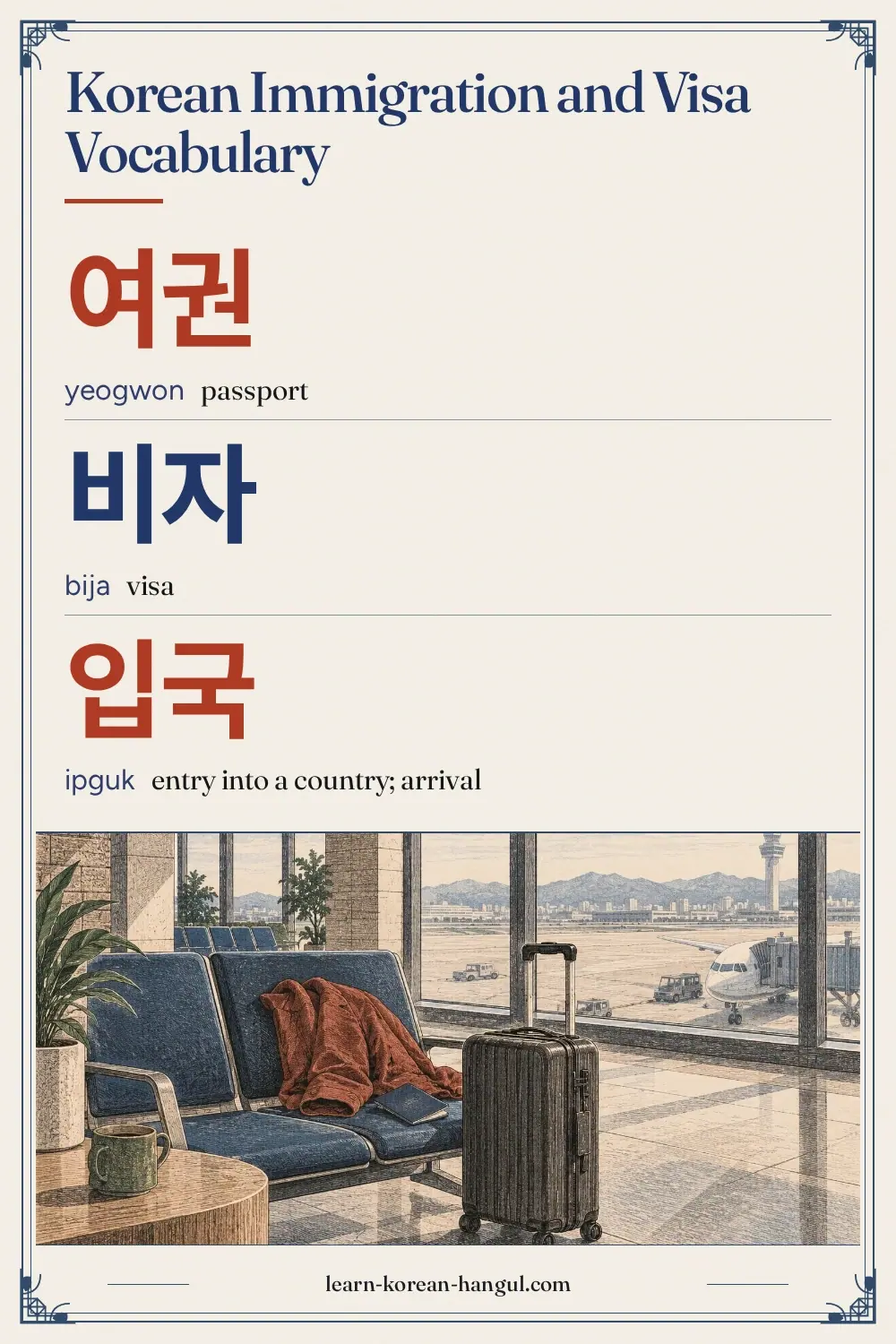
Korean Immigration and Visa Vocabulary at a Glance
The list has 30 words in five groups of six. It follows a visitor from the passport desk to a longer stay: identity documents, the kind of visa, the arrival card, living in Korea for a period and the customs check. It belongs to Travel and Airport, after the Korean Airport Vocabulary list and before Korean Tourist Attractions Vocabulary. The words are formal nouns written on forms and desks, so they are easier to read than to hear in conversation.
| Group | Words | Use |
|---|---|---|
| Passport and ID | 6 | Documents and personal details |
| Visa types | 6 | Kinds of visa and status |
| Entry cards and forms | 6 | Arrival cards, signing and entry |
| Residence | 6 | Longer stays and registration |
| Customs | 6 | Declaring and inspecting goods |
Which Immigration and Visa Words Should You Learn First?
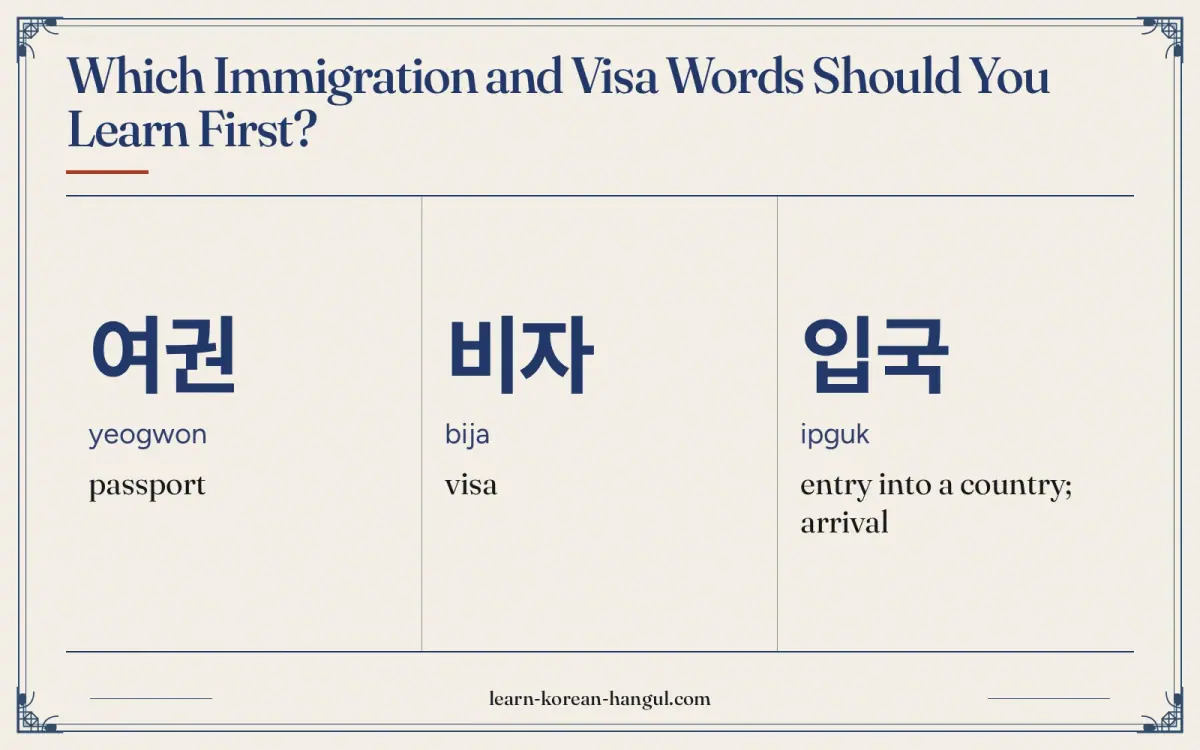
Learn 여권 (passport), 비자 (visa), 입국 (entry), 출국 (departure) and 신고 (declaration) first. They let you understand the signs and the first questions at the desk. Add 입국신고서 and 세관 before you land.
- Words to say. 여권, 비자, 관광, 신고.
- Words to recognise. 입국신고서, 체류 기간, 외국인등록증, 금지 품목. They are printed on forms.
- Words for longer stays. 체류, 연장, 거주지, 신청.
The scene below numbers ten of the 30 words, from the passport desk to the customs check. Play the clip on each item to hear the headword.
Word · 10
- 1
여권
yeogwon
passport
- 2
비자
bija
visa
- 3
입국
ipguk
entry into a country; arrival
- 4
입국신고서
ipguksingoseo
arrival card
- 5
서명
seomyeong
signature
- 6
체류 기간
cheryu gigan
period of stay
- 7
외국인등록증
oegugindeungnokjeung
alien registration card
- 8
세관
segwan
customs
- 9
신고
singo
declaration; report
- 10
검사
geomsa
inspection; check
Passport and ID
The first words are the documents and personal details an officer asks about. 여권 is the passport, 신분증 is an ID card, 국적 is your nationality and 생년월일 is your date of birth. They are the answers to the questions on every form. The two forms of a name are worth noticing: 성명 is the formal word on a form, and 이름 is the word you use in speech.
| No. | Hangul | Revised Romanization | Meaning and note | Example sentence | Audio assetId |
|---|---|---|---|---|---|
| 1 | 여권 | yeogwon | passport. Said [여꿘]. The same -권 as in 승차권, a ticket or pass. | 여권을 보여 주세요. (Please show your passport.) | au-pg-vocabulary-places-travel-immigration-visa-1; example: au-pg-vocabulary-places-travel-immigration-visa-31 |
| 2 | 신분증 | sinbunjeung | ID card. Said [신분쯩]. Used to prove who you are, for example at a bank. | 신분증이 필요해요. (An ID card is needed.) | au-pg-vocabulary-places-travel-immigration-visa-2; example: au-pg-vocabulary-places-travel-immigration-visa-32 |
| 3 | 국적 | gukjeok | nationality. Said [국쩍]. Not the same as 나라, which is a country. | 국적이 어디예요? (What is your nationality?) | au-pg-vocabulary-places-travel-immigration-visa-3; example: au-pg-vocabulary-places-travel-immigration-visa-33 |
| 4 | 생년월일 | saengnyeonworil | date of birth. Four parts: 생 (birth), 년 (year), 월 (month), 일 (day). Said [생녀눠릴]. | 생년월일을 써요. (I write my date of birth.) | au-pg-vocabulary-places-travel-immigration-visa-4; example: au-pg-vocabulary-places-travel-immigration-visa-34 |
| 5 | 성명 | seongmyeong | full name (on forms). The formal word for a name on a form. In speech people say 이름. | 성명을 영어로 써 주세요. (Please write your name in English.) | au-pg-vocabulary-places-travel-immigration-visa-5; example: au-pg-vocabulary-places-travel-immigration-visa-35 |
| 6 | 사진 | sajin | photo. Passport photos are 여권 사진. | 여권 사진을 찍어요. (I take a passport photo.) | au-pg-vocabulary-places-travel-immigration-visa-6; example: au-pg-vocabulary-places-travel-immigration-visa-36 |
An officer usually asks with a polite request, and you can understand most of it from the nouns. 여권을 보여 주세요 means please show your passport, and 국적이 어디예요? means what is your nationality. Notice that the question uses 어디 (where), not 무엇 (what), because Korean asks for a nationality as a place. The date of birth is written year, month, day, so 생년월일 is the order on the form. The related word 나라 (country) is the everyday word; 국적 is the legal one. The single-word entry for passport in Korean has more on 여권, and the word 사진 (photo) is the one printed on the passport page.
How Do You Say Visa Types in Korean?
Visas are named by their purpose. The pattern is the purpose followed by 비자: 관광 비자 for sightseeing, 학생 비자 for study and 취업 비자 for work. If you do not need a visa, the word is 무비자, with 무 meaning none. Behind these everyday names is a legal category called 체류 자격, which is written as a letter and a number.
| No. | Hangul | Revised Romanization | Meaning and note | Example sentence | Audio assetId |
|---|---|---|---|---|---|
| 7 | 비자 | bija | visa. The everyday word. The legal term is 사증 (sajeung), rarely heard. | 비자가 필요해요? (Do I need a visa?) | au-pg-vocabulary-places-travel-immigration-visa-7; example: au-pg-vocabulary-places-travel-immigration-visa-37 |
| 8 | 관광 비자 | gwangwang bija | tourist visa. 관광 is sightseeing. | 관광 비자로 입국했어요. (I entered with a tourist visa.) | au-pg-vocabulary-places-travel-immigration-visa-8; example: au-pg-vocabulary-places-travel-immigration-visa-38 |
| 9 | 학생 비자 | haksaeng bija | student visa. Said [학쌩 비자]. 학생 is a student. | 학생 비자를 신청해요. (I apply for a student visa.) | au-pg-vocabulary-places-travel-immigration-visa-9; example: au-pg-vocabulary-places-travel-immigration-visa-39 |
| 10 | 취업 비자 | chwieop bija | work visa. 취업 is getting a job. | 취업 비자가 있어요. (I have a work visa.) | au-pg-vocabulary-places-travel-immigration-visa-10; example: au-pg-vocabulary-places-travel-immigration-visa-40 |
| 11 | 무비자 | mubija | visa-free. 무 means none. Who is visa-free depends on nationality and changes. | 무비자로 입국해요. (I enter without a visa.) | au-pg-vocabulary-places-travel-immigration-visa-11; example: au-pg-vocabulary-places-travel-immigration-visa-41 |
| 12 | 체류 자격 | cheryu jagyeok | status of stay. The legal category of a visa, written as a code such as D-2 for study. | 체류 자격을 확인해요. (I check my status of stay.) | au-pg-vocabulary-places-travel-immigration-visa-12; example: au-pg-vocabulary-places-travel-immigration-visa-42 |
The legal codes are the part to leave to the official sources. A student visa is commonly written D-2, for example, but which category applies to you, and which visitors need no visa at all, depends on nationality, purpose and length of stay, and the rules change. The Korea Immigration Service publishes the current rules on its HiKorea site (hikorea.go.kr), and the Ministry of Foreign Affairs publishes visa information for people applying abroad. This page teaches the words, not the rules. The pattern purpose + 비자 is a safe guide to a name you have not met: 결혼 비자 is a marriage visa and 방문 비자 is a visit visa. For the single-word entry, see visa in Korean.
Entry Cards and Forms
On arrival you may fill in an arrival card, called 입국신고서, and answer a few questions about why you came. The words in this group are the ones printed on the card and spoken at the desk: 입국 and 출국 for entering and leaving, 작성 for filling in, 서명 for signing and 방문 목적 for the purpose of your visit. Many arrivals can now complete an electronic version, and the form itself changes from time to time.
| No. | Hangul | Revised Romanization | Meaning and note | Example sentence | Audio assetId |
|---|---|---|---|---|---|
| 13 | 입국 | ipguk | entry into a country; arrival. Said [입꾹]. 입 means in and 국 means country. | 인천공항으로 입국해요. (I enter the country through Incheon Airport.) | au-pg-vocabulary-places-travel-immigration-visa-13; example: au-pg-vocabulary-places-travel-immigration-visa-43 |
| 14 | 출국 | chulguk | departure from a country. Said [출국], with no tensing, because in Sino-Korean words a final ㄹ tenses only a following ㄷ, ㅅ or ㅈ. The opposite of 입국. | 내일 출국해요. (I leave the country tomorrow.) | au-pg-vocabulary-places-travel-immigration-visa-14; example: au-pg-vocabulary-places-travel-immigration-visa-44 |
| 15 | 입국신고서 | ipguksingoseo | arrival card. Said [입꾹씬고서]. Many arrivals now have an electronic version, and forms differ. | 입국신고서를 작성해요. (I fill in the arrival card.) | au-pg-vocabulary-places-travel-immigration-visa-15; example: au-pg-vocabulary-places-travel-immigration-visa-45 |
| 16 | 작성 | jakseong | filling in; drawing up. Said [작썽]. The verb is 작성하다. | 영어로 작성해도 돼요? (May I fill it in in English?) | au-pg-vocabulary-places-travel-immigration-visa-16; example: au-pg-vocabulary-places-travel-immigration-visa-46 |
| 17 | 서명 | seomyeong | signature. The formal word for signing. 사인 is the casual loanword. | 여기에 서명해 주세요. (Please sign here.) | au-pg-vocabulary-places-travel-immigration-visa-17; example: au-pg-vocabulary-places-travel-immigration-visa-47 |
| 18 | 방문 목적 | bangmun mokjeok | purpose of visit. Said [방문 목쩍]. | 방문 목적은 관광이에요. (The purpose of my visit is sightseeing.) | au-pg-vocabulary-places-travel-immigration-visa-18; example: au-pg-vocabulary-places-travel-immigration-visa-48 |
The pair 입국 and 출국 is easy to remember with 국 (country): 입 means in and 출 means out, the same two characters as in 입구 (entrance) and 출구 (exit). The verb 하다 turns each into a verb: 입국해요 (I enter), 출국해요 (I leave). Forms use the plain noun style, such as 방문 목적 followed by a blank, so you can fill them without knowing the sentence form. At the desk the officer may say 방문 목적이 뭐예요? and you can answer with the noun and 이에요, as in 관광이에요 (it is sightseeing). The tense sounds are heavy here: 입국 [입꾹], 입국신고서 [입꾹씬고서] and 방문 목적 [방문 목쩍].
How Do You Say Residence in Korean?
A longer stay brings a different set of words. 체류 means staying for a period, 체류 기간 is how long the period lasts and 연장 is extending it. Foreign residents register and receive an 외국인등록증, and a 거주지 is the address where they live. Each step begins with a 신청 (application). These words appear on notices, websites and at the immigration office.
| No. | Hangul | Revised Romanization | Meaning and note | Example sentence | Audio assetId |
|---|---|---|---|---|---|
| 19 | 체류 | cheryu | stay; residing for a period. The verb is 체류하다. | 한국에서 일 년 체류해요. (I stay in Korea for one year.) | au-pg-vocabulary-places-travel-immigration-visa-19; example: au-pg-vocabulary-places-travel-immigration-visa-49 |
| 20 | 체류 기간 | cheryu gigan | period of stay. 기간 means a period of time. | 체류 기간이 한 달이에요. (My period of stay is one month.) | au-pg-vocabulary-places-travel-immigration-visa-20; example: au-pg-vocabulary-places-travel-immigration-visa-50 |
| 21 | 연장 | yeonjang | extension. The verb is 연장하다. | 비자를 연장하고 싶어요. (I want to extend my visa.) | au-pg-vocabulary-places-travel-immigration-visa-21; example: au-pg-vocabulary-places-travel-immigration-visa-51 |
| 22 | 거주지 | geojuji | place of residence. 거주 is residing and 지 is a place. | 거주지 주소를 써요. (I write my residence address.) | au-pg-vocabulary-places-travel-immigration-visa-22; example: au-pg-vocabulary-places-travel-immigration-visa-52 |
| 23 | 외국인등록증 | oegugindeungnokjeung | alien registration card. Said [외구긴등녹쯩]. The card of a registered foreign resident, also called a residence card in English. | 외국인등록증을 받았어요. (I received my alien registration card.) | au-pg-vocabulary-places-travel-immigration-visa-23; example: au-pg-vocabulary-places-travel-immigration-visa-53 |
| 24 | 신청 | sincheong | application. The verb is 신청하다. | 신청은 온라인으로 해요. (I apply online.) | au-pg-vocabulary-places-travel-immigration-visa-24; example: au-pg-vocabulary-places-travel-immigration-visa-54 |
The difference between 체류 and 거주 is a good one to learn. 체류 means staying in a place for a limited period, as a visitor or student does, while 거주 means living in a place as a home. That is why the form asks for a 거주지 and a 체류 기간 separately. The details of the registration system for foreign residents are revised from time to time, so look at HiKorea (hikorea.go.kr) for the current card and procedure. The dates page helps with the dates on these documents, because a Korean date is written year, month, day.
Customs
Customs is the last stop on arrival. The 세관 checks what you bring in. You may be asked to 신고 (declare) certain goods, your bag may get a 검사 (inspection) and some items fall under 금지 품목 (prohibited items). Shoppers also meet 면세, which is the tax exemption behind duty-free shops. The words in this group are written on signs in the arrival hall.
| No. | Hangul | Revised Romanization | Meaning and note | Example sentence | Audio assetId |
|---|---|---|---|---|---|
| 25 | 세관 | segwan | customs. The office that checks goods at the border. | 세관을 지나가요. (I go through customs.) | au-pg-vocabulary-places-travel-immigration-visa-25; example: au-pg-vocabulary-places-travel-immigration-visa-55 |
| 26 | 신고 | singo | declaration; report. Used for declaring goods and also for reporting to the police. | 신고할 물건이 있어요. (I have items to declare.) | au-pg-vocabulary-places-travel-immigration-visa-26; example: au-pg-vocabulary-places-travel-immigration-visa-56 |
| 27 | 면세 | myeonse | duty-free; tax exemption. 면세점 is a duty-free shop. | 면세 한도를 확인해요. (I check the duty-free allowance.) | au-pg-vocabulary-places-travel-immigration-visa-27; example: au-pg-vocabulary-places-travel-immigration-visa-57 |
| 28 | 검사 | geomsa | inspection; check. Used for bags, tests and medical checks. | 가방 검사를 받아요. (I get my bag inspected.) | au-pg-vocabulary-places-travel-immigration-visa-28; example: au-pg-vocabulary-places-travel-immigration-visa-58 |
| 29 | 반입 | banip | bringing in (goods). Said [바닙]. 반입 금지 means bringing it in is banned. | 이 물건은 반입이 안 돼요. (This item cannot be brought in.) | au-pg-vocabulary-places-travel-immigration-visa-29; example: au-pg-vocabulary-places-travel-immigration-visa-59 |
| 30 | 금지 품목 | geumji pummok | prohibited items. 품목 is an item or category of goods. | 금지 품목을 확인해요. (I check the list of prohibited items.) | au-pg-vocabulary-places-travel-immigration-visa-30; example: au-pg-vocabulary-places-travel-immigration-visa-60 |
The idea of 반입 is bringing something in, and the same word with 금지 forms 반입 금지, "bringing in banned". The sound is [바닙], with the final ㄴ of 반 moving to the vowel of 입. The word 신고 has a second use outside customs: it is also what you do when you report a crime or a lost item, as in 경찰에 신고해요 (I report it to the police). Context decides which one. What may be brought in, and the duty-free allowance, are set by the Korea Customs Service (관세청), so check the current rules on its official site (customs.go.kr) before you travel, especially for food, medicine and plants.
How Do You Pronounce These Words?
Immigration words are heavy with tense sounds, because many end in ㄱ or ㅂ and are followed by a plain consonant. A plain consonant becomes tense after those final sounds, and a final consonant moves to the next syllable when a vowel follows. Standard pronunciation follows the National Institute of Korean Language (국립국어원) rules. Revised Romanization shows the linking but not the tensing.
| Spelling | Sounds like | What changes |
|---|---|---|
| 여권 | [여꿘] | The ㄱ of 권 is said as tense ㄲ. |
| 입국신고서 | [입꾹씬고서] | After the final ㅂ the ㄱ is tense, and after the final ㄱ the ㅅ is tense. |
| 생년월일 | [생녀눠릴] | The final ㄴ of 년 and the final ㄹ of 월 move to the vowel that follows. |
| 외국인등록증 | [외구긴등녹쯩] | Linking in 외국인, then 록 becomes [녹] and the ㅈ after its final ㄱ is tense. |
| 반입 | [바닙] | The final ㄴ of 반 moves to the vowel of 입. |
| 방문 목적 | [방문 목쩍] | In 목적, the ㅈ after the final ㄱ is tense. |
Audio and Slow Playback
Each word and example has its own clip, and five more replay the hardest words slowly. Play 입국신고서 first and count the syllables on your fingers, then compare your tense sounds in 입꾹 and 씬 with the clip.
What Mistakes Do Learners Make with Immigration and Visa Words?
Five slips are common at the border.
- Mixing 입국 and 출국. 입 is in and 출 is out. If you are not sure, picture the arrival hall as 입국 and the departure hall as 출국.
- Using 국적 for a country. 국적 is the nationality you hold. For the country as a place, say 나라, and answer 국적이 어디예요? with the country name.
- Treating 체류 and 거주 as the same. 체류 is a stay for a period, and 거주 is living somewhere as a home. A visitor has a 체류 기간 and a resident has a 거주지.
- Reading 신고 only as "report". At customs it means declare. Outside customs it means report, as in 경찰에 신고해요.
- Skipping the tense sounds. 여권 is [여꿘], not [여권]. A plain ㄱ is understood, but the tense sound is the standard one.
Keep the pairs together: 입국 with 출국, 체류 with 거주, 비자 with 체류 자격. This page is a vocabulary guide and not legal advice, so use the official sites for any decision about a visa or a stay.
Practice: Flashcards and Worksheet
Study in three steps. First, run the deck in recognition mode until the 30 words feel familiar. Second, switch to listening mode and play the clip before you flip each card. Third, take the five-question quiz. Your deck progress stays in your browser, and the vocabulary flashcard decks page lists the other decks.
Practice · 65
- 01여권
Show answer
headword 1: passport
- 02신분증
Show answer
headword 2: ID card
- 03국적
Show answer
headword 3: nationality
- 04생년월일
Show answer
headword 4: date of birth
- 05성명
Show answer
headword 5: full name (on forms)
- 06사진
Show answer
headword 6: photo
- 07비자
Show answer
headword 7: visa
- 08관광 비자
Show answer
headword 8: tourist visa
- 09학생 비자
Show answer
headword 9: student visa
- 10취업 비자
Show answer
headword 10: work visa
- 11무비자
Show answer
headword 11: visa-free
- 12체류 자격
Show answer
headword 12: status of stay
- 13입국
Show answer
headword 13: entry into a country; arrival
- 14출국
Show answer
headword 14: departure from a country
- 15입국신고서
Show answer
headword 15: arrival card
- 16작성
Show answer
headword 16: filling in; drawing up
- 17서명
Show answer
headword 17: signature
- 18방문 목적
Show answer
headword 18: purpose of visit
- 19체류
Show answer
headword 19: stay; residing for a period
- 20체류 기간
Show answer
headword 20: period of stay
- 21연장
Show answer
headword 21: extension
- 22거주지
Show answer
headword 22: place of residence
- 23외국인등록증
Show answer
headword 23: alien registration card
- 24신청
Show answer
headword 24: application
- 25세관
Show answer
headword 25: customs
- 26신고
Show answer
headword 26: declaration; report
- 27면세
Show answer
headword 27: duty-free; tax exemption
- 28검사
Show answer
headword 28: inspection; check
- 29반입
Show answer
headword 29: bringing in (goods)
- 30금지 품목
Show answer
headword 30: prohibited items
- 31여권을 보여 주세요.
Show answer
example sentence for 여권
- 32신분증이 필요해요.
Show answer
example sentence for 신분증
- 33국적이 어디예요?
Show answer
example sentence for 국적
- 34생년월일을 써요.
Show answer
example sentence for 생년월일
- 35성명을 영어로 써 주세요.
Show answer
example sentence for 성명
- 36여권 사진을 찍어요.
Show answer
example sentence for 사진
- 37비자가 필요해요?
Show answer
example sentence for 비자
- 38관광 비자로 입국했어요.
Show answer
example sentence for 관광 비자
- 39학생 비자를 신청해요.
Show answer
example sentence for 학생 비자
- 40취업 비자가 있어요.
Show answer
example sentence for 취업 비자
- 41무비자로 입국해요.
Show answer
example sentence for 무비자
- 42체류 자격을 확인해요.
Show answer
example sentence for 체류 자격
- 43인천공항으로 입국해요.
Show answer
example sentence for 입국
- 44내일 출국해요.
Show answer
example sentence for 출국
- 45입국신고서를 작성해요.
Show answer
example sentence for 입국신고서
- 46영어로 작성해도 돼요?
Show answer
example sentence for 작성
- 47여기에 서명해 주세요.
Show answer
example sentence for 서명
- 48방문 목적은 관광이에요.
Show answer
example sentence for 방문 목적
- 49한국에서 일 년 체류해요.
Show answer
example sentence for 체류
- 50체류 기간이 한 달이에요.
Show answer
example sentence for 체류 기간
- 51비자를 연장하고 싶어요.
Show answer
example sentence for 연장
- 52거주지 주소를 써요.
Show answer
example sentence for 거주지
- 53외국인등록증을 받았어요.
Show answer
example sentence for 외국인등록증
- 54신청은 온라인으로 해요.
Show answer
example sentence for 신청
- 55세관을 지나가요.
Show answer
example sentence for 세관
- 56신고할 물건이 있어요.
Show answer
example sentence for 신고
- 57면세 한도를 확인해요.
Show answer
example sentence for 면세
- 58가방 검사를 받아요.
Show answer
example sentence for 검사
- 59이 물건은 반입이 안 돼요.
Show answer
example sentence for 반입
- 60금지 품목을 확인해요.
Show answer
example sentence for 금지 품목
- 61입국신고서
Show answer
slow playback: arrival card
- 62외국인등록증
Show answer
slow playback: alien registration card
- 63생년월일
Show answer
slow playback: date of birth
- 64체류 자격
Show answer
slow playback: status of stay
- 65금지 품목
Show answer
slow playback: prohibited items
Practice · 5
What does 여권 (yeogwon) mean?
Show answer
passport
여권 means passport. Example: 여권을 보여 주세요. (Please show your passport.)
What does 관광 비자 (gwangwang bija) mean?
Show answer
tourist visa
관광 비자 means tourist visa. Example: 관광 비자로 입국했어요. (I entered with a tourist visa.)
What does 입국신고서 (ipguksingoseo) mean?
Show answer
arrival card
입국신고서 means arrival card. Example: 입국신고서를 작성해요. (I fill in the arrival card.)
What does 외국인등록증 (oegugindeungnokjeung) mean?
Show answer
alien registration card
외국인등록증 means alien registration card. Example: 외국인등록증을 받았어요. (I received my alien registration card.)
What does 반입 (banip) mean?
Show answer
bringing in (goods)
반입 means bringing in (goods). Example: 이 물건은 반입이 안 돼요. (This item cannot be brought in.)
Korean Immigration and Visa Vocabulary Worksheet (PDF)
A printable worksheet for these words (word list, matching, writing practice, fill-in-the-blank exercises and answer key) is available in A4 and US Letter from the download card on this page. Meanwhile, fill in an imaginary arrival card in Korean: write your nationality, date of birth and purpose of visit, and say each answer aloud.
Where to Go Next
After this page, continue with Korean Tourist Attractions Vocabulary for the places you visit once you have arrived, or go back to Korean Airport Vocabulary for the words before passport control. To move up a level, return to Travel and Airport.
Frequently Asked Questions
How Do You Say Passport in Korean?
Passport is 여권 (yeogwon), said [여꿘]. A visa is 비자 (bija). To ask someone to show it, say 여권을 보여 주세요 (please show your passport). The single-word page on passport in Korean gives more detail.
How Do You Pronounce 비자 (bija)?
Say bi-ja in two beats. The first vowel is an ee, as in "bee", and the ja is a soft j, between j and ch in English. There is no sound change, so it is [비자]. Press the audio button to hear it.
How Many Immigration and Visa Words Should I Learn First?
Five: 여권, 비자, 입국, 출국 and 신고. They cover the first questions at the desk. At five new words a day the full 30 take six days plus review. Add 입국신고서 before you land.
Where Can I Practise Immigration and Visa Words with Flashcards?
Use the vocabulary flashcard decks. The deck for this page holds all 30 words with Hangul, romanization and audio. Your progress stays in your browser. Try listening mode on 입국신고서 and 외국인등록증, because their spoken forms differ from the spelling.
Is the Romanization on This Page Official?
It follows the Revised Romanization of Korean, which South Korea adopted on 7 July 2000 and whose rules the National Institute of Korean Language (국립국어원) publishes. It is a learning aid. It shows linking such as saengnyeonworil, but it does not show tensing that the spelling does not write, such as the [ㄲ] in 여권 [여꿘], so rely on the Hangul and the audio.
Is There a Printable Worksheet for Immigration and Visa Words?
A printable worksheet for these words (word list, matching, writing practice, fill-in-the-blank exercises and answer key) is available in A4 and US Letter from the download card on this page. For practice, copy the tables by hand and write one example sentence for each of the five groups.