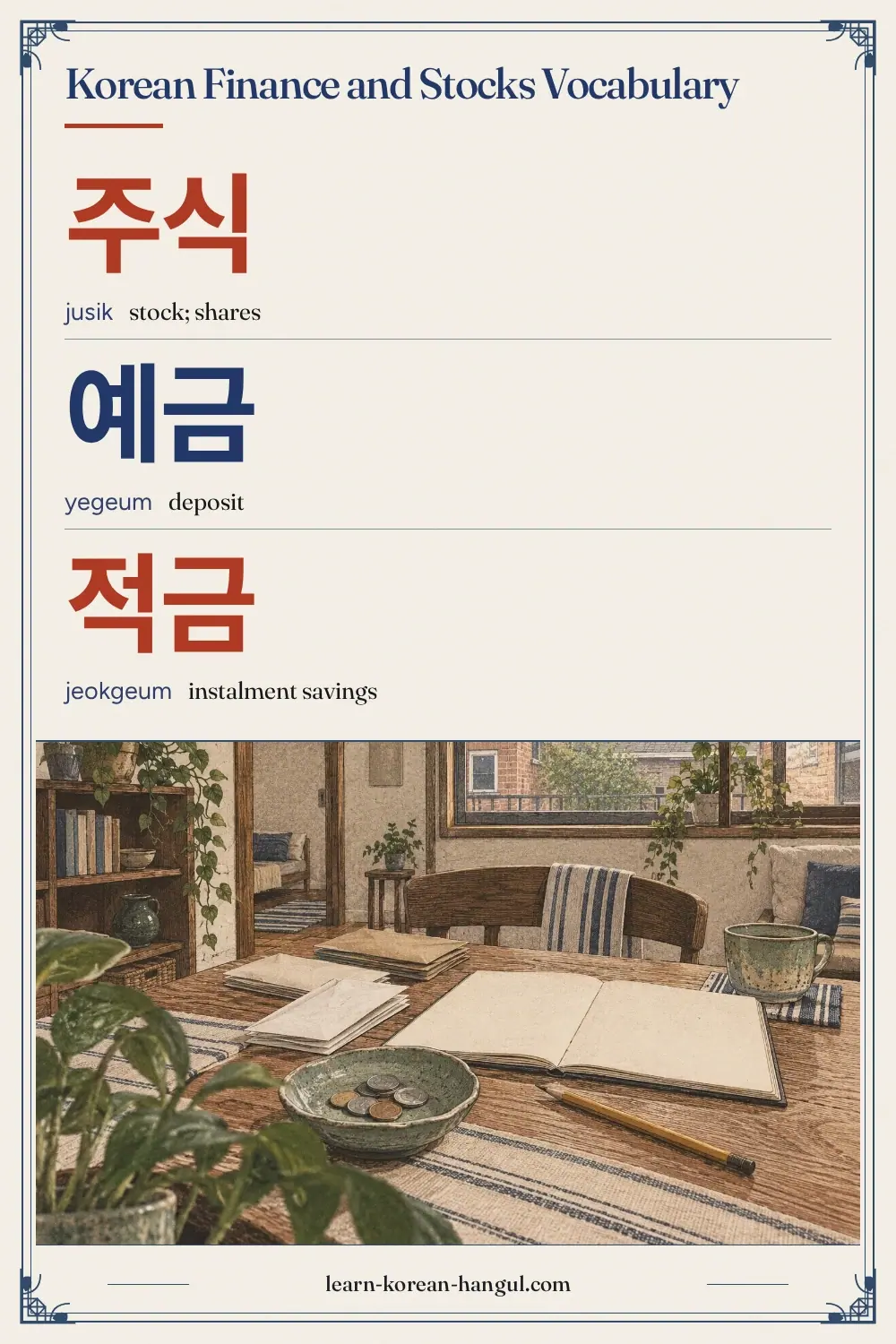
Korean Finance and Stocks Vocabulary at a Glance
Korean finance and stocks vocabulary is the set of words you meet in business news, at the bank and on a pay slip. It sits in Korean Society Vocabulary, next to the lists for law, politics and news. The words are mostly Sino-Korean (built from syllables of Chinese origin), which is why a headline can look like a row of two-syllable blocks.
Of the 35 words, 31 are Sino-Korean and 4 are loanwords from English. The loanwords are 코스피, 코스닥, 펀드 and 인플레이션. The origin column marks each word.
| Group | Words | Use |
|---|---|---|
| Markets and stocks | 7 | Name the market and talk about share prices |
| Investing | 7 | Talk about money you put in and what comes out |
| Banks and insurance | 7 | Handle savings, loans and cover |
| Taxes | 7 | Understand your pay slip and the tax year |
| Economic news | 7 | Read headlines about rates, prices and the economy |
This page teaches words to read and say. It does not tell you what to buy, and no sentence on it is advice. You need to read Hangul to use the tables. If you cannot yet, start with reading Hangul.
Which Finance and Stock Words Should You Learn First?
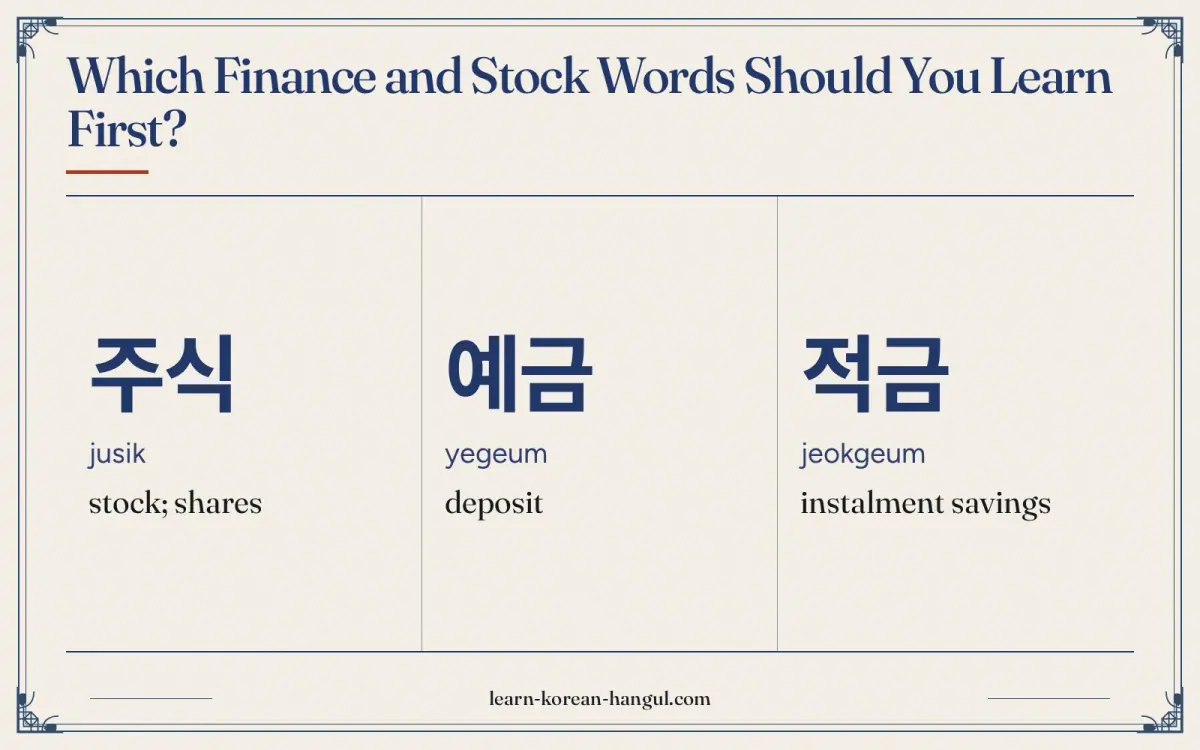
Learn the bank and tax words first if you live in Korea, and the stock words first if you read business news. The bank words appear on forms and in apps, and the stock words appear in every business report.
- If you live in Korea. 예금, 적금, 이자, 대출, 보험, 세금 and 연말정산.
- If you read business news. 주가, 금리, 환율, 물가, 경기 and 불황.
- If you follow the stock market. 주식, 코스피, 코스닥, 투자자, 배당 and 수익률.
- If you prepare for a job in finance. 증권, 상장, 펀드, 원금, 손실 and 인플레이션.
The scene below numbers ten of the objects at the counter, so that you can tie each word to something you can point at.
Word · 10
- 1
주식
jusik
stock; shares
- 2
예금
yegeum
deposit
- 3
적금
jeokgeum
instalment savings
- 4
이자
ija
interest (on money)
- 5
대출
daechul
loan
- 6
보험
boheom
insurance
- 7
연금
yeongeum
pension
- 8
세금
segeum
tax
- 9
금리
geumni
interest rate
- 10
환율
hwanyul
exchange rate
Tap a number to hear the word. At 5 words a day the 35 words take about a week with review. For everyday bank words such as account and card, see the bank vocabulary page.
Markets and Stocks
A stock market is where shares are bought and sold. 주식 is the share, 주가 is its price, 증권 is the wider word for shares and bonds, and 증시 is the market as it appears in news. In Korea there are two main markets, the 코스피, which lists mostly large and established companies, and the 코스닥, which lists smaller growth companies. Both names are written in Hangul from English-language abbreviations (KOSPI and KOSDAQ). 상장 is the step when a company's shares start to trade.
| No. | Hangul | Revised Romanization | Origin | Meaning and note | Example sentence | Audio assetId |
|---|---|---|---|---|---|---|
| 1 | 주식 | jusik | Sino-Korean | stock; shares. The general word for shares in a company | 아버지는 주식을 조금 가지고 있어요. (My father owns a few shares.) | au-pg-vocabulary-society-finance-1; example: au-pg-vocabulary-society-finance-36 |
| 2 | 주가 | juga | Sino-Korean | stock price. Said [주까]. It is 주식 plus 가 (price) | 오늘 주가가 올랐어요. (The stock price rose today.) | au-pg-vocabulary-society-finance-2; example: au-pg-vocabulary-society-finance-37 |
| 3 | 증권 | jeunggwon | Sino-Korean | securities. Said [증꿘]. Shares, bonds and similar papers | 증권 회사에서 일해요. (I work at a securities firm.) | au-pg-vocabulary-society-finance-3; example: au-pg-vocabulary-society-finance-38 |
| 4 | 증시 | jeungsi | Sino-Korean | stock market. A short form of 증권 시장, common in news | 오늘 증시 뉴스를 봤어요. (I watched today's stock market news.) | au-pg-vocabulary-society-finance-4; example: au-pg-vocabulary-society-finance-39 |
| 5 | 코스피 | koseupi | loanword | KOSPI; the main Korean stock index. Short for Korea Composite Stock Price Index | 뉴스에서 코스피 소식을 전해요. (The news reports on the KOSPI.) | au-pg-vocabulary-society-finance-5; example: au-pg-vocabulary-society-finance-40 |
| 6 | 코스닥 | koseudak | loanword | KOSDAQ; the market for smaller growth companies. Another stock market in Korea, separate from the KOSPI | 코스닥에는 작은 기업이 많아요. (KOSDAQ has many small companies.) | au-pg-vocabulary-society-finance-6; example: au-pg-vocabulary-society-finance-41 |
| 7 | 상장 | sangjang | Sino-Korean | listing (on a stock exchange) | 그 회사의 상장 소식이 나왔어요. (News of the company's listing came out.) | au-pg-vocabulary-society-finance-7; example: au-pg-vocabulary-society-finance-42 |
주가 is built from 주 (share) and 가 (price), and this pattern repeats: 물가 (prices in general) and 환율 (exchange rate) are in the economic news group. 증시 is the shortened form of 증권 시장, and news writers prefer the short form in headlines. You will see both 코스피 and 코스닥 on the evening news, usually followed by whether the index rose or fell.
Example Sentences
Each example is a short polite sentence. Many follow the pattern noun + 이/가 + verb, where 이/가 is the subject particle. Say a sentence aloud, then swap the noun. In 오늘 주가가 올랐어요 you can replace 주가 with 환율 and say 오늘 환율이 올랐어요 (the exchange rate rose today). The particles are explained in the Korean particles guide.
How Do You Say Investing in Korean?
Investing words describe putting money in and getting something back. 투자 is the investment, 투자자 is the person who invests, and 펀드 is a pool of money managed together. What you get back is 배당 (dividend) or 수익률 (rate of return), and what you can lose is 손실 or even 원금 (the principal, your original amount).
| No. | Hangul | Revised Romanization | Origin | Meaning and note | Example sentence | Audio assetId |
|---|---|---|---|---|---|---|
| 8 | 투자 | tuja | Sino-Korean | investment | 저는 작은 투자를 시작했어요. (I started a small investment.) | au-pg-vocabulary-society-finance-8; example: au-pg-vocabulary-society-finance-43 |
| 9 | 투자자 | tujaja | Sino-Korean | investor. -자 names a person | 투자자들이 뉴스를 확인해요. (Investors check the news.) | au-pg-vocabulary-society-finance-9; example: au-pg-vocabulary-society-finance-44 |
| 10 | 배당 | baedang | Sino-Korean | dividend. A share of profit paid to shareholders | 이 회사는 배당을 줘요. (This company pays a dividend.) | au-pg-vocabulary-society-finance-10; example: au-pg-vocabulary-society-finance-45 |
| 11 | 수익률 | suingnyul | Sino-Korean | rate of return. Said [수잉뉼]. 률 means rate | 은행 이자보다 수익률이 높아요. (The rate of return is higher than bank interest.) | au-pg-vocabulary-society-finance-11; example: au-pg-vocabulary-society-finance-46 |
| 12 | 손실 | sonsil | Sino-Korean | loss. The opposite of 수익 (gain) | 이번 달에는 손실이 컸어요. (I had a large loss this month.) | au-pg-vocabulary-society-finance-12; example: au-pg-vocabulary-society-finance-47 |
| 13 | 펀드 | peondeu | loanword | fund. From English. A pool of money managed together | 월급의 일부를 펀드에 넣어요. (I put part of my salary into a fund.) | au-pg-vocabulary-society-finance-13; example: au-pg-vocabulary-society-finance-48 |
| 14 | 원금 | wongeum | Sino-Korean | principal; the original amount | 원금을 잃고 싶지 않아요. (I do not want to lose my principal.) | au-pg-vocabulary-society-finance-14; example: au-pg-vocabulary-society-finance-49 |
수익률 is 수익 (gain) plus 률 (rate). The ending 률 or 율 means rate, and it appears in 성장률 (growth rate) and 환율 (exchange rate). The spelling rule is that 률 follows a final consonant other than ㄴ, as in 수익률, and 율 follows a vowel or ㄴ, as in 환율. 손실 is the opposite of 수익. These words describe ideas, and they are not advice.
Banks and Insurance
At a bank you put money in with 예금 (a deposit) or 적금 (monthly instalment savings) and you earn 이자 (interest). You borrow with a 대출 (loan). Insurance is 보험, the monthly fee is 보험료, and a pension is 연금. The words are short and the same ones are on bank forms and in banking apps.
| No. | Hangul | Revised Romanization | Origin | Meaning and note | Example sentence | Audio assetId |
|---|---|---|---|---|---|---|
| 15 | 예금 | yegeum | Sino-Korean | deposit | 은행에 예금을 했어요. (I made a deposit at the bank.) | au-pg-vocabulary-society-finance-15; example: au-pg-vocabulary-society-finance-50 |
| 16 | 적금 | jeokgeum | Sino-Korean | instalment savings. Said [적끔]. You pay in a fixed amount each month | 매달 적금을 넣어요. (I pay into an instalment savings account every month.) | au-pg-vocabulary-society-finance-16; example: au-pg-vocabulary-society-finance-51 |
| 17 | 이자 | ija | Sino-Korean | interest (on money) | 예금 이자가 낮아요. (Deposit interest is low.) | au-pg-vocabulary-society-finance-17; example: au-pg-vocabulary-society-finance-52 |
| 18 | 대출 | daechul | Sino-Korean | loan | 집을 사려고 대출을 받았어요. (I took out a loan to buy a house.) | au-pg-vocabulary-society-finance-18; example: au-pg-vocabulary-society-finance-53 |
| 19 | 보험 | boheom | Sino-Korean | insurance | 자동차 보험에 들었어요. (I took out car insurance.) | au-pg-vocabulary-society-finance-19; example: au-pg-vocabulary-society-finance-54 |
| 20 | 보험료 | boheomnyo | Sino-Korean | insurance premium. Said [보험뇨]. 료 means a fee | 보험료는 매달 내요. (I pay the insurance premium monthly.) | au-pg-vocabulary-society-finance-20; example: au-pg-vocabulary-society-finance-55 |
| 21 | 연금 | yeongeum | Sino-Korean | pension | 부모님은 연금으로 생활하세요. (My parents live on their pension.) | au-pg-vocabulary-society-finance-21; example: au-pg-vocabulary-society-finance-56 |
예금 and 적금 differ. With 예금 you place a sum of money and leave it. With 적금 you pay a fixed amount each month for a set period, and in daily speech 저금 (saving) also covers both. 이자 means interest on money. The word is short, so context matters: at a bank it can only mean interest. For prices, notes and coins, see Korean won.
How Do You Say Taxes in Korean?
Tax words follow the money. 세금 is tax in general. 소득세 is the tax on income, and 부가가치세 is the tax added to the price of goods, which people shorten to 부가세. You pay at the 세무서 (tax office), and the act of paying is 납부. 공제 is a deduction. 연말정산 is a Korean practice. Employees add up the year's tax at the end of the year and settle the difference, usually early in the new year.
| No. | Hangul | Revised Romanization | Origin | Meaning and note | Example sentence | Audio assetId |
|---|---|---|---|---|---|---|
| 22 | 세금 | segeum | Sino-Korean | tax | 세금은 매년 내야 해요. (You have to pay tax every year.) | au-pg-vocabulary-society-finance-22; example: au-pg-vocabulary-society-finance-57 |
| 23 | 소득세 | sodeukse | Sino-Korean | income tax. Said [소득쎄] | 소득세는 월급에서 나가요. (Income tax is taken from the salary.) | au-pg-vocabulary-society-finance-23; example: au-pg-vocabulary-society-finance-58 |
| 24 | 부가가치세 | bugagachise | Sino-Korean | value-added tax; VAT. Often shortened to 부가세 | 부가가치세는 물건 값에 들어 있어요. (VAT is included in the price of goods.) | au-pg-vocabulary-society-finance-24; example: au-pg-vocabulary-society-finance-59 |
| 25 | 연말정산 | yeonmaljeongsan | Sino-Korean | year-end tax settlement. A Korean term. Employees settle their tax for the year, usually early in the new year | 연말정산을 하면 세금을 돌려받을 수 있어요. (With the year-end tax settlement you may get tax back.) | au-pg-vocabulary-society-finance-25; example: au-pg-vocabulary-society-finance-60 |
| 26 | 세무서 | semuseo | Sino-Korean | tax office | 세무서에 서류를 냈어요. (I submitted documents at the tax office.) | au-pg-vocabulary-society-finance-26; example: au-pg-vocabulary-society-finance-61 |
| 27 | 납부 | napbu | Sino-Korean | payment (to the government) | 세금 납부는 이번 달까지예요. (The tax payment is due this month.) | au-pg-vocabulary-society-finance-27; example: au-pg-vocabulary-society-finance-62 |
| 28 | 공제 | gongje | Sino-Korean | deduction | 서류가 있으면 공제를 받을 수 있어요. (With the documents you can get a deduction.) | au-pg-vocabulary-society-finance-28; example: au-pg-vocabulary-society-finance-63 |
연말정산 is made of 연말 (year end) and 정산 (settlement of accounts). It has no short English match, so the translation is a phrase. For the verb of paying tax, Korean says 세금을 내다 (to put out tax) and the formal 세금을 납부하다. Official details of Korean tax rules are published by the National Tax Service, and you should check them there, because rules change.
Economic News
News about the economy is about a few measures: how high the interest rate is (금리), how the exchange rate has moved (환율), how much prices have risen (물가 and 인플레이션), and how the economy is doing (경기, 불황 and 성장률). These seven words are the base of any business report.
| No. | Hangul | Revised Romanization | Origin | Meaning and note | Example sentence | Audio assetId |
|---|---|---|---|---|---|---|
| 29 | 금리 | geumni | Sino-Korean | interest rate. Said [금니] | 은행이 금리를 올렸어요. (The bank raised its interest rate.) | au-pg-vocabulary-society-finance-29; example: au-pg-vocabulary-society-finance-64 |
| 30 | 환율 | hwanyul | Sino-Korean | exchange rate | 오늘 환율을 확인했어요. (I checked today's exchange rate.) | au-pg-vocabulary-society-finance-30; example: au-pg-vocabulary-society-finance-65 |
| 31 | 물가 | mulga | Sino-Korean | prices; cost of living. Said [물까] | 물가가 계속 올라요. (Prices keep rising.) | au-pg-vocabulary-society-finance-31; example: au-pg-vocabulary-society-finance-66 |
| 32 | 인플레이션 | inpeulleisyeon | loanword | inflation. From English | 인플레이션 때문에 물건 값이 올랐어요. (Prices went up because of inflation.) | au-pg-vocabulary-society-finance-32; example: au-pg-vocabulary-society-finance-67 |
| 33 | 경기 | gyeonggi | Sino-Korean | economy; business conditions. Also means a sports match | 올해는 경기가 좋지 않아요. (The economy is not good this year.) | au-pg-vocabulary-society-finance-33; example: au-pg-vocabulary-society-finance-68 |
| 34 | 불황 | bulhwang | Sino-Korean | recession. The opposite of 호황 (boom) | 불황 때문에 가게가 문을 닫았어요. (Shops closed because of the recession.) | au-pg-vocabulary-society-finance-34; example: au-pg-vocabulary-society-finance-69 |
| 35 | 성장률 | seongjangnyul | Sino-Korean | growth rate. Said [성장뉼] | 경제 성장률이 발표됐어요. (The economic growth rate was announced.) | au-pg-vocabulary-society-finance-35; example: au-pg-vocabulary-society-finance-70 |
경기 has two meanings. In 경기가 좋다 it means the economy is good, and in 축구 경기 it means a football match. The word 불황 is the opposite of 호황 (boom). News headlines use a short style with no verb endings, so you need a few extra words to read them. The table shows five common headline words. They are not part of the 35 words but you will see them next to these words.
| Headline word | Revised Romanization | Meaning |
|---|---|---|
| 인상 | insang | a raise (of a price or rate) |
| 하락 | harak | a fall |
| 상승 | sangseung | a rise |
| 급등 | geupdeung | a sudden rise |
| 급락 | geumnak | a sudden fall |
Here are four example headlines written for this page, in the style of a news headline. They drop particles and endings, which is normal in headlines.
| Headline | Meaning |
|---|---|
| 금리 인상, 대출 이자 부담 커져 | Interest rates rise, and the burden of loan interest grows |
| 환율 상승에 수입 물가 올라 | Imported prices go up with the rise in the exchange rate |
| 코스피 하락, 투자자 손실 우려 | KOSPI falls, and there is worry about investor losses |
| 불황에 문 닫는 가게 늘어 | More shops close because of the recession |
For more news words, see the news and media vocabulary page.
How Do You Pronounce These Words?
Most words in this list are said as they are spelled. The table shows eight that learners often get wrong.
| Spelling | Pronunciation | What happens |
|---|---|---|
| 주가 | [주까] | ㄱ is said as a tense sound in this word |
| 적금 | [적끔] | ㄱ is said as a tense sound after the final ㄱ |
| 소득세 | [소득쎄] | ㅅ is said as a tense sound after the final ㄱ |
| 수익률 | [수잉뉼] | ㄱ becomes ㅇ before ㄴ, and 률 is said 뉼 |
| 환율 | [화뉼] | The final ㄴ links to the next syllable, which begins with a vowel sound |
| 금리 | [금니] | ㄹ becomes ㄴ after ㅁ |
| 보험료 | [보험뇨] | ㄹ becomes ㄴ after ㅁ |
| 연말정산 | [연말쩡산] | ㅈ is said as a tense sound after ㄹ in this Sino-Korean word |
The rules come from the Standard Pronunciation rules (표준 발음법) of the 국립국어원. Revised Romanization does not write tensing caused by a neighbouring sound, so it writes 주가 as juga and 적금 as jeokgeum even though they are said [주까] and [적끔]. It does write the changes in 수익률 (suingnyul), 금리 (geumni) and 보험료 (boheomnyo).
Audio and Slow Playback
Each word has a normal clip, and five harder words also have a slow clip at 0.8 times the speed: 주가, 수익률, 환율, 보험료 and 연말정산. Nothing plays until you press a button.
Listen to 수익률 first. You should hear a nasal ng and then n, so the word sounds close to su-ing-nyul. Then listen to 환율, where the second syllable begins with a vowel sound and the ㄴ of 환 links to it.
What Mistakes Do Learners Make with Finance and Stock Words?
- Mixing 주식 and 주가. 주식 is the share you own, and 주가 is its price. Say 주식을 사요 (I buy shares) and 주가가 올랐어요 (the price rose).
- Writing 환률 or 수익율. The spelling rule is 환율 (after ㄴ) and 수익률 (after a consonant other than ㄴ).
- Saying 세금을 줘요 for "I pay tax". The usual verb is 내다: 세금을 내요.
- Reading 보험료 as boheom-ryo. The ㄹ becomes ㄴ, so it is [보험뇨].
- Treating 예금 and 적금 as the same. 예금 is a lump sum, and 적금 is a monthly instalment.
- Reading 경기 only as "match". In business news it means the economy.
The 률 and 율 rule is the one that appears on most test papers, because a wrong spelling is easy to spot. The next sections turn the list into drills.
Practice: Flashcards and Worksheet
Study in three steps. First, run the deck in recognition mode until the 35 words feel familiar. Second, switch to listening mode and press the clip before the card turns. Third, take the quiz below. The deck stores your progress only in your browser. The vocabulary flashcard decks page lists the other decks, and the vocabulary worksheets page lists printable sheets. A printable worksheet for these words (word list, matching, writing practice, fill-in-the-blank exercises and answer key) is available in A4 and US Letter from the download card on this page.
The deck holds the same 35 cards as the tables above: Hangul, Revised Romanization and meaning.
Practice · 35
- 01주식
Show answer
jusik
stock; shares
- 02주가
Show answer
juga
stock price
- 03증권
Show answer
jeunggwon
securities
- 04증시
Show answer
jeungsi
stock market
- 05코스피
Show answer
koseupi
KOSPI; the main Korean stock index
- 06코스닥
Show answer
koseudak
KOSDAQ; the market for smaller growth companies
- 07상장
Show answer
sangjang
listing (on a stock exchange)
- 08투자
Show answer
tuja
investment
- 09투자자
Show answer
tujaja
investor
- 10배당
Show answer
baedang
dividend
- 11수익률
Show answer
suingnyul
rate of return
- 12손실
Show answer
sonsil
loss
- 13펀드
Show answer
peondeu
fund
- 14원금
Show answer
wongeum
principal; the original amount
- 15예금
Show answer
yegeum
deposit
- 16적금
Show answer
jeokgeum
instalment savings
- 17이자
Show answer
ija
interest (on money)
- 18대출
Show answer
daechul
loan
- 19보험
Show answer
boheom
insurance
- 20보험료
Show answer
boheomnyo
insurance premium
- 21연금
Show answer
yeongeum
pension
- 22세금
Show answer
segeum
tax
- 23소득세
Show answer
sodeukse
income tax
- 24부가가치세
Show answer
bugagachise
value-added tax; VAT
- 25연말정산
Show answer
yeonmaljeongsan
year-end tax settlement
- 26세무서
Show answer
semuseo
tax office
- 27납부
Show answer
napbu
payment (to the government)
- 28공제
Show answer
gongje
deduction
- 29금리
Show answer
geumni
interest rate
- 30환율
Show answer
hwanyul
exchange rate
- 31물가
Show answer
mulga
prices; cost of living
- 32인플레이션
Show answer
inpeulleisyeon
inflation
- 33경기
Show answer
gyeonggi
economy; business conditions
- 34불황
Show answer
bulhwang
recession
- 35성장률
Show answer
seongjangnyul
growth rate
Korean Finance and Stocks Vocabulary Worksheet
Try this eight-question check.
Practice · 8
What does 주식 (jusik) mean?
Show answer
stock; shares
주식 means stock or shares. Example: 아버지는 주식을 조금 가지고 있어요. (My father owns a few shares.)
What does 이자 (ija) mean in a bank?
Show answer
interest on money
이자 means interest. Example: 예금 이자가 낮아요. (Deposit interest is low.)
Which word means "exchange rate"?
Show answer
환율
환율 (hwanyul) means exchange rate. 금리 is the interest rate, 물가 is prices and 배당 is a dividend.
Which word means "year-end tax settlement"?
Show answer
연말정산
연말정산 is the year-end tax settlement. 부가가치세 is VAT, 소득세 is income tax and 세무서 is the tax office.
How is 주가 pronounced?
Show answer
[주까]
ㄱ is said as a tense sound in 주가, so it is [주까].
What does 배당 (baedang) mean?
Show answer
dividend
배당 means dividend, a share of profit paid to shareholders.
Which is the correct spelling of "rate of return"?
Show answer
수익률
률 follows a final consonant other than ㄴ, so the spelling is 수익률. It is said [수잉뉼].
What does 불황 (bulhwang) mean?
Show answer
recession
불황 means recession. Its opposite is 호황, a boom.
Where to Go Next
After this page, continue with the news and media vocabulary page to read more headlines, or return to Korean Society Vocabulary for the other lists. For everyday money words, open the bank vocabulary page.
Frequently Asked Questions
How Do You Say Stock in Korean?
Stock, in the sense of a share in a company, is 주식 (jusik). Many people use it for the whole idea of buying shares, as in 주식을 사요 (I buy shares). The price of a share is 주가 (juga), and the market is 증시 or 주식 시장. The words are for reading and talking, not advice.
How Do You Pronounce 주가 (juga)?
주가 is spelled ju-ga, but it is said [주까], with a tense k sound in the second syllable. Tighten your throat on the second sound and give it a short, hard start, without a puff of air. The Revised Romanization still writes juga, so use the audio for the real sound.
How Many Finance and Stock Words Should I Learn First?
Learn about 12 first. Take 6 for daily life (예금, 적금, 이자, 대출, 보험, 세금) and 6 for news (주가, 금리, 환율, 물가, 경기, 불황). Add 연말정산 if you work in Korea. Then finish the rest of the 35 words over the next week.
Where Can I Practise Finance and Stock Words with Flashcards?
Use the vocabulary flashcard decks, which list every deck with audio. This page also carries a deck with all 35 words in recognition mode. Your progress stays in your browser, so it is not shared with other devices.
Is the Romanization on This Page Official?
It follows the Revised Romanization of Korean, which South Korea officially adopted on 7 July 2000 and whose rules the National Institute of Korean Language (국립국어원) publishes. It is a learning aid that does not show tensing caused by a neighbouring sound, so learn the Hangul and use the audio.
Is There a Printable Worksheet for Finance and Stock Words?
A printable worksheet for these words (word list, matching, writing practice, fill-in-the-blank exercises and answer key) is available in A4 and US Letter from the download card on this page. For practice, write the Hangul from memory, cover the English column and check your answers against the tables.