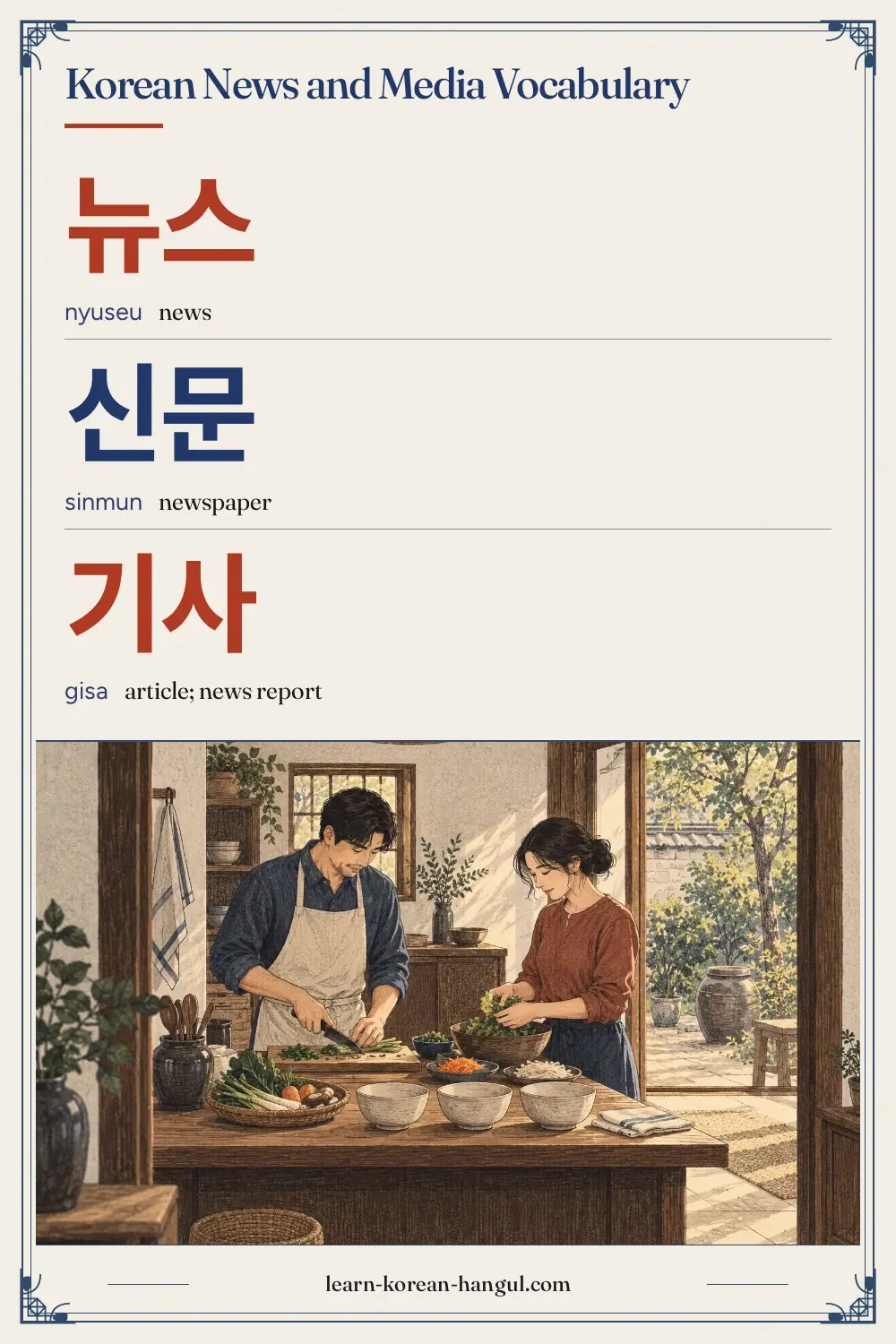
Korean News and Media Vocabulary at a Glance
Korean news and media vocabulary is the set of words used to talk about news reports, newspapers, broadcasts and the way people read the news online. About two thirds of the words are Sino-Korean, built from Chinese-origin syllables, and a quarter are English loanwords such as 뉴스 and 인터뷰. This page holds 35 words in five groups. Each word has Hangul, Revised Romanization, audio and one example sentence. It also explains how a Korean headline is built, so you can start reading real headlines.
| Group | Words | Use |
|---|---|---|
| News types | 7 | Naming news and its sections |
| Newspaper and broadcast | 7 | Talking about the paper, the reporter and the studio |
| Headlines | 7 | Reading headlines and how a story is reported |
| Social media news | 7 | Describing online news, comments and corrections |
| Opinion | 7 | Telling reports apart from editorials and debate |
This list belongs to Korean Society Vocabulary. For a single word, the page on newspaper in Korean goes deeper into 신문.
Which News and Media Words Should You Learn First?
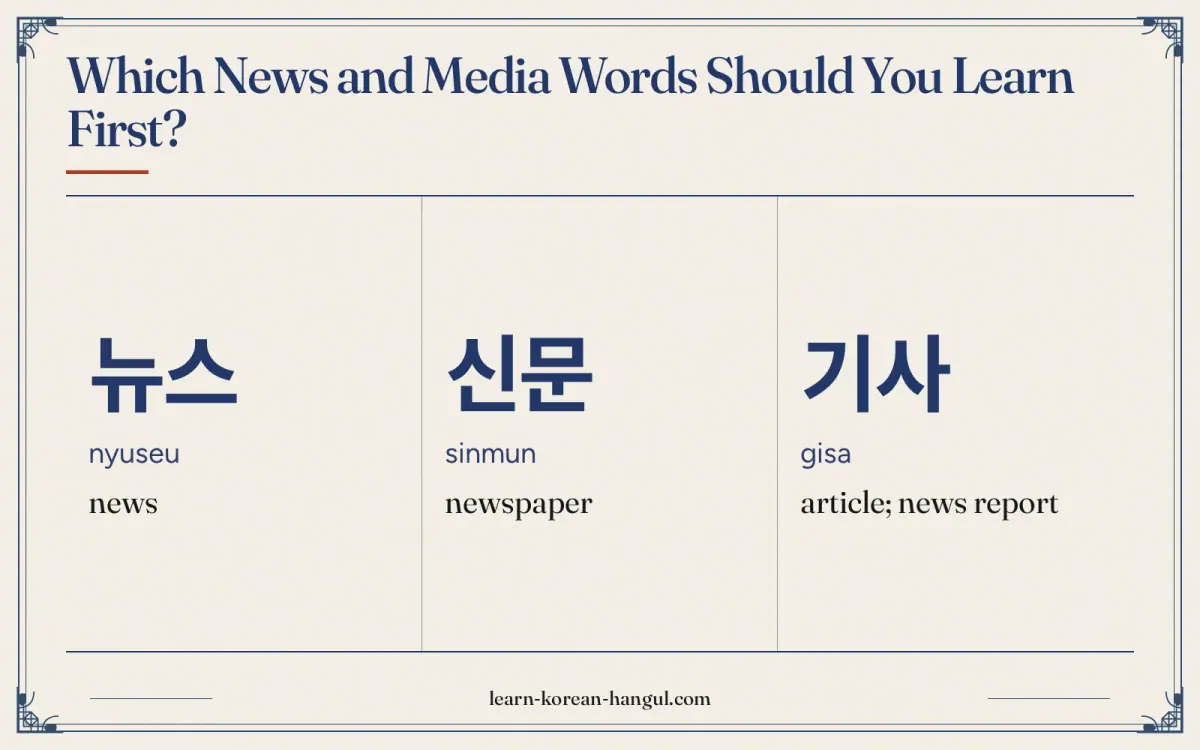
Learn 뉴스, 신문, 기사, 기자 and 속보 first. They appear in almost every news app, and you can use them from the first day. The section names come next, because they sort what you read. The social media and opinion words follow.
- Day one. 뉴스, 신문, 기사, 기자, 속보, 방송 and 제목.
- Day two. The section names: 경제, 사회, 문화, 국제 and 스포츠, plus 방송국, 라디오 and 앵커.
- Day three. The reporting words: 보도, 단독, 발표, 취재, 출처, 헤드라인 and 인터뷰.
- Day four. The online words: 소셜 미디어, 온라인, 댓글, 구독, 알림, 가짜 뉴스 and 정정 보도.
- Day five. The opinion words: 사설, 칼럼, 의견, 여론, 비판 and 논란.
At 7 words a day, the list takes five days. The scene below puts eight of the words on one picture.
Word · 8
- 1
뉴스
nyuseu
news
- 2
신문
sinmun
newspaper
- 3
기사
gisa
article; news report
- 4
기자
gija
reporter; journalist
- 5
방송국
bangsongguk
broadcasting station
- 6
라디오
radio
radio
- 7
앵커
aengkeo
news anchor
- 8
댓글
daetgeul
comment (under an article or post)
By origin, the list has 23 Sino-Korean words, 9 loanwords, 2 mixed words and 1 native word. The two mixed words are 댓글 and 가짜 뉴스, and the native word is 알림. The origin column in each table marks them.
News Types
A report of what has just happened is 뉴스. A fast report of an event happening now is a 속보. News is sorted into sections, and the section names are short Sino-Korean words: 경제 (economy and business), 사회 (society, including incidents), 문화 (culture), 국제 (international). Sports news is 스포츠, a loanword. Politics news is 정치, which you can learn on the politics vocabulary page.
| No. | Hangul | Revised Romanization | Origin | Meaning | Example sentence | Audio assetId |
|---|---|---|---|---|---|---|
| 1 | 뉴스 | nyuseu | loanword | news | 저녁마다 뉴스를 봐요. (I watch the news every evening.) | au-pg-vocabulary-society-media-1; example: au-pg-vocabulary-society-media-36 |
| 2 | 속보 | sokbo | Sino-Korean | breaking news; news flash | 속보가 나왔어요. (Breaking news has come out.) | au-pg-vocabulary-society-media-2; example: au-pg-vocabulary-society-media-37 |
| 3 | 경제 | gyeongje | Sino-Korean | economy; business (news section) | 경제 뉴스를 읽어요. (I read business news.) | au-pg-vocabulary-society-media-3; example: au-pg-vocabulary-society-media-38 |
| 4 | 사회 | sahoe | Sino-Korean | society (news section) | 사회 뉴스에는 사건 소식이 많아요. (The society news has many reports of incidents.) | au-pg-vocabulary-society-media-4; example: au-pg-vocabulary-society-media-39 |
| 5 | 문화 | munhwa | Sino-Korean | culture (news section) | 문화 소식이 재미있어요. (The culture news is interesting.) | au-pg-vocabulary-society-media-5; example: au-pg-vocabulary-society-media-40 |
| 6 | 국제 | gukje | Sino-Korean | international (news section) | 국제 뉴스는 외국 소식이에요. (International news is news from other countries.) | au-pg-vocabulary-society-media-6; example: au-pg-vocabulary-society-media-41 |
| 7 | 스포츠 | seupocheu | loanword | sports | 스포츠 뉴스를 좋아해요. (I like sports news.) | au-pg-vocabulary-society-media-7; example: au-pg-vocabulary-society-media-42 |
Section names work in two ways. They name a topic, as in 경제 뉴스, and they name a page or a section of a paper. Learn them as topic words first, and you will recognise them as section labels in any news app.
Example Sentences
The examples in this list use two simple patterns. The first is noun + 을/를 + verb, as in 뉴스를 봐요 (I watch the news). The second is noun + 이/가 + verb, as in 속보가 나왔어요 (breaking news has come out). Say each one aloud, then swap in another section name. For instance, 경제 뉴스를 읽어요 becomes 문화 뉴스를 읽어요.
How Do You Say Newspaper and Broadcast in Korean?
A newspaper is a 신문. A story inside it is a 기사, and the person who writes it is a 기자. For television and radio, the general word is 방송, and the building or company that sends the programme is a 방송국. A 라디오 is the radio, and the 앵커 is the person who presents the news in the studio.
| No. | Hangul | Revised Romanization | Origin | Meaning | Example sentence | Audio assetId |
|---|---|---|---|---|---|---|
| 8 | 신문 | sinmun | Sino-Korean | newspaper | 아침에 신문을 읽어요. (I read the newspaper in the morning.) | au-pg-vocabulary-society-media-8; example: au-pg-vocabulary-society-media-43 |
| 9 | 기사 | gisa | Sino-Korean | article; news report | 흥미로운 기사를 찾았어요. (I found an interesting article.) | au-pg-vocabulary-society-media-9; example: au-pg-vocabulary-society-media-44 |
| 10 | 기자 | gija | Sino-Korean | reporter; journalist | 기자가 질문을 했어요. (The reporter asked a question.) | au-pg-vocabulary-society-media-10; example: au-pg-vocabulary-society-media-45 |
| 11 | 방송 | bangsong | Sino-Korean | broadcast; broadcasting | 방송은 저녁 여덟 시에 시작해요. (The broadcast starts at eight in the evening.) | au-pg-vocabulary-society-media-11; example: au-pg-vocabulary-society-media-46 |
| 12 | 방송국 | bangsongguk | Sino-Korean | broadcasting station | 방송국에서 일해요. (I work at a broadcasting station.) | au-pg-vocabulary-society-media-12; example: au-pg-vocabulary-society-media-47 |
| 13 | 라디오 | radio | loanword | radio | 차에서 라디오를 들어요. (I listen to the radio in the car.) | au-pg-vocabulary-society-media-13; example: au-pg-vocabulary-society-media-48 |
| 14 | 앵커 | aengkeo | loanword | news anchor | 앵커가 뉴스를 전해요. (The anchor delivers the news.) | au-pg-vocabulary-society-media-14; example: au-pg-vocabulary-society-media-49 |
The difference between 기사 and 기자 is a single vowel, so check the last syllable. 기사 ends in 사 (事, matter), and 기자 ends in 자 (者, a person). The suffix -자 appears in many other words for people, as in 유권자 (voter) on the politics vocabulary page.
Headlines
A headline is a 제목 in plain speech and a 헤드라인 in the news. A 보도 is a news report, and a 단독 is a report that only one outlet has. An official 발표 is an announcement, and 취재 is the work of gathering news on the scene. A good report names the 출처, the source of information.
| No. | Hangul | Revised Romanization | Origin | Meaning | Example sentence | Audio assetId |
|---|---|---|---|---|---|---|
| 15 | 제목 | jemok | Sino-Korean | title; headline | 기사 제목을 먼저 읽어요. (I read the article title first.) | au-pg-vocabulary-society-media-15; example: au-pg-vocabulary-society-media-50 |
| 16 | 헤드라인 | hedeurain | loanword | headline | 헤드라인만 읽었어요. (I only read the headlines.) | au-pg-vocabulary-society-media-16; example: au-pg-vocabulary-society-media-51 |
| 17 | 보도 | bodo | Sino-Korean | news report; coverage | 방송이 그 소식을 보도했어요. (The broadcaster reported that news.) | au-pg-vocabulary-society-media-17; example: au-pg-vocabulary-society-media-52 |
| 18 | 단독 | dandok | Sino-Korean | exclusive (report) | 이 기사는 단독 보도예요. (This article is an exclusive report.) | au-pg-vocabulary-society-media-18; example: au-pg-vocabulary-society-media-53 |
| 19 | 발표 | balpyo | Sino-Korean | announcement | 회사가 새 제품을 발표했어요. (The company announced a new product.) | au-pg-vocabulary-society-media-19; example: au-pg-vocabulary-society-media-54 |
| 20 | 취재 | chwijae | Sino-Korean | news gathering; reporting from the scene | 현장에서 취재했어요. (I reported from the scene.) | au-pg-vocabulary-society-media-20; example: au-pg-vocabulary-society-media-55 |
| 21 | 출처 | chulcheo | Sino-Korean | source (of information) | 출처를 확인하세요. (Please check the source.) | au-pg-vocabulary-society-media-21; example: au-pg-vocabulary-society-media-56 |
How to Read a Korean Headline
Korean headlines are written as stacks of nouns. They drop the particles (은/는, 이/가, 을/를) and often end on a noun, not on a verb. The four headlines below are original examples written for this page. They are not copied from any newspaper.
| Headline | What to notice | Meaning |
|---|---|---|
| 정부, 새 정책 발표 | The comma replaces the topic marker 은/는, and the verb becomes the noun 발표 | The government announces a new policy |
| 내일 전국에 비 | 에 stays to mark the place, and there is no verb at all | Rain nationwide tomorrow |
| 한국 팀 결승 진출 | Four nouns in a row; 결승 is final and 진출 is advancing | The Korean team advances to the final |
| 단독: 새 영화 제작 | 단독 is a label before the colon; 제작 is production | Exclusive: a new film is in production |
In the body of an article, the verbs return, but in a plain written style: 발표했다 (announced) and not the polite 발표했어요. The ending -다 belongs to news writing and to books. The polite endings in this page's examples are the ones you use in speech.
Social Media News
Many people read the news online. The general words are 온라인 (online) and 소셜 미디어. Under an article, readers leave a 댓글 (comment). A news site can offer a 구독 (subscription), and an app sends you an 알림 (notification). Two words matter for trust: 가짜 뉴스 means fake news, and a 정정 보도 is a correction that a newspaper publishes when it made a mistake.
| No. | Hangul | Revised Romanization | Origin | Meaning | Example sentence | Audio assetId |
|---|---|---|---|---|---|---|
| 22 | 소셜 미디어 | sosyeol midieo | loanword | social media | 소셜 미디어로 뉴스를 봐요. (I read the news on social media.) | au-pg-vocabulary-society-media-22; example: au-pg-vocabulary-society-media-57 |
| 23 | 온라인 | ollain | loanword | online | 온라인 기사를 읽어요. (I read online articles.) | au-pg-vocabulary-society-media-23; example: au-pg-vocabulary-society-media-58 |
| 24 | 댓글 | daetgeul | mixed | comment (under an article or post) | 댓글을 남겼어요. (I left a comment.) | au-pg-vocabulary-society-media-24; example: au-pg-vocabulary-society-media-59 |
| 25 | 구독 | gudok | Sino-Korean | subscription | 신문을 구독해요. (I subscribe to a newspaper.) | au-pg-vocabulary-society-media-25; example: au-pg-vocabulary-society-media-60 |
| 26 | 알림 | allim | native | notification; notice | 휴대폰으로 알림이 왔어요. (A notification came to my phone.) | au-pg-vocabulary-society-media-26; example: au-pg-vocabulary-society-media-61 |
| 27 | 가짜 뉴스 | gajja nyuseu | mixed | fake news | 가짜 뉴스를 조심하세요. (Be careful of fake news.) | au-pg-vocabulary-society-media-27; example: au-pg-vocabulary-society-media-62 |
| 28 | 정정 보도 | jeongjeong bodo | Sino-Korean | correction (of a news report) | 신문이 정정 보도를 냈어요. (The newspaper published a correction.) | au-pg-vocabulary-society-media-28; example: au-pg-vocabulary-society-media-63 |
Notice that 소셜 미디어 and 가짜 뉴스 are written with a space, because each is made of two words. The Revised Romanization keeps the space too: sosyeol midieo and gajja nyuseu. A correction is a good sign about a news source, not a bad one, since it shows that the outlet fixes mistakes.
Opinion
Not every piece in a paper is a report. A 사설 is the paper's own editorial, and a 칼럼 is a column written by one author. An 의견 is an opinion, and the 여론 is public opinion, the general view among the public. A 비판 is criticism, and a 논란 is a controversy. An 인터뷰 can be news or opinion, depending on the questions.
| No. | Hangul | Revised Romanization | Origin | Meaning | Example sentence | Audio assetId |
|---|---|---|---|---|---|---|
| 29 | 사설 | saseol | Sino-Korean | editorial | 신문의 사설을 읽었어요. (I read the newspaper's editorial.) | au-pg-vocabulary-society-media-29; example: au-pg-vocabulary-society-media-64 |
| 30 | 칼럼 | kalleom | loanword | column (opinion piece) | 이 칼럼이 재미있어요. (I enjoy this column.) | au-pg-vocabulary-society-media-30; example: au-pg-vocabulary-society-media-65 |
| 31 | 의견 | uigyeon | Sino-Korean | opinion; view | 각자 의견이 달라요. (Everyone's opinion is different.) | au-pg-vocabulary-society-media-31; example: au-pg-vocabulary-society-media-66 |
| 32 | 여론 | yeoron | Sino-Korean | public opinion | 여론을 조사했어요. (They surveyed public opinion.) | au-pg-vocabulary-society-media-32; example: au-pg-vocabulary-society-media-67 |
| 33 | 비판 | bipan | Sino-Korean | criticism | 그 계획에 대한 비판이 있어요. (There is criticism of that plan.) | au-pg-vocabulary-society-media-33; example: au-pg-vocabulary-society-media-68 |
| 34 | 논란 | nollan | Sino-Korean | controversy; debate | 그 기사가 논란이 됐어요. (That article became a controversy.) | au-pg-vocabulary-society-media-34; example: au-pg-vocabulary-society-media-69 |
| 35 | 인터뷰 | inteobyu | loanword | interview | 가수와 인터뷰를 했어요. (I did an interview with a singer.) | au-pg-vocabulary-society-media-35; example: au-pg-vocabulary-society-media-70 |
When you read, the first question is whether a piece is a 기사 or an opinion. A 사설 and a 칼럼 carry a point of view. A 보도 should report facts. The word 여론 can appear in both, as in 여론 조사 (public opinion poll).
How Do You Pronounce These Words?
Several words in this list change in speech. The table lists the changes that learners most often miss. Brackets show the spoken sound.
| Spelling | Pronunciation | What happens |
|---|---|---|
| 속보 | [속뽀] | The ㅂ after a final ㄱ is said tense |
| 알림 | [알림] | The two ㄹ letters make one long l sound, and Revised Romanization writes allim |
| 국제 | [국쩨] | The ㅈ after a final ㄱ is said tense |
| 댓글 | [댇끌] | The final ㅅ is said as ㄷ, and the ㄱ after it is tense |
| 논란 | [놀란] | The ㄴ before ㄹ becomes ㄹ, and Revised Romanization writes nollan |
| 온라인 | [올라인] | The ㄴ before ㄹ becomes ㄹ, so you hear ol-la-in |
| 칼럼 | [칼럼] | The loanword has a double l sound written ㄹㄹ |
The rules come from the Standard Pronunciation rules (표준 발음법) of the 국립국어원. Revised Romanization is a learning aid. It writes the ㄹ change in nollan and ollain, but it does not show tensing such as [속뽀].
Audio and Slow Playback
Each word has a normal clip. Five words with tricky sounds also have a slow clip at 0.8 times the speed: 속보, 알림, 국제, 댓글 and 논란. Nothing plays until you press a button. The audio is generated with text-to-speech and checked by a Korean teacher before publication.
Listen to 속보 first. You should hear a tense b sound in the second syllable, [속뽀], with the first syllable closed by an unreleased k.
What Mistakes Do Learners Make with News and Media Words?
- Mixing 기사 (article) with 기사 (driver). The two words share a spelling. 기사 means an article in a news context, and 택시 기사님 means a taxi driver. The sentence decides.
- Mixing 보도 (report) with 보도 (pavement). 보도 is also a sidewalk. In 방송이 그 소식을 보도했어요, it is the verb 보도하다, "to report".
- Mixing 기사 and 기자. Wrong: 기자를 읽었어요 for "I read the article". Correct: 기사를 읽었어요. You read a 기사, and you interview a 기자.
- Writing headlines like speech. Wrong: using 정부가 새 정책을 발표했어요 as a headline. Correct: 정부, 새 정책 발표. Headlines drop particles and polite endings.
- Using 뉴스 and 소식 as if they were the same. 뉴스 is news as a media product. 소식 is a piece of news about someone or something, such as news from a friend.
- Saying sokbo with a plain b. Wrong: sok-bo with a soft b. Correct: [속뽀], with a tense b.
Mistakes 1, 2, 3 and 5 change the meaning, and mistakes 4 and 6 change how natural you sound.
Reading with Care: a Short Checklist
Words alone do not make you a good news reader. The table shows five checks, each with the word to look for.
| Check | Word to look for | What it tells you |
|---|---|---|
| Who reported it? | 기자, 방송국 | The outlet and the person behind the report |
| Where did it come from? | 출처 | Whether the information has a named source |
| Is it exclusive? | 단독 | That only one outlet has the story so far, so no one else has confirmed it yet |
| Was it corrected? | 정정 보도 | Whether the outlet fixed a mistake |
| Is it fact or opinion? | 보도, 사설, 칼럼 | Whether you are reading a report or a point of view |
These checks work in any language, and the Korean words make them easy to apply to Korean sources. For more practice with real text, see the real-world texts page.
Practice: Flashcards and Worksheet
Drill these words with the vocabulary flashcard decks. A printable worksheet for these words (word list, matching, writing practice, fill-in-the-blank exercises and answer key) is available in A4 and US Letter from the download card on this page. Progress in the decks is saved only in your browser.
News and Media Vocabulary Worksheet
Try this five-question check, then say all 35 words aloud once more.
Practice · 5
What does 뉴스 mean?
Show answer
news
뉴스 (nyuseu) means news.
What does 기자 mean?
Show answer
reporter; journalist
기자 (gija) means reporter; journalist.
What does 속보 mean?
Show answer
breaking news; news flash
속보 (sokbo) means breaking news; news flash.
What does 사설 mean?
Show answer
editorial
사설 (saseol) means editorial.
What does 정정 보도 mean?
Show answer
correction (of a news report)
정정 보도 (jeongjeong bodo) means correction (of a news report).
Where to Go Next
This list sits inside Korean Society Vocabulary. After Korean news and media vocabulary, many learners move on to Korean Renting and Housing Vocabulary, or to Korean Finance and Stocks Vocabulary, which uses many of the business words you meet in the 경제 section.
Frequently Asked Questions
How Do You Say News in Korean?
News is 뉴스 (nyuseu), an English loanword written in Hangul. A newspaper is 신문 (sinmun), and a news article is 기사 (gisa). To say you watch the news, use 뉴스를 봐요 (nyuseureul bwayo). Press the audio button to hear the word.
How Do You Pronounce 신문 (sinmun)?
신문 is said [신문], sin-mun, in two beats. Both syllables have a plain consonant, and the ㄴ at the end of 신 is a clear n that joins smoothly to the ㅁ of the next syllable. The vowel ㅜ in 문 is rounded, and the vowel ㅣ in 신 is spread. Use the word clip to match the rhythm.
How Many News and Media Words Should I Learn First?
Learn five first: 뉴스, 신문, 기사, 기자 and 속보. That takes one day. Then add the section names, the reporting words, the online words and the opinion words. The whole list of 35 takes five days at 7 words a day, with review on the sixth day.
Where Can I Practise News and Media Words with Flashcards?
Use the vocabulary flashcard decks, which list every deck with audio. A deck for these words is planned. Progress stays in your browser. Until then, copy a table above onto cards: Hangul on one side, English on the other, and say each word aloud as you flip it.
Is the Romanization on This Page Official?
It follows the Revised Romanization of Korean, which South Korea officially adopted on 7 July 2000 and whose rules the National Institute of Korean Language (국립국어원) publishes. It is a learning aid that does not show tensing caused by a neighbouring sound, so learn the Hangul and use the audio to hear the real sound.
Is There a Printable Worksheet for News and Media Words?
A printable worksheet for these words (word list, matching, writing practice, fill-in-the-blank exercises and answer key) is available in A4 and US Letter from the download card on this page. For practice, write the Hangul from memory, cover the English column and check your answers against the tables above.