
What Is on the TOPIK 2 Vocabulary List?
The TOPIK 2 vocabulary list on this page covers the topics that TOPIK II listening, reading and writing draw on: society, economy, science, culture and abstract ideas. These differ from TOPIK I topics, which stay with personal life. The 12 groups fall into five clusters.
| Group | Topic | Cluster | Typical TOPIK II use |
|---|---|---|---|
| 1 | Economy | Society and economy | graph items, news reports |
| 2 | Society | Society and economy | question 54 essay topics |
| 3 | Law and rules | Society and economy | notices, editorials |
| 4 | Workplace | Society and economy | dialogues, interviews |
| 5 | Environment | Science and environment | explanatory texts, essays |
| 6 | Science and technology | Science and environment | lectures, academic passages |
| 7 | Health | Science and environment | news, documentaries |
| 8 | Education | Education, media and culture | survey graphs for question 53 |
| 9 | Media | Education, media and culture | headlines, debates |
| 10 | Culture | Education, media and culture | reviews, literary texts |
| 11 | Relationships | Relationships and communication | essays, interviews |
| 12 | Abstract concepts | Abstract and academic words | every section |
Romanization follows Revised Romanization and is only a learning aid. Where a word is said differently from its spelling, the pronunciation appears in [brackets], following the 국립국어원 standard pronunciation rules. The example sentences use the written plain style (-다), because that is the register of TOPIK II reading and writing.
Which Topic Groups Are Covered?
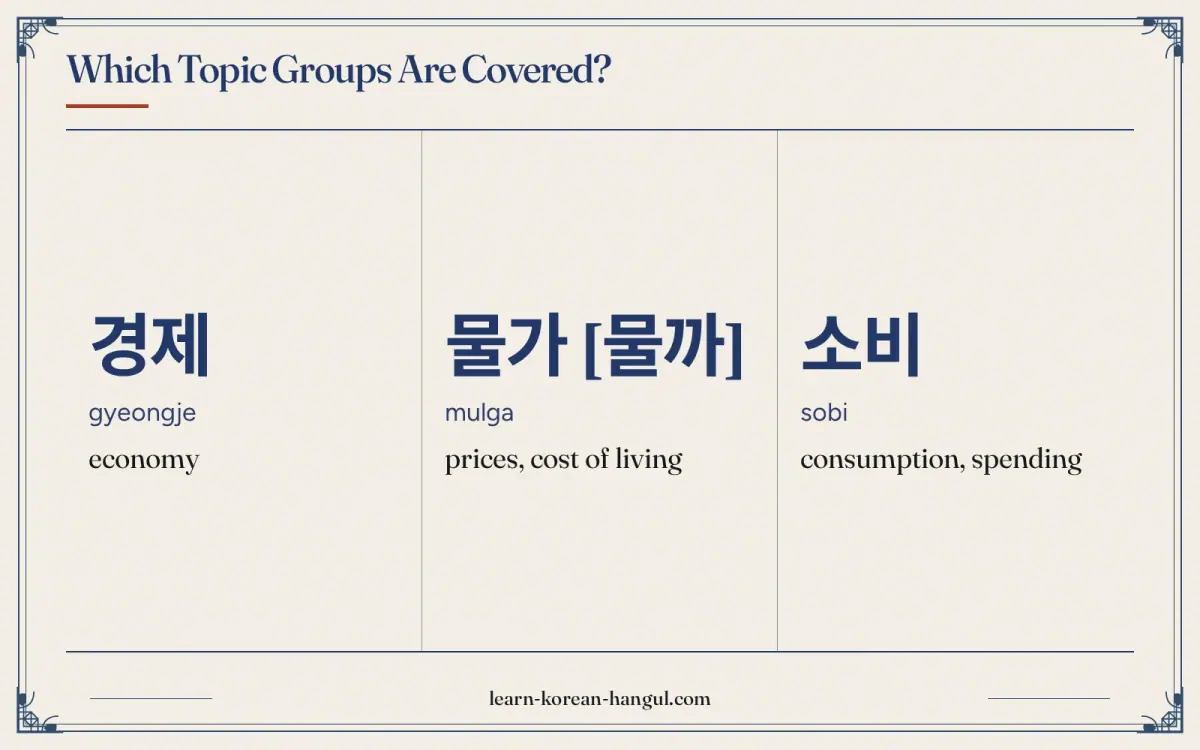
The 12 topic groups below each give six anchor words and one example sentence that uses at least two of them. Each group has the same structure, so you can study one per session.
Society and Economy
Group 1: economy. Economy words carry the graph and news items.
| Korean | Romanization | Meaning |
|---|---|---|
| 경제 | gyeongje | economy |
| 물가 [물까] | mulga | prices, cost of living |
| 소비 | sobi | consumption, spending |
| 투자 | tuja | investment |
| 수입 | suip | income; imports |
| 증가 | jeungga | increase |
물가가 오르면서 소비가 줄었다.
mulgaga oreumyeonseo sobiga jureotda.
As prices rose, spending fell.
Group 2: society. These words are the core of question 54 topics.
| Korean | Romanization | Meaning |
|---|---|---|
| 사회 | sahoe | society |
| 인구 | ingu | population |
| 고령화 | goryeonghwa | population ageing |
| 저출산 [저출싼] | jeochulsan | low birth rate |
| 갈등 [갈뜽] | galdeung | conflict |
| 복지 [복찌] | bokji | welfare |
고령화로 인해 복지 비용이 증가하고 있다.
goryeonghwaro inhae bokji biyongi jeunggahago itda.
Welfare costs are rising because of population ageing.
Group 3: law and rules. Rule words appear in notices and editorials.
| Korean | Romanization | Meaning |
|---|---|---|
| 법 | beop | law |
| 규칙 | gyuchik | rule |
| 위반 | wiban | violation |
| 처벌 | cheobeol | punishment |
| 권리 [궐리] | gwolli | right, entitlement |
| 의무 | uimu | duty, obligation |
모든 시민은 권리와 함께 의무도 가진다.
modeun simineun gwolliwa hamkke uimudo gajinda.
Every citizen has duties as well as rights.
Group 4: workplace. Workplace words fill the interview and office dialogues.
| Korean | Romanization | Meaning |
|---|---|---|
| 직장 [직짱] | jikjang | workplace, job |
| 업무 [엄무] | eommu | duties, work tasks |
| 회의 | hoeui | meeting |
| 승진 | seungjin | promotion |
| 경력 [경녁] | gyeongnyeok | work experience, career |
| 퇴근 | toegeun | leaving work |
그는 경력을 인정받아 팀장으로 승진했다.
geuneun gyeongnyeogeul injeongbada timjangeuro seungjinhaetda.
His experience was recognised and he was promoted to team leader.
Science and Environment
Group 5: environment. Environment is one of the most frequent essay themes.
| Korean | Romanization | Meaning |
|---|---|---|
| 환경 | hwangyeong | environment |
| 오염 | oyeom | pollution |
| 기후 | gihu | climate |
| 재활용 [재화룡] | jaehwaryong | recycling |
| 에너지 | eneoji | energy |
| 보호 | boho | protection |
환경을 보호하려면 에너지 사용을 줄여야 한다.
hwangyeongeul bohoharyeomyeon eneoji sayongeul juryeoya handa.
To protect the environment, we must reduce energy use.
Group 6: science and technology. These words dominate lectures and academic passages.
| Korean | Romanization | Meaning |
|---|---|---|
| 과학 | gwahak | science |
| 기술 | gisul | technology, skill |
| 발달 [발딸] | baldal | development, advance |
| 연구 | yeongu | research |
| 개발 | gaebal | development (of products) |
| 정보 | jeongbo | information |
기술이 발달하면서 생활 방식이 크게 바뀌었다.
gisuri baldalhamyeonseo saenghwal bangsigi keuge bakkwieotda.
As technology developed, the way we live changed greatly.
Group 7: health. Health words appear in news and documentary items.
| Korean | Romanization | Meaning |
|---|---|---|
| 건강 | geongang | health |
| 질병 | jilbyeong | disease |
| 예방 | yebang | prevention |
| 치료 | chiryo | treatment |
| 수명 | sumyeong | lifespan |
| 스트레스 | seuteureseu | stress |
질병은 치료보다 예방이 중요하다.
jilbyeongeun chiryoboda yebangi jungyohada.
With disease, prevention matters more than treatment.
Education, Media and Culture
Group 8: education. Education surveys are a favourite source for question 53 graphs.
| Korean | Romanization | Meaning |
|---|---|---|
| 교육 | gyoyuk | education |
| 학습 [학씁] | hakseup | learning, study |
| 입시 [입씨] | ipsi | entrance exams |
| 성적 | seongjeok | grades, results |
| 사교육 | sagyoyuk | private tutoring |
| 평가 [평까] | pyeongga | assessment |
입시 경쟁 때문에 사교육 비용이 늘고 있다.
ipsi gyeongjaeng ttaemune sagyoyuk biyongi neulgo itda.
Spending on private tutoring is growing because of competition for entrance exams.
Group 9: media. Media words turn up in headline items and debates.
| Korean | Romanization | Meaning |
|---|---|---|
| 언론 [얼론] | eollon | the press |
| 매체 | maeche | medium, media |
| 기사 | gisa | news article |
| 광고 | gwanggo | advertisement |
| 여론 | yeoron | public opinion |
| 보도 | bodo | news coverage, report |
언론은 사실을 정확하게 보도해야 한다.
eolloneun sasireul jeonghwakage bodohaeya handa.
The press must report facts accurately.
Group 10: culture. Culture words appear in reviews and literary texts.
| Korean | Romanization | Meaning |
|---|---|---|
| 문화 | munhwa | culture |
| 전통 | jeontong | tradition |
| 예술 | yesul | art |
| 축제 [축쩨] | chukje | festival |
| 관광 | gwangwang | tourism |
| 다양성 [다양썽] | dayangseong | diversity |
전통을 지키면서 문화의 다양성도 존중해야 한다.
jeontongeul jikimyeonseo munhwaui dayangseongdo jonjunghaeya handa.
We should keep traditions while also respecting cultural diversity.
Relationships and Communication
Group 11: relationships. Relationship words carry interviews and opinion essays about modern life.
| Korean | Romanization | Meaning |
|---|---|---|
| 인간관계 | ingangwangye | human relationships |
| 소통 | sotong | communication |
| 배려 | baeryeo | consideration for others |
| 신뢰 [실뢰] | silloe | trust |
| 존중 | jonjung | respect |
| 오해 | ohae | misunderstanding |
원활한 소통은 서로에 대한 신뢰에서 시작된다.
wonhwalhan sotongeun seoroe daehan silloeeseo sijakdoenda.
Smooth communication starts from mutual trust.
Abstract and Academic Words
Group 12: abstract concepts. These six words appear in every section, often in the answer options themselves.
| Korean | Romanization | Meaning |
|---|---|---|
| 가치 | gachi | value |
| 관점 [관쩜] | gwanjeom | point of view |
| 현상 | hyeonsang | phenomenon |
| 원인 | wonin | cause |
| 결과 | gyeolgwa | result |
| 영향 | yeonghyang | influence, effect |
이 현상의 원인은 관점에 따라 다르게 해석될 수 있다.
i hyeonsangui wonineun gwanjeome ttara dareuge haeseokdoel su itda.
The cause of this phenomenon can be interpreted differently depending on the point of view.
The 72 anchor words are a starting core, not the whole of TOPIK II. Review them in the deck below, which follows the table order. For a shorter 30-card set with usage notes, use the TOPIK 2 vocabulary flashcards.
Practice · 14
- 01물가가 오르면서 소비가 줄었다.
Show answer
mulgaga oreumyeonseo sobiga jureotda.
As prices rose, spending fell.
- 02고령화로 인해 복지 비용이 증가하고 있다.
Show answer
goryeonghwaro inhae bokji biyongi jeunggahago itda.
Welfare costs are rising because of population ageing.
- 03모든 시민은 권리와 함께 의무도 가진다.
Show answer
modeun simineun gwolliwa hamkke uimudo gajinda.
Every citizen has duties as well as rights.
- 04그는 경력을 인정받아 팀장으로 승진했다.
Show answer
geuneun gyeongnyeogeul injeongbada timjangeuro seungjinhaetda.
His experience was recognised and he was promoted to team leader.
- 05환경을 보호하려면 에너지 사용을 줄여야 한다.
Show answer
hwangyeongeul bohoharyeomyeon eneoji sayongeul juryeoya handa.
To protect the environment, we must reduce energy use.
- 06기술이 발달하면서 생활 방식이 크게 바뀌었다.
Show answer
gisuri baldalhamyeonseo saenghwal bangsigi keuge bakkwieotda.
As technology developed, the way we live changed greatly.
- 07질병은 치료보다 예방이 중요하다.
Show answer
jilbyeongeun chiryoboda yebangi jungyohada.
With disease, prevention matters more than treatment.
- 08입시 경쟁 때문에 사교육 비용이 늘고 있다.
Show answer
ipsi gyeongjaeng ttaemune sagyoyuk biyongi neulgo itda.
Spending on private tutoring is growing because of competition for entrance exams.
- 09언론은 사실을 정확하게 보도해야 한다.
Show answer
eolloneun sasireul jeonghwakage bodohaeya handa.
The press must report facts accurately.
- 10전통을 지키면서 문화의 다양성도 존중해야 한다.
Show answer
jeontongeul jikimyeonseo munhwaui dayangseongdo jonjunghaeya handa.
We should keep traditions while also respecting cultural diversity.
- 11원활한 소통은 서로에 대한 신뢰에서 시작된다.
Show answer
wonhwalhan sotongeun seoroe daehan silloeeseo sijakdoenda.
Smooth communication starts from mutual trust.
- 12이 현상의 원인은 관점에 따라 다르게 해석될 수 있다.
Show answer
i hyeonsangui wonineun gwanjeome ttara dareuge haeseokdoel su itda.
The cause of this phenomenon can be interpreted differently depending on the point of view.
- 13스마트폰 사용 시간이 늘어남에 따라 수면 시간은 감소한 것으로 나타났다.
Show answer
seumateupon sayong sigani neureoname ttara sumyeon siganeun gamsohan geoseuro natanatda.
As smartphone use increased, sleep time was found to decrease. (question 53 style)
- 14이 문제를 해결하기 위해서는 사회 전체의 노력이 필요하다.
Show answer
i munjereul haegyeolhagi wihaeseoneun sahoe jeoncheui noryeogi piryohada.
Solving this problem requires effort from society as a whole. (question 54 style)
Learning words one by one is slow at this level; the faster route is through shared roots.
How Do Sino-Korean Word Families Help?
Sino-Korean word families help because one root or suffix, learned once, appears in dozens of TOPIK II words. Sino-Korean words are built from Chinese-origin roots (hanja), and most abstract vocabulary in TOPIK II reading is Sino-Korean. You do not need to write hanja; you need to recognise the repeated syllables.
| Root or suffix | Meaning | Family members |
|---|---|---|
| 사회 (社會) | society | 사회적 (sahoejeok, social), 사회화 (sahoehwa, socialisation), 사회생활 (sahoesaenghwal, social life) |
| -화 (化) | -isation, becoming | 고령화 (goryeonghwa, ageing), 세계화 (segyehwa, globalisation), 도시화 (dosihwa, urbanisation) |
| -성 (性) | -ness, -ity | 가능성 [가능썽] (ganeungseong, possibility), 중요성 [중요썽] (jungyoseong, importance), 다양성 [다양썽] (dayangseong, diversity) |
| -적 (的) | -ic, -al | 경제적 (gyeongjejeok, economic), 효과적 (hyogwajeok, effective), 적극적 [적끅쩍] (jeokgeukjeok, active) |
| 증 (增) / 감 (減) | increase / decrease | 증가 (jeungga, increase), 감소 (gamso, decrease), 급증 [급쯩] (geupjeung, surge), 급감 [급깜] (geupgam, sharp fall) |
The -화 row shows the method in action. Once you know that -화 means "becoming", 정보화 (jeongbohwa) is easy to guess: 정보 (information) + 화 = the shift to an information society. The Sino-Korean words hub explains how these roots work, and the page on hanja word families shows how one character builds dozens of words.
The common mistake is to guess from one syllable alone. 수입 can mean income (收入) or imports (輸入), because two different roots are both read 수. Check a guess against the context before you commit to it. Recognising families builds reading speed; producing the right word combinations builds writing points.
Writing Collocations for Questions 53 and 54
Questions 53 and 54 reward fixed word combinations (collocations) used in reports and essays. Raters judge language use partly on whether the words sit together naturally, so learning the pair is safer than learning each word alone.
| Collocation | Romanization | Meaning | Typical use |
|---|---|---|---|
| 영향을 미치다 | yeonghyangeul michida | to have an effect on | 54: causes and effects |
| 증가하다 / 감소하다 | jeunggahada / gamsohada | to increase / to decrease | 53: describing a graph |
| 비율을 차지하다 | biyureul chajihada | to account for a share | 53: percentages |
| 조사를 실시하다 | josareul silsihada | to carry out a survey | 53: opening sentence |
| 문제를 해결하다 | munjereul haegyeolhada | to solve a problem | 54: solutions |
| 대책을 마련하다 | daechaegeul maryeonhada | to prepare measures | 54: proposals |
| 노력을 기울이다 | noryeogeul giurida | to make an effort | 54: conclusions |
The two sentences below show the collocations at work, one for each question type.
스마트폰 사용 시간이 늘어남에 따라 수면 시간은 감소한 것으로 나타났다.
seumateupon sayong sigani neureoname ttara sumyeon siganeun gamsohan geoseuro natanatda.
As smartphone use increased, sleep time was found to decrease. (question 53 style)
이 문제를 해결하기 위해서는 사회 전체의 노력이 필요하다.
i munjereul haegyeolhagi wihaeseoneun sahoe jeoncheui noryeogi piryohada.
Solving this problem requires effort from society as a whole. (question 54 style)
With the words and the combinations in place, the order you study them decides how much you keep.
How to Study the TOPIK 2 Word List
Study the TOPIK 2 word list one topic per session, with the example sentence first and the family second, and review earlier groups on a spaced schedule. Five steps work for most learners:
- Read the sentence before the table. Guess each anchor word's meaning from context, then check the table. TOPIK II tests words in context, never in isolation.
- Add the family. For each Sino-Korean word, find one other word that shares a root, such as 교육 (education) and 교육적 (educational).
- Write one sentence in the plain style. Use two anchor words in a -다 sentence, the register of questions 53 and 54.
- Review with spaced repetition. Return to the group after one day, three days and one week, using the deck.
- Check against a past paper. After four groups, read a TOPIK II reading passage and underline every anchor word you meet.
The honest limitation: this list gives the core of each topic, not the 3,000 to 9,000 words that the rough level estimates suggest. Real reading of news and articles is what fills the gap. The page on how many words for TOPIK explains where the estimates come from.
Where to Go Next
For a broader set of word lists by level, the TOPIK vocabulary hub routes to every list on the site, and TOPIK flashcards collects the exam decks. To see where these words appear in the test, read the TOPIK 2 exam format, and for idioms that a word list cannot capture, see TOPIK idioms. The TOPIK 2 grammar list covers the patterns that hold these words together, and the TOPIK II guide links every page for the test. Once this TOPIK 2 vocabulary list feels familiar, plan your schedule with how to pass TOPIK 2.
Frequently Asked Questions
How Many Words Do I Need for TOPIK 2?
Rough estimates commonly cited by teachers are about 3,000 words for Level 3, 5,000 for Level 4, 7,000 for Level 5 and 9,000 or more for Level 6. None of these figures is official, because NIIED publishes no word list. Treat them as a sense of scale and measure progress with timed past papers instead.
Is Hanja Needed for TOPIK 2 Vocabulary?
No. TOPIK II never asks you to read or write Chinese characters; every question is in Hangul. Knowing common hanja roots still helps, because most abstract TOPIK II words are Sino-Korean, and a root such as 화 or 성 lets you guess many new words. Learn the meaning of the root, not the character's strokes.
Which Words Are Most Important for Writing?
The most useful words for TOPIK II writing are report verbs and fixed collocations: 증가하다 and 감소하다 for graphs, 조사를 실시하다 for survey openings, and 영향을 미치다, 문제를 해결하다 and 대책을 마련하다 for essays. They appear in nearly every model answer for questions 53 and 54, so learn them as whole phrases.
Is There an Official TOPIK 2 Vocabulary List?
No official TOPIK II word list is published for candidates. Lists online, including this one, are editorial, built from course books and past-paper topics. The National Institute of Korean Language has published learner vocabulary references, but they are not TOPIK lists. Use past papers on topik.go.kr to see the words real questions use.