
100 Korean Words at a Glance
The list holds 100 nouns, pronouns and adverbs in a suggested study order. Of the 100 words, 71 are native Korean, 28 are Sino-Korean (built from Chinese-derived syllables) and 1 is a place name. The numbers in the first column show the study order, which is an editorial judgement of usefulness for a beginner, not a count from a corpus. The groups are:
| Group | Words | Examples |
|---|---|---|
| Pronouns and demonstratives | 16 | 이, 그, 저, 나 |
| People and family | 20 | 사람, 친구, 어머니 |
| Time and numbers | 18 | 오늘, 시간, 하나 |
| Places and things | 30 | 집, 학교, 물 |
| Everyday adverbs and connectors | 16 | 아주, 같이, 그리고 |
This page lists nouns, pronouns and adverbs. Verbs and adjectives are ranked separately, and you will find them in the 100 Korean verbs list. You need to read Hangul to use the tables, so start with reading Hangul if the letters still feel new. The first question is where to begin.
Which Core Korean Words Should You Learn First?
Learn 이, 그, 저, 나 and 사람 first. These five words carry the most weight, because 이, 그 and 저 point at things, 나 and 저 name the speaker, and 사람 names a person. Each is shown here with an audio button and an example.
이 means this. It comes before a noun: 이 책은 재미있어요 (This book is interesting).
그 means that, something near the listener or already mentioned: 그 사람은 선생님이에요 (That person is a teacher).
저 has two jobs. It means that over there, and it is the humble word for I, used with elders and strangers: 저는 미국 사람이에요 (I am American).
나 is the casual word for I, used with friends and juniors: 나도 알아 (I know too).
사람 means person, and it is counted with 명: 저 사람은 친구예요 (That person is a friend).
Pronouns and Demonstratives
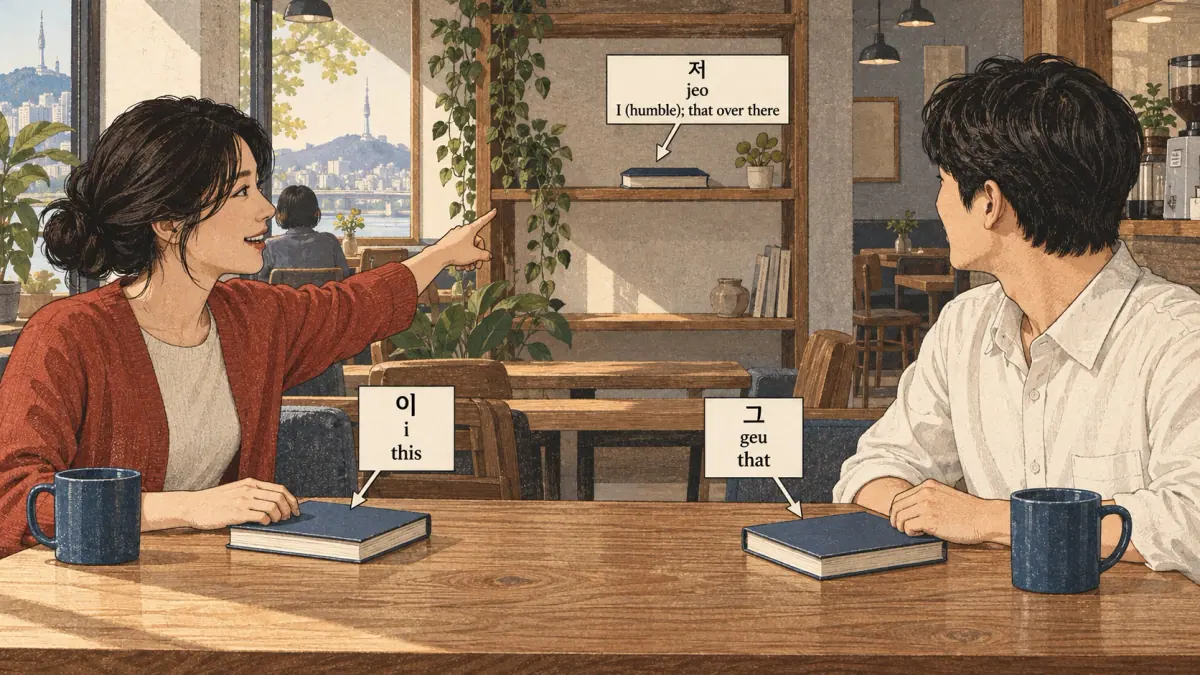
Pronouns and demonstratives point to people, things and places. A demonstrative is a word such as this or that. Korean has three distances: 이 (near me), 그 (near you) and 저 (far from both). The same three appear in 이것, 그것 and 저것 (this, that, that over there) and in 여기, 거기 and 저기 (here, there, over there).
| No. | Hangul | Revised Romanization | Meaning | Origin | Example sentence | Audio assetId |
|---|---|---|---|---|---|---|
| 1 | 이 | i | this | native | 이 책은 재미있어요. (This book is interesting.) | au-pg-vocabulary-core-words-top-100-1; example: au-pg-vocabulary-core-words-top-100-101 |
| 2 | 그 | geu | that | native | 그 사람은 선생님이에요. (That person is a teacher.) | au-pg-vocabulary-core-words-top-100-2; example: au-pg-vocabulary-core-words-top-100-102 |
| 3 | 저 | jeo | I (humble); that over there | native | 저는 미국 사람이에요. (I am American.) | au-pg-vocabulary-core-words-top-100-3; example: au-pg-vocabulary-core-words-top-100-103 |
| 4 | 나 | na | I (casual) | native | 나도 알아. (I know too.) | au-pg-vocabulary-core-words-top-100-4; example: au-pg-vocabulary-core-words-top-100-104 |
| 5 | 너 | neo | you (casual) | native | 너는 어디 가? (Where are you going?) | au-pg-vocabulary-core-words-top-100-5; example: au-pg-vocabulary-core-words-top-100-105 |
| 6 | 우리 | uri | we, our | native | 우리 집은 서울에 있어요. (Our house is in Seoul.) | au-pg-vocabulary-core-words-top-100-6; example: au-pg-vocabulary-core-words-top-100-106 |
| 7 | 이것 | igeot | this thing | native | 이것은 물이에요. (This is water.) | au-pg-vocabulary-core-words-top-100-7; example: au-pg-vocabulary-core-words-top-100-107 |
| 8 | 그것 | geugeot | that thing | native | 그것은 제 책이에요. (That is my book.) | au-pg-vocabulary-core-words-top-100-8; example: au-pg-vocabulary-core-words-top-100-108 |
| 9 | 저것 | jeogeot | that thing over there | native | 저것은 무엇이에요? (What is that over there?) | au-pg-vocabulary-core-words-top-100-9; example: au-pg-vocabulary-core-words-top-100-109 |
| 10 | 여기 | yeogi | here | native | 여기가 우리 학교예요. (This is our school.) | au-pg-vocabulary-core-words-top-100-10; example: au-pg-vocabulary-core-words-top-100-110 |
| 11 | 거기 | geogi | there | native | 거기에 친구가 있어요. (A friend is there.) | au-pg-vocabulary-core-words-top-100-11; example: au-pg-vocabulary-core-words-top-100-111 |
| 12 | 저기 | jeogi | over there | native | 저기가 화장실이에요. (The restroom is over there.) | au-pg-vocabulary-core-words-top-100-12; example: au-pg-vocabulary-core-words-top-100-112 |
| 13 | 누구 | nugu | who | native | 이 사람은 누구예요? (Who is this person?) | au-pg-vocabulary-core-words-top-100-13; example: au-pg-vocabulary-core-words-top-100-113 |
| 14 | 무엇 | mueot | what | native | 이것은 무엇이에요? (What is this?) | au-pg-vocabulary-core-words-top-100-14; example: au-pg-vocabulary-core-words-top-100-114 |
| 15 | 어디 | eodi | where | native | 학교가 어디예요? (Where is the school?) | au-pg-vocabulary-core-words-top-100-15; example: au-pg-vocabulary-core-words-top-100-115 |
| 16 | 언제 | eonje | when | native | 언제 가요? (When do you go?) | au-pg-vocabulary-core-words-top-100-16; example: au-pg-vocabulary-core-words-top-100-116 |
Question words such as 누구 (who), 무엇 (what), 어디 (where) and 언제 (when) sit in the same place as the answer. 학교가 어디예요? keeps the order of 학교가 저기예요. The next group moves from pointing words to the people around you.
Example Sentences
Read each sentence aloud and say the Hangul before you read the translation. In speech, 이것 is often shortened to 이거, 그것 to 그거 and 저것 to 저거. The long forms are the dictionary forms that the table shows.
How Do You Say People and Family in Korean?
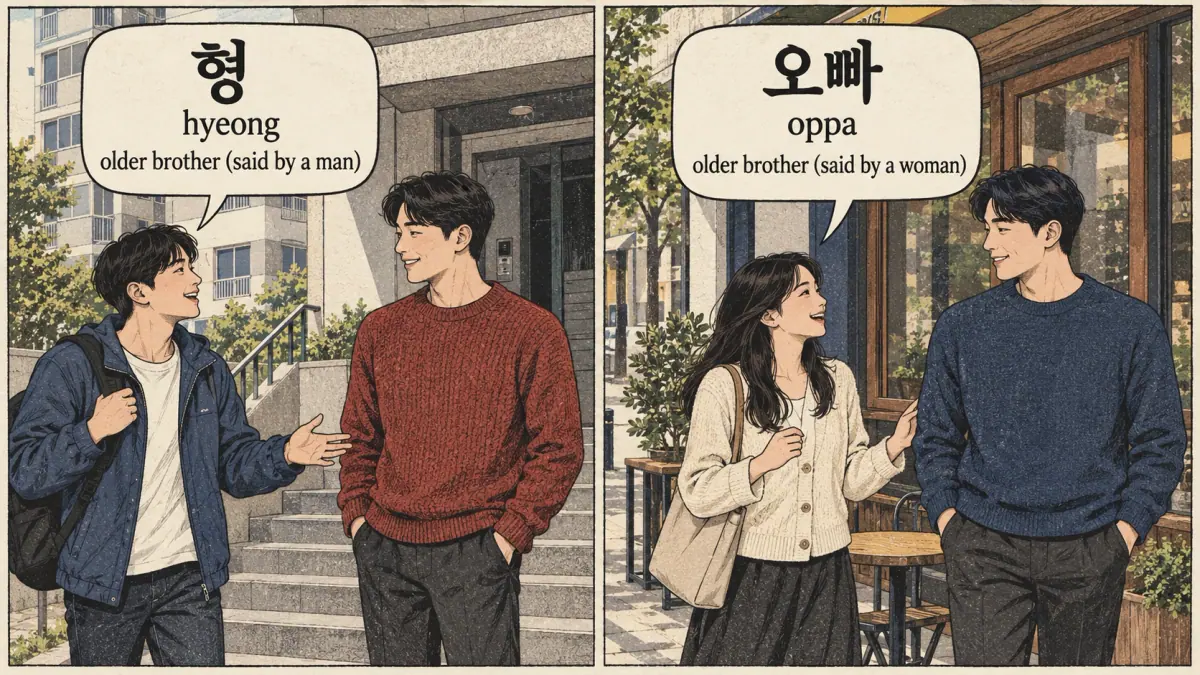
People words follow a pattern of kin terms that depend on who is speaking. A man calls his older brother 형 and his older sister 누나, while a woman calls them 오빠 and 언니. Use 어머니 and 아버지 in polite speech, and 엄마 and 아빠 with family and in casual speech.
| No. | Hangul | Revised Romanization | Meaning | Origin | Example sentence | Audio assetId |
|---|---|---|---|---|---|---|
| 17 | 사람 | saram | person | native | 저 사람은 친구예요. (That person is a friend.) | au-pg-vocabulary-core-words-top-100-17; example: au-pg-vocabulary-core-words-top-100-117 |
| 18 | 남자 | namja | man | Sino-Korean | 저 남자는 선생님이에요. (That man is a teacher.) | au-pg-vocabulary-core-words-top-100-18; example: au-pg-vocabulary-core-words-top-100-118 |
| 19 | 여자 | yeoja | woman | Sino-Korean | 그 여자는 학생이에요. (That woman is a student.) | au-pg-vocabulary-core-words-top-100-19; example: au-pg-vocabulary-core-words-top-100-119 |
| 20 | 아이 | ai | child | native | 아이가 물을 마셔요. (The child drinks water.) | au-pg-vocabulary-core-words-top-100-20; example: au-pg-vocabulary-core-words-top-100-120 |
| 21 | 친구 | chingu | friend | Sino-Korean | 친구가 집에 와요. (My friend comes to the house.) | au-pg-vocabulary-core-words-top-100-21; example: au-pg-vocabulary-core-words-top-100-121 |
| 22 | 선생님 | seonsaengnim | teacher | Sino-Korean | 선생님이 학교에 있어요. (The teacher is at school.) | au-pg-vocabulary-core-words-top-100-22; example: au-pg-vocabulary-core-words-top-100-122 |
| 23 | 학생 | haksaeng | student | Sino-Korean | 저는 한국어 학생이에요. (I am a Korean-language student.) | au-pg-vocabulary-core-words-top-100-23; example: au-pg-vocabulary-core-words-top-100-123 |
| 24 | 가족 | gajok | family | Sino-Korean | 우리 가족은 네 명이에요. (Our family has four people.) | au-pg-vocabulary-core-words-top-100-24; example: au-pg-vocabulary-core-words-top-100-124 |
| 25 | 어머니 | eomeoni | mother | native | 어머니는 집에 계세요. (My mother is at home.) | au-pg-vocabulary-core-words-top-100-25; example: au-pg-vocabulary-core-words-top-100-125 |
| 26 | 아버지 | abeoji | father | native | 아버지는 회사에 가요. (My father goes to the office.) | au-pg-vocabulary-core-words-top-100-26; example: au-pg-vocabulary-core-words-top-100-126 |
| 27 | 엄마 | eomma | mom | native | 엄마, 물 주세요. (Mom, please give me water.) | au-pg-vocabulary-core-words-top-100-27; example: au-pg-vocabulary-core-words-top-100-127 |
| 28 | 아빠 | appa | dad | native | 아빠가 밥을 먹어요. (Dad eats a meal.) | au-pg-vocabulary-core-words-top-100-28; example: au-pg-vocabulary-core-words-top-100-128 |
| 29 | 형 | hyeong | older brother (said by a man) | Sino-Korean | 형은 학생이에요. (My older brother is a student.) | au-pg-vocabulary-core-words-top-100-29; example: au-pg-vocabulary-core-words-top-100-129 |
| 30 | 누나 | nuna | older sister (said by a man) | native | 누나가 한국어를 가르쳐요. (My older sister teaches Korean.) | au-pg-vocabulary-core-words-top-100-30; example: au-pg-vocabulary-core-words-top-100-130 |
| 31 | 오빠 | oppa | older brother (said by a woman) | native | 오빠가 서울에 살아요. (My older brother lives in Seoul.) | au-pg-vocabulary-core-words-top-100-31; example: au-pg-vocabulary-core-words-top-100-131 |
| 32 | 언니 | eonni | older sister (said by a woman) | native | 언니는 회사에 다녀요. (My older sister works at a company.) | au-pg-vocabulary-core-words-top-100-32; example: au-pg-vocabulary-core-words-top-100-132 |
| 33 | 동생 | dongsaeng | younger sibling | Sino-Korean | 동생은 학교에 가요. (My younger sibling goes to school.) | au-pg-vocabulary-core-words-top-100-33; example: au-pg-vocabulary-core-words-top-100-133 |
| 34 | 아들 | adeul | son | native | 아들이 하나 있어요. (I have one son.) | au-pg-vocabulary-core-words-top-100-34; example: au-pg-vocabulary-core-words-top-100-134 |
| 35 | 딸 | ttal | daughter | native | 딸이 둘 있어요. (I have two daughters.) | au-pg-vocabulary-core-words-top-100-35; example: au-pg-vocabulary-core-words-top-100-135 |
| 36 | 이름 | ireum | name | native | 이름이 뭐예요? (What is your name?) | au-pg-vocabulary-core-words-top-100-36; example: au-pg-vocabulary-core-words-top-100-136 |
Note that 선생님 (teacher) ends in 님, a respect suffix that Koreans add to titles. It is also used to address a teacher directly. The next group covers time and numbers.
Time and Numbers
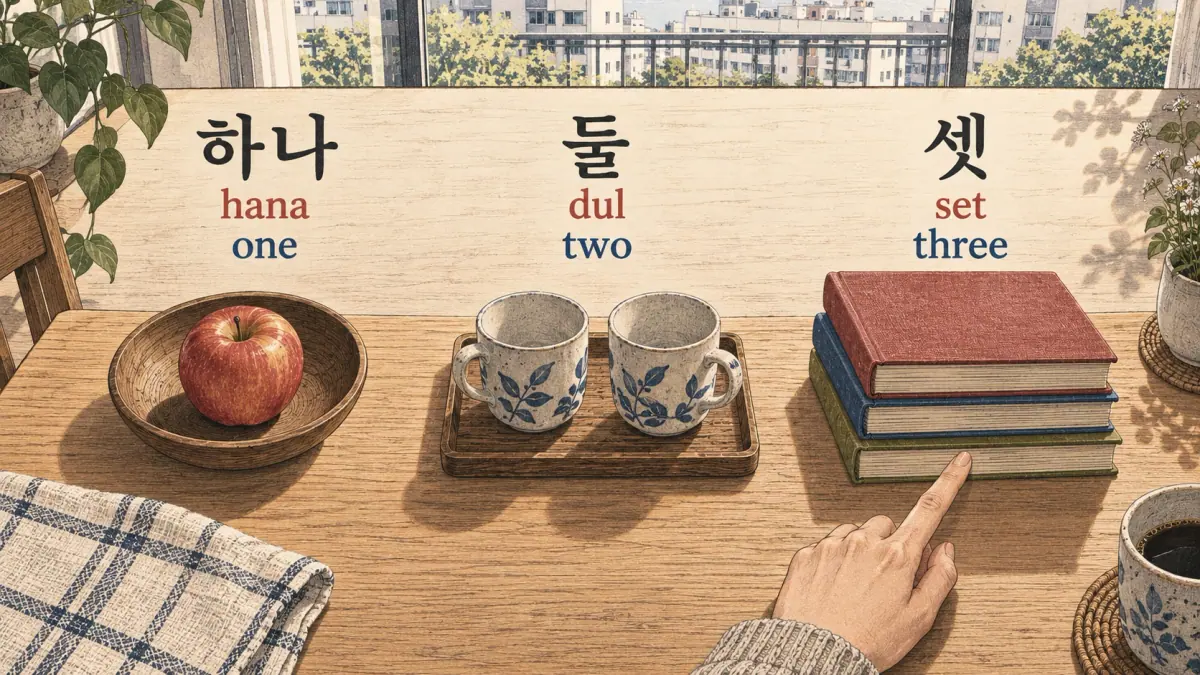
Time words and native counting numbers appear in nearly every daily sentence. The native numbers 하나, 둘, 셋 and 열 count things, while 백 is a Sino-Korean number. Read more in the Sino-Korean numbers lesson, since several top words, such as 시간 and 학교, are Sino-Korean in the same way as 일, 이 and 삼.
| No. | Hangul | Revised Romanization | Meaning | Origin | Example sentence | Audio assetId |
|---|---|---|---|---|---|---|
| 37 | 시간 | sigan | time | Sino-Korean | 시간이 없어요. (I have no time.) | au-pg-vocabulary-core-words-top-100-37; example: au-pg-vocabulary-core-words-top-100-137 |
| 38 | 오늘 | oneul | today | native | 오늘은 월요일이에요. (Today is Monday.) | au-pg-vocabulary-core-words-top-100-38; example: au-pg-vocabulary-core-words-top-100-138 |
| 39 | 내일 | naeil | tomorrow | Sino-Korean | 내일 학교에 가요. (I go to school tomorrow.) | au-pg-vocabulary-core-words-top-100-39; example: au-pg-vocabulary-core-words-top-100-139 |
| 40 | 어제 | eoje | yesterday | native | 어제 친구를 만났어요. (I met a friend yesterday.) | au-pg-vocabulary-core-words-top-100-40; example: au-pg-vocabulary-core-words-top-100-140 |
| 41 | 지금 | jigeum | now | Sino-Korean | 지금 뭐 해요? (What are you doing now?) | au-pg-vocabulary-core-words-top-100-41; example: au-pg-vocabulary-core-words-top-100-141 |
| 42 | 아침 | achim | morning; breakfast | native | 아침에 커피를 마셔요. (I drink coffee in the morning.) | au-pg-vocabulary-core-words-top-100-42; example: au-pg-vocabulary-core-words-top-100-142 |
| 43 | 저녁 | jeonyeok | evening; dinner | native | 저녁에 집에 있어요. (I am at home in the evening.) | au-pg-vocabulary-core-words-top-100-43; example: au-pg-vocabulary-core-words-top-100-143 |
| 44 | 밤 | bam | night | native | 밤에 자요. (I sleep at night.) | au-pg-vocabulary-core-words-top-100-44; example: au-pg-vocabulary-core-words-top-100-144 |
| 45 | 주 | ju | week | Sino-Korean | 한 주에 한 번 가요. (I go once a week.) | au-pg-vocabulary-core-words-top-100-45; example: au-pg-vocabulary-core-words-top-100-145 |
| 46 | 달 | dal | month; moon | native | 다음 달에 서울에 가요. (I go to Seoul next month.) | au-pg-vocabulary-core-words-top-100-46; example: au-pg-vocabulary-core-words-top-100-146 |
| 47 | 해 | hae | sun; year | native | 해가 떠요. (The sun rises.) | au-pg-vocabulary-core-words-top-100-47; example: au-pg-vocabulary-core-words-top-100-147 |
| 48 | 하루 | haru | one day | native | 하루에 세 번 먹어요. (I eat three times a day.) | au-pg-vocabulary-core-words-top-100-48; example: au-pg-vocabulary-core-words-top-100-148 |
| 49 | 하나 | hana | one | native | 사과가 하나 있어요. (There is one apple.) | au-pg-vocabulary-core-words-top-100-49; example: au-pg-vocabulary-core-words-top-100-149 |
| 50 | 둘 | dul | two | native | 친구가 둘 있어요. (I have two friends.) | au-pg-vocabulary-core-words-top-100-50; example: au-pg-vocabulary-core-words-top-100-150 |
| 51 | 셋 | set | three | native | 책이 셋 있어요. (There are three books.) | au-pg-vocabulary-core-words-top-100-51; example: au-pg-vocabulary-core-words-top-100-151 |
| 52 | 열 | yeol | ten | native | 학생이 열 명이에요. (There are ten students.) | au-pg-vocabulary-core-words-top-100-52; example: au-pg-vocabulary-core-words-top-100-152 |
| 53 | 백 | baek | hundred | Sino-Korean | 백 원이에요. (It is 100 won.) | au-pg-vocabulary-core-words-top-100-53; example: au-pg-vocabulary-core-words-top-100-153 |
| 54 | 몇 | myeot | how many | native | 몇 명이에요? (How many people?) | au-pg-vocabulary-core-words-top-100-54; example: au-pg-vocabulary-core-words-top-100-154 |
Note the two homophones 달 (month; moon) and 해 (sun; year). Context tells you which meaning is intended, as in 다음 달 (next month) and 해가 떠요 (the sun rises). The next group holds the concrete nouns of daily life.
How Do You Say Places and Things in Korean?
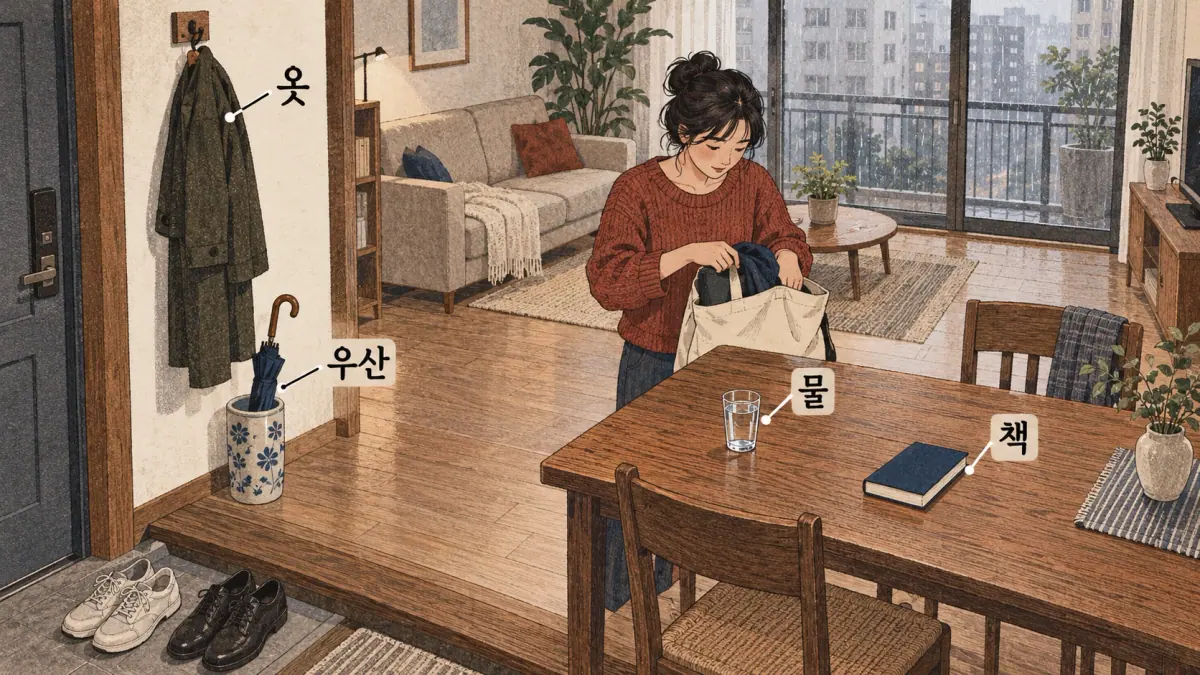
Places and things are the largest group, and they hold most of the Sino-Korean words, such as 학교, 회사 and 병원. Many two-syllable Sino-Korean nouns end in a place or object syllable, which makes new words easier to guess: 병원 (hospital) shares 원 (institution) with 학원 (private academy).
| No. | Hangul | Revised Romanization | Meaning | Origin | Example sentence | Audio assetId |
|---|---|---|---|---|---|---|
| 55 | 집 | jip | house, home | native | 집에 가요. (I go home.) | au-pg-vocabulary-core-words-top-100-55; example: au-pg-vocabulary-core-words-top-100-155 |
| 56 | 학교 | hakgyo | school | Sino-Korean | 학교는 멀어요. (The school is far.) | au-pg-vocabulary-core-words-top-100-56; example: au-pg-vocabulary-core-words-top-100-156 |
| 57 | 회사 | hoesa | company | Sino-Korean | 회사는 서울에 있어요. (The company is in Seoul.) | au-pg-vocabulary-core-words-top-100-57; example: au-pg-vocabulary-core-words-top-100-157 |
| 58 | 나라 | nara | country | native | 한국은 큰 나라가 아니에요. (Korea is not a big country.) | au-pg-vocabulary-core-words-top-100-58; example: au-pg-vocabulary-core-words-top-100-158 |
| 59 | 한국 | hanguk | Korea | Sino-Korean | 저는 한국에 살아요. (I live in Korea.) | au-pg-vocabulary-core-words-top-100-59; example: au-pg-vocabulary-core-words-top-100-159 |
| 60 | 서울 | seoul | Seoul | name | 서울은 한국의 수도예요. (Seoul is the capital of Korea.) | au-pg-vocabulary-core-words-top-100-60; example: au-pg-vocabulary-core-words-top-100-160 |
| 61 | 방 | bang | room | Sino-Korean | 제 방은 작아요. (My room is small.) | au-pg-vocabulary-core-words-top-100-61; example: au-pg-vocabulary-core-words-top-100-161 |
| 62 | 문 | mun | door | Sino-Korean | 문을 열어요. (I open the door.) | au-pg-vocabulary-core-words-top-100-62; example: au-pg-vocabulary-core-words-top-100-162 |
| 63 | 길 | gil | road, way | native | 길이 멀어요. (The way is far.) | au-pg-vocabulary-core-words-top-100-63; example: au-pg-vocabulary-core-words-top-100-163 |
| 64 | 시장 | sijang | market | Sino-Korean | 시장에 가요. (I go to the market.) | au-pg-vocabulary-core-words-top-100-64; example: au-pg-vocabulary-core-words-top-100-164 |
| 65 | 식당 | sikdang | restaurant | Sino-Korean | 식당은 저기에 있어요. (The restaurant is over there.) | au-pg-vocabulary-core-words-top-100-65; example: au-pg-vocabulary-core-words-top-100-165 |
| 66 | 병원 | byeongwon | hospital | Sino-Korean | 병원은 어디예요? (Where is the hospital?) | au-pg-vocabulary-core-words-top-100-66; example: au-pg-vocabulary-core-words-top-100-166 |
| 67 | 은행 | eunhaeng | bank | Sino-Korean | 은행에 가요. (I go to the bank.) | au-pg-vocabulary-core-words-top-100-67; example: au-pg-vocabulary-core-words-top-100-167 |
| 68 | 역 | yeok | station | Sino-Korean | 역은 가까워요. (The station is close.) | au-pg-vocabulary-core-words-top-100-68; example: au-pg-vocabulary-core-words-top-100-168 |
| 69 | 물 | mul | water | native | 물을 마셔요. (I drink water.) | au-pg-vocabulary-core-words-top-100-69; example: au-pg-vocabulary-core-words-top-100-169 |
| 70 | 밥 | bap | cooked rice; meal | native | 밥을 먹어요. (I eat a meal.) | au-pg-vocabulary-core-words-top-100-70; example: au-pg-vocabulary-core-words-top-100-170 |
| 71 | 음식 | eumsik | food | Sino-Korean | 한국 음식이 맛있어요. (Korean food is delicious.) | au-pg-vocabulary-core-words-top-100-71; example: au-pg-vocabulary-core-words-top-100-171 |
| 72 | 차 | cha | tea; car | Sino-Korean | 차를 마셔요. (I drink tea.) | au-pg-vocabulary-core-words-top-100-72; example: au-pg-vocabulary-core-words-top-100-172 |
| 73 | 책 | chaek | book | Sino-Korean | 책을 읽어요. (I read a book.) | au-pg-vocabulary-core-words-top-100-73; example: au-pg-vocabulary-core-words-top-100-173 |
| 74 | 돈 | don | money | native | 돈이 없어요. (I have no money.) | au-pg-vocabulary-core-words-top-100-74; example: au-pg-vocabulary-core-words-top-100-174 |
| 75 | 전화 | jeonhwa | phone; phone call | Sino-Korean | 전화가 와요. (A call is coming in.) | au-pg-vocabulary-core-words-top-100-75; example: au-pg-vocabulary-core-words-top-100-175 |
| 76 | 옷 | ot | clothes | native | 옷이 예뻐요. (The clothes are pretty.) | au-pg-vocabulary-core-words-top-100-76; example: au-pg-vocabulary-core-words-top-100-176 |
| 77 | 신발 | sinbal | shoes | native | 신발이 커요. (The shoes are big.) | au-pg-vocabulary-core-words-top-100-77; example: au-pg-vocabulary-core-words-top-100-177 |
| 78 | 우산 | usan | umbrella | Sino-Korean | 우산이 있어요. (I have an umbrella.) | au-pg-vocabulary-core-words-top-100-78; example: au-pg-vocabulary-core-words-top-100-178 |
| 79 | 일 | il | work; thing to do | native | 오늘 일이 많아요. (I have a lot of work today.) | au-pg-vocabulary-core-words-top-100-79; example: au-pg-vocabulary-core-words-top-100-179 |
| 80 | 말 | mal | word; speech | native | 한국말을 배워요. (I learn the Korean language.) | au-pg-vocabulary-core-words-top-100-80; example: au-pg-vocabulary-core-words-top-100-180 |
| 81 | 눈 | nun | eye; snow | native | 눈이 아파요. (My eye hurts.) | au-pg-vocabulary-core-words-top-100-81; example: au-pg-vocabulary-core-words-top-100-181 |
| 82 | 배 | bae | pear; belly; ship | native | 배가 아파요. (My stomach hurts.) | au-pg-vocabulary-core-words-top-100-82; example: au-pg-vocabulary-core-words-top-100-182 |
| 83 | 손 | son | hand | native | 손을 씻어요. (I wash my hands.) | au-pg-vocabulary-core-words-top-100-83; example: au-pg-vocabulary-core-words-top-100-183 |
| 84 | 것 | geot | thing | native | 이것은 제 것이에요. (This is mine.) | au-pg-vocabulary-core-words-top-100-84; example: au-pg-vocabulary-core-words-top-100-184 |
Verbs pair with these nouns, so build short sentences early. The common verbs pages show how 가다, 먹다 and 읽다 combine with the nouns above. The last word group is the small adverbs that tie sentences together.
Everyday Adverbs and Connectors
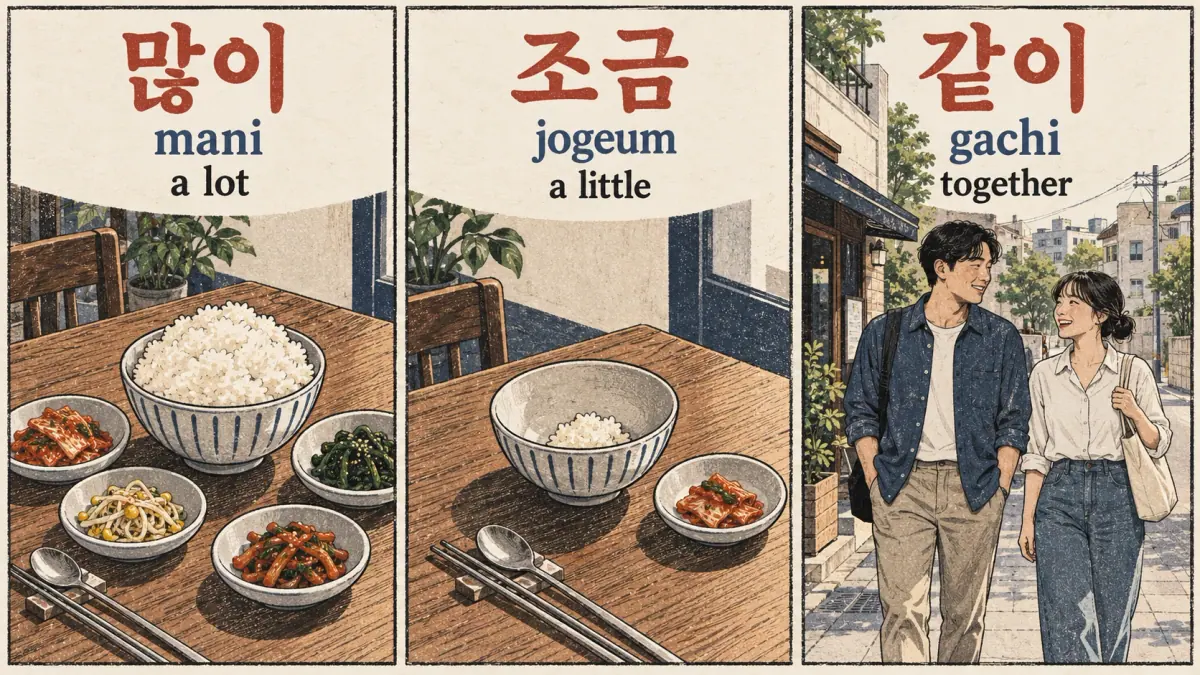
Adverbs change how much, how often or how fast something happens, and connectors link sentences. These 16 words are short and appear in nearly every conversation.
| No. | Hangul | Revised Romanization | Meaning | Origin | Example sentence | Audio assetId |
|---|---|---|---|---|---|---|
| 85 | 아주 | aju | very | native | 아주 좋아요. (It is very good.) | au-pg-vocabulary-core-words-top-100-85; example: au-pg-vocabulary-core-words-top-100-185 |
| 86 | 곧 | got | soon | native | 곧 가요. (I will go soon.) | au-pg-vocabulary-core-words-top-100-86; example: au-pg-vocabulary-core-words-top-100-186 |
| 87 | 너무 | neomu | too much | native | 너무 커요. (It is too big.) | au-pg-vocabulary-core-words-top-100-87; example: au-pg-vocabulary-core-words-top-100-187 |
| 88 | 많이 | mani | a lot | native | 많이 먹어요. (I eat a lot.) | au-pg-vocabulary-core-words-top-100-88; example: au-pg-vocabulary-core-words-top-100-188 |
| 89 | 조금 | jogeum | a little | native | 조금 기다려 주세요. (Please wait a little.) | au-pg-vocabulary-core-words-top-100-89; example: au-pg-vocabulary-core-words-top-100-189 |
| 90 | 더 | deo | more | native | 더 주세요. (Please give me more.) | au-pg-vocabulary-core-words-top-100-90; example: au-pg-vocabulary-core-words-top-100-190 |
| 91 | 또 | tto | again | native | 또 만나요. (Let us meet again.) | au-pg-vocabulary-core-words-top-100-91; example: au-pg-vocabulary-core-words-top-100-191 |
| 92 | 같이 | gachi | together | native | 같이 가요. (Let us go together.) | au-pg-vocabulary-core-words-top-100-92; example: au-pg-vocabulary-core-words-top-100-192 |
| 93 | 다시 | dasi | again, once more | native | 다시 말해 주세요. (Please say it again.) | au-pg-vocabulary-core-words-top-100-93; example: au-pg-vocabulary-core-words-top-100-193 |
| 94 | 먼저 | meonjeo | first, before | native | 먼저 가세요. (Please go first.) | au-pg-vocabulary-core-words-top-100-94; example: au-pg-vocabulary-core-words-top-100-194 |
| 95 | 자주 | jaju | often | native | 자주 영화를 봐요. (I often watch movies.) | au-pg-vocabulary-core-words-top-100-95; example: au-pg-vocabulary-core-words-top-100-195 |
| 96 | 가끔 | gakkeum | sometimes | native | 가끔 커피를 마셔요. (I sometimes drink coffee.) | au-pg-vocabulary-core-words-top-100-96; example: au-pg-vocabulary-core-words-top-100-196 |
| 97 | 빨리 | ppalli | quickly | native | 빨리 오세요. (Please come quickly.) | au-pg-vocabulary-core-words-top-100-97; example: au-pg-vocabulary-core-words-top-100-197 |
| 98 | 그리고 | geurigo | and (between sentences) | native | 밥을 먹어요. 그리고 커피를 마셔요. (I eat a meal. And I drink coffee.) | au-pg-vocabulary-core-words-top-100-98; example: au-pg-vocabulary-core-words-top-100-198 |
| 99 | 그런데 | geureonde | but; by the way | native | 그런데 이름이 뭐예요? (By the way, what is your name?) | au-pg-vocabulary-core-words-top-100-99; example: au-pg-vocabulary-core-words-top-100-199 |
| 100 | 그래서 | geuraeseo | so, therefore | native | 비가 와요. 그래서 집에 있어요. (It is raining. So I stay home.) | au-pg-vocabulary-core-words-top-100-100; example: au-pg-vocabulary-core-words-top-100-200 |
Place an adverb before the verb or adjective it modifies, as in 많이 먹어요 (I eat a lot). Connectors such as 그리고, 그런데 and 그래서 start a sentence. The list is complete, so the next step is to hear the words.
How Do You Pronounce These Words?
Press the play button on any entry to hear the word, and repeat it before you read the romanization. Revised Romanization is a learning aid. It follows the sound of a word, as in 같이 (gachi), but it does not show tensing caused by a neighbouring sound, so 학교 stays hakgyo although it is said [학꾜]. The table below shows the sounds that learners most often miss.
| Word | Romanization | Said | Rule |
|---|---|---|---|
| 한국 | hanguk | [한국] | final ㄱ is closed, with no puff of air |
| 학교 | hakgyo | [학꾜] | ㄱ before ㄱ makes the second sound tense |
| 같이 | gachi | [가치] | ㅌ before 이 becomes ㅊ |
| 몇 | myeot | [멷] | final ㅊ closes as [t] |
| 많이 | mani | [마니] | ㅎ is not heard before a vowel |
The rules come from the Standard Pronunciation rules (표준 발음법) of the 국립국어원, and a Korean reviewer should confirm each form.
Audio and Slow Playback
Each headword has a normal clip, and the five spotlight words (이, 그, 저, 나 and 사람) also have a slow clip at 0.8 times the speed. Nothing plays until you press a button, and the generated clips were approved by Min-ji Park on 15 October 2026.
Homophones to Watch
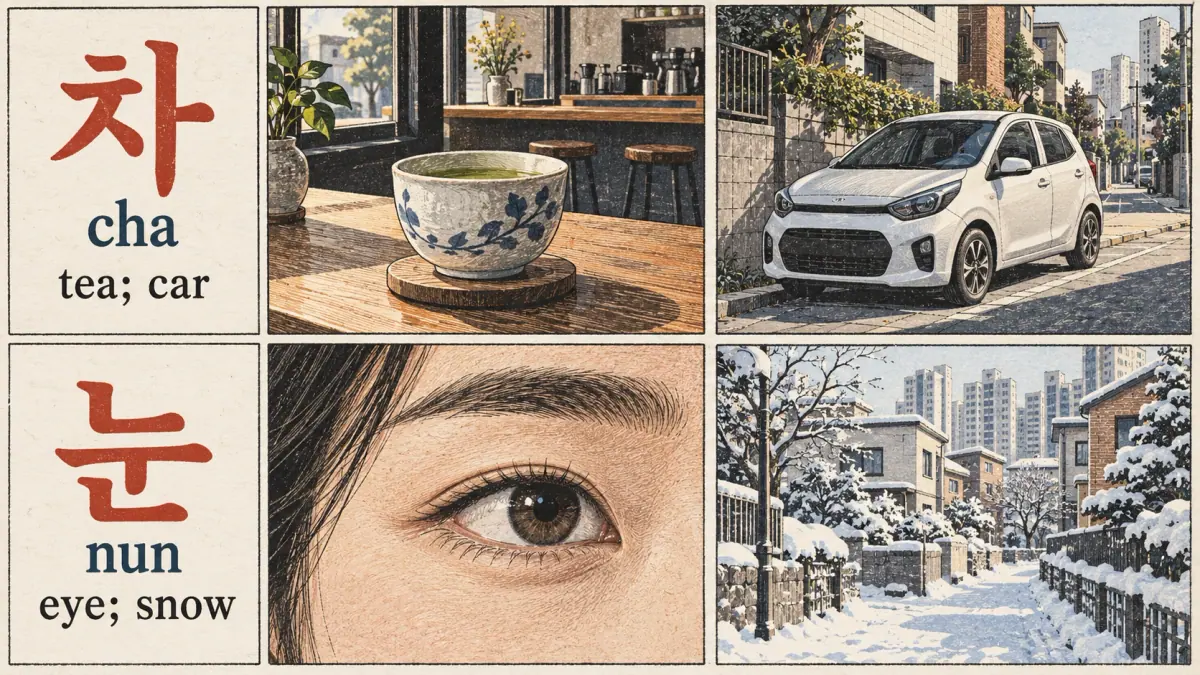
Korean has several common words that sound the same but mean different things. In the top 100 list these are the ones to learn together with an example:
- 배: pear, belly or ship. 배가 아파요 means my stomach hurts; 배를 먹어요 means I eat a pear.
- 눈: eye or snow. 눈이 아파요 means my eye hurts; 눈이 와요 means it snows.
- 차: tea or car. 차를 마셔요 means I drink tea; 차를 타요 means I ride in a car.
- 밤: night, or a chestnut. 밤에 자요 means I sleep at night.
- 말: speech, or a horse. 한국말을 배워요 means I learn Korean.
- 달: month or moon. 다음 달 means next month.
The verb in the sentence usually settles the meaning, so learn each noun with its verb.
What Mistakes Do Learners Make with Core Korean Words?
- Using 나 with elders or strangers. Use 저 and a polite ending.
- Treating 이, 그 and 저 as the same. They are three distances, so pick the one that matches where the thing is.
- Learning words alone. Learn 배가 아파요, not just 배, so the meaning is clear.
- Reading the romanization instead of the Hangul. Cover the romanization column and read the Hangul.
- Treating the order in this list as a frequency count. It is an editorial study order.
Self-Test: 20 Sentences
Fill each blank with a word from this list. Say the full sentence aloud once you have it. The answers follow the test.
- 저는 ___이에요. (I am a student.)
- ___을 마셔요. (I drink water.)
- ___에 가요. (I go home.)
- ___이 아파요. (My hand hurts.)
- 이것은 ___이에요. (This is a book.)
- ___은 한국의 수도예요. (Seoul is the capital of Korea.)
- 학교가 ___예요? (Where is the school?)
- ___이 없어요. (I have no money.)
- ___가 둘 있어요. (I have two friends.)
- ___ 가요. (Let us go together.)
- 비가 와요. ___ 집에 있어요. (It is raining. So I stay home.)
- ___ 학교에 가요. (I go to school tomorrow.)
- 아침에 ___을 먹어요. (I eat a meal in the morning.)
- ___ 주세요. (Please give me more.)
- 우리 ___은 네 명이에요. (Our family has four people.)
- 이 사람은 ___예요? (Who is this person?)
- 오늘 ___이 많아요. (I have a lot of work today.)
- 한국 ___이 맛있어요. (Korean food is delicious.)
- ___ 오세요. (Please come quickly.)
- 아버지는 ___에 가요. (My father goes to the office.)
Answers: 1. 학생; 2. 물; 3. 집; 4. 손; 5. 책; 6. 서울; 7. 어디; 8. 돈; 9. 친구; 10. 같이; 11. 그래서; 12. 내일; 13. 밥; 14. 더; 15. 가족; 16. 누구; 17. 일; 18. 음식; 19. 빨리; 20. 회사.
A score of 16 or more suggests the words are settling in. If you scored lower, reread the groups where you missed words.
Practice: Flashcards and Worksheet

Drill this list with the 100 Korean words flashcards: the deck holds the same 100 words, in the same order and with the same meanings, plus a short use or sound note on each card. Find other themed decks in the vocabulary flashcard decks. The 100 Korean words worksheet has writing practice for the same words, and the vocabulary worksheets page lists the other sheets. The worksheet reuses the scene above as a blank labelling task.
Where to Go Next
This list sits inside Most Common Korean Words. When words 1–100 feel easy, move on to Top 500 Korean Words for words 101–500, bringing your cumulative total to 500. Later, Top 1000 Korean Words covers words 501–1000: 500 additional words, bringing your cumulative total to 1000. To build sentences, pair this noun list with the 100 Korean verbs.
Frequently Asked Questions
How Do You Say This in Korean?
Say 이 (i) before a noun, as in 이 책 (this book), and 이것 (igeot) when it stands alone, as in 이것은 물이에요. In speech 이것 is often shortened to 이거. Use 그 for something near the listener and 저 for something far from both of you.
How Do You Pronounce 그 (geu)?
그 is read geu. The vowel ㅡ is said with the lips spread flat, as if you began to say oo but smiled instead. It is not the English word go. Press the play button on the 그 entry and repeat it slowly.
How Many Core Korean Words Should I Learn First?
Learn the 100 words on this page first, at about 10 new words a day, which takes about 10 days plus review. Then move to the top 500. These 100 words give you the building blocks of simple sentences, though not yet a full conversation.
Where Can I Practise Core Korean Words with Flashcards?
Use the 100 Korean words flashcards, which hold 100 cards with Hangul, romanization and audio, and review them with a five-box Leitner schedule. The deck holds the same 100 words as this list, in the same order and with the same meanings. Progress is saved only in your browser, and no account is needed.
Is the Romanization on This Page Official?
It follows the Revised Romanization of Korean, the system South Korea officially adopted on 7 July 2000, whose rules are published by the National Institute of Korean Language (국립국어원). It is a learning aid and does not mark every sound change, so learn the Hangul and use the audio buttons to check the real sound.
Is There a Printable Worksheet for Core Korean Words?
Yes. The 100 Korean words worksheet is a printable PDF with writing practice for the same words. It pairs with the 100 Korean words flashcards, so you can drill on screen and then write the words by hand. It is free for personal and classroom use.