Korean Sound Symbolism at a Glance
Sound symbolism means that the sounds of a word suggest its meaning. English has a little ("tiny" and "huge" feel different), but Korean builds it into a system. Two vowels or consonants in the same word family can show size, weight or force. 졸졸 is a thin trickle, and 줄줄 is a heavier flow. 반짝 is a twinkle, and 번쩍 is a flash.
| Pattern | What changes | Typical effect | Example pair |
|---|---|---|---|
| Bright and dark vowels | ㅏ, ㅗ against ㅓ, ㅜ | small and light against big and heavy | 졸졸 / 줄줄 |
| Plain, tense and aspirated consonants | ㄱ against ㄲ against ㅋ | gentle against strong | 감감 / 깜깜 / 캄캄 |
| Reduplication | the word is said twice | a repeated or continuing action | 반짝 / 반짝반짝 |
The page sits in Onomatopoeia and Mimetic Words. It follows Korean Mimetic Words (Uitaeeo), which lists the words themselves, and Animal Sounds in Korean, which lists sound words for animals. This lesson explains why the words have the shapes they do.
Which Sound Symbolism Patterns Should You Learn First?
Learn the vowel contrast first. It is the easiest to hear, and it covers the most pairs. Then add the consonant contrast, and last the doubling pattern.
- Start with. 졸졸 / 줄줄, 깡충깡충 / 껑충껑충, 퐁당 / 풍덩. They are everyday words with a very clear size difference.
- Then add. 반짝반짝 / 번쩍번쩍, 올록볼록 / 울룩불룩, 방긋방긋 / 벙긋벙긋.
- Last. The consonant triads (감감 / 깜깜 / 캄캄) and the stronger forms 빨갛다 and 뽀송뽀송, which carry the finest shades.
Bright and Dark Vowels
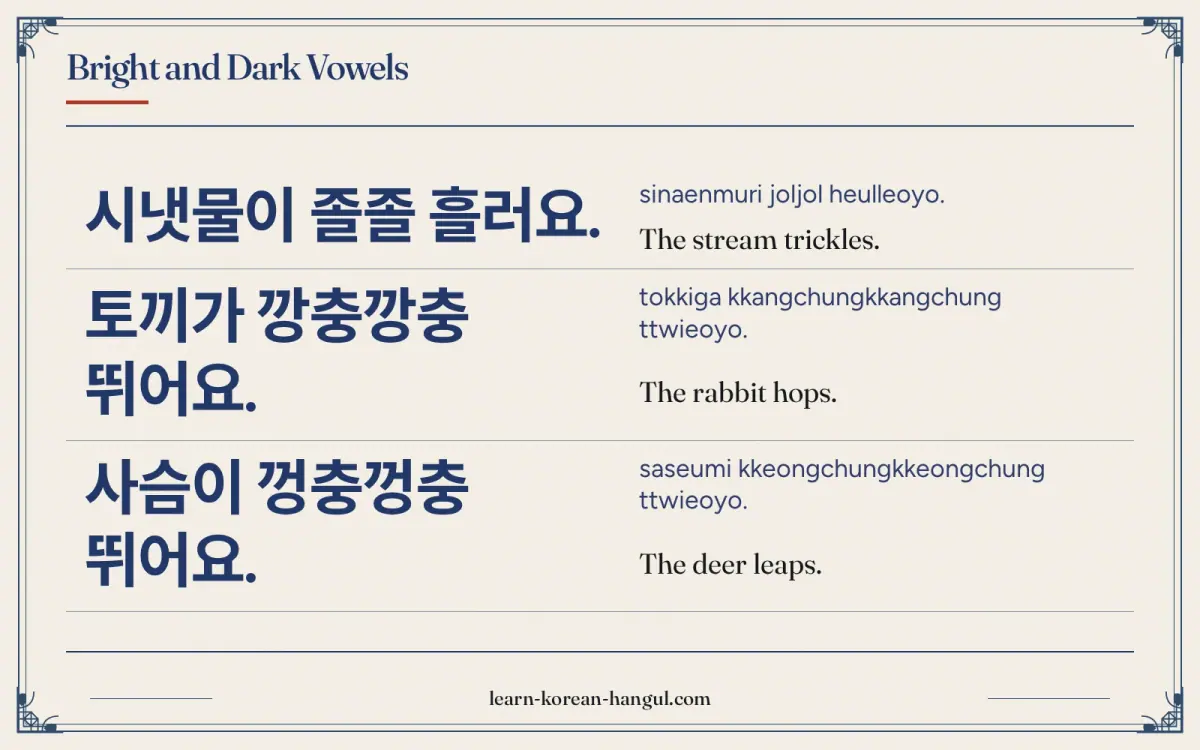
Korean vowels fall into two groups that grammars call 양성모음 (bright vowels) and 음성모음 (dark vowels). The bright vowels are ㅏ and ㅗ (and ㅑ, ㅛ). The dark vowels are ㅓ and ㅜ (and ㅕ, ㅠ, and traditionally ㅡ). ㅣ is neutral and goes with either. In sound words, a bright vowel gives a small, light, quick feel, and a dark vowel gives a big, heavy, slow feel. The dictionary calls the first kind 작은말 (small word) and the second 큰말 (big word).
The same two groups run the 아/어 ending in verbs. A stem whose last vowel is ㅏ or ㅗ takes 아: 작다 → 작아요, 높다 → 높아요. Other stems take 어: 크다 → 커요, 깊다 → 깊어요. So bright and dark vowels are not just a feature of sound words. They shape the whole language, and the pairs in sound words are the easiest place to hear it.
| No. | Bright (small) | Revised Romanization | Dark (big) | Revised Romanization | The difference | Audio assetId |
|---|---|---|---|---|---|---|
| 1 | 졸졸 | joljol | 줄줄 | juljul | a thin, light trickle; a heavier, bigger flow | au-pg-vocabulary-word-types-onomatopoeia-sound-symbolism-1; au-pg-vocabulary-word-types-onomatopoeia-sound-symbolism-2 |
| 2 | 깡충깡충 | kkangchungkkangchung | 껑충껑충 | kkeongchungkkeongchung | small, light hops; long, bigger leaps | au-pg-vocabulary-word-types-onomatopoeia-sound-symbolism-3; au-pg-vocabulary-word-types-onomatopoeia-sound-symbolism-4 |
| 3 | 퐁당 | pongdang | 풍덩 | pungdeong | a small plop into water; a big splash | au-pg-vocabulary-word-types-onomatopoeia-sound-symbolism-5; au-pg-vocabulary-word-types-onomatopoeia-sound-symbolism-6 |
| 4 | 반짝반짝 | banjjakbanjjak | 번쩍번쩍 | beonjjeokbeonjjeok | twinkling, small lights; flashing, bigger lights | au-pg-vocabulary-word-types-onomatopoeia-sound-symbolism-7; au-pg-vocabulary-word-types-onomatopoeia-sound-symbolism-8 |
| 5 | 달달 | daldal | 덜덜 | deoldeol | trembling lightly; shaking hard | au-pg-vocabulary-word-types-onomatopoeia-sound-symbolism-9; au-pg-vocabulary-word-types-onomatopoeia-sound-symbolism-10 |
| 6 | 올록볼록 | ollokbollok | 울룩불룩 | ullukbulluk | small, neat bumps; bigger, rougher bumps | au-pg-vocabulary-word-types-onomatopoeia-sound-symbolism-11; au-pg-vocabulary-word-types-onomatopoeia-sound-symbolism-12 |
| 7 | 오물오물 | omuromul | 우물우물 | umurumul | chewing with a small mouth; chewing a big mouthful, or mumbling | au-pg-vocabulary-word-types-onomatopoeia-sound-symbolism-13; au-pg-vocabulary-word-types-onomatopoeia-sound-symbolism-14 |
| 8 | 방긋방긋 | banggeutbanggeut | 벙긋벙긋 | beonggeutbeonggeut | a small, sweet smile; a wide, open smile | au-pg-vocabulary-word-types-onomatopoeia-sound-symbolism-15; au-pg-vocabulary-word-types-onomatopoeia-sound-symbolism-16 |
| 9 | 꼬불꼬불 | kkobulkkobul | 꾸불꾸불 | kkubulkkubul | small, tight curves; bigger, looser curves | au-pg-vocabulary-word-types-onomatopoeia-sound-symbolism-17; au-pg-vocabulary-word-types-onomatopoeia-sound-symbolism-18 |
In the middle of each pair the consonants are the same and only the vowels change. 졸졸 and 줄줄 differ only in ㅗ and ㅜ. 깡충깡충 and 껑충껑충 differ in ㅏ and ㅓ. Once you spot this, a new word such as 퐁당 gives you its partner 풍덩 almost for free. The dictionary still lists each word, though, so check it before using a pair you have guessed.
Worked Examples
Read each pair of sentences aloud. The verb and the particles stay the same. Only the sound word changes, and the picture changes with it.
시냇물이 졸졸 흘러요.
sinaenmuri joljol heulleoyo.
The stream trickles.
비가 와서 지붕에서 물이 줄줄 흘러요.
biga waseo jibungeseo muri juljul heulleoyo.
Because of the rain, water is pouring off the roof.
토끼가 깡충깡충 뛰어요.
tokkiga kkangchungkkangchung ttwieoyo.
The rabbit hops.
사슴이 껑충껑충 뛰어요.
saseumi kkeongchungkkeongchung ttwieoyo.
The deer leaps.
Two more pairs show a splash and a flash. A coin that falls in the water goes 퐁당, and a child who jumps in goes 풍덩. A faraway star goes 반짝반짝, and lightning goes 번쩍.
동전이 물에 퐁당 빠졌어요.
dongjeoni mure pongdang ppajyeosseoyo.
The coin plopped into the water.
아이가 수영장에 풍덩 뛰어들었어요.
aiga suyeongjange pungdeong ttwieodeureosseoyo.
The child jumped into the pool with a big splash.
별이 반짝반짝 빛나요.
byeori banjjakbanjjak binnayo.
The stars twinkle.
번개가 번쩍 쳤어요.
beongaega beonjjeok chyeosseoyo.
The lightning flashed.
What Do You Need to Know about Plain, Tense and Aspirated Consonants?
The second pattern changes the first consonant. Korean has three strengths for ㄱ, ㄷ, ㅂ, ㅈ: plain (ㄱ), tense (ㄲ) and aspirated (ㅋ). The dictionary calls the plain one 여린말, the tense one 센말 and the aspirated one 거센말. In mimetic words and colour words, a tense or aspirated consonant makes the word stronger, sharper or more intense. This is the same plain, tense and aspirated contrast you meet in plain, tense and aspirated sounds, now used for meaning.
| Plain | Tense | Aspirated | Meaning | Audio assetId |
|---|---|---|---|---|
| 감감하다 (gamgamhada) | 깜깜하다 (kkamkkamhada) | 캄캄하다 (kamkamhada) | 감감: faint, or no news at all. 깜깜 and 캄캄: pitch dark | au-pg-vocabulary-word-types-onomatopoeia-sound-symbolism-21; au-pg-vocabulary-word-types-onomatopoeia-sound-symbolism-19; au-pg-vocabulary-word-types-onomatopoeia-sound-symbolism-20 |
| 반짝반짝 (banjjakbanjjak) | 빤짝빤짝 (ppanjjakppanjjak) | twinkling; the tense form is a sharper twinkle | au-pg-vocabulary-word-types-onomatopoeia-sound-symbolism-22; au-pg-vocabulary-word-types-onomatopoeia-sound-symbolism-23 | |
| 발갛다 (balgata) | 빨갛다 (ppalgata) | reddish; red | au-pg-vocabulary-word-types-onomatopoeia-sound-symbolism-24; au-pg-vocabulary-word-types-onomatopoeia-sound-symbolism-25 | |
| 보송보송 (bosongbosong) | 뽀송뽀송 (pposongpposong) | dry and soft; fresh and dry | au-pg-vocabulary-word-types-onomatopoeia-sound-symbolism-26; au-pg-vocabulary-word-types-onomatopoeia-sound-symbolism-27 | |
| 고불고불 (gobulgobul) | 꼬불꼬불 (kkobulkkobul) | winding; tightly winding | au-pg-vocabulary-word-types-onomatopoeia-sound-symbolism-28; au-pg-vocabulary-word-types-onomatopoeia-sound-symbolism-17 | |
| 반들반들 (bandeulbandeul) | 빤들빤들 (ppandeulppandeul) | smooth and shiny; very smooth and shiny | au-pg-vocabulary-word-types-onomatopoeia-sound-symbolism-29; au-pg-vocabulary-word-types-onomatopoeia-sound-symbolism-30 |
Two warnings apply. First, not every word has all three forms. Most have a plain and a tense form, and only a few have an aspirated one as well. Second, the pairs in this table are standard, but the meaning gap is often small. Dictionaries describe the tense form as the 'stronger' version, and a Korean speaker may hear it as only slightly more vivid. Do not expect a big jump in meaning.
Some pairs combine both patterns. 발갛다 and 빨갛다 differ in the consonant, and 벌겋다 and 뻘겋다 repeat the contrast with the dark vowel. Colour words are the clearest place to see the grid: the bright vowel with a plain or tense consonant is light and clean, and the dark vowel with a plain or tense consonant is dull and heavy.
| Plain consonant | Tense consonant | |
|---|---|---|
| Bright vowel | 발갛다 (balgata), reddish | 빨갛다 (ppalgata), red |
| Dark vowel | 벌겋다 (beolgeota), dull red | 뻘겋다 (ppeolgeota), dull and strongly red |
For comparison, 사과가 빨개요 means 'The apple is red'. 빨갛다 is a ㅎ-irregular adjective, so 빨갛 + 아요 becomes 빨개요. A bright, clean red uses 빨갛다. A dull, angry red face uses 뻘겋다.
사과가 빨개요.
sagwaga ppalgaeyo.
The apple is red.
What Do You Need to Know about Reduplication?
Most Korean sound words come in a doubled form. 반짝 is one twinkle and 반짝반짝 is a continuing twinkle. 깜박 is one blink and 깜박깜박 is repeated blinking. The single form describes one event. The doubled form describes something that repeats or lasts. Both forms can become verbs with -거리다 or -이다: 반짝거리다 and 반짝이다 both mean to twinkle. The two are close in meaning; the -거리다 form stresses that the action keeps repeating.
| Base | Doubled | Verb forms | Meaning | Audio assetId |
|---|---|---|---|---|
| 반짝 (banjjak) | 반짝반짝 (banjjakbanjjak) | 반짝거리다, 반짝이다 | twinkle once; keep twinkling | au-pg-vocabulary-word-types-onomatopoeia-sound-symbolism-31; au-pg-vocabulary-word-types-onomatopoeia-sound-symbolism-34 |
| 깜박 (kkambak) | 깜박깜박 (kkambakkkambak) | 깜박거리다, 깜박이다 | blink once; keep blinking | au-pg-vocabulary-word-types-onomatopoeia-sound-symbolism-32; au-pg-vocabulary-word-types-onomatopoeia-sound-symbolism-37; au-pg-vocabulary-word-types-onomatopoeia-sound-symbolism-35 |
| 출렁 (chulleong) | 출렁출렁 (chulleongchulleong) | 출렁거리다, 출렁이다 | slosh once; keep sloshing | au-pg-vocabulary-word-types-onomatopoeia-sound-symbolism-33; au-pg-vocabulary-word-types-onomatopoeia-sound-symbolism-38; au-pg-vocabulary-word-types-onomatopoeia-sound-symbolism-36 |
Not every sound word has a single form. Some, such as 졸졸, exist only as a double. Say each one the way the dictionary lists it.
What Do You Need to Know about Choosing between Pairs?
When two forms exist, pick the one that fits the size, weight or force of the thing you describe. Use this short test.
- Is it small and light, or big and heavy? Small and light takes the bright vowel (졸졸, 퐁당). Big and heavy takes the dark vowel (줄줄, 풍덩).
- Is it gentle or strong? Gentle takes the plain consonant. Strong takes the tense or aspirated one.
- Does it happen once or continue? Once takes the single form. Continuing takes the doubled form.
- Is the word in the dictionary? If you cannot find the pair in the 표준국어대사전 (Standard Korean Dictionary), do not use it.
Try a sorting task. 'A kitten steps lightly' is a bright-vowel scene. 'A large dog pads heavily' is a dark-vowel scene. 'A tiny star' is bright, and 'a big flash' is dark. Sorting by scene is how Korean speakers choose, without thinking about the rule.
Examples
Here is a last mixed set. In each sentence the sound word sets the tone, so read the sentence aloud and listen for the size. 방이 깜깜하다 means the room is pitch dark, and the tense ㄲ adds a strong feel of darkness. 아기가 방긋방긋 웃어요 uses the bright vowel ㅏ for a small, sweet smile.
추워서 몸이 덜덜 떨려요.
chuwoseo momi deoldeol tteollyeoyo.
I am cold, so my body shakes.
방이 깜깜해서 아무것도 안 보여요.
bangi kkamkkamhaeseo amugeotdo an boyeoyo.
The room is pitch dark, so I cannot see anything.
아기가 방긋방긋 웃어요.
agiga banggeutbanggeut useoyo.
The baby smiles sweetly.
Audio and Slow Playback
Each word and sentence has its own clip. The clips below replay five pairs slowly. Say the bright word, then the dark word, and notice that only the vowel moves.
Tense consonants such as the ㄲ in 깡충깡충 and 껑충껑충 are said with a tight throat and no puff of air. Practise them with the help of plain, tense and aspirated sounds.
What Mistakes Do Learners Make with Sound Symbolism Patterns?
Five mistakes come up often.
- Treating bright and dark as good and bad. The contrast is about size, weight and force, not about good or bad. 줄줄 is not a worse word than 졸졸. It is a bigger flow.
- Inventing new pairs. Pairs follow the dictionary. 반짝 pairs with 번쩍, where both vowels change together, so a half-changed word such as 번짝 is not Korean.
- Thinking tense always means loud. A tense consonant adds force or sharpness, not volume. 깜깜하다 is a strong dark, not a noisy one.
- Mixing up 졸졸 and 줄줄. 줄줄 is also used for fast, smooth reading (줄줄 읽다) and for sweat, so it covers more ground than 졸졸.
- Applying the rule to ordinary words. 날다 (to fly) and 널다 (to hang out laundry) differ by one vowel, but they are separate words, not a bright and dark pair. The rule works for sound words and colour words, not for every word with ㅏ and ㅓ.
The second mistake is the one most learners make. Look the pair up before you use it.
Practice: Sort and Recall
Take the quiz below. It sorts ten words and ideas from this lesson. Eight right means you have the pattern. If you want to drill the words, use the Korean onomatopoeia flashcards. A printable sorting sheet is available in A4 and US Letter; see the vocabulary worksheets page.
Practice · 10
Which word describes the heavier, bigger flow of water: 졸졸 or 줄줄?
Show answer
줄줄
줄줄 has the dark vowel ㅜ, so it is the heavier flow. 졸졸 has ㅗ and is a thin trickle.
What does 깡충깡충 (kkangchungkkangchung) describe?
Show answer
small, light hops
깡충깡충 has the bright vowel ㅏ, so it describes small, light hops, like a rabbit.
Which pair is a bright vowel and dark vowel pair?
Show answer
졸졸 / 줄줄
졸졸 and 줄줄 differ only in the vowel (ㅗ and ㅜ), so they are a bright and dark pair. The other pairs differ in the consonant or are single and doubled forms.
Which word is the tense (stronger) form of 발갛다?
Show answer
빨갛다
빨갛다 is the tense form of 발갛다 with the same vowel. 벌겋다 is the dark-vowel partner, not the tense one.
What is the difference between 올록볼록 and 울룩불룩?
Show answer
the size of the bumps
올록볼록 has bright vowels and describes small bumps; 울룩불룩 has dark vowels and describes bigger ones.
Which is the doubled (reduplicated) form of 깜박?
Show answer
깜박깜박
깜박깜박 doubles 깜박 to mean repeated blinking. 깜박이다 is a verb, and 깜깜 means pitch dark.
Which word fits a small rabbit hopping?
Show answer
깡충깡충
깡충깡충 has the bright vowel ㅏ and fits a small rabbit. 껑충껑충 is for bigger leaps, such as a deer.
Which pair is NOT a sound-symbolic pair?
Show answer
날다 / 널다
날다 (to fly) and 널다 (to hang out laundry) are unrelated words, so they are not a sound-symbolic pair.
What do tense consonants usually add to a mimetic word?
Show answer
more force or intensity
Tense consonants (ㄲ, ㄸ, ㅃ, ㅆ, ㅉ) usually add force or sharpness to a mimetic word.
Which vowels are the main "bright" vowels in this lesson?
Show answer
ㅏ and ㅗ
ㅏ and ㅗ are the bright (small, light) vowels. ㅓ and ㅜ are dark.
Korean Sound Symbolism Sorting Sheet (PDF)
Where to Go Next
Read the word list in Korean Mimetic Words (Uitaeeo), then try the sound words for animals in Animal Sounds in Korean. To go up, return to Onomatopoeia and Mimetic Words. To practise tense consonants, visit plain, tense and aspirated sounds.
Frequently Asked Questions
What Is the Difference between 졸졸 and 줄줄?
졸졸 (joljol) has the bright vowel ㅗ and describes a thin, light trickle, such as a small stream. 줄줄 (juljul) has the dark vowel ㅜ and describes a heavier, bigger flow, such as water running off a roof. 줄줄 is also used for reading smoothly and for sweat.
Do Bright and Dark Vowels Always Change the Size of the Meaning?
No. They change size, weight or force in sound words and colour words, and the dictionary lists the pairs. In ordinary words, such as 날다 (to fly) and 널다 (to hang out laundry), the same vowel contrast does not work as a pattern. The rule helps you guess, but you should check the dictionary.
Are Tense Consonants Always Stronger in Mimetic Words?
Usually. A tense consonant makes a sound word sharper or more intense, as in 빨갛다 against 발갛다. The size of the difference is often small, so do not expect a big jump in meaning. Not every word has a tense form.
How Can I Practise Sound Symbolism Patterns?
Pick five pairs, such as 졸졸 / 줄줄 and 퐁당 / 풍덩. Say the bright word, then the dark word, and picture a small scene and a big one. Then take the quiz on this page and review the pairs with the flashcards.
Where Can I Find Flashcards for Sound Symbolism Patterns?
The Korean onomatopoeia flashcards deck drills common sound and manner words such as 졸졸, 깡충깡충 and 반짝반짝, and the vocabulary flashcard decks page lists the other decks. For the full pairs, use the tables on this page as a card list.
Is the Romanization on This Page Official?
It follows the Revised Romanization of Korean, which South Korea adopted on 7 July 2000 and whose rules the National Institute of Korean Language (국립국어원) publishes. It is a learning aid and does not mark every sound change, so rely on the Hangul and the audio.