Animal Sounds in Korean at a Glance
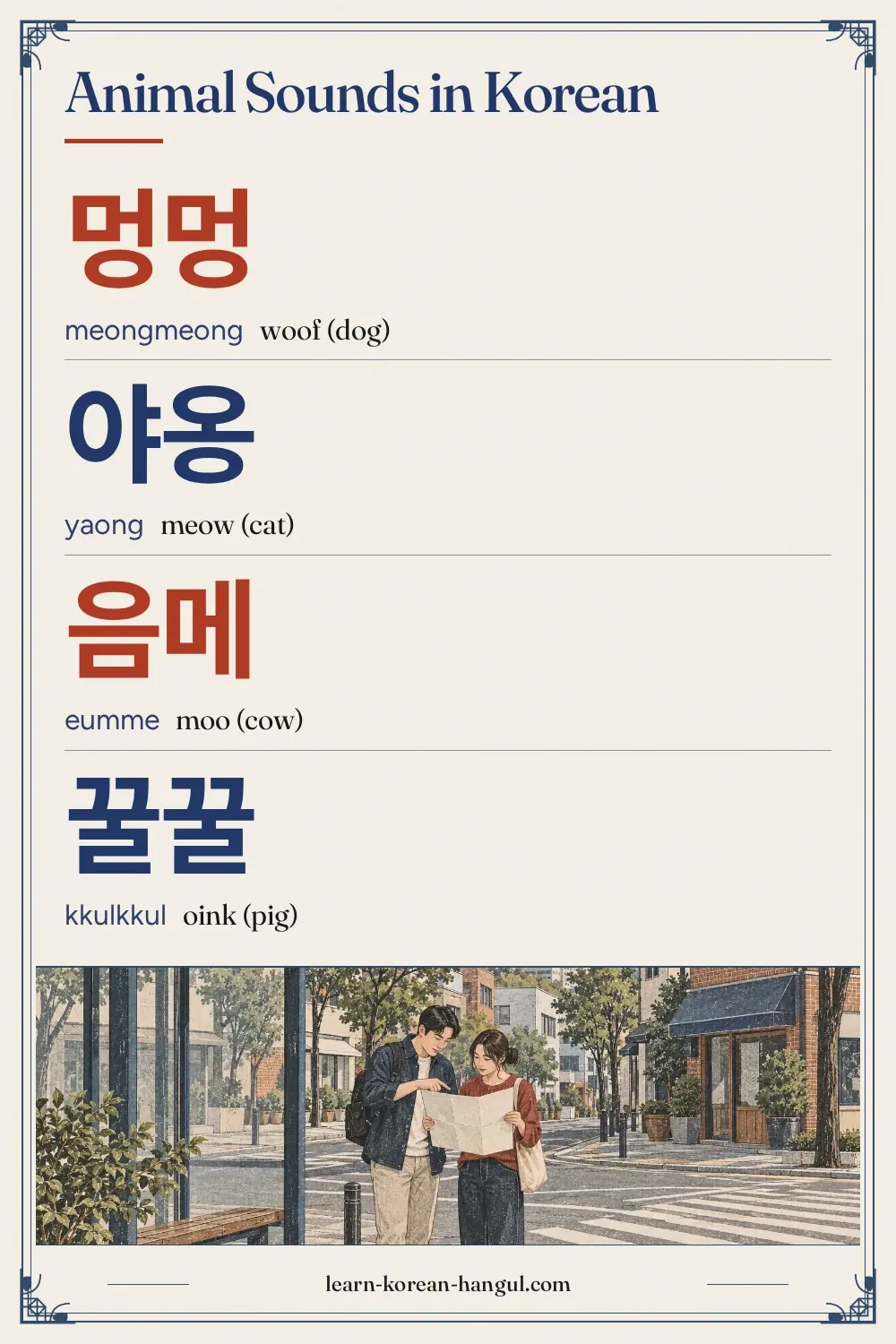
Every language hears animals a little differently. The Korean dog says 멍멍, the pig says 꿀꿀 and the frog says 개굴개굴. These sound words belong to a wider group called 의성어 (uiseongeo, words that imitate sounds). The page sits in Onomatopoeia and Mimetic Words next to Korean Mimetic Words (Uitaeeo), which covers words that imitate movement or manner, and Korean Sound Symbolism and Vowel Harmony, which explains why the sounds have the shapes they do. For the animal names themselves, see animal names.
| Group | Words | What it covers |
|---|---|---|
| Pets and the word for sound | 6 | Dog, cat and small pet sounds, plus 소리 |
| Farm animals | 7 | Cow, pig, chickens, sheep, horse, duck |
| Wild animals | 3 | Tiger and wolf |
| Birds and insects | 9 | Sparrow, cuckoo, crow, owl, chick, frog, cicada, bee, cricket |
Many sound words are reduplicated: the same syllable or pair is said twice, as in 멍멍 and 짹짹. Reduplication gives a repeated sound. A few, such as 야옹, 음메 and 꼬끼오, stay single.
Which Animal Sounds Should You Learn First?
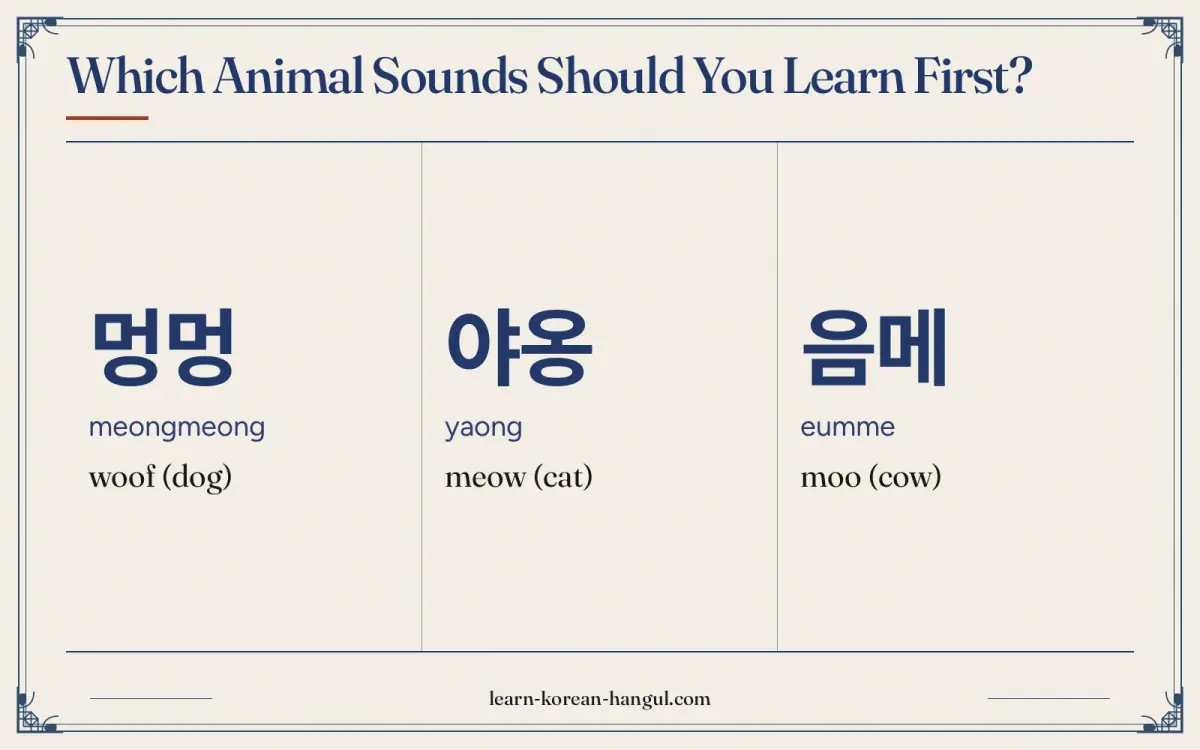
Start with 멍멍 and 야옹, the two sounds nearly every child's book includes. Then learn 음메, 꿀꿀 and 꼬끼오, which complete the standard farmyard. Learn the others in groups of three, pairing each with its animal name. The sound alone is less useful than the pair: 개 멍멍, 고양이 야옹, 소 음메.
- Say first. 멍멍, 야옹, 음메, 꿀꿀, 꼬끼오, 꽥꽥, 짹짹.
- Know the contrast. 꼬꼬댁 is the hen, 꼬끼오 is the rooster, 삐약삐약 is the chick.
- Recognise. 맴맴, 귀뚤귀뚤, 개굴개굴. They mark summer and autumn nights in stories.
The scene below is a farm with a pond, a barn and a tree, and ten animals as numbered items. Tap a number to hear the sound.
Word · 10
- 1
멍멍
meongmeong
woof (dog)
- 2
야옹
yaong
meow (cat)
- 3
음메
eumme
moo (cow)
- 4
꿀꿀
kkulkkul
oink (pig)
- 5
꼬꼬댁
kkokkodaek
cluck (hen)
- 6
꼬끼오
kkokkio
cock-a-doodle-doo (rooster)
- 7
꽥꽥
kkwaekkkwaek
quack (duck)
- 8
개굴개굴
gaegulgaegul
ribbit (frog)
- 9
삐약삐약
ppiyakppiyak
peep (chick)
- 10
짹짹
jjaekjjaek
chirp (sparrow)
Pets (멍멍, 야옹)
Pet sounds come with a note. A dog has three barks: 멍멍 is the standard bark, 왈왈 is louder and sharper, and 컹컹 is deep. Cats say 야옹, and a mouse says 찍찍. 소리 is the word for sound, and it appears in phrases such as 고양이 소리 (a cat's sound) and 개 짖는 소리 (the sound of a dog barking). Avoid 개소리 on its own: it is a rude slang word for nonsense. Pets are the best group to start with because you can use them in conversation.
| No. | Hangul | Revised Romanization | Meaning and note | Example sentence | Audio assetId |
|---|---|---|---|---|---|
| 1 | 소리 | sori | sound; noise. The general word, used for any sound. | 무슨 소리예요? (What sound is that?) | au-pg-vocabulary-word-types-onomatopoeia-animal-sounds-1; example: au-pg-vocabulary-word-types-onomatopoeia-animal-sounds-26 |
| 2 | 멍멍 | meongmeong | woof (dog). The standard dog bark. Animal: 개 (dog). | 개가 멍멍 짖어요. (The dog barks woof woof.) | au-pg-vocabulary-word-types-onomatopoeia-animal-sounds-2; example: au-pg-vocabulary-word-types-onomatopoeia-animal-sounds-27 |
| 3 | 왈왈 | walwal | woof woof (loud dog). A louder, sharper bark, often for a big dog. | 큰 개가 왈왈 짖어요. (A big dog barks loudly.) | au-pg-vocabulary-word-types-onomatopoeia-animal-sounds-3; example: au-pg-vocabulary-word-types-onomatopoeia-animal-sounds-28 |
| 4 | 컹컹 | keongkeong | deep bark (dog). A low, deep bark. Animal: 개. | 밖에서 개가 컹컹 짖어요. (A dog barks deeply outside.) | au-pg-vocabulary-word-types-onomatopoeia-animal-sounds-4; example: au-pg-vocabulary-word-types-onomatopoeia-animal-sounds-29 |
| 5 | 야옹 | yaong | meow (cat). The cat's sound. Animal: 고양이 (cat). | 고양이가 야옹 울어요. (The cat meows.) | au-pg-vocabulary-word-types-onomatopoeia-animal-sounds-5; example: au-pg-vocabulary-word-types-onomatopoeia-animal-sounds-30 |
| 6 | 찍찍 | jjikjjik | squeak (mouse). A small squeak. Animal: 쥐 (mouse). | 쥐가 찍찍 울어요. (The mouse squeaks.) | au-pg-vocabulary-word-types-onomatopoeia-animal-sounds-6; example: au-pg-vocabulary-word-types-onomatopoeia-animal-sounds-31 |
Example Sentences
All the sentences use one frame: animal + 이/가 + sound + verb. The animal takes 이 after a consonant and 가 after a vowel: 개가, 고양이가, 쥐가. The verbs 짖다 (to bark) and 울다 (to cry, call) carry the action: 개가 멍멍 짖어요, 고양이가 야옹 울어요. 짖다 is for dogs only. 울다 is used for most animals, including cats, cows and birds. Play the sentence, repeat it, then swap the animal.
How Do You Say Farm Animal Sounds in Korean?
The farm is where Korean and English differ most. A pig is 꿀꿀 (kkulkkul), which is not "oink". A duck is 꽥꽥, close to "quack". A cow is 음메, with a drawn-out ending. Chickens come in three: 꼬꼬댁 is the hen's cluck, 꼬끼오 is the rooster's crow, and 삐약삐약 is the chick's peep (in the bird group). Every farm animal in this group takes the verb 울다.
| No. | Hangul | Revised Romanization | Meaning and note | Example sentence | Audio assetId |
|---|---|---|---|---|---|
| 7 | 음메 | eumme | moo (cow). The cow's sound. Animal: 소 (cow). Also spelled 음매. | 소가 음메 울어요. (The cow moos.) | au-pg-vocabulary-word-types-onomatopoeia-animal-sounds-7; example: au-pg-vocabulary-word-types-onomatopoeia-animal-sounds-32 |
| 8 | 꿀꿀 | kkulkkul | oink (pig). Animal: 돼지 (pig). | 돼지가 꿀꿀 울어요. (The pig oinks.) | au-pg-vocabulary-word-types-onomatopoeia-animal-sounds-8; example: au-pg-vocabulary-word-types-onomatopoeia-animal-sounds-33 |
| 9 | 꼬꼬댁 | kkokkodaek | cluck (hen). The hen's cluck. Animal: 암탉 (hen). | 암탉이 꼬꼬댁 울어요. (The hen clucks.) | au-pg-vocabulary-word-types-onomatopoeia-animal-sounds-9; example: au-pg-vocabulary-word-types-onomatopoeia-animal-sounds-34 |
| 10 | 꼬끼오 | kkokkio | cock-a-doodle-doo (rooster). The rooster's crow. Animal: 수탉 (rooster). | 수탉이 꼬끼오 울어요. (The rooster crows.) | au-pg-vocabulary-word-types-onomatopoeia-animal-sounds-10; example: au-pg-vocabulary-word-types-onomatopoeia-animal-sounds-35 |
| 11 | 메에 | mee | baa (sheep). Drawn out. Animal: 양 (sheep). | 양이 메에 울어요. (The sheep baas.) | au-pg-vocabulary-word-types-onomatopoeia-animal-sounds-11; example: au-pg-vocabulary-word-types-onomatopoeia-animal-sounds-36 |
| 12 | 히힝 | hihing | neigh (horse). Animal: 말 (horse). | 말이 히힝 울어요. (The horse neighs.) | au-pg-vocabulary-word-types-onomatopoeia-animal-sounds-12; example: au-pg-vocabulary-word-types-onomatopoeia-animal-sounds-37 |
| 13 | 꽥꽥 | kkwaekkkwaek | quack (duck). Animal: 오리 (duck). | 오리가 꽥꽥 울어요. (The duck quacks.) | au-pg-vocabulary-word-types-onomatopoeia-animal-sounds-13; example: au-pg-vocabulary-word-types-onomatopoeia-animal-sounds-38 |
Words for the animals themselves: 소 (cow), 돼지 (pig), 암탉 (hen), 수탉 (rooster), 양 (sheep), 말 (horse) and 오리 (duck). Note that 닭 is the general word for chicken, and 암탉 and 수탉 specify the sex.
Wild Animals
Wild animal sounds are less standardized. 어흥 is the tiger's roar, a very common sound in children's stories, because the tiger is the animal Korean folk tales feature most. 으르렁 is a growl and is often used with 소리를 내다, "to make a sound": 늑대가 으르렁 소리를 내요. 아우우 is the wolf's howl. Because wild animals are rare in daily life, the words appear mostly in books, songs and games.
| No. | Hangul | Revised Romanization | Meaning and note | Example sentence | Audio assetId |
|---|---|---|---|---|---|
| 14 | 어흥 | eoheung | roar (tiger). The tiger's roar in stories and songs. Animal: 호랑이 (tiger). | 호랑이가 어흥 해요. (The tiger goes roar.) | au-pg-vocabulary-word-types-onomatopoeia-animal-sounds-14; example: au-pg-vocabulary-word-types-onomatopoeia-animal-sounds-39 |
| 15 | 으르렁 | eureureong | growl. A low growl; often used with 소리를 내다. | 늑대가 으르렁 소리를 내요. (The wolf makes a growling sound.) | au-pg-vocabulary-word-types-onomatopoeia-animal-sounds-15; example: au-pg-vocabulary-word-types-onomatopoeia-animal-sounds-40 |
| 16 | 아우우 | auu | awoo (howl). A howl. Animal: 늑대 (wolf). | 늑대가 아우우 울어요. (The wolf howls.) | au-pg-vocabulary-word-types-onomatopoeia-animal-sounds-16; example: au-pg-vocabulary-word-types-onomatopoeia-animal-sounds-41 |
A pattern to notice: 어흥 and 으르렁 use the darker vowels ㅓ and ㅡ, while 야옹 and 왈왈 use the brighter vowels ㅑ and ㅏ. This is the vowel contrast between darker and brighter sounds that the sound symbolism page explains.
How Do You Say Birds and Insects in Korean?
Birds and insects are the largest group, with nine words. Bird sounds are often tied to the name of the bird: 뻐꾸기 (cuckoo) calls 뻐꾹뻐꾹, and 부엉이 (owl) calls 부엉부엉. Insect sounds mark seasons: 매미 (cicada) means summer, and 귀뚜라미 (cricket) means autumn evenings. 개구리 (frog) calls 개굴개굴 and 벌 (bee) buzzes 윙윙. Many names echo the sound they make, which is a hallmark of onomatopoeia.
| No. | Hangul | Revised Romanization | Meaning and note | Example sentence | Audio assetId |
|---|---|---|---|---|---|
| 17 | 짹짹 | jjaekjjaek | chirp (sparrow). The small bird's chirp. Animal: 참새 (sparrow). | 참새가 짹짹 울어요. (The sparrow chirps.) | au-pg-vocabulary-word-types-onomatopoeia-animal-sounds-17; example: au-pg-vocabulary-word-types-onomatopoeia-animal-sounds-42 |
| 18 | 뻐꾹뻐꾹 | ppeokkukppeokkuk | cuckoo. Animal: 뻐꾸기 (cuckoo). | 뻐꾸기가 뻐꾹뻐꾹 울어요. (The cuckoo calls.) | au-pg-vocabulary-word-types-onomatopoeia-animal-sounds-18; example: au-pg-vocabulary-word-types-onomatopoeia-animal-sounds-43 |
| 19 | 까악까악 | kkaakkkaak | caw (crow). Animal: 까마귀 (crow). | 까마귀가 까악까악 울어요. (The crow caws.) | au-pg-vocabulary-word-types-onomatopoeia-animal-sounds-19; example: au-pg-vocabulary-word-types-onomatopoeia-animal-sounds-44 |
| 20 | 부엉부엉 | bueongbueong | hoot (owl). Animal: 부엉이 (owl). | 부엉이가 부엉부엉 울어요. (The owl hoots.) | au-pg-vocabulary-word-types-onomatopoeia-animal-sounds-20; example: au-pg-vocabulary-word-types-onomatopoeia-animal-sounds-45 |
| 21 | 삐약삐약 | ppiyakppiyak | peep (chick). Animal: 병아리 (chick). | 병아리가 삐약삐약 울어요. (The chick peeps.) | au-pg-vocabulary-word-types-onomatopoeia-animal-sounds-21; example: au-pg-vocabulary-word-types-onomatopoeia-animal-sounds-46 |
| 22 | 개굴개굴 | gaegulgaegul | ribbit (frog). Animal: 개구리 (frog). | 개구리가 개굴개굴 울어요. (The frog croaks.) | au-pg-vocabulary-word-types-onomatopoeia-animal-sounds-22; example: au-pg-vocabulary-word-types-onomatopoeia-animal-sounds-47 |
| 23 | 맴맴 | maemmaem | buzz of a cicada. Animal: 매미 (cicada); a summer sound. | 매미가 맴맴 울어요. (The cicada buzzes.) | au-pg-vocabulary-word-types-onomatopoeia-animal-sounds-23; example: au-pg-vocabulary-word-types-onomatopoeia-animal-sounds-48 |
| 24 | 윙윙 | wingwing | buzz (bee). Animal: 벌 (bee). | 벌이 윙윙 날아요. (The bee buzzes as it flies.) | au-pg-vocabulary-word-types-onomatopoeia-animal-sounds-24; example: au-pg-vocabulary-word-types-onomatopoeia-animal-sounds-49 |
| 25 | 귀뚤귀뚤 | gwittulgwittul | chirp (cricket). Animal: 귀뚜라미 (cricket); an autumn night sound. | 귀뚜라미가 귀뚤귀뚤 울어요. (The cricket chirps.) | au-pg-vocabulary-word-types-onomatopoeia-animal-sounds-25; example: au-pg-vocabulary-word-types-onomatopoeia-animal-sounds-50 |
Sounds in Children's Songs
Animal sounds are among the first words Korean children learn, and they fill picture books and nursery rhymes. This page does not quote song lyrics, since many are protected. Instead, build your own lines from the frames above: 소가 음메, 돼지가 꿀꿀 is a short chant that uses two of the words, and you can add a verb. A child's book usually pairs each sound with its animal and the verb 울다, so the same frame appears over and over.
Spelling varies between books. 음메 is sometimes written 음매, 꼬꼬댁 may appear as 꼬꼬 or 꼬꼬댁꼬꼬, and 야옹 can be stretched into 야오옹. The forms on this page are the common ones. These are not fixed dictionary headwords in every case, so treat them as sounds first and words second.
How Do You Pronounce These Words?
Animal sounds use tense consonants (ㄲ, ㄸ, ㅃ, ㅉ) and doubled syllables, and each is a drill for those sounds. Standard pronunciation follows the National Institute of Korean Language (국립국어원) rules, and the romanization follows the Revised Romanization of Korean.
| Spelling | Sounds like | What changes |
|---|---|---|
| 꿀꿀 | [꿀꿀] | Two tense ㄲ; no puff of air. |
| 꽥꽥 | [꽥꽥] | Two tense ㄲ with the vowel ㅙ. |
| 짹짹 | [짹짹] | Final ㄱ is unreleased; keep the stop short. |
| 뻐꾹뻐꾹 | [뻐꾹뻐꾹] | Tense ㅃ and ㄲ; final ㄱ is unreleased. |
| 맴맴 | [맴맴] | Final ㅁ is said with closed lips. |
| 귀뚤귀뚤 | [귀뚤귀뚤] | Tense ㄸ between vowels. |
Tense consonants are said with a tight throat and no breath, unlike English p, t and k at the start of a word. Practise 꿀꿀 and 꽥꽥, because they use the tense ㄲ twice.
Audio and Slow Playback
Each word and sentence has its own clip. The clips below replay the trickiest words slowly. Play one, repeat it, then play it again and compare.
What Mistakes Do Learners Make with Animal Sounds?
Five mistakes come up often.
- Using English sounds. "Woof", "oink" and "ribbit" are not Korean; use 멍멍, 꿀꿀 and 개굴개굴.
- Using 짖다 for every animal. 짖다 is for dogs only; use 울다 for most others.
- Mixing up the chicken sounds. 꼬꼬댁 is the hen, 꼬끼오 is the rooster, 삐약삐약 is the chick.
- Dropping tense consonants. 꿀꿀 said as [굴굴] sounds like a different word.
- Leaving out the particle. Say 개가 멍멍 짖어요, not 개 멍멍 짖어요 in a full sentence.
The tense consonants matter most. A dropped tension changes the shape of the word, even when the vowel is right.
Practice: Flashcards and Worksheet
Run the deck in recognition mode until each sound matches its animal, then switch to listening mode and take the quiz. The deck holds all 25 words with audio, and your progress stays in your browser. The vocabulary flashcard decks page lists the other decks.
Practice · 55
- 01소리
Show answer
headword 1: sound; noise
- 02멍멍
Show answer
headword 2: woof (dog)
- 03왈왈
Show answer
headword 3: woof woof (loud dog)
- 04컹컹
Show answer
headword 4: deep bark (dog)
- 05야옹
Show answer
headword 5: meow (cat)
- 06찍찍
Show answer
headword 6: squeak (mouse)
- 07음메
Show answer
headword 7: moo (cow)
- 08꿀꿀
Show answer
headword 8: oink (pig)
- 09꼬꼬댁
Show answer
headword 9: cluck (hen)
- 10꼬끼오
Show answer
headword 10: cock-a-doodle-doo (rooster)
- 11메에
Show answer
headword 11: baa (sheep)
- 12히힝
Show answer
headword 12: neigh (horse)
- 13꽥꽥
Show answer
headword 13: quack (duck)
- 14어흥
Show answer
headword 14: roar (tiger)
- 15으르렁
Show answer
headword 15: growl
- 16아우우
Show answer
headword 16: awoo (howl)
- 17짹짹
Show answer
headword 17: chirp (sparrow)
- 18뻐꾹뻐꾹
Show answer
headword 18: cuckoo
- 19까악까악
Show answer
headword 19: caw (crow)
- 20부엉부엉
Show answer
headword 20: hoot (owl)
- 21삐약삐약
Show answer
headword 21: peep (chick)
- 22개굴개굴
Show answer
headword 22: ribbit (frog)
- 23맴맴
Show answer
headword 23: buzz of a cicada
- 24윙윙
Show answer
headword 24: buzz (bee)
- 25귀뚤귀뚤
Show answer
headword 25: chirp (cricket)
- 26무슨 소리예요?
Show answer
example sentence for 소리
- 27개가 멍멍 짖어요.
Show answer
example sentence for 멍멍
- 28큰 개가 왈왈 짖어요.
Show answer
example sentence for 왈왈
- 29밖에서 개가 컹컹 짖어요.
Show answer
example sentence for 컹컹
- 30고양이가 야옹 울어요.
Show answer
example sentence for 야옹
- 31쥐가 찍찍 울어요.
Show answer
example sentence for 찍찍
- 32소가 음메 울어요.
Show answer
example sentence for 음메
- 33돼지가 꿀꿀 울어요.
Show answer
example sentence for 꿀꿀
- 34암탉이 꼬꼬댁 울어요.
Show answer
example sentence for 꼬꼬댁
- 35수탉이 꼬끼오 울어요.
Show answer
example sentence for 꼬끼오
- 36양이 메에 울어요.
Show answer
example sentence for 메에
- 37말이 히힝 울어요.
Show answer
example sentence for 히힝
- 38오리가 꽥꽥 울어요.
Show answer
example sentence for 꽥꽥
- 39호랑이가 어흥 해요.
Show answer
example sentence for 어흥
- 40늑대가 으르렁 소리를 내요.
Show answer
example sentence for 으르렁
- 41늑대가 아우우 울어요.
Show answer
example sentence for 아우우
- 42참새가 짹짹 울어요.
Show answer
example sentence for 짹짹
- 43뻐꾸기가 뻐꾹뻐꾹 울어요.
Show answer
example sentence for 뻐꾹뻐꾹
- 44까마귀가 까악까악 울어요.
Show answer
example sentence for 까악까악
- 45부엉이가 부엉부엉 울어요.
Show answer
example sentence for 부엉부엉
- 46병아리가 삐약삐약 울어요.
Show answer
example sentence for 삐약삐약
- 47개구리가 개굴개굴 울어요.
Show answer
example sentence for 개굴개굴
- 48매미가 맴맴 울어요.
Show answer
example sentence for 맴맴
- 49벌이 윙윙 날아요.
Show answer
example sentence for 윙윙
- 50귀뚜라미가 귀뚤귀뚤 울어요.
Show answer
example sentence for 귀뚤귀뚤
- 51꿀꿀
Show answer
slow playback: 꿀꿀
- 52꽥꽥
Show answer
slow playback: 꽥꽥
- 53뻐꾹뻐꾹
Show answer
slow playback: 뻐꾹뻐꾹
- 54귀뚤귀뚤
Show answer
slow playback: 귀뚤귀뚤
- 55개굴개굴
Show answer
slow playback: 개굴개굴
Practice · 5
What does 멍멍 (meongmeong) mean?
Show answer
woof (dog)
멍멍 means woof (dog). Example: 개가 멍멍 짖어요. (The dog barks woof woof.)
What does 음메 (eumme) mean?
Show answer
moo (cow)
음메 means moo (cow). Example: 소가 음메 울어요. (The cow moos.)
What does 꼬끼오 (kkokkio) mean?
Show answer
cock-a-doodle-doo (rooster)
꼬끼오 means cock-a-doodle-doo (rooster). Example: 수탉이 꼬끼오 울어요. (The rooster crows.)
What does 개굴개굴 (gaegulgaegul) mean?
Show answer
ribbit (frog)
개굴개굴 means ribbit (frog). Example: 개구리가 개굴개굴 울어요. (The frog croaks.)
What does 꿀꿀 (kkulkkul) mean?
Show answer
oink (pig)
꿀꿀 means oink (pig). Example: 돼지가 꿀꿀 울어요. (The pig oinks.)
Animal Sounds in Korean Worksheet (PDF)
A printable worksheet for these words (word list, matching, writing practice, fill-in-the-blank exercises and answer key) is available in A4 and US Letter from the download card on this page. For practice, draw five animals, write the Korean name under each and the sound beside it.
Where to Go Next
Continue with Korean Mimetic Words (Uitaeeo) for words that imitate motion, then Korean Sound Symbolism and Vowel Harmony to see why the vowels differ. For the animals themselves, see animal names. To go up, return to Onomatopoeia and Mimetic Words.
Frequently Asked Questions
What Sound Does a Dog Make in Korean?
A dog says 멍멍 (meongmeong). A big or loud dog may be written 왈왈 (walwal), and a deep bark is 컹컹. The verb for barking is 짖다, so 개가 멍멍 짖어요 means "The dog barks".
What Sound Does a Cat Make in Korean?
A cat says 야옹 (yaong). Say 고양이가 야옹 울어요 for "The cat meows". The verb 울다 is used for most animal calls, including cats, cows and birds. Dogs are the main exception; they take 짖다 (to bark).
How Do You Say Oink and Cock-a-Doodle-Doo in Korean?
A pig says 꿀꿀 (kkulkkul) and a rooster says 꼬끼오 (kkokkio). A hen says 꼬꼬댁 and a chick says 삐약삐약. These words are not close to the English ones, so learn them as separate words.
What Are Korean Animal Sounds Called?
They are 의성어 (uiseongeo), words that imitate sounds. Korean also has 의태어 (uitaeeo), words that imitate movement or manner. Animal sounds are the first type, and the same sound-making pattern, with repeated syllables, runs through both.
Are Korean Animal Sound Spellings Fixed?
Not completely. Some words have variant spellings, such as 음메 and 음매 for a cow, and children's books may stretch or repeat a sound. The forms on this page are the common ones, and a dictionary from the National Institute of Korean Language (국립국어원) is the place to check a spelling.
Is the Romanization on This Page Official?
It follows the Revised Romanization of Korean, which South Korea adopted on 7 July 2000 and whose rules the National Institute of Korean Language (국립국어원) publishes. It is a learning aid and does not mark every sound change, so rely on the Hangul and the audio.