Korean Proverbs and English Equivalents at a Glance
Many Korean proverbs share an idea with an English proverb but use a different picture. English says the horse has bolted, and Korean says the cow is gone. English says too many cooks, and Korean says too many boatmen. This page pairs the Korean sayings with their nearest English saying and rates how close the match is, so you know when you can translate and when you need to explain. The ratings are an editorial judgement, not an official measure. Where English has no set proverb, the page says so and gives the idea in plain English.
| Group | Words | What it covers |
|---|---|---|
| Same idea, different image | 6 | Late action, too many leaders, searching, splitting hairs, boasting and teamwork |
| Close matches | 6 | Sowing and reaping, time, spilled water, worms, dripping water and thunderbolts |
| No English match | 6 | Ways out of trouble, bad luck, perks, forced choices, red skirts and betrayal |
| Proverbs about weather and nature | 6 | Drizzle, rain, mouse holes, mountains, birds and whales |
| Proverbs about money and work | 6 | Saving, small wrongs, hunger, bad tools, freebies and asking |
| Match level | What it means | Proverbs |
|---|---|---|
| very close | the same idea and almost the same picture | 7 |
| close | the same idea, a different picture | 12 |
| loose | the ideas partly overlap | 8 |
| none | no set English saying | 3 |
The page belongs to Korean Proverbs, which teaches 40 sayings in all. For the thirty most-quoted proverbs, with no English pairing, see Famous Korean Proverbs With Meanings.
Which Proverbs with English Equivalents Should You Learn First?
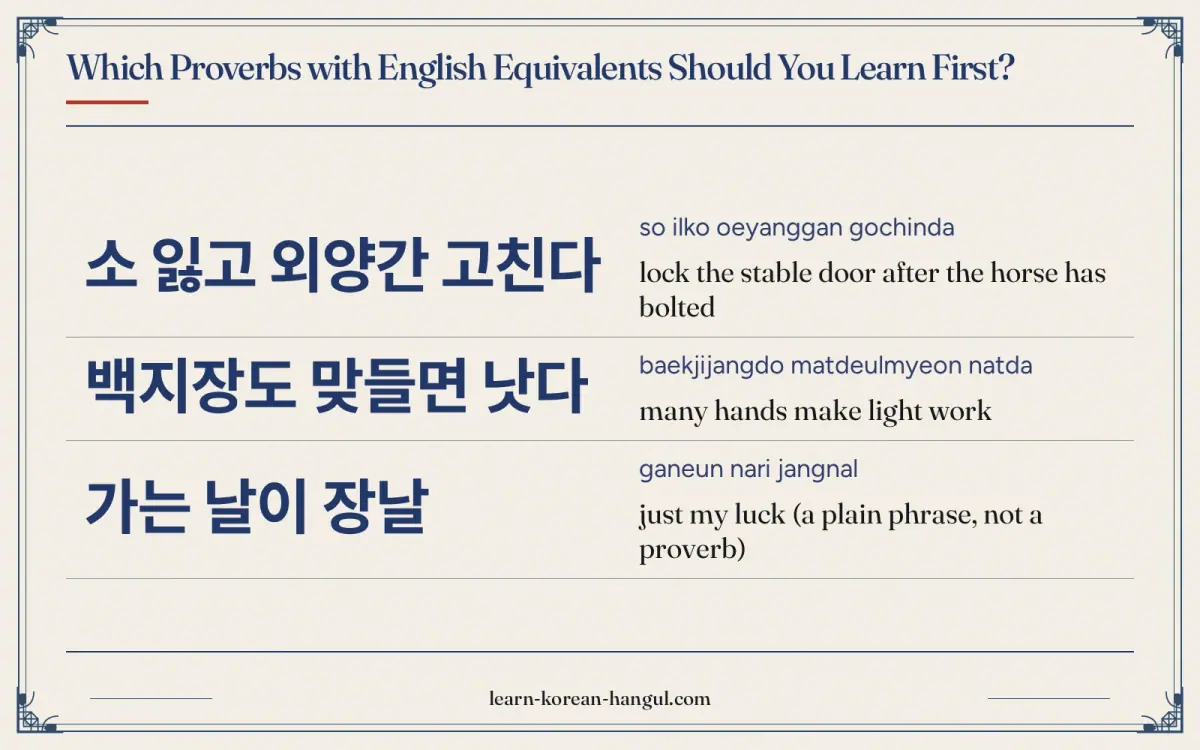
Start with the proverbs that have a close English twin, because you already know the idea. Then learn the ones that do not, because they teach you something new about Korean life.
- Learn first (very close). 뿌린 대로 거둔다, 시간이 약이다, 엎질러진 물, 지렁이도 밟으면 꿈틀한다, 마른하늘에 날벼락.
- Learn next (close). 백지장도 맞들면 낫다, 사공이 많으면 배가 산으로 간다, 서울 가서 김 서방 찾기, 티끌 모아 태산.
- Learn for fun (loose or none). 가는 날이 장날, 하늘이 무너져도 솟아날 구멍이 있다, 같은 값이면 다홍치마, 공짜라면 양잿물도 마신다.
The scene below is a market street with a farmhouse, a cowshed, a boat, a road and a rain cloud. Ten numbered objects match ten proverbs. Tap a number to hear the proverb.
Word · 10
- 1
소 잃고 외양간 고친다
so ilko oeyanggan gochinda
lock the stable door after the horse has bolted
- 2
백지장도 맞들면 낫다
baekjijangdo matdeulmyeon natda
many hands make light work
- 3
하늘이 무너져도 솟아날 구멍이 있다
haneuri muneojyeodo sosanal gumeongi itda
where there is a will there is a way (loosely; there is no neat match)
- 4
가는 날이 장날
ganeun nari jangnal
just my luck (a plain phrase, not a proverb)
- 5
사공이 많으면 배가 산으로 간다
sagongi maneumyeon baega saneuro ganda
too many cooks spoil the broth
- 6
뿌린 대로 거둔다
ppurin daero geodunda
you reap what you sow
- 7
마른하늘에 날벼락
mareunhaneure nalbyeorak
a bolt from the blue
- 8
쥐구멍에도 볕 들 날 있다
jwigumeongedo byeot deul nal itda
every dog has its day
- 9
티끌 모아 태산
tikkeul moa taesan
many a little makes a mickle
- 10
우는 아이 젖 준다
uneun ai jeot junda
the squeaky wheel gets the grease
Same Idea, Different Image
The best Korean proverbs to learn first are the ones with an English twin. The idea is the same, but the picture comes from a different world. English has a stable and a horse where Korean has a cowshed and a cow. English has cooks where Korean has boatmen. Seeing the two pictures side by side makes both easier to remember.
| No. | Hangul | Revised Romanization | Literally | Meaning and closest English saying | Example sentence | Audio assetId |
|---|---|---|---|---|---|---|
| 1 | 소 잃고 외양간 고친다 | so ilko oeyanggan gochinda [소 일코 외양간 고친다] | fixing the cowshed after losing the cow | Acting too late, after the damage is done. English: lock the stable door after the horse has bolted. Match: very close. | 시험이 끝난 뒤에 공부 계획을 세우는 건 소 잃고 외양간 고치는 거예요. (Making a study plan after the exam is over is locking the stable door after the horse has gone.) | au-pg-vocabulary-word-types-proverbs-english-equivalents-1; example: au-pg-vocabulary-word-types-proverbs-english-equivalents-31 |
| 2 | 사공이 많으면 배가 산으로 간다 | sagongi maneumyeon baega saneuro ganda [사공이 마느면 배가 사느로 간다] | with many boatmen the boat goes up the mountain | Too many people in charge ruin a plan. 사공 is a boatman. English: too many cooks spoil the broth. Match: close. | 사공이 많으면 배가 산으로 간다고 하니까 담당자를 한 명만 정해요. (They say too many boatmen send the boat up the mountain, so let us choose just one person in charge.) | au-pg-vocabulary-word-types-proverbs-english-equivalents-2; example: au-pg-vocabulary-word-types-proverbs-english-equivalents-32 |
| 3 | 서울 가서 김 서방 찾기 | seoul gaseo gim seobang chatgi [서울 가서 김 서방 찯끼] | going to Seoul to look for Mr Kim | A hopeless search with too little information. 김 is a very common surname and 서방 is an old word for a man. English: looking for a needle in a haystack. Match: close. | 이름만 알고 주소를 모르면 서울 가서 김 서방 찾기예요. (If you know only the name and not the address, it is a needle in a haystack.) | au-pg-vocabulary-word-types-proverbs-english-equivalents-3; example: au-pg-vocabulary-word-types-proverbs-english-equivalents-33 |
| 4 | 도토리 키 재기 | dotori ki jaegi | measuring the height of acorns | Comparing things that are all about the same. English: six of one and half a dozen of the other. Match: close. | 두 후보의 실력은 도토리 키 재기예요. (The two candidates are about as good as each other.) | au-pg-vocabulary-word-types-proverbs-english-equivalents-4; example: au-pg-vocabulary-word-types-proverbs-english-equivalents-34 |
| 5 | 공자 앞에서 문자 쓴다 | gongja apeseo munja sseunda [공자 아페서 문짜 쓴다] | writing Chinese characters in front of Confucius | Showing off in front of the real expert. 공자 is Confucius and 문자 means written characters. English: teach your grandmother to suck eggs. Match: close. | 한국어 선생님 앞에서 아는 척하면 공자 앞에서 문자 쓰는 거예요. (Acting as if you know it in front of the Korean teacher is teaching your grandmother to suck eggs.) | au-pg-vocabulary-word-types-proverbs-english-equivalents-5; example: au-pg-vocabulary-word-types-proverbs-english-equivalents-35 |
| 6 | 백지장도 맞들면 낫다 | baekjijangdo matdeulmyeon natda [백찌장도 맏뜰면 낟따] | even a sheet of paper is easier lifted together | Even a light job is easier with help. 백지장 is a sheet of white paper. English: many hands make light work. Match: close. | 백지장도 맞들면 낫다고 하니까 같이 청소하면 금방 끝나요. (They say even a sheet of paper is easier lifted together, so if we clean together it will be done quickly.) | au-pg-vocabulary-word-types-proverbs-english-equivalents-6; example: au-pg-vocabulary-word-types-proverbs-english-equivalents-36 |
Example Sentences
Treat the Korean proverb and its English twin as a pair. First say the Korean saying, then the English one, and check that your listener knows the English. Three patterns cover almost every row. First, a noun-phrase proverb with 이에요 or 예요: 이미 엎질러진 물이에요, 마른하늘에 날벼락이에요. Second, a quoted saying with 라고 하니까: 사공이 많으면 배가 산으로 간다고 하니까 담당자를 한 명만 정해요. Third, an example with 거예요: 소 잃고 외양간 고치는 거예요. Play each sentence, repeat it, then swap in a new situation.
시험이 끝난 뒤에 공부 계획을 세우는 건 소 잃고 외양간 고치는 거예요.
siheomi kkeunnan dwie gongbu gyehoegeul seuneun geon so ilko oeyanggan gochineun geoyeyo.
Making a study plan after the exam is over is locking the stable door after the horse has gone.
지금은 슬프겠지만 시간이 약이에요.
jigeumeun seulpeugetjiman sigani yagieyo.
You must be sad now, but time is the best medicine.
식당에 갔는데 쉬는 날이었어요. 가는 날이 장날이네요.
sikdange ganneunde swineun narieosseoyo. ganeun nari jangnarineyo.
I went to the restaurant and it was closed. Just my luck.
How Do You Say Close Matches in Korean?
These six are the nearest to their English counterparts, with almost the same picture as well as the same idea. If you know the English saying, you can often guess the Korean one. They are the safest ones to translate, but still learn the Korean form exactly as it is.
| No. | Hangul | Revised Romanization | Literally | Meaning and closest English saying | Example sentence | Audio assetId |
|---|---|---|---|---|---|---|
| 7 | 뿌린 대로 거둔다 | ppurin daero geodunda | you harvest what you sowed | You get back what you put in, good or bad. English: you reap what you sow. Match: very close. | 뿌린 대로 거둔다고 하니까 지금 열심히 준비해야 해요. (They say you reap what you sow, so you need to prepare hard now.) | au-pg-vocabulary-word-types-proverbs-english-equivalents-7; example: au-pg-vocabulary-word-types-proverbs-english-equivalents-37 |
| 8 | 시간이 약이다 | sigani yagida [시가니 야기다] | time is medicine | Time eases pain and sadness. Often said to comfort someone. English: time heals all wounds. Match: very close. | 지금은 슬프겠지만 시간이 약이에요. (You must be sad now, but time is the best medicine.) | au-pg-vocabulary-word-types-proverbs-english-equivalents-8; example: au-pg-vocabulary-word-types-proverbs-english-equivalents-38 |
| 9 | 엎질러진 물 | eopjilleojin mul [업찔러진 물] | spilled water | Something done cannot be undone. Often said as 이미 엎질러진 물이다. English: no use crying over spilt milk. Match: very close. | 이미 엎질러진 물이니까 다음에 잘하면 돼요. (It is spilled water already, so just do better next time.) | au-pg-vocabulary-word-types-proverbs-english-equivalents-9; example: au-pg-vocabulary-word-types-proverbs-english-equivalents-39 |
| 10 | 지렁이도 밟으면 꿈틀한다 | jireongido balbeumyeon kkumteulhanda [지렁이도 발브면 꿈틀한다] | even an earthworm wriggles when stepped on | Even a patient person fights back if pushed too far. English: the worm will turn. Match: very close. | 지렁이도 밟으면 꿈틀한다고 하니까 너무 무시하지 마세요. (They say even a worm wriggles when stepped on, so do not look down on people too much.) | au-pg-vocabulary-word-types-proverbs-english-equivalents-10; example: au-pg-vocabulary-word-types-proverbs-english-equivalents-40 |
| 11 | 낙숫물이 댓돌을 뚫는다 | naksunmuri daetdoreul ttulleunda [낙쑨무리 댇또를 뚤른다] | dripping water pierces the stone step | Steady small effort can break through anything. 낙숫물 is water dripping from the eaves and 댓돌 is the stone slab under them. English: constant dripping wears away the stone. Match: very close. | 낙숫물이 댓돌을 뚫는다고 하니까 꾸준히 연습해요. (They say dripping water pierces the stone step, so I practise steadily.) | au-pg-vocabulary-word-types-proverbs-english-equivalents-11; example: au-pg-vocabulary-word-types-proverbs-english-equivalents-41 |
| 12 | 마른하늘에 날벼락 | mareunhaneure nalbyeorak [마른하느레 날벼락] | a thunderbolt from a dry sky | Sudden bad news from nowhere. 마른하늘 is a dry, cloudless sky. English: a bolt from the blue. Match: very close. | 갑자기 해고 소식을 들었어요. 마른하늘에 날벼락이에요. (I suddenly heard I was being laid off. It is a bolt from the blue.) | au-pg-vocabulary-word-types-proverbs-english-equivalents-12; example: au-pg-vocabulary-word-types-proverbs-english-equivalents-42 |
No English Match
These six have no neat English twin. The English in the tables is only the nearest idea, and a few have no set English proverb at all. They are often the most fun to learn, because they show Korean life: market days, local magistrates, mustard and skirts. Say them to Korean friends and see what they think.
| No. | Hangul | Revised Romanization | Literally | Meaning and closest English saying | Example sentence | Audio assetId |
|---|---|---|---|---|---|---|
| 13 | 하늘이 무너져도 솟아날 구멍이 있다 | haneuri muneojyeodo sosanal gumeongi itda [하느리 무너저도 소사날 꾸멍이 읻따] | even if the sky collapses there is a hole to rise through | There is always a way out of even the worst trouble. English: where there is a will there is a way (loosely; there is no neat match). Match: loose. | 하늘이 무너져도 솟아날 구멍이 있다고 하니까 힘내세요. (They say that even if the sky falls there is a way out, so cheer up.) | au-pg-vocabulary-word-types-proverbs-english-equivalents-13; example: au-pg-vocabulary-word-types-proverbs-english-equivalents-43 |
| 14 | 가는 날이 장날 | ganeun nari jangnal [가는 나리 장날] | the day I go is market day | You arrive on an unlucky day or meet an odd coincidence. 장날 is market day. It is usually bad luck, but can also be a happy surprise. English: just my luck (a plain phrase, not a proverb). Match: loose. | 식당에 갔는데 쉬는 날이었어요. 가는 날이 장날이네요. (I went to the restaurant and it was closed. Just my luck.) | au-pg-vocabulary-word-types-proverbs-english-equivalents-14; example: au-pg-vocabulary-word-types-proverbs-english-equivalents-44 |
| 15 | 원님 덕에 나팔 분다 | wonnim deoge napal bunda [원님 더게 나팔 분다] | blowing the trumpet thanks to the magistrate | Getting a perk because of someone else's rank. 원님 is an old word for a local magistrate. English: to ride on someone's coattails. Match: loose. | 친구 덕에 비싼 식당에서 먹었어요. 원님 덕에 나팔 분 거죠. (Thanks to my friend I ate at an expensive restaurant. I rode on his coattails.) | au-pg-vocabulary-word-types-proverbs-english-equivalents-15; example: au-pg-vocabulary-word-types-proverbs-english-equivalents-45 |
| 16 | 울며 겨자 먹기 | ulmyeo gyeoja meokgi [울며 겨자 먹끼] | eating mustard while crying | Doing something you do not want to do because you have no choice. English: to bite the bullet. Match: loose. | 하기 싫었지만 울며 겨자 먹기로 야근했어요. (I did not want to, but I had no choice and worked overtime.) | au-pg-vocabulary-word-types-proverbs-english-equivalents-16; example: au-pg-vocabulary-word-types-proverbs-english-equivalents-46 |
| 17 | 같은 값이면 다홍치마 | gateun gapsimyeon dahongchima [가튼 갑씨면 다홍치마] | if the price is the same, take the deep-red skirt | If everything else is equal, choose the nicer one. 다홍치마 is a deep-red skirt. English: no set English proverb; plain English is "other things being equal, pick the better one". Match: none. | 같은 값이면 다홍치마라고 디자인이 더 예쁜 옷을 골랐어요. (Since the price was the same, I chose the prettier design.) | au-pg-vocabulary-word-types-proverbs-english-equivalents-17; example: au-pg-vocabulary-word-types-proverbs-english-equivalents-47 |
| 18 | 믿는 도끼에 발등 찍힌다 | minneun dokkie baldeung jjikinda [민는 도끼에 발뜽 찌킨다] | the axe you trust chops your instep | Being hurt by someone you trusted. English: no set English proverb; plain English is "stabbed in the back by a friend". Match: loose. | 믿는 도끼에 발등 찍힌다고 오랜 친구에게 배신당했어요. (As the saying goes, I was betrayed by an old friend I trusted.) | au-pg-vocabulary-word-types-proverbs-english-equivalents-18; example: au-pg-vocabulary-word-types-proverbs-english-equivalents-48 |
How Do You Say Proverbs about Weather and Nature in Korean?
Weather and nature give Korean its images of patience and change. Rain, mountains, mice, birds and whales are the pictures here. People in farming communities watched the sky and the ground closely, and the proverbs reflect that. Three of the six also have English twins: 낮말은 새가 듣고 밤말은 쥐가 듣는다 matches "walls have ears", 고래 싸움에 새우 등 터진다 matches "when elephants fight, the grass suffers", and 쥐구멍에도 볕 들 날 있다 matches "every dog has its day".
| No. | Hangul | Revised Romanization | Literally | Meaning and closest English saying | Example sentence | Audio assetId |
|---|---|---|---|---|---|---|
| 19 | 가랑비에 옷 젖는 줄 모른다 | garangbie ot jeonneun jul moreunda [가랑비에 옫 전는 줄 모른다] | you do not notice your clothes getting wet in a drizzle | Small amounts add up before you notice. 가랑비 is light drizzle. English: a small leak will sink a great ship (loosely). Match: loose. | 커피값도 가랑비에 옷 젖는 줄 모른다고 한 달이면 큰돈이에요. (Even coffee money adds up before you notice; in a month it is a lot.) | au-pg-vocabulary-word-types-proverbs-english-equivalents-19; example: au-pg-vocabulary-word-types-proverbs-english-equivalents-49 |
| 20 | 비 온 뒤에 땅이 굳는다 | bi on dwie ttangi gunneunda [비 온 뒤에 땅이 군는다] | the ground hardens after rain | Hardship makes people stronger. English: what does not kill you makes you stronger (loosely). Match: loose. | 비 온 뒤에 땅이 굳는다고 이번 실패가 힘이 될 거예요. (They say the ground hardens after rain, and this failure will make you stronger.) | au-pg-vocabulary-word-types-proverbs-english-equivalents-20; example: au-pg-vocabulary-word-types-proverbs-english-equivalents-50 |
| 21 | 쥐구멍에도 볕 들 날 있다 | jwigumeongedo byeot deul nal itda [쥐구멍에도 볃 들 날 읻따] | even a mouse hole gets sunshine someday | Even the unlucky have a good day eventually. 볕 is sunshine. English: every dog has its day. Match: close. | 지금은 힘들어도 쥐구멍에도 볕 들 날 있다고 하니까 기다려 보세요. (It is hard now, but they say even a mouse hole sees the sun, so please wait.) | au-pg-vocabulary-word-types-proverbs-english-equivalents-21; example: au-pg-vocabulary-word-types-proverbs-english-equivalents-51 |
| 22 | 산이 높아야 골이 깊다 | sani nopaya gori gipda [사니 노파야 고리 깁따] | the higher the mountain, the deeper the valley | Great achievements need a deep foundation. 골 is a valley. English: no set English proverb; plain English is "great things need a solid base". Match: none. | 산이 높아야 골이 깊다고 큰 꿈에는 큰 준비가 필요해요. (The higher the mountain, the deeper the valley; a big dream needs big preparation.) | au-pg-vocabulary-word-types-proverbs-english-equivalents-22; example: au-pg-vocabulary-word-types-proverbs-english-equivalents-52 |
| 23 | 낮말은 새가 듣고 밤말은 쥐가 듣는다 | nanmareun saega deutgo bammareun jwiga deunneunda [난마른 새가 듣꼬 밤마른 쥐가 든는다] | birds hear daytime talk and mice hear night talk | Someone is always listening, so be careful what you say. English: walls have ears. Match: close. | 낮말은 새가 듣고 밤말은 쥐가 듣는다고 하니까 회사에서 비밀 이야기는 조심하세요. (They say birds hear day talk and mice hear night talk, so be careful with secrets at work.) | au-pg-vocabulary-word-types-proverbs-english-equivalents-23; example: au-pg-vocabulary-word-types-proverbs-english-equivalents-53 |
| 24 | 고래 싸움에 새우 등 터진다 | gorae ssaume saeu deung teojinda [고래 싸우메 새우 등 터진다] | when whales fight, the shrimp's back bursts | The weak get hurt when the powerful fight. English: when elephants fight, it is the grass that suffers. Match: close. | 큰 회사끼리 싸우면 고래 싸움에 새우 등 터진다고 작은 가게가 피해를 봐요. (When big companies fight, small shops suffer, as the whale and shrimp saying goes.) | au-pg-vocabulary-word-types-proverbs-english-equivalents-24; example: au-pg-vocabulary-word-types-proverbs-english-equivalents-54 |
Proverbs about Money and Work
Money and work make up the last six. They are practical, a little cynical and often funny. Learners like them because they come up in office talk, in the news and at the family table. Use them about things and situations, not to put a person down.
| No. | Hangul | Revised Romanization | Literally | Meaning and closest English saying | Example sentence | Audio assetId |
|---|---|---|---|---|---|---|
| 25 | 티끌 모아 태산 | tikkeul moa taesan | gathering dust makes a great mountain | Small savings or efforts add up to something big. 태산 is a great mountain. English: many a little makes a mickle. Match: close. | 티끌 모아 태산이라고 매달 오만 원씩 저금해요. (A little at a time adds up, so I save fifty thousand won a month.) | au-pg-vocabulary-word-types-proverbs-english-equivalents-25; example: au-pg-vocabulary-word-types-proverbs-english-equivalents-55 |
| 26 | 바늘 도둑이 소 도둑 된다 | baneul dodugi so doduk doenda [바늘 도두기 소 도둑 된다] | a needle thief becomes a cow thief | A small wrong grows into a big one if it is not stopped. English: he that will steal a pin will steal a pound. Match: close. | 바늘 도둑이 소 도둑 된다고 작은 거짓말도 조심하세요. (A needle thief becomes a cow thief, so be careful even with small lies.) | au-pg-vocabulary-word-types-proverbs-english-equivalents-26; example: au-pg-vocabulary-word-types-proverbs-english-equivalents-56 |
| 27 | 목구멍이 포도청 | mokgumeongi podocheong [목꾸멍이 포도청] | the throat is the police station | The need to eat forces people to do things they would rather not. 포도청 was a police office in the Joseon period. English: necessity knows no law (loosely). Match: loose. | 목구멍이 포도청이라서 싫어도 일해야 해요. (The need to eat comes first, so I have to work even when I do not like it.) | au-pg-vocabulary-word-types-proverbs-english-equivalents-27; example: au-pg-vocabulary-word-types-proverbs-english-equivalents-57 |
| 28 | 서툰 무당이 장구만 나무란다 | seotun mudangi jangguman namuranda | a clumsy shaman blames only the drum | A poor worker blames the tools. 무당 is a shaman and 장구 is an hourglass drum. English: a bad workman blames his tools. Match: close. | 서툰 무당이 장구만 나무란다고 도구 탓은 하지 마세요. (A clumsy shaman blames the drum, so do not blame your tools.) | au-pg-vocabulary-word-types-proverbs-english-equivalents-28; example: au-pg-vocabulary-word-types-proverbs-english-equivalents-58 |
| 29 | 공짜라면 양잿물도 마신다 | gongjjaramyeon yangjaenmuldo masinda [공짜라면 양잰물도 마신다] | if it is free, people will even drink lye | People cannot resist a freebie. 양잿물 is lye, a harsh cleaning chemical. English: no set English proverb; plain English is "everyone loves a freebie". Match: none. | 공짜라면 양잿물도 마신다고 무료 샘플은 금방 없어져요. (Free samples vanish quickly, since people will take anything that is free.) | au-pg-vocabulary-word-types-proverbs-english-equivalents-29; example: au-pg-vocabulary-word-types-proverbs-english-equivalents-59 |
| 30 | 우는 아이 젖 준다 | uneun ai jeot junda [우는 아이 젇 준다] | the crying baby gets milk | You get what you want by asking for it. English: the squeaky wheel gets the grease. Match: close. | 우는 아이 젖 준다고 필요하면 먼저 말해야 해요. (The crying baby gets milk, so if you need something, say so first.) | au-pg-vocabulary-word-types-proverbs-english-equivalents-30; example: au-pg-vocabulary-word-types-proverbs-english-equivalents-60 |
How Do You Pronounce These Words?
Long proverbs are full of double consonants, linking and tensing. The hardest sounds on this page come from words with a 사이시옷 (a linking ㅅ), such as 낙숫물 and 댓돌, and from clusters such as 값 and 엎. Standard pronunciation follows the National Institute of Korean Language (국립국어원) rules, and the romanization follows the Revised Romanization of Korean, which does not write tensing caused by a neighbouring sound.
| Spelling | Sounds like | What changes |
|---|---|---|
| 엎질러진 | [업찔러진] | The final ㅍ is said [ㅂ], and ㅈ after it becomes tense. The double ㄹ is a long [ㄹ]. |
| 낙숫물이 | [낙쑨무리] | After the final ㄱ, ㅅ becomes tense. The linking ㅅ is said [ㄷ] and then [ㄴ] before ㅁ. |
| 댓돌을 | [댇또를] | The linking ㅅ is said [ㄷ], and the ㄷ after it becomes tense. |
| 뚫는다 | [뚤른다] | ㅎ is silent, and ㄴ after ㄹ becomes [ㄹ]. |
| 값이면 | [갑씨면] | ㅅ of the cluster ㅄ moves to the next syllable and is said tense [ㅆ]. |
| 젖는 | [전는] | ㅈ is said [ㄷ] as a final sound and then [ㄴ] before ㄴ. |
| 양잿물도 | [양잰물도] | The linking ㅅ is said [ㄷ] and then [ㄴ] before ㅁ. |
Break long proverbs at the natural pause, as in 사공이 많으면 / 배가 산으로 간다. Stress the key word in each half and let the rest fall away.
Audio and Slow Playback
Each word and sentence has its own clip. The clips below replay the five longest or trickiest proverbs at a slower pace. Play one, repeat it, then play it again and compare.
What Mistakes Do Learners Make with Proverbs with English Equivalents?
Five mistakes come up often.
- Treating the English twin as exact. Even a very close match can differ in tone. 백지장도 맞들면 낫다 is about help with a light job, and 'many hands make light work' is about sharing a big one.
- Saying the Korean picture in English. An English speaker who hears 'fixing the cowshed after losing the cow' may not know what you mean. Use the English twin when you speak English.
- Using 가는 날이 장날 for any bad luck. It is about timing: you arrive just when something is unexpected, such as a closed shop. It is not for illness or accidents.
- Swapping the animals. Say 낮말은 새가 듣고 밤말은 쥐가 듣는다 (birds hear the day, mice hear the night). Saying it the other way round changes the saying.
- Forgetting to quote. In a sentence, say 사공이 많으면 배가 산으로 간다고 해요. The plain form on its own sounds as if you were reading a poster aloud.
The first mistake is the most common. The English match is a guide to the idea, not a translation.
Practice: Flashcards and Worksheet
Run the deck in recognition mode until each proverb matches its English twin, then switch to listening mode and take the quiz. The deck holds all 30 words with audio, and your progress stays in your browser. The vocabulary flashcard decks page lists the other decks, including the Korean proverbs flashcards.
Practice · 3
- 01시험이 끝난 뒤에 공부 계획을 세우는 건 소 잃고 외양간 고치는 거예요.
Show answer
siheomi kkeunnan dwie gongbu gyehoegeul seuneun geon so ilko oeyanggan gochineun geoyeyo.
Making a study plan after the exam is over is locking the stable door after the horse has gone.
- 02지금은 슬프겠지만 시간이 약이에요.
Show answer
jigeumeun seulpeugetjiman sigani yagieyo.
You must be sad now, but time is the best medicine.
- 03식당에 갔는데 쉬는 날이었어요. 가는 날이 장날이네요.
Show answer
sikdange ganneunde swineun narieosseoyo. ganeun nari jangnarineyo.
I went to the restaurant and it was closed. Just my luck.
Practice · 5
What does 소 잃고 외양간 고친다 (so ilko oeyanggan gochinda) mean?
Show answer
acting too late, after the damage is done
소 잃고 외양간 고친다 is fixing the cowshed after losing the cow. English: lock the stable door after the horse has bolted.
Which Korean proverb matches "many hands make light work"?
Show answer
백지장도 맞들면 낫다
백지장도 맞들면 낫다: even a sheet of paper is easier lifted together.
Which proverb means "you reap what you sow"?
Show answer
뿌린 대로 거둔다
뿌린 대로 거둔다 is you harvest what you sowed. It is almost the same picture as the English proverb.
What does 가는 날이 장날 (ganeun nari jangnal) describe?
Show answer
an unlucky coincidence on the day you go
가는 날이 장날 is "the day I go is market day": an unlucky coincidence. English has no set proverb, but "just my luck" fits.
Which proverb says "the squeaky wheel gets the grease"?
Show answer
우는 아이 젖 준다
우는 아이 젖 준다: the crying baby gets milk. You get what you want by asking.
Korean Proverbs and English Equivalents Worksheet (PDF)
A printable worksheet for these words (word list, matching, writing practice, fill-in-the-blank exercises and answer key) is available in A4 and US Letter from the download card on this page. For practice, copy five proverbs from the tables, cover the English column and write the English twin from memory.
Where to Go Next
Read the thirty most-quoted sayings in Famous Korean Proverbs With Meanings. To go up, return to Korean Proverbs. For sayings built from four Chinese characters, see the four-character idioms lessons.
Frequently Asked Questions
How Do You Say Lock the Stable after the Horse Is Gone in Korean?
The Korean proverb is 소 잃고 외양간 고친다 (so ilko oeyanggan gochinda), literally 'fixing the cowshed after losing the cow'. The idea matches the English proverb, and the picture is almost the same. Say 이미 소 잃고 외양간 고치는 거예요 for 'It is too late now'.
How Do You Pronounce 백지장도 맞들면 낫다 (baekjijangdo matdeulmyeon natda)?
Say it as [백찌장도 맏뜰면 낟따]. After the final ㄱ of 백, ㅈ becomes tense. In 맞들면 the final ㅈ is said [ㄷ] and the ㄷ that follows becomes tense. In 낫다 the final ㅅ is said [ㄷ], and again the next ㄷ becomes tense.
How Many Proverbs with English Equivalents Should I Learn First?
Start with the seven very close pairs: 소 잃고 외양간 고친다, 뿌린 대로 거둔다, 시간이 약이다, 엎질러진 물, 지렁이도 밟으면 꿈틀한다, 낙숫물이 댓돌을 뚫는다 and 마른하늘에 날벼락. You already know the idea, so only the Korean words are new.
Where Can I Practise Proverbs with English Equivalents with Flashcards?
The deck on this page holds all 30 words with audio. Use recognition mode first, then listening mode. The Korean proverbs flashcards deck and other decks are on the vocabulary flashcard decks page.
Is the Romanization on This Page Official?
It follows the Revised Romanization of Korean, which South Korea adopted on 7 July 2000 and whose rules the National Institute of Korean Language (국립국어원) publishes. It is a learning aid and does not mark every sound change, so rely on the Hangul and the audio.
Is There a Printable Worksheet for Proverbs with English Equivalents?
A printable worksheet for these words (word list, matching, writing practice, fill-in-the-blank exercises and answer key) is available in A4 and US Letter from the download card on this page. For additional practice, you can copy the tables onto paper and cover the English column to test yourself.