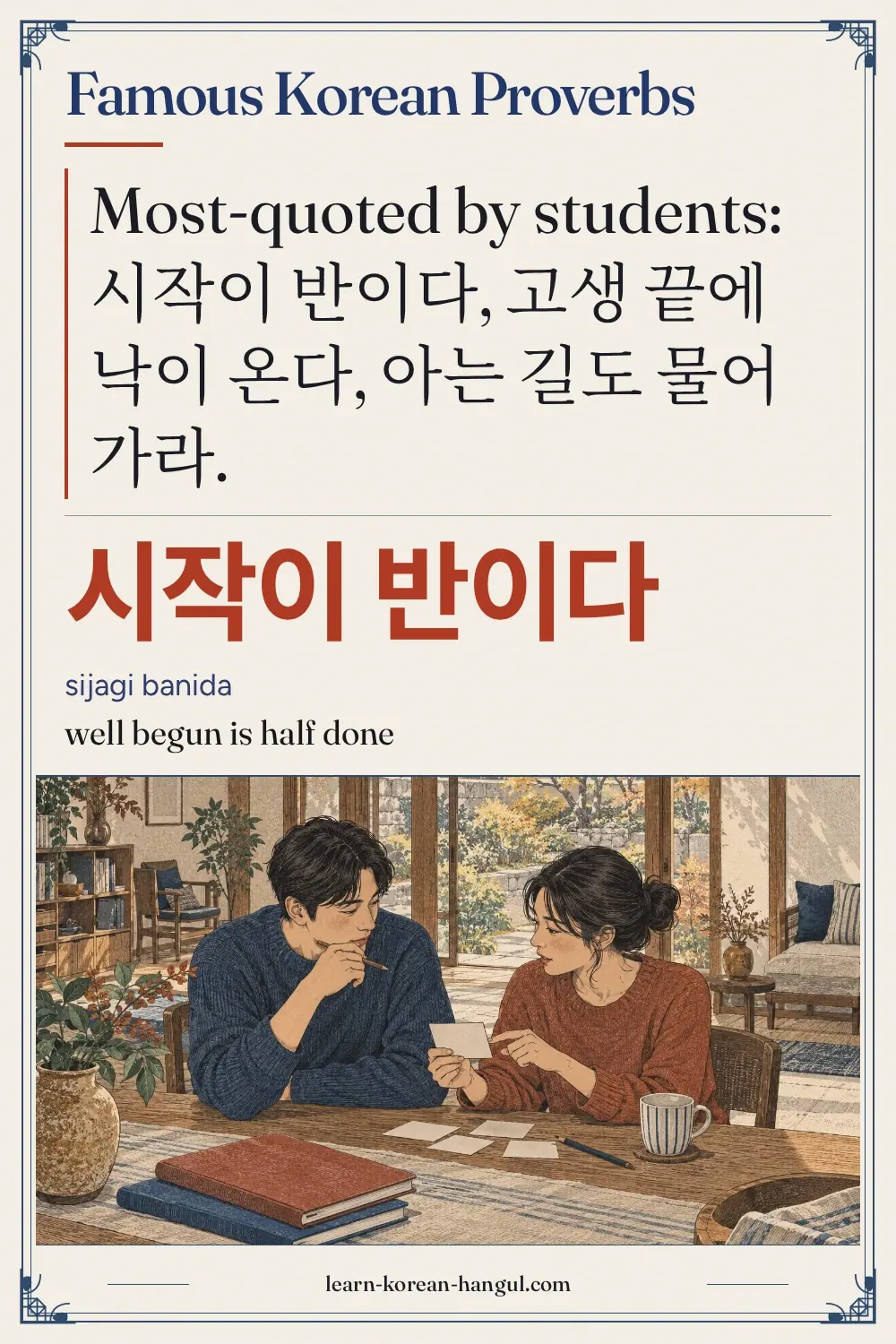
Famous Korean Proverbs at a Glance
A proverb is a short saying that gives advice. In Korean it is called 속담 (sokdam). Famous Korean proverbs mostly come from farm life, wells, tigers and old markets, so each has a picture you can see. Once you know the picture, the lesson is easy to guess. The thirty on this page are well known across ages. Many are quoted in school, on posters, in dramas and by parents. A few borrow Chinese characters, such as 백문이 불여일견 (百聞不如一見), which is also a four-character idiom.
| Group | Words | What it covers |
|---|---|---|
| Proverbs about starting and trying | 6 | First steps, caution, persistence and hard-to-get things |
| Proverbs about patience and time | 6 | Hardship, hurry, change, anger and small problems |
| Proverbs about words and manners | 6 | Kind words, rumours, long talk and leaders |
| Proverbs about learning | 6 | Knowledge, quick learners, early talent and shortcuts |
| Proverbs about friends and family | 6 | Friends, neighbours, couples, parents and children |
The page belongs to Korean Proverbs, which teaches 40 sayings in all. If you want to compare Korean sayings with English ones, see Korean Proverbs and English Equivalents. For the four-character form, see the four-character idioms lessons.
Which Famous Korean Proverbs Should You Learn First?
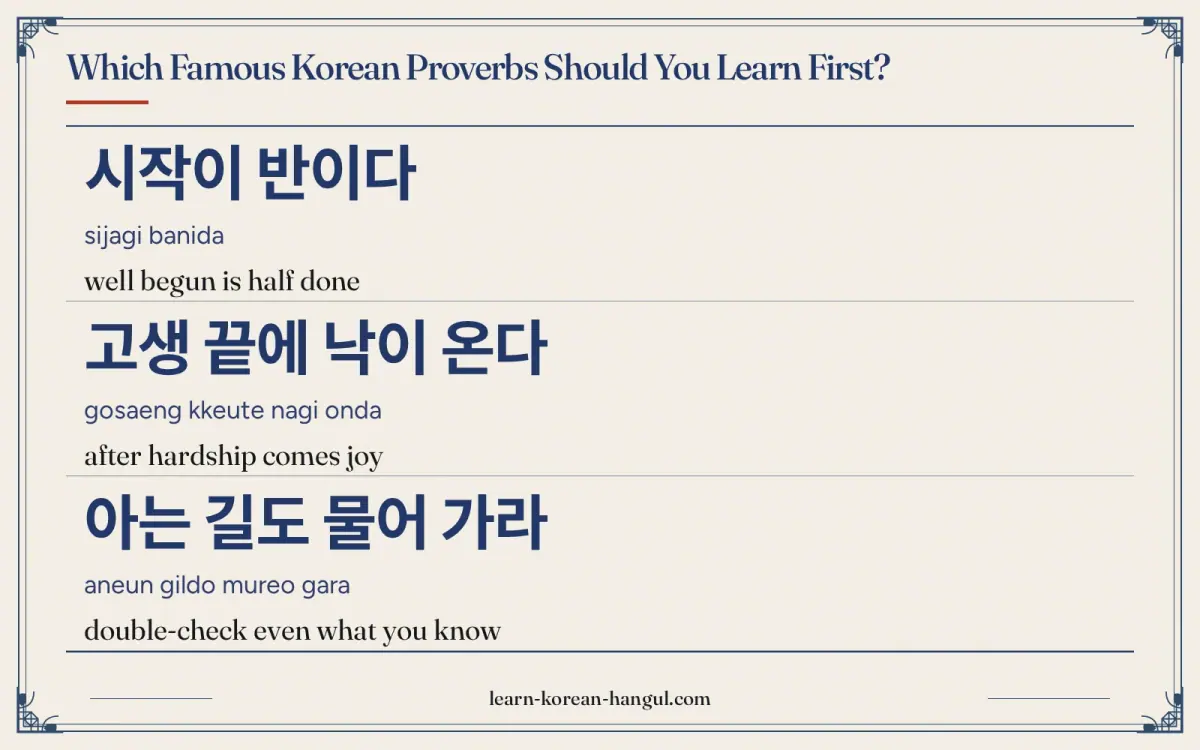
Learn the proverbs that you will hear before the ones you will read. The ones students quote most often make the best start, because teachers, parents and friends say them at exam time, on birthdays and when plans go wrong.
- Say first. 시작이 반이다, 고생 끝에 낙이 온다, 아는 길도 물어 가라, 하늘의 별 따기, 아는 것이 힘이다.
- Use often. 천 리 길도 한 걸음부터, 가는 말이 고와야 오는 말이 곱다, 친구 따라 강남 간다, 급할수록 돌아가라, 돌다리도 두들겨 보고 건너라.
- Recognise first, mostly in books. 될성부른 나무는 떡잎부터 알아본다, 호미로 막을 것을 가래로 막는다, 혀 아래 도끼 들었다, 참을 인 자 셋이면 살인도 피한다.
The scene below is a village road with a well, a bridge, a market and a house. Ten numbered objects match ten famous proverbs. Tap a number to hear the proverb.
Word · 10
- 1
시작이 반이다
sijagi banida
well begun is half done
- 2
고생 끝에 낙이 온다
gosaeng kkeute nagi onda
after hardship comes joy
- 3
아는 길도 물어 가라
aneun gildo mureo gara
double-check even what you know
- 4
하늘의 별 따기
haneurui byeol ttagi
next to impossible
- 5
돌다리도 두들겨 보고 건너라
doldarido dudeulgyeo bogo geonneora
look before you leap
- 6
우물에 가서 숭늉 찾는다
umure gaseo sungnyung channeunda
too impatient; expecting instant results
- 7
가는 말이 고와야 오는 말이 곱다
ganeun mari gowaya oneun mari gopda
treat others kindly and they will treat you kindly
- 8
아는 것이 힘이다
aneun geosi himida
knowledge is power
- 9
친구 따라 강남 간다
chingu ttara gangnam ganda
going along with a friend
- 10
열 손가락 깨물어 안 아픈 손가락 없다
yeol songarak kkaemureo an apeun songarak eopda
parents love every child
Proverbs about Starting and Trying
Proverbs about starting and trying are the most quoted ones among students. They say that the first step counts (시작이 반이다), that you should be careful (돌다리도 두들겨 보고 건너라) and that effort pays off (열 번 찍어 안 넘어가는 나무 없다). People often say them before exams, on the first day of a project or when a friend is about to give up.
| No. | Hangul | Revised Romanization | Literally | Meaning and note | Example sentence | Audio assetId |
|---|---|---|---|---|---|---|
| 1 | 시작이 반이다 | sijagi banida [시자기 바니다] | the start is half | well begun is half done. Heard daily. Said to encourage someone who has just taken the first step. | 오늘 한 페이지라도 읽었으면 시작이 반이에요. (If you read even one page today, well begun is half done.) | au-pg-vocabulary-word-types-proverbs-famous-1; example: au-pg-vocabulary-word-types-proverbs-famous-31 |
| 2 | 천 리 길도 한 걸음부터 | cheon ri gildo han georeumbuteo [철리 길도 한 거름부터] | even a thousand-ri road starts with one step | a journey of a thousand miles begins with one step. Common. 리 is an old Korean unit of distance, so 천 리 just means a very long way. | 천 리 길도 한 걸음부터라고 생각하고 하루에 열 단어씩 외워요. (I think of a thousand-mile road as one step at a time, so I memorise ten words a day.) | au-pg-vocabulary-word-types-proverbs-famous-2; example: au-pg-vocabulary-word-types-proverbs-famous-32 |
| 3 | 돌다리도 두들겨 보고 건너라 | doldarido dudeulgyeo bogo geonneora | cross even a stone bridge only after tapping it | be careful even when things look safe. Common. Said to someone about to act in a hurry. | 계약서는 돌다리도 두들겨 보고 건너라고 하니까 한 번 더 읽어 보세요. (They say to tap even a stone bridge before crossing, so please read the contract once more.) | au-pg-vocabulary-word-types-proverbs-famous-3; example: au-pg-vocabulary-word-types-proverbs-famous-33 |
| 4 | 아는 길도 물어 가라 | aneun gildo mureo gara [아는 길도 무러 가라] | ask even on a road you know | double-check even what you think you know. Common. A parent or teacher says it before an exam or a trip. | 아는 길도 물어 가라고 하니까 지도를 한 번 더 확인해요. (They say to ask even on a road you know, so I check the map once more.) | au-pg-vocabulary-word-types-proverbs-famous-4; example: au-pg-vocabulary-word-types-proverbs-famous-34 |
| 5 | 열 번 찍어 안 넘어가는 나무 없다 | yeol beon jjigeo an neomeoganeun namu eopda [열번 찌거 안 너머가는 나무 업따] | no tree fails to fall after ten chops | persistence always pays off. Common. Words of encouragement before exams, interviews and big projects. | 열 번 찍어 안 넘어가는 나무 없다고 하니까 포기하지 마세요. (They say no tree survives ten chops, so do not give up.) | au-pg-vocabulary-word-types-proverbs-famous-5; example: au-pg-vocabulary-word-types-proverbs-famous-35 |
| 6 | 하늘의 별 따기 | haneurui byeol ttagi [하느릐 별 따기] | picking a star from the sky | next to impossible. Heard daily. Used for tickets, jobs and homes that are very hard to get. | 인기 가수의 콘서트 표를 구하는 건 하늘의 별 따기예요. (Getting a ticket to a popular singer's concert is next to impossible.) | au-pg-vocabulary-word-types-proverbs-famous-6; example: au-pg-vocabulary-word-types-proverbs-famous-36 |
Proverbs keep a plain dictionary ending when you quote them. In a sentence you add 라고 해요 or 고 하니까, as the examples show.
Example Sentences
A proverb stays in its plain dictionary form when you quote it. To use one in a sentence, add a quoting ending. Three patterns cover almost every row. First, 라고 해요 or 다고 해요: 시작이 반이라고 해요 (They say well begun is half done). Second, 라고 하니까 or 다고 하니까, to give a reason: 급할수록 돌아가라고 하니까 천천히 해요. Third, 잖아요, for a saying that both of you know: 아는 길도 물어 가라고 하잖아요. Noun-ending proverbs such as 시작이 반이다 and 하늘의 별 따기 can take 이에요 or 예요 directly: 시작이 반이에요, 하늘의 별 따기예요. Play each sentence, repeat it, then swap in a new situation.
오늘 한 페이지라도 읽었으면 시작이 반이에요.
oneul han peijirado ilgeosseumyeon sijagi banieyo.
If you read even one page today, well begun is half done.
힘들어도 조금만 참으세요. 고생 끝에 낙이 온다고 해요.
himdeureodo jogeumman chameuseyo. gosaeng kkeute nagi ondago haeyo.
Even if it is hard, please hold on a little. They say joy comes after hardship.
친구 따라 강남 간다고 저도 같이 등록했어요.
chingu ttara gangnam gandago jeodo gachi deungnokaesseoyo.
I signed up too, just following my friend.
How Do You Say Proverbs about Patience and Time in Korean?
Patience is a big theme in Korean sayings, and many come from farm life: wells, rice, hoes and spades. These six tell you to wait for the reward, to take the careful road when you are in a hurry and to deal with small problems before they grow.
| No. | Hangul | Revised Romanization | Literally | Meaning and note | Example sentence | Audio assetId |
|---|---|---|---|---|---|---|
| 7 | 고생 끝에 낙이 온다 | gosaeng kkeute nagi onda [고생 끄테 나기 온다] | at the end of hardship, joy comes | after hardship comes joy. Common. Used to comfort someone in a hard period. | 힘들어도 조금만 참으세요. 고생 끝에 낙이 온다고 해요. (Even if it is hard, please hold on a little. They say joy comes after hardship.) | au-pg-vocabulary-word-types-proverbs-famous-7; example: au-pg-vocabulary-word-types-proverbs-famous-37 |
| 8 | 급할수록 돌아가라 | geupalsurok doragara [그팔쑤록 도라가라] | the more urgent it is, the more you should go around | haste makes waste. Common. Take the safe way, even a longer one, when you are in a hurry. | 급할수록 돌아가라고 하니까 천천히 다시 확인해 봐요. (They say to go the long way when in a hurry, so let us check again slowly.) | au-pg-vocabulary-word-types-proverbs-famous-8; example: au-pg-vocabulary-word-types-proverbs-famous-38 |
| 9 | 십 년이면 강산도 변한다 | sip nyeonimyeon gangsando byeonhanda [심 녀니면 강산도 변한다] | in ten years even mountains and rivers change | time changes everything. Common. Said about how much a place or a person has changed. | 십 년이면 강산도 변한다더니 우리 동네가 완전히 달라졌어요. (Ten years change even the mountains and rivers, and our neighbourhood has changed completely.) | au-pg-vocabulary-word-types-proverbs-famous-9; example: au-pg-vocabulary-word-types-proverbs-famous-39 |
| 10 | 참을 인 자 셋이면 살인도 피한다 | chameul in ja sesimyeon sarindo pihanda [차믈 인 자 세시면 사린도 피한다] | three patience characters can avoid even a killing | patience can prevent a disaster. Common. 인 (忍) is the Chinese character for patience, and 인 자 means "the character 인". Used to calm an angry person. | 화가 나도 참을 인 자 셋이면 살인도 피한다고 하잖아요. (Even when you are angry, remember that three patience characters can avoid a killing.) | au-pg-vocabulary-word-types-proverbs-famous-10; example: au-pg-vocabulary-word-types-proverbs-famous-40 |
| 11 | 우물에 가서 숭늉 찾는다 | umure gaseo sungnyung channeunda [우무레 가서 숭늉 찬는다] | go to the well and ask for scorched-rice tea | being too impatient. 숭늉 is a drink made by pouring water into the pot of scorched rice, which takes time. Common. | 어제 시작했는데 벌써 결과를 물으면 우물에 가서 숭늉 찾는 거예요. (If you ask for results when you started only yesterday, that is asking for tea at the well.) | au-pg-vocabulary-word-types-proverbs-famous-11; example: au-pg-vocabulary-word-types-proverbs-famous-41 |
| 12 | 호미로 막을 것을 가래로 막는다 | homiro mageul geoseul garaero mangneunda [호미로 마글꺼슬 가래로 망는다] | block with a spade what a hoe could have blocked | a small problem ignored becomes a big one. A 호미 is a small hand hoe and a 가래 is a big spade. Common. | 작은 문제를 미루다가 호미로 막을 것을 가래로 막게 됐어요. (I put off a small problem and ended up needing a spade where a hoe would have done.) | au-pg-vocabulary-word-types-proverbs-famous-12; example: au-pg-vocabulary-word-types-proverbs-famous-42 |
Look at 십 년이면 강산도 변한다. 십 년이면 is 십 년 (ten years) plus 이면 (if it is), and it reads naturally as "in ten years" or "after ten years".
Proverbs about Words and Manners
Korean has many sayings about speech. Words travel, words return and words can hurt. These six are widely quoted by parents and teachers, and adults still use them to give gentle advice. Say them softly, because telling someone a proverb about manners can sound like a lecture.
| No. | Hangul | Revised Romanization | Literally | Meaning and note | Example sentence | Audio assetId |
|---|---|---|---|---|---|---|
| 13 | 가는 말이 고와야 오는 말이 곱다 | ganeun mari gowaya oneun mari gopda [가는 마리 고와야 오는 마리 곱따] | words that go must be kind for words that come to be kind | treat others kindly and they will treat you kindly. Heard daily. A reminder to speak politely first. | 가는 말이 고와야 오는 말이 곱다고 하니까 먼저 인사해 보세요. (They say kind words get kind words back, so try greeting first.) | au-pg-vocabulary-word-types-proverbs-famous-13; example: au-pg-vocabulary-word-types-proverbs-famous-43 |
| 14 | 말 한마디로 천 냥 빚을 갚는다 | mal hanmadiro cheon nyang bijeul gamneunda [말 한마디로 천 냥 비즐 감는다] | one word repays a debt of a thousand nyang | a kind word can solve a big problem. Common. 냥 was an old unit of money. Used to encourage an apology. | 말 한마디로 천 냥 빚을 갚는다고 했으니 사과부터 하세요. (They say one word repays a thousand-nyang debt, so start with an apology.) | au-pg-vocabulary-word-types-proverbs-famous-14; example: au-pg-vocabulary-word-types-proverbs-famous-44 |
| 15 | 발 없는 말이 천 리 간다 | bal eomneun mari cheon ri ganda [발 엄는 마리 철리 간다] | words without feet travel a thousand ri | rumours spread fast; be careful what you say. Heard daily. | 발 없는 말이 천 리 간다고 하니까 비밀 이야기는 조심하세요. (They say words with no feet travel a thousand ri, so be careful with secrets.) | au-pg-vocabulary-word-types-proverbs-famous-15; example: au-pg-vocabulary-word-types-proverbs-famous-45 |
| 16 | 말이 많으면 쓸 말이 적다 | mari maneumyeon sseul mari jeokda [마리 마느면 쓸 마리 적따] | many words, few worth saying | the more you talk, the less you say that matters. Common. A hint to keep a meeting or a speech short. | 말이 많으면 쓸 말이 적다고 해요. 회의는 짧게 합시다. (They say the more you talk, the less is worth saying. Let us keep the meeting short.) | au-pg-vocabulary-word-types-proverbs-famous-16; example: au-pg-vocabulary-word-types-proverbs-famous-46 |
| 17 | 윗물이 맑아야 아랫물이 맑다 | winmuri malgaya araenmuri makda [윈무리 말가야 아랜무리 막따] | upstream must be clear for downstream to be clear | leaders must set a good example. Common. Used about bosses, teachers and parents. | 윗물이 맑아야 아랫물이 맑다고 하니까 선배가 먼저 모범을 보여야 해요. (They say clear water upstream makes clear water downstream, so seniors must set the example first.) | au-pg-vocabulary-word-types-proverbs-famous-17; example: au-pg-vocabulary-word-types-proverbs-famous-47 |
| 18 | 혀 아래 도끼 들었다 | hyeo arae dokki deureotda [혀 아래 도끼 드럳따] | there is an axe under the tongue | careless words can bring disaster; watch what you say. Common in writing. | 화가 나도 혀 아래 도끼 들었다는 말을 기억하세요. (Even when you are angry, remember the saying that an axe lies under the tongue.) | au-pg-vocabulary-word-types-proverbs-famous-18; example: au-pg-vocabulary-word-types-proverbs-famous-48 |
How Do You Say Proverbs about Learning in Korean?
School and study have their own proverbs, and many are quoted in class. They are good for a Korean learner, because the situations are ones you know: learning something new, trying hard and wondering if there is a shortcut.
| No. | Hangul | Revised Romanization | Literally | Meaning and note | Example sentence | Audio assetId |
|---|---|---|---|---|---|---|
| 19 | 아는 것이 힘이다 | aneun geosi himida [아는 거시 히미다] | to know is strength | knowledge is power. Heard daily. Used on posters and in school. | 아는 것이 힘이라서 매일 신문을 읽어요. (Knowledge is power, so I read the newspaper every day.) | au-pg-vocabulary-word-types-proverbs-famous-19; example: au-pg-vocabulary-word-types-proverbs-famous-49 |
| 20 | 하나를 알면 열을 안다 | hanareul almyeon yeoreul anda [하나를 알면 여를 안다] | if you know one, you know ten | a quick learner works out the rest from a little. Common. A compliment for a clever person. | 동생은 하나를 알면 열을 알아서 설명이 많이 필요 없어요. (My younger sibling works out the rest from a little, so I do not need to explain much.) | au-pg-vocabulary-word-types-proverbs-famous-20; example: au-pg-vocabulary-word-types-proverbs-famous-50 |
| 21 | 배워서 남 주나 | baewoseo nam juna | do you give away what you learn? | learn all you can, because nobody can take it from you. Common and spoken. It is a rhetorical question: of course you do not. | 배워서 남 주나 하는 마음으로 열심히 공부해요. (I study hard with the thought that what I learn stays with me.) | au-pg-vocabulary-word-types-proverbs-famous-21; example: au-pg-vocabulary-word-types-proverbs-famous-51 |
| 22 | 될성부른 나무는 떡잎부터 알아본다 | doelseongbureun namuneun tteongnipbuteo arabonda [될썽부른 나무는 떵닙뿌터 아라본다] | a tree that will grow well is known from its seed leaves | talent shows early. Common. 떡잎 are the first two leaves of a seedling. | 될성부른 나무는 떡잎부터 알아본다고 하는데 그 아이는 어릴 때부터 노래를 잘했어요. (They say you can tell a good tree from its first leaves, and that child sang well from an early age.) | au-pg-vocabulary-word-types-proverbs-famous-22; example: au-pg-vocabulary-word-types-proverbs-famous-52 |
| 23 | 공부에는 왕도가 없다 | gongbueneun wangdoga eopda [공부에는 왕도가 업따] | there is no royal road in study | there is no shortcut to learning. Common. 왕도 means the road a king would take, a smooth easy way. | 공부에는 왕도가 없다고 하니까 매일 조금씩 해요. (They say there is no royal road to study, so I do a little every day.) | au-pg-vocabulary-word-types-proverbs-famous-23; example: au-pg-vocabulary-word-types-proverbs-famous-53 |
| 24 | 백문이 불여일견 | baengmuni buryeoilgyeon [뱅무니 부려일견] | a hundred hearings are not worth one seeing | seeing is believing. Common in speech and writing. It is also a four-character idiom (百聞不如一見) used as a proverb. | 백문이 불여일견이니까 직접 가 보세요. (Seeing is believing, so go and see it yourself.) | au-pg-vocabulary-word-types-proverbs-famous-24; example: au-pg-vocabulary-word-types-proverbs-famous-54 |
Proverbs about Friends and Family
Family and friends are the topic of the last six. Korean sayings about parents, children and neighbours are warm and often funny. They also reflect how much weight Korean tradition gives to close neighbours, family bonds and long friendships.
| No. | Hangul | Revised Romanization | Literally | Meaning and note | Example sentence | Audio assetId |
|---|---|---|---|---|---|---|
| 25 | 친구 따라 강남 간다 | chingu ttara gangnam ganda | follow a friend to Gangnam | going along with a friend even where you had not planned to go. 강남 here is usually explained as the old name for the warm lands far to the south, not the Seoul district. Heard daily. Often said when you join something because a friend did. | 친구 따라 강남 간다고 저도 같이 등록했어요. (I signed up too, just following my friend.) | au-pg-vocabulary-word-types-proverbs-famous-25; example: au-pg-vocabulary-word-types-proverbs-famous-55 |
| 26 | 가까운 이웃이 먼 사촌보다 낫다 | gakkaun iusi meon sachonboda natda [가까운 이우시 먼 사촌보다 낟따] | a close neighbour is better than a distant cousin | a close neighbour beats a distant relative. Common. A neighbour can help at once. | 가까운 이웃이 먼 사촌보다 낫다고 하잖아요. 이웃과 인사하고 지내요. (You know the saying that a near neighbour beats a far cousin. I greet my neighbours and get along.) | au-pg-vocabulary-word-types-proverbs-famous-26; example: au-pg-vocabulary-word-types-proverbs-famous-56 |
| 27 | 부부 싸움은 칼로 물 베기 | bubu ssaumeun kallo mul begi [부부 싸우믄 칼로 물 베기] | a couple's quarrel is cutting water with a knife | a couple's quarrel heals quickly. Heard daily. Water closes up again right after a knife cuts it. | 부부 싸움은 칼로 물 베기라서 하룻밤 자고 나면 풀려요. (A couple's quarrel is like cutting water with a knife, so it is settled after a night's sleep.) | au-pg-vocabulary-word-types-proverbs-famous-27; example: au-pg-vocabulary-word-types-proverbs-famous-57 |
| 28 | 내리사랑은 있어도 치사랑은 없다 | naerisarangeun isseodo chisarangeun eopda [내리사랑은 이써도 치사랑은 업따] | there is downward love but no upward love | love flows from parents to children more easily than from children to parents. Common. | 내리사랑은 있어도 치사랑은 없다지만 저는 부모님께 자주 전화해요. (They say love flows down but not up, yet I call my parents often.) | au-pg-vocabulary-word-types-proverbs-famous-28; example: au-pg-vocabulary-word-types-proverbs-famous-58 |
| 29 | 자식 이기는 부모 없다 | jasik igineun bumo eopda [자식 이기는 부모 업따] | no parent beats a child | parents give in to their children in the end. Heard daily. | 자식 이기는 부모 없다고 아버지는 결국 장난감을 사 주셨어요. (As the saying goes, no parent wins against a child; Father bought the toy in the end.) | au-pg-vocabulary-word-types-proverbs-famous-29; example: au-pg-vocabulary-word-types-proverbs-famous-59 |
| 30 | 열 손가락 깨물어 안 아픈 손가락 없다 | yeol songarak kkaemureo an apeun songarak eopda [열 손까락 깨무러 안 아픈 손까락 업따] | bite any of your ten fingers and it hurts | parents love all their children equally. Heard daily. Every finger hurts when you bite it. | 열 손가락 깨물어 안 아픈 손가락 없다고 부모님은 우리 삼 남매를 똑같이 사랑하세요. (Bite any of ten fingers and it hurts, and our parents love us three siblings equally.) | au-pg-vocabulary-word-types-proverbs-famous-30; example: au-pg-vocabulary-word-types-proverbs-famous-60 |
How Do You Pronounce These Words?
Proverbs are long, so the sound changes pile up: final consonants link to the next vowel, ㅂ and ㄱ become nasals before ㄴ, and the ending -ㄹ수록 makes ㅅ tense. Standard pronunciation follows the National Institute of Korean Language (국립국어원) rules, and the romanization follows the Revised Romanization of Korean, which does not write tensing caused by a neighbouring sound.
| Spelling | Sounds like | What changes |
|---|---|---|
| 고생 끝에 | [고생 끄테] | The final ㅌ of 끝 links to the vowel of 에 and is said [ㅌ]. |
| 급할수록 | [그팔쑤록] | ㅂ and ㅎ join into [ㅍ] (급하다 is a predicate), and the ending -ㄹ수록 makes ㅅ tense. |
| 십 년이면 | [심 녀니면] | ㅂ is said [ㅁ] before ㄴ, even across the space when you say the phrase smoothly. |
| 열 번 | [열번] | The counter 번 runs into 열 when you say the phrase. Many speakers make it tense, [열뻔], but the plain sound is the safe standard form. |
| 손가락 | [손까락] | In this compound the ㄱ of 가락 is said tense. |
| 윗물이 | [윈무리] | The ㅅ of 윗 is said [ㄷ], then [ㄴ] before ㅁ, and 물 links to 이. |
| 떡잎부터 | [떵닙뿌터] | A ㄴ is added before 잎, so ㄱ becomes [ㅇ]. The final ㅍ is said [ㅂ], which makes the next ㅂ tense. |
| 찾는다 | [찬는다] | ㅈ is said [ㄷ] as a final sound and then [ㄴ] before ㄴ. |
Say each proverb in two halves. Many have a pause in the middle, as in 가는 말이 고와야 / 오는 말이 곱다, and the pause is the best place to breathe.
Audio and Slow Playback
Each word and sentence has its own clip. The clips below replay the five longest proverbs at a slower pace. Play one, repeat it, then play it again and compare.
What Mistakes Do Learners Make with Famous Korean Proverbs?
Five mistakes come up often.
- Translating word for word. 하늘의 별 따기 is not about stars. It means next to impossible. Learn the meaning with the picture.
- Changing the words. Proverbs are fixed. Say 시작이 반이다, not 시작이 절반이다, and 호랑이도 제 말 하면 온다, not 호랑이도 말하면 온다.
- Using a proverb as a plain sentence. After 속담, add 라고 해요 or 고 하니까 when you quote: 고생 끝에 낙이 온다고 해요. Dropping the quote ending makes you sound as if you were reading a poster aloud.
- Lecturing. Telling a friend 가는 말이 고와야 오는 말이 곱다 right after an argument can sound like a lecture. Use it about a situation, not as a reply.
- Cutting a proverb short. Many have two halves, as in 가는 말이 고와야 / 오는 말이 곱다. Saying only the first half leaves the listener waiting, so say both.
The first mistake is the most common, because the pictures are so different from English ones.
Practice: Flashcards and Worksheet
Run the deck in recognition mode until each proverb matches its meaning, then switch to listening mode and take the quiz. The deck holds all 30 words with audio, and your progress stays in your browser. The vocabulary flashcard decks page lists the other decks, including the Korean proverbs flashcards.
Practice · 3
- 01오늘 한 페이지라도 읽었으면 시작이 반이에요.
Show answer
oneul han peijirado ilgeosseumyeon sijagi banieyo.
If you read even one page today, well begun is half done.
- 02힘들어도 조금만 참으세요. 고생 끝에 낙이 온다고 해요.
Show answer
himdeureodo jogeumman chameuseyo. gosaeng kkeute nagi ondago haeyo.
Even if it is hard, please hold on a little. They say joy comes after hardship.
- 03친구 따라 강남 간다고 저도 같이 등록했어요.
Show answer
chingu ttara gangnam gandago jeodo gachi deungnokaesseoyo.
I signed up too, just following my friend.
Practice · 5
What does 시작이 반이다 (sijagi banida) mean?
Show answer
well begun is half done
시작이 반이다 literally means the start is half, so well begun is half done. Example: 오늘 한 페이지라도 읽었으면 시작이 반이에요.
Which proverb describes someone who is too impatient and expects results at once?
Show answer
우물에 가서 숭늉 찾는다
우물에 가서 숭늉 찾는다 is going to the well and asking for scorched-rice tea straight away.
What does 하늘의 별 따기 (haneurui byeol ttagi) mean?
Show answer
next to impossible
하늘의 별 따기 is picking a star from the sky, so it means next to impossible. Example: 인기 가수의 콘서트 표를 구하는 건 하늘의 별 따기예요.
Which proverb tells you to speak kindly first so that others speak kindly to you?
Show answer
가는 말이 고와야 오는 말이 곱다
가는 말이 고와야 오는 말이 곱다: words that go must be kind for the words that come back to be kind.
Which proverb means "knowledge is power"?
Show answer
아는 것이 힘이다
아는 것이 힘이다 literally means to know is strength, so knowledge is power.
Famous Korean Proverbs Worksheet (PDF)
A printable worksheet for these words (word list, matching, writing practice, fill-in-the-blank exercises and answer key) is available in A4 and US Letter from the download card on this page. For practice, copy five proverbs from the tables, cover the meaning column and write the meaning from memory.
Where to Go Next
Compare the Korean sayings with English ones in Korean Proverbs and English Equivalents. To go up, return to Korean Proverbs. For short sayings of four characters, see the four-character idioms.
Frequently Asked Questions
How Do You Say Well Begun Is Half Done in Korean?
The Korean proverb is 시작이 반이다 (sijagi banida), literally 'the start is half'. It means the first step is half of the work. Say 시작이 반이에요 to encourage a friend who has just started.
How Do You Pronounce 고생 끝에 낙이 온다 (gosaeng kkeute nagi onda)?
Say it as [고생 끄테 나기 온다]. The final ㅌ of 끝 links to the vowel of 에, and the final ㄱ of 낙 links to 이. Each phrase runs into the next without a break, so say 끄테 and 나기 smoothly.
How Many Famous Korean Proverbs Should I Learn First?
Start with five: 시작이 반이다, 고생 끝에 낙이 온다, 아는 길도 물어 가라, 하늘의 별 따기 and 아는 것이 힘이다. Add three a week and quote each one in a sentence with 라고 해요.
Where Can I Practise Famous Korean Proverbs with Flashcards?
The deck on this page holds all 30 words with audio. Use recognition mode first, then listening mode. The Korean proverbs flashcards deck and other decks are on the vocabulary flashcard decks page.
Is the Romanization on This Page Official?
It follows the Revised Romanization of Korean, which South Korea adopted on 7 July 2000 and whose rules the National Institute of Korean Language (국립국어원) publishes. It is a learning aid and does not mark every sound change, so rely on the Hangul and the audio.
Is There a Printable Worksheet for Famous Korean Proverbs?
A printable worksheet for these words (word list, matching, writing practice, fill-in-the-blank exercises and answer key) is available in A4 and US Letter from the download card on this page. For additional practice, you can copy the group tables onto paper and cover the meaning column to test yourself.