
What you will be able to do (about 30 minutes)
- Choose the correct layout for a vowel: vertical, horizontal or mixed.
- Put the initial, vowel and final consonant in the right zone.
- Build 36 blocks from their parts and check them against an answer key.
- Say why a block with no sound at the start still needs ㅇ.
Download the Blank Hangul Syllable Template
The download includes A4 and US Letter files with the same layout. Pick the one that fits your printer. No sign-up is needed.
Blank Hangul Syllable Block Template
Download PDF (A4) PDF (US Letter)
Preview
Three Block Layouts, Six Rows
The next section describes the three layouts and what each row contains.
What Is on Each Page?
The practice page has six rows, two for each layout, and the answer key is a second sheet. Each row has six boxes. Under every box a small caption shows the block you are building, for example 밤. You write the parts of that block in the numbered zones: ㅂ in zone 1, ㅏ in zone 2 and ㅁ in zone 3.
Layout A: vertical vowel. The vowel is a long vertical line (ㅏ ㅑ ㅓ ㅕ ㅣ). Zone 1 for the initial consonant is on the left, zone 2 for the vowel is on the right, and zone 3 for the final consonant is below both. Rows A1 and A2 use this layout.
Layout B: horizontal vowel. The vowel is a long horizontal line (ㅗ ㅛ ㅜ ㅠ ㅡ). The initial consonant sits on top, the vowel sits underneath it, and the final consonant sits at the bottom. Rows B1 and B2 use this layout.
Layout C: mixed vowel. The vowel combines a horizontal and a vertical part (ㅘ ㅝ ㅟ ㅢ ㅚ ㅙ). The initial sits at the upper left, the vowel wraps down the right side and along the middle, and the final sits at the bottom. Rows C1 and C2 use this layout.
The table below lists the blocks of each row, with the parts you should place in the zones. It is also the content of the answer key.
| Row | Layout | Blocks and their parts |
|---|---|---|
| A1 | Layout A, vertical vowel, no final | 가 = ㄱ + ㅏ; 나 = ㄴ + ㅏ; 마 = ㅁ + ㅏ; 사 = ㅅ + ㅏ; 아 = ㅇ + ㅏ; 하 = ㅎ + ㅏ |
| A2 | Layout A, vertical vowel, with final | 밤 = ㅂ + ㅏ + ㅁ; 산 = ㅅ + ㅏ + ㄴ; 강 = ㄱ + ㅏ + ㅇ; 달 = ㄷ + ㅏ + ㄹ; 말 = ㅁ + ㅏ + ㄹ; 선 = ㅅ + ㅓ + ㄴ |
| B1 | Layout B, horizontal vowel, no final | 고 = ㄱ + ㅗ; 노 = ㄴ + ㅗ; 두 = ㄷ + ㅜ; 오 = ㅇ + ㅗ; 그 = ㄱ + ㅡ; 소 = ㅅ + ㅗ |
| B2 | Layout B, horizontal vowel, with final | 곰 = ㄱ + ㅗ + ㅁ; 눈 = ㄴ + ㅜ + ㄴ; 문 = ㅁ + ㅜ + ㄴ; 불 = ㅂ + ㅜ + ㄹ; 숲 = ㅅ + ㅜ + ㅍ; 늘 = ㄴ + ㅡ + ㄹ |
| C1 | Layout C, mixed vowel, no final | 과 = ㄱ + ㅘ; 와 = ㅇ + ㅘ; 위 = ㅇ + ㅟ; 의 = ㅇ + ㅢ; 화 = ㅎ + ㅘ; 외 = ㅇ + ㅚ |
| C2 | Layout C, mixed vowel, with final | 관 = ㄱ + ㅘ + ㄴ; 원 = ㅇ + ㅝ + ㄴ; 왕 = ㅇ + ㅘ + ㅇ; 권 = ㄱ + ㅝ + ㄴ; 괜 = ㄱ + ㅙ + ㄴ; 월 = ㅇ + ㅝ + ㄹ |
Notice that rows A1, B1 and C1 contain blocks with no final consonant, so zone 3 stays empty. Each of these rows includes at least one block that starts with ㅇ, such as 아, 오 and 와. In those blocks ㅇ is silent: it fills zone 1 so that the vowel has a block to sit in. The relevant background is in the lesson on korean syllable blocks.
With the rows described, the next section shows how to work through them.
How Do I Use This Sheet?
Fill the blocks from the word list and colour the three positions, so each zone is easy to see. The caption under each box acts as the word list. Follow these steps:
- Read the caption block aloud, for example "밤, bam".
- Split it in your head into its parts: initial, vowel and final.
- Write each part in its numbered zone, keeping the vowel in the shape that matches the layout.
- If you like, colour the zones: one colour for the initial, one for the vowel and one for the final.
- Finally, write the whole block next to the frame, as a check that the parts fit together.
You will know a row went well when all six frames match the layout of the row and no letter crosses a zone line. Start with row A1, because it has only two parts per block, and move down the page.
Practise the same parts on screen with the korean syllable flashcards and read the full set of rules in the korean syllable blocks lesson.
What Is the Answer Key For?
The answer key is for checking after you finish. It lists the initial, vowel and final of all 36 blocks, row by row. Compare the zone in which you put each letter, not only the letters themselves. A common wrong answer is a correct letter in the wrong zone. Keep the key face down during the exercise.
Print Settings
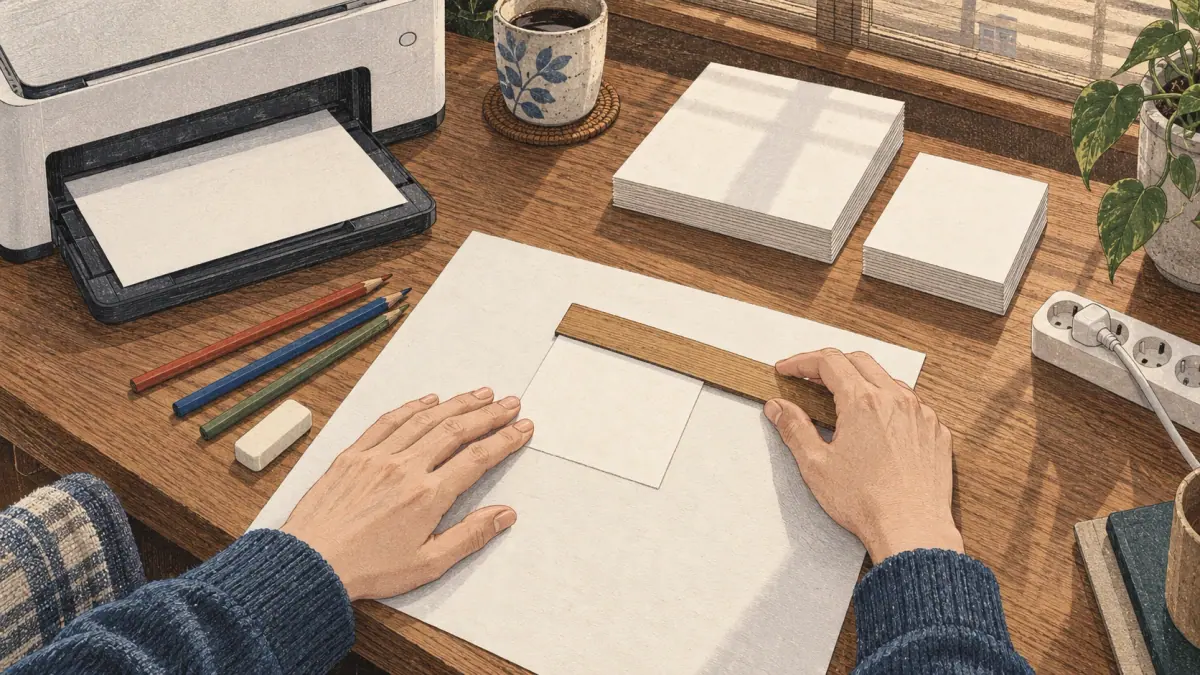
The frames should print at 30 mm so the zone shapes keep their proportions. Use these settings:
- Paper: A4 (210 by 297 mm) or US Letter (8.5 by 11 inches), with the matching file.
- Scale: 100 percent, with "fit to page" turned off.
- Margins: 12 mm on every side, with room for a hole punch.
- Colour: black and white is enough. Zone outlines are light gray. If you want to colour the zones, use coloured pencils on the black-and-white print.
Print the page twice if you want to repeat the exercise a week later without the pencil marks.
Mistakes to Watch For
Most block errors come from position, not from the shape of a letter.
- Wrong position. The most common mistake is putting a vertical-vowel initial on top, or a horizontal-vowel initial on the left. Look at the vowel first, and the layout follows.
- Forgetting ㅇ. A block that starts with a vowel sound still needs ㅇ in zone 1. Writing the vowel alone is not a normal block.
- Mismatched size. A final consonant written as large as the initial pushes the block out of the frame. Write the final smaller, so the whole block stays in its square.
- Mixing up ㅗ and ㅜ. Both are horizontal vowels, so both use Layout B, but ㅗ has its short stroke on top and ㅜ has it below.
What Should I Practice Next?
After the template, practise the blocks on a clean grid. The korean manuscript paper printable gives you boxes for whole paragraphs, and the korean syllable blocks quiz checks your block reading on screen. For a vocabulary notebook, continue with the korean vocabulary list template. All printables are collected on the korean printables page.
This sheet covers blocks with at most one final consonant. It does not include double final consonants such as ㄺ, double initial consonants or the sound changes that happen across blocks. Used in one sitting, the blank hangul syllable template trains you to put every letter of a block in its correct position.
Frequently Asked Questions
Which block layouts are on the template?
The sheet has three layouts. Layout A is for vertical vowels such as ㅏ and ㅣ, Layout B is for horizontal vowels such as ㅗ and ㅜ, and Layout C is for mixed vowels such as ㅘ and ㅢ. Each layout appears in two rows: one without a final consonant and one with a final consonant.
Can I colour the zones?
Yes. Colouring is part of the exercise. Use one colour for the initial consonant zone, another for the vowel and a third for the final consonant. The frames are printed in black and white with light gray zone outlines, so coloured pencils show clearly, and the colours help you remember the positions.
Is there an answer key?
Yes. The second sheet of the PDF lists all 36 blocks, row by row, with the initial, vowel and final of each one. For example, 밤 is ㅂ plus ㅏ plus ㅁ. Use the key after you finish, and compare the zone in which you put each letter as well as the letter itself.
Is the template suitable for children?
Free for personal and classroom use. Teachers may print copies for their students. No reselling or republishing online.
Is the worksheet free to print?
Free for personal and classroom use. Teachers may print copies for their students. No reselling or republishing online.
May I use these worksheets in class?
Free for personal and classroom use. Teachers may print copies for their students. No reselling or republishing online.
Free for personal and classroom use. Teachers may print copies for their students. No reselling or republishing online.