Key facts
- Format: PDF, 1 practice page plus a 1-page model and answer key, in A4 and US Letter versions.
- Layout: 25 numbered rows, five columns and three review boxes (1, 3 and 7 days).
- Level: A1. It works with any word list, and it suits the 100-word beginner list best.
What you will be able to do (about 30 minutes for the first five rows)
- Record a new word with its sound, meaning and a short sentence.
- Keep a list that you can cover and test yourself on.
- Track reviews at 1, 3 and 7 days with tick boxes.
- Tell which words are still weak without any app.
Download the Korean Vocabulary List Template
The download has one file for A4 and one for US Letter. The layout is the same, so pick the file that matches your paper. No sign-up is needed.
Korean Vocabulary List Template
Download PDF (A4) PDF (US Letter)
Preview
Blank Vocabulary List
The next section explains each column and shows the five model rows.
What Is on Each Page?
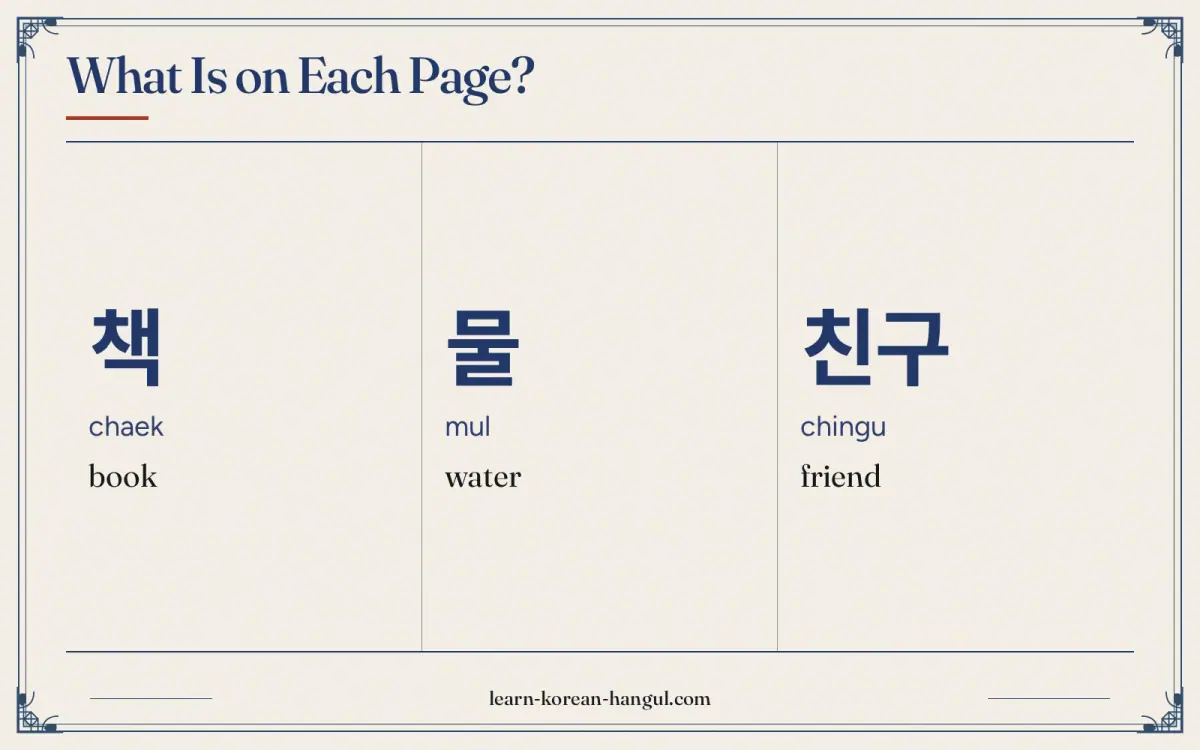
The sheet has two pages. Page 1 is the blank list you fill in. Page 2 is the model page, with the first five rows already written, so you can copy the style.
The Five Columns
| Column | Width | What to write |
|---|---|---|
| Hangul (한글) | 30 mm | the word in Hangul, in your best handwriting |
| Romanization (로마자) | 30 mm | Revised Romanization, and the sound in [brackets] if it differs from the spelling |
| Meaning (뜻) | 30 mm | one short English meaning, not a list |
| Example (예문) | 62 mm | a sentence of three to five words that uses the word |
| Review boxes | 3 × 8 mm | tick after 1 day, 3 days and 7 days |
The Model Rows (page 2)
| # | Hangul | Romanization | Meaning | Example |
|---|---|---|---|---|
| 1 | 책 | chaek | book | 책을 읽어요. (I read a book.) |
| 2 | 물 | mul | water | 물을 마셔요. (I drink water.) |
| 3 | 친구 | chingu | friend | 친구가 와요. (A friend is coming.) |
| 4 | 학교 | hakgyo [학꾜] | school | 학교에 가요. (I go to school.) |
| 5 | 우산 | usan | umbrella | 우산이 있어요. (I have an umbrella.) |
The sound in brackets for 학교 shows why the romanization column is useful: the spelling is hakgyo, but the standard pronunciation is [학꾜], with a tense ㄱ. The note costs two seconds and saves you from reading it wrongly later.
How Do I Fill in the Columns?
Fill the columns from left to right, and say the word aloud at each step. Follow these steps for each new word:
- Write the word in Hangul and say it aloud once.
- Write the Revised Romanization. If you know the sound differs from the spelling, add it in brackets.
- Write one short English meaning. If the word has several meanings, choose the one you met first.
- Write an example sentence of three to five words. Reuse words you already know.
- Leave the review boxes empty until the day you test yourself.
The example sentence is the column most learners skip, and it is the one that helps most. A word with a sentence attached tells you the particle it takes, the verb it goes with and where it sits in the sentence. The sentence 물을 마셔요 teaches 물 and also shows that "drink" goes with 을 and 마셔요.
Review Boxes: When to Look Again
The three boxes stand for 1 day, 3 days and 7 days after you wrote the word. On each review day, cover the Hangul column and read the meaning, or cover the meaning and read the Hangul, then tick the box if you got it right. If you got it wrong, leave the box empty and look at the word again the next day.
This follows the same idea as the review schedule in the 100 korean words flashcards deck, whose Leitner boxes also use 1-, 3- and 7-day gaps (plus a 10-minute box and a 21-day box). Both rest on the same principle, spaced retrieval: testing yourself after a growing gap keeps a word longer than rereading it.
What Is the Answer Key For?
The answer key is page 2, the model page. It is not a set of right answers, because this is a blank notebook page. Use it to check your format after you fill in your first five rows: is the sound in brackets where it should be, is the meaning short, and is the example short enough to say in one breath?
Which Words Go on the List?
Choose words you have just met, and group them by theme. A list of 25 food words is easier to recall than 25 random words, because each word cues the next. The korean vocabulary section has word lists by theme, and the first 25 words of the 100-word list are a good start. Add only words you plan to use, and keep each page to one theme if you can.
A practical plan is five new words a day, so a page fills in five days. If five feels easy, raise it. If you keep missing the 3-day review, lower it.
Print Settings
The sheet prints well in black and white. Use these settings:
- Paper: A4 (210 by 297 mm) or US Letter (8.5 by 11 inches), using the matching file.
- Scale: 100 percent, with "fit to page" turned off, so the columns keep their width.
- Margins: 12 mm on every side, with room for a hole punch.
- Pencil: use a pencil for the first pass, because you may want to correct a meaning later.
Mistakes to Watch For
- Dropping romanization too early. Keep the column for your first weeks and shade it out once you can read the Hangul without it. Do not use romanization as your only record.
- Writing too much. A long sentence or a list of five meanings is hard to review. One meaning and a short sentence are enough.
- Leaving out the example. A bare word is easy to forget. Write the sentence even if it is simple.
- Never testing. Writing the list is only half of the job. The boxes are there to remind you to cover and test.
What Should I Practice Next?
When the page is full, turn the list into cards with the korean printable flashcards template, or study the same words on screen with the 100 korean words flashcards. For a four-page printable on the same word set, see the 100 korean words worksheet. All the printables are gathered on the korean printables page.
This sheet does not supply a word list. It gives you the page to hold your own list. Used with a few new words a day, the korean vocabulary list template turns a pile of words into a notebook you can test.
Frequently Asked Questions
How many words fit on one page?
The page has 25 numbered rows, so it holds 25 words. Each row has five columns plus three small review boxes. If you want to write bigger, use two pages and 12 or 13 words on each. The rows are about 9 mm high, which suits normal pencil handwriting.
Is the vocabulary list template free?
Free for personal and classroom use. Teachers may print copies for their students. No reselling or republishing online.
Should I use A4 or US Letter?
Use the file that matches your printer. The A4 and US Letter files have the same columns and the same 12 mm margins, but the Letter page is a little wider and shorter than A4. Print at 100 percent scale, with fit-to-page turned off, so the columns stay the same width.
Can I fill it in on a screen?
The PDF is made for printing and writing by hand, and it does not have fillable fields. If you prefer to type, copy the five column headings into a spreadsheet. Handwriting has one advantage here: forming each Hangul block yourself helps you remember its shape and its spelling.
Which words should I put on the list?
Start with words you have just met in a lesson or a flashcard deck, such as the first 25 words of the 100-word list. A list built from one theme, for example food or school, is easier to remember than a mixed list. Add only words you want to use in your own sentences.
May I use these worksheets in class?
Free for personal and classroom use. Teachers may print copies for their students. No reselling or republishing online.
Free for personal and classroom use. Teachers may print copies for their students. No reselling or republishing online.