Before you start
- Time: about 15 minutes to read, plus a few minutes to say the ten phrases aloud.
- Level: beginner. You only need to read Hangul slowly and copy the audio.
- Goal: use ten polite phrases and four habits (two hands, shoes, tipping, calling staff) during a trip.
- Safe default: end sentences with 요 or use the phrases below as they are.
Korean Etiquette for Tourists: the Essentials
Tourists in Korea are forgiven for many mistakes, but a few habits make a strong, positive impression. They are polite speech, careful handling of objects and awareness of homes and temples. None of them needs fluent Korean.
The four manners to remember are these.
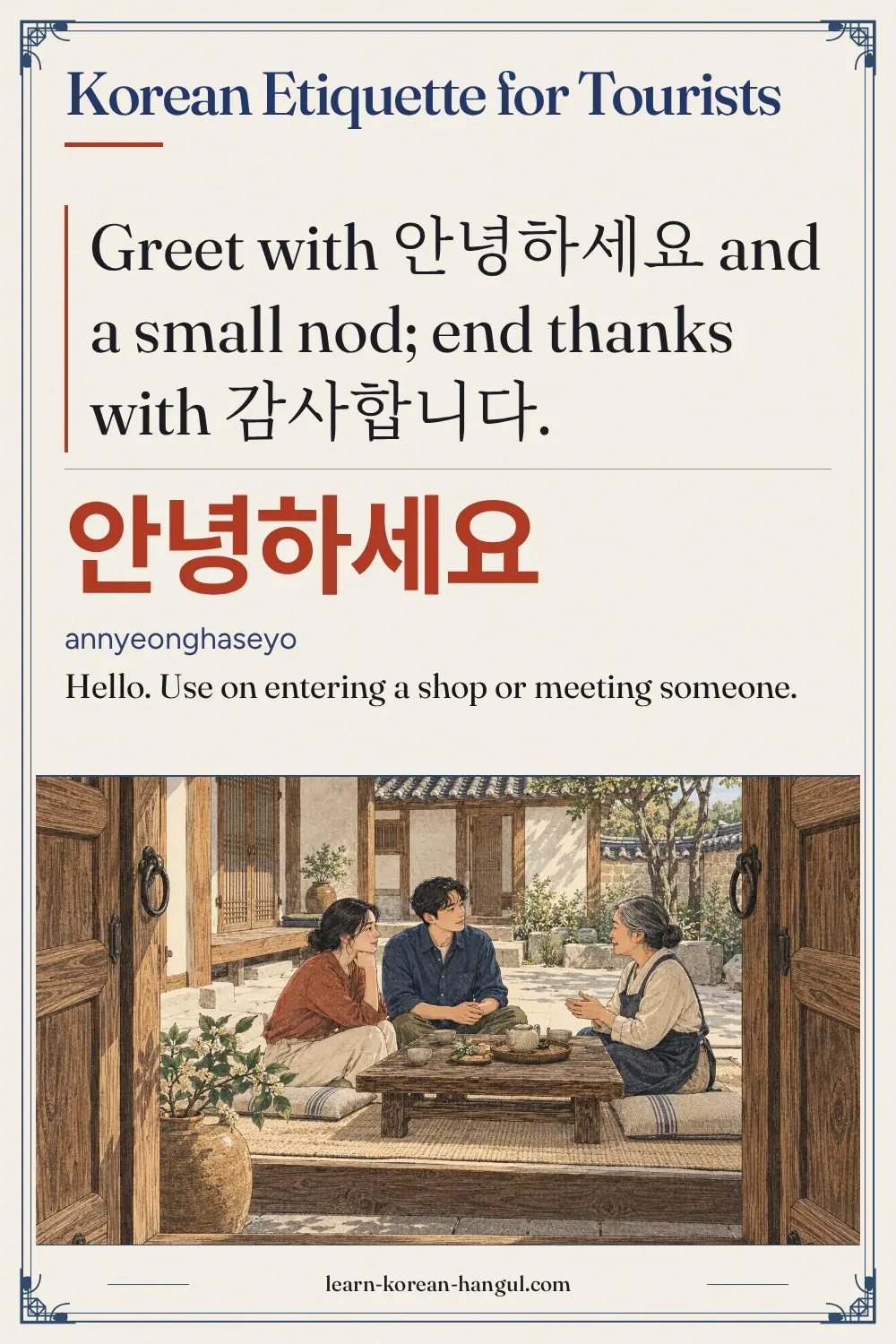
- Greet with 안녕하세요 and a small nod. See Korean greeting etiquette for the full bow guide.
- Use two hands (or one hand supported by the other) when giving or receiving cards, cash, gifts and drinks, especially with older people.
- Take off your shoes in homes, many guesthouses and traditional rooms with a raised floor.
- Do not tip. Tipping is not customary in Korea, and a clear thank-you is enough.
Language is the other half of etiquette. Korean marks respect in word endings, so even a very short phrase sounds politer with 요 or 주세요 than with a bare noun. Learning ten phrases gives you the right tone for shops, restaurants, transport and hotels. The next section lists them.
Which Ten Phrases Should You Use?
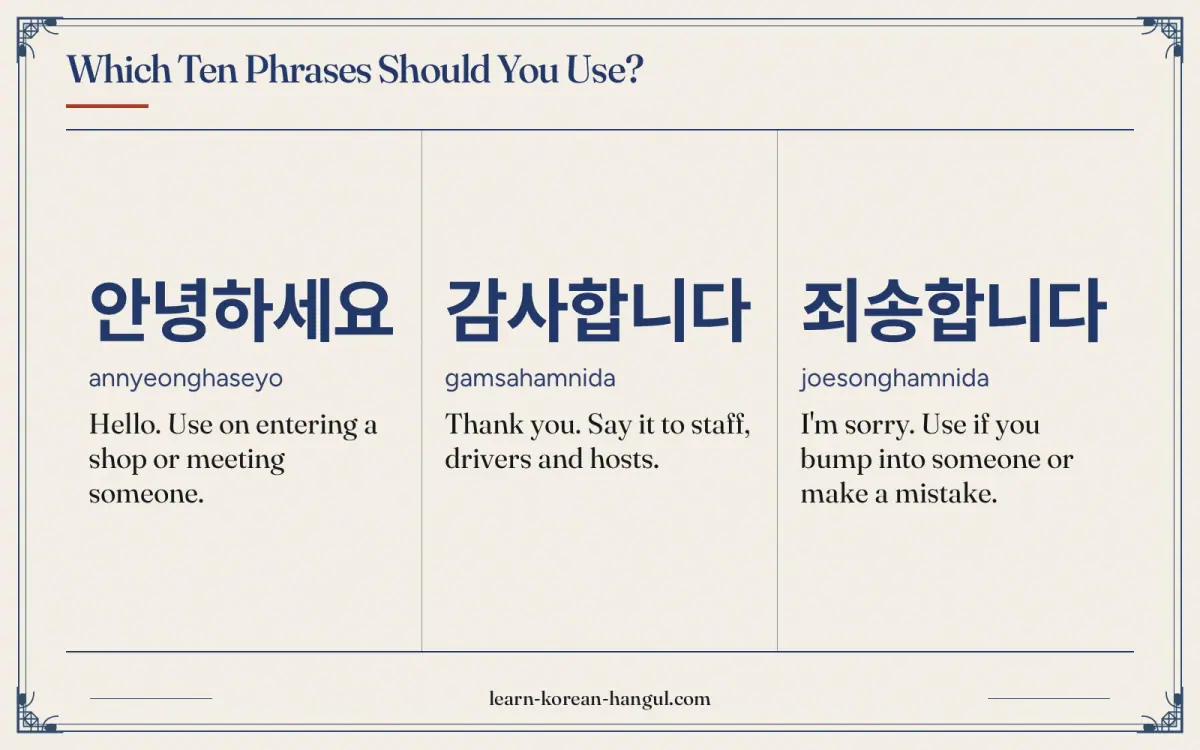
Use these ten polite phrases for greetings, thanks, apologies, shopping, eating, asking for help and leaving. All of them are in the standard polite style, which is safe with strangers of any age.
| # | Korean | Romanization | Pronunciation | Meaning and use |
|---|---|---|---|---|
| 1 | 안녕하세요 | annyeonghaseyo | [안녕하세요] | Hello. Use on entering a shop or meeting someone. |
| 2 | 감사합니다 | gamsahamnida | [감사함니다] | Thank you. Say it to staff, drivers and hosts. |
| 3 | 죄송합니다 | joesonghamnida | [죄송함니다] | I'm sorry. Use if you bump into someone or make a mistake. |
| 4 | 잠시만요 | jamsimanyo | [잠시만뇨] (common speech) | Just a moment. Use to pass through a crowd. |
| 5 | 얼마예요? | eolmayeyo? | [얼마예요] | How much is it? Use in markets and shops. |
| 6 | 주세요 | juseyo | [주세요] | Please give me. Add the item before it: 이거 주세요. |
| 7 | 맛있어요 | masisseoyo | [마시써요] | It's delicious. A warm compliment to a cook or owner. |
| 8 | 화장실이 어디예요? | hwajangsiri eodiyeyo? | [화장시리 어디예요] | Where is the restroom? |
| 9 | 도와주세요 | dowajuseyo | [도와주세요] | Please help me. |
| 10 | 안녕히 계세요 | annyeonghi gyeseyo | [안녕히 계세요] | Goodbye, said when you leave and the other person stays. |
Here is how the phrases work together on a short shopping trip.
| Moment | You say | Meaning |
|---|---|---|
| Entering a shop | 안녕하세요. | Hello. |
| Pointing at an item | 이거 얼마예요? | How much is this? |
| Choosing | 이거 주세요. | This one, please. |
| Paying | 감사합니다. | Thank you. |
| Leaving | 안녕히 계세요. | Goodbye. |
A pronunciation note: 감사합니다 is written with ㅂ before ㄴ, so the standard sound is [감사함니다] (the ㅂ becomes ㅁ). The same change happens in 죄송합니다. For 잠시만요, many speakers add an n sound and say [잠시만뇨]. Revised Romanization writes jamsimanyo, without the extra n, and the spoken form is a common speech habit. Wh-questions such as 얼마예요? and 어디예요? do not need a sharp rise at the end. A normal falling or level tone is fine.
Expert insight: 주세요 is the most useful word for a visitor. Put any noun before it and you have a polite request: 물 주세요 (water, please), 영수증 주세요 (a receipt, please), 하나 더 주세요 (one more, please). For other travel needs, see Korean travel phrases. The next section moves from words to the hands.
How Do You Give and Receive Things?
Give and receive with two hands, or with your right hand supported by your left hand at the wrist or forearm. This is a sign of respect, and it matters most with older people, bosses and people you have just met. It applies to business cards (명함, myeongham), gifts, documents, money passed hand to hand and drinks.
Follow these steps.
- Hold the object with both hands, or with your right hand and your left hand lightly at the right wrist.
- Offer it with a small nod and a short phrase: 여기 있습니다 (yeogi itseumnida, "Here it is"), or simply 감사합니다.
- When receiving, take it with both hands and say 감사합니다.
- Look at a business card for a moment before you put it away carefully. Do not write on it or stuff it into a back pocket in front of the person.
At a shop counter, a card or cash is often placed in a small tray, so no hand-to-hand gesture is needed. With an older person at a table, though, receive a drink with two hands and say 감사합니다 before you sip.
If you are handed something with one hand by a young shop assistant in a hurry, do not take it as rude. It is a quick service gesture, and the two-hand rule is mainly about courtesy between people.
When Do You Take off Your Shoes?
Take off your shoes when you enter a Korean home and whenever the floor is raised, heated or covered with mats. The rule is simple: if you see a step, a shoe rack (신발장, sinbaljang) or slippers, shoes come off.
| Place | Shoes off? | Clue |
|---|---|---|
| Private home | yes | a step down at the door and a pile of shoes |
| Hanok (traditional house) and guesthouse | yes | a wooden or heated floor |
| Traditional restaurant with floor seating | yes | low tables and cushions |
| Temple prayer hall | yes | a shoe rack outside the hall |
| Hotel room | usually no | you may take shoes off if you prefer |
| Normal restaurant with chairs | no | tables with chairs |
| Subway, shops, offices | no | normal floors |
| Clinics and some small offices | sometimes | slippers waiting at the door |
If you are unsure, ask: 신발 벗어야 해요? (sinbal beoseoya haeyo?, [신발 버서야 해요], "Do I need to take off my shoes?"). Most hosts will answer with a smile and show you where to leave them.
Wear clean socks, and bring a spare pair if you are visiting a home or a hanok stay. Place your shoes neatly, with the toes pointing toward the door if there is space. Slippers are provided in some homes, and bathroom slippers are separate from room slippers.
How Do You Call Staff and Pay?
To call staff, say 저기요 (jeogiyo) or 여기요 (yeogiyo), or press the call button on the table. Both words mean "excuse me" and are normal in restaurants and cafes. It is not rude to call out quietly across the room, because the staff expect it.
Many restaurants have a small button (호출벨, hochulbel) on the table. Press it once and wait. Water, side dishes (반찬, banchan) and basic items are often self-service or refilled for free, so ask 더 주세요 (deo juseyo, "more, please") if you need more.
At a casual restaurant, you may also hear people call out to the owner with 사장님 (sajangnim) and to an older female worker with 이모 (imo, literally "aunt on the mother's side"). Foreign visitors do not need to copy these. 저기요 is fine for everyone.
Paying often works differently from some other countries.
- Order first or at the table. In some places you order at a kiosk or counter. In others, staff take the order at the table.
- Ask for the bill if needed. Say 계산해 주세요 (gyesanhae juseyo, "Please total my bill").
- Pay at the counter. In many restaurants you pay at the register on your way out, not at the table.
- Share politely. Groups often take turns paying, and splitting the bill is also accepted. Say 따로 계산해 주세요 (ttaro gyesanhae juseyo, "Please separate the bills") if you want to pay separately.
- Ask for a receipt. 영수증 주세요 (yeongsujeung juseyo).
For restaurant vocabulary beyond these lines, read Korean restaurant phrases.
Do You Need to Tip in Korea?
No. Tipping is not customary in Korea, in restaurants, taxis, cafes, hair salons or for most services. The price on the menu or the meter is the price you pay. Some higher-end hotels and restaurants add a service charge to the bill, and that replaces a tip.
If you leave money on a table, staff may run after you to return it. This is not an insult. It is a sign that they believe the price was already fair. A warm 감사합니다 and 맛있게 먹었어요 (masitge meogeosseoyo, [마싣께 머거써요], "I enjoyed the meal") are the best thanks. For current tourist guidance, check the Korea Tourism Organization site (visitkorea.or.kr), because practices can change.
How Do You Behave When Eating?
Eating etiquette in Korea is mostly about waiting for elders and sharing food. A few habits are worth knowing.
- Wait for the eldest person to start, or until everyone is served.
- Say 잘 먹겠습니다 (jal meokgetseumnida, [잘 먹껟씀니다], "I will eat well") before you eat, and 잘 먹었습니다 (jal meogeotseumnida, [잘 머걷씀니다], "I ate well") when you finish.
- Leave the rice bowl on the table. Unlike in some other countries, Koreans usually do not lift the rice or soup bowl to the mouth.
- Use the spoon for rice and soup, and chopsticks for side dishes.
- Do not stand chopsticks or a spoon upright in rice. This resembles incense sticks at a memorial rite.
- Share dishes. Side dishes and stews are for the whole table, so take from the shared plate with your own utensils.
- Pour for others. With drinks, pour for your companions before yourself, and receive a pour with two hands.
Is eating while walking rude? It is not seen as a serious offence, and people do eat street food near the stall. In crowded places such as subway cars and buses, though, food with a strong smell is better saved for later. When in doubt, finish your snack at the stall and then move on.
What Else Should Tourists Know about Public Manners?
Public manners are quiet, and a few specific habits matter on transport. Speak softly on the subway and the bus, and keep phone calls short. The seats marked for the elderly, disabled and pregnant (노약자석, 임산부 배려석) should stay free unless nobody needs them. Offering your seat with 여기 앉으세요 (yeogi anjeuseyo, "Please sit here") is welcome.
Pointing and queues also matter. Queue at bus stops and subway platforms in the marked lines. If you must pass someone, say 잠시만요 or 죄송합니다 with a small nod. A bump on a crowded street often passes without an apology, but a quick 죄송합니다 is always accepted.
Names are another detail. Koreans usually put the family name first, and use titles instead of "you". For a stranger, 선생님 (seonsaengnim, "teacher", also a polite term for respected adults) is a safe title. How to use names and titles politely is covered in how to address people by name.
Which Language Mistakes Do Tourists Make?
Most tourist mistakes are small, and the fixes are quick. Check yourself against this list.
- Dropping the polite ending. Wrong: 물 줘 ("give me water", casual). Right: 물 주세요. The casual form sounds rude to a stranger.
- Saying 안녕하세요 when leaving. Wrong: leaving a shop with 안녕하세요. Right: 안녕히 계세요, or simply 감사합니다.
- Using 너 for "you". Wrong: 너 한국 사람이야? Right: avoid "you" and use a title, or leave the subject out.
- Pointing at a person with one finger. Wrong: pointing at a server with a finger. Right: use 저기요 and a small wave, or a nod.
- Treating 죄송합니다 as only for big apologies. It also works as "excuse me" when you squeeze past someone.
If you make one of these slips, nobody will mind. Korean speakers are pleased when visitors try, and they will often reply with a smile or a few words of English. The best response is to repeat the polite form once and continue.
Practice: a Restaurant Visit in Six Lines
Try this exchange aloud. It uses six of the phrases above.
| Speaker | Korean | Romanization | Meaning |
|---|---|---|---|
| You | 안녕하세요. 두 명이에요. | annyeonghaseyo. du myeongieyo. | Hello. Two people. |
| Staff | 네, 이쪽으로 오세요. | ne, ijjogeuro oseyo. | Yes, please come this way. |
| You | 이거 두 개 주세요. | igeo du gae juseyo. | Two of these, please. |
| Staff | 여기 있습니다. | yeogi itseumnida. | Here you are. |
| You | 맛있어요! 감사합니다. | masisseoyo! gamsahamnida. | It's delicious! Thank you. |
| You | 계산해 주세요. | gyesanhae juseyo. | The bill, please. |
After the meal, say 잘 먹었습니다 to the staff or the owner as you leave. It is a short, friendly phrase and the staff will smile.
What Are the Limits of This Guide?
This page covers common courtesy for short visits, not every situation. Customs vary by place, age and setting. A modern cafe, a family home and a temple each have their own rules, and young people in big cities are often more relaxed. Practices such as tipping and card payment can change, so check current tourism guidance before you travel.
Safety and law are outside this page. For emergencies and transport, use the travel pages and local official sources.
The Bottom Line
Korean etiquette for tourists is simple to practise: greet with 안녕하세요, use two hands for giving and receiving, take off your shoes where there is a step or mat, skip the tip and call staff with 저기요. Learn the ten phrases in this page, add 주세요 to any noun, and end each exchange with 감사합니다. These small steps show respect and open doors.
For the next step, read about Korean greeting etiquette, why age shapes speech in Korean age etiquette, the phrases for excuse me and the wider set of Korean travel phrases.
Frequently Asked Questions
Do I need to tip?
No. Tipping is not customary in Korea in restaurants, taxis, cafes or salons, and staff may try to return money left on a table. Some upscale hotels and restaurants add a service charge to the bill. Say 감사합니다 and 맛있게 먹었어요 instead. Check the Korea Tourism Organization site for current guidance.
How do I get a waiter's attention?
Say 저기요 or 여기요 in a normal, clear voice, or press the call button (호출벨) on the table if there is one. Both words mean excuse me, and neither is rude in a restaurant. Do not snap your fingers. When the server arrives, add what you need and 주세요, for example 물 주세요.
Is it rude to eat while walking?
It is not a serious offence, and people often eat street food next to the stall. On the subway, buses and in crowded areas, strong-smelling food is better saved for later. A relaxed rule is to finish your snack at the stall, then walk on. Drinks in lidded cups are common everywhere.
What should I say before eating?
Say 잘 먹겠습니다 (jal meokgetseumnida), meaning I will eat well, before you start. It thanks the person who cooked or paid. After the meal, say 잘 먹었습니다 (I ate well). If you are eating alone in a restaurant, you can say it quietly or skip it. With a host, always say it.
Do I have to bow as a tourist?
No. Visitors are not expected to bow perfectly. A small nod with 안녕하세요 is polite almost everywhere, and a slightly deeper bow for an older host or a guide is noticed warmly. The page on Korean greeting etiquette explains the three bow depths and which to use.