
실례합니다
실례합니다
What you'll learn
- Pick the right excuse me for five jobs: interrupting, getting attention, calling staff, passing and apologising.
- Call restaurant staff with 여기요 or 저기요 without feeling rude.
- Say 실례합니다 aloud as [실례함니다].
- Ask someone to repeat themselves, which needs a different phrase.
Before you start: knowing sorry in Korean helps, because 죄송합니다 doubles as an apologetic excuse me. Time: about 12 minutes. Audio plays only when you press a button.
How Do You Say Excuse Me in Korean?
The formal way to say excuse me in Korean is 실례합니다, but the best phrase depends on what you want the excuse me to do. Choose by the job, not by the English word.
| Job | Phrase | Romanization | Example situation |
|---|---|---|---|
| Interrupting, entering, asking a stranger | 실례합니다 | sillyehamnida | Knocking on an office door |
| Getting a stranger's attention | 저기요 | jeogiyo | Someone dropped a glove |
| Calling staff to your table | 여기요 | yeogiyo | Ordering in a restaurant |
| Getting past people | 잠시만요 | jamsimanyo | Leaving a crowded subway car |
| Apologising for a small disturbance | 죄송합니다 | joesonghamnida | Bumping someone's bag |
실례 (失禮) is a Sino-Korean noun meaning a breach of manners, so 실례합니다 literally says "I am committing a small rudeness". 저기 and 여기 are simply "over there" and "here". The next section shows each phrase in a sentence.
What Are the Formal and Polite Ways to Say Excuse Me?
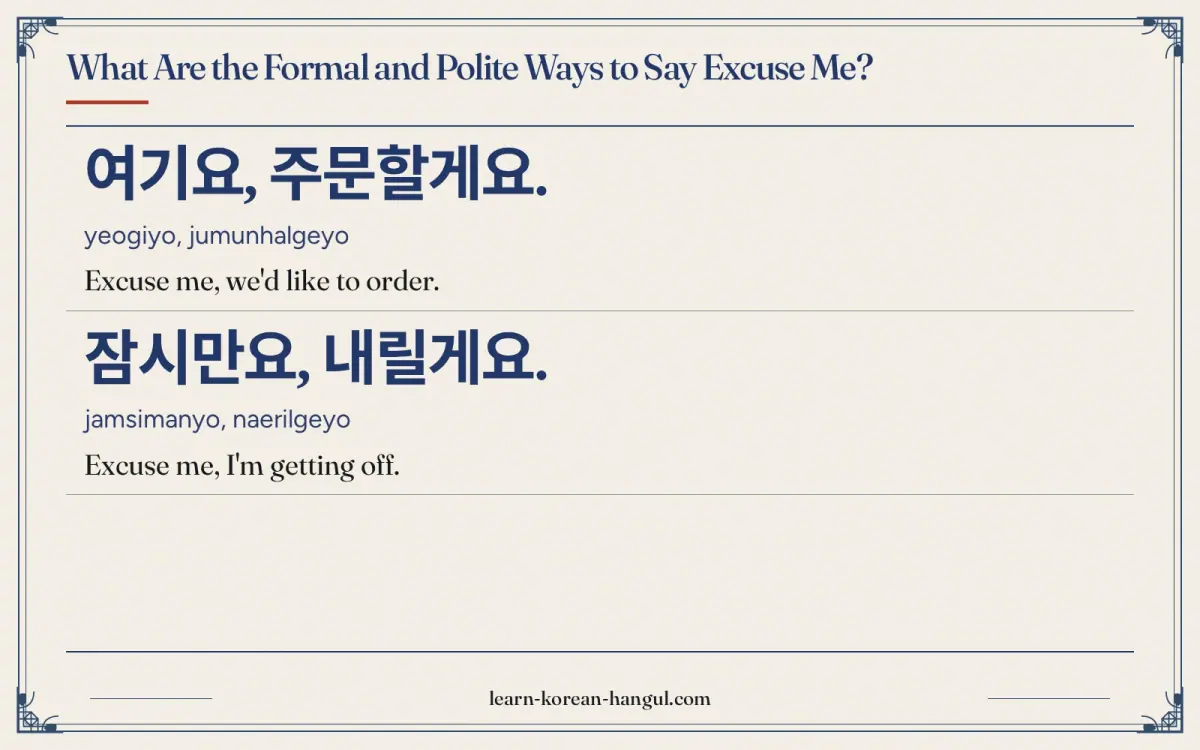
Excuse me follows the Korean speech levels, the endings that change with the listener, explained in the guide to Korean speech levels. Most excuse-me phrases are said to strangers, so formal and polite forms dominate.
Formal: 실례합니다 (sillyehamnida)
Formal · 합쇼체실례합니다 is the formal excuse me for intruding on someone's space or time: entering an office, interrupting a conversation, or asking a stranger for directions. Its softer partner 실례지만 (excuse me, but) introduces a personal question.
실례합니다. 김 선생님 계세요?
sillyehamnida. gim seonsaengnim gyeseyo?
Excuse me. Is Mr Kim in?
When you leave after interrupting, 실례했습니다 (sillyehaetseumnida), "sorry for the disturbance", closes the visit politely.
Polite: 저기요 (jeogiyo)
Polite · 해요체저기요 literally means "over there" with the polite -요, and it is the standard way to catch a stranger's attention. Use it when someone drops something, when you need to ask a passer-by a question, or when calling staff from a distance.
저기요, 이거 떨어뜨리셨어요.
jeogiyo, igeo tteoreotteurisyeosseoyo
Excuse me, you dropped this.
Polite: 여기요 (yeogiyo)
Polite · 해요체여기요 means "over here" and calls staff to your table. It is the everyday phrase for ordering or asking for the bill in Korean restaurants.
여기요, 주문할게요.
yeogiyo, jumunhalgeyo
Excuse me, we'd like to order.
Polite: 잠시만요 (jamsimanyo)
Polite · 해요체잠시만요 means "just a moment" and is what you say when you need people to let you through: on a crowded bus, in a narrow aisle, or leaving a full lift. The variant 잠깐만요 (jamkkanmanyo) means the same and is equally common.
잠시만요, 내릴게요.
jamsimanyo, naerilgeyo
Excuse me, I'm getting off.
Formal: 죄송합니다 (joesonghamnida)
Formal · 합쇼체죄송합니다 is an apology, but it also covers the "excuse me" of English when you have already disturbed someone: bumping a bag, stepping on a foot, or reaching across a stranger. It is backward-looking, while 실례합니다 comes before the disturbance.
아, 죄송합니다. 괜찮으세요?
a, joesonghamnida. gwaenchaneuseyo?
Oh, excuse me. Are you all right?
Casual: 저기 and 잠깐만
Casual · 반말With friends, drop the -요: 저기 (jeogi) works like "hey, um" to get attention, and 잠깐만 (jamkkanman) means "hang on" or "let me through". Never use these with strangers or elders.
Six phrases may seem like many, but each has one clear job. The main formal one is worth pronouncing carefully.
How Do You Pronounce 실례합니다?
실례합니다 is pronounced [실례함니다], sillyehamnida, in five syllables, with a long l across the first two and an m sound where the spelling shows ㅂ.
- 실 (sil): "sheel" with a short vowel; the ㅅ before ㅣ sounds close to English "sh".
- 례 (lye): continue the l from 실 into "lyeh", so you hear a long l, not an English r.
- 함 (ham): written 합, said "hahm".
- 니 (ni): "nee".
- 다 (da): a soft d and "ah".
Sound Changes to Listen For
Three points make 실례합니다 and its partners sound natural:
- ㄹ plus ㄹ is a long l. When a syllable ending in ㄹ meets one starting with ㄹ, both are said as one long l. Revised Romanization writes it as ll: sillye.
- Nasalization in 합니다. Under the National Institute of Korean Language Standard Pronunciation rules (표준 발음법), ㅂ before ㄴ becomes ㅁ, giving [실례함니다]. See ㅂ-to-ㅁ nasalization.
- An extra [ㄴ] before 요. In everyday speech an [ㄴ] sound is usually added before 요 after the final ㄴ of 만, so 잠시만요 is heard as [잠시만뇨], and 잠깐만요 as [잠깐만뇨].
Pronunciation done, the real skill is choosing the phrase that fits the moment.
When Should You Use 실례합니다, and When Should You Not?
Use 실례합니다 before you intrude on someone's space or time, especially in offices, homes and formal settings. Do not use it to call a waiter, to pass on a crowded train, or with friends, where other phrases fit better.
Situations Where It Fits
- Entering an office or a teacher's room. Knock, open the door slightly and say 실례합니다.
- Interrupting two people talking. 실례합니다, 잠깐 여쭤봐도 될까요? (Excuse me, may I ask something?)
- Asking a stranger for directions. 실례합니다, or the lighter 저기요.
- Entering someone's home. Guests often say 실례합니다 as they step inside.
Situations to Avoid
- Calling a waiter. 실례합니다 sounds stiff; say 여기요 or 저기요.
- Squeezing past on the subway. Say 잠시만요.
- After bumping someone. The disturbance has happened; say 죄송합니다.
- With friends. Use 저기 or the friend's name.
Seeing the phrases in real exchanges makes the jobs clearer.
What Does Excuse Me Sound Like in a Real Conversation?
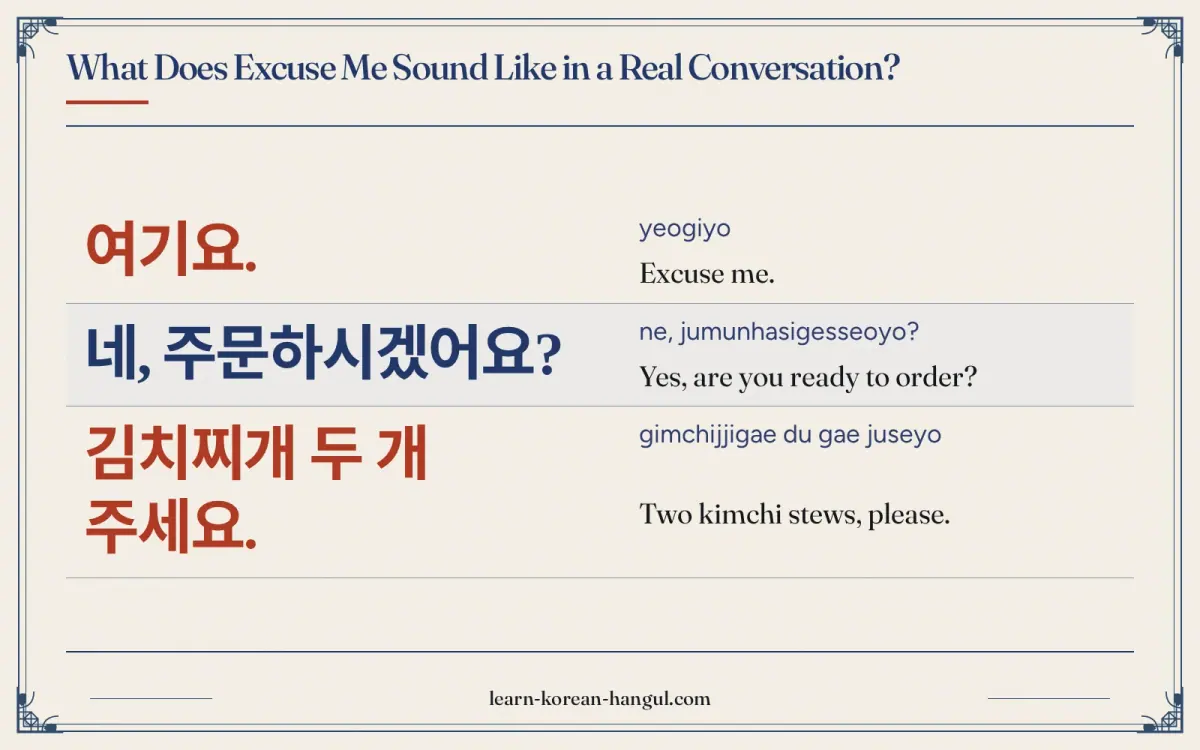
Excuse me in Korean usually opens a short exchange and is followed by the real request. Listen for which phrase starts each one.
Ordering in a Restaurant
Customer
여기요.
yeogiyo
Excuse me.
Server
네, 주문하시겠어요?
ne, jumunhasigesseoyo?
Yes, are you ready to order?
Customer
김치찌개 두 개 주세요.
gimchijjigae du gae juseyo
Two kimchi stews, please.
What to notice: 여기요 needs no extra words; the server comes to you. The request uses 주세요, explained in please in Korean.
Getting off a Crowded Subway
Passenger
잠시만요. 내릴게요.
jamsimanyo. naerilgeyo
Excuse me. I'm getting off.
Other Passenger
아, 네.
a, ne
Oh, sure.
What to notice: 내릴게요 (I'm getting off) tells people why you need to pass.
Visiting an Office
Visitor
실례합니다. 이 서류 어디에 내면 돼요?
sillyehamnida. i seoryu eodie naemyeon dwaeyo?
Excuse me. Where do I hand in this form?
Clerk
저쪽 창구로 가세요.
jeojjok changguro gaseyo
Please go to that counter over there.
Visitor
감사합니다.
gamsahamnida
Thank you.
What to notice: the visit ends with 감사합니다; see thank you in Korean. These patterns grow out of everyday Korean manners.
What Should You Know about the Culture behind Excuse Me?
Korean excuse-me phrases reflect how public space works in Korea: staff expect to be called, and crowds move with few words.
- Calling staff is expected. In most Korean restaurants, staff do not check on tables regularly. Customers call 여기요 or press a table bell when they need something.
- Address terms in casual places. Some customers call staff 사장님 (boss) or, in casual eateries, 이모 (auntie). Learners are safer with 여기요 or 저기요.
- Brief words in crowds. On busy trains, a short 잠시만요 is the norm, and some people pass with no words at all.
- Knocking and announcing. In offices and homes, 실례합니다 announces that you are about to step into someone's space.
An expert insight: many visitors wait politely for a server to come over and can wait a long time. In Korea, calling out 여기요 is the polite system, not a breach of it. The mistakes table below collects this and similar errors.
What Mistakes Do Learners Make with Excuse Me in Korean?
Most excuse-me mistakes come from using one Korean phrase for every English "excuse me".
| Mistake | Why it is a problem | Fix |
|---|---|---|
| Waiting silently for restaurant staff | Staff expect to be called | Say 여기요 or press the bell |
| Saying 실례합니다 to a waiter | Sounds stiff and odd | Say 여기요 or 저기요 |
| Saying 실례합니다 when you bump someone | It belongs before the disturbance | Say 죄송합니다 |
| Pushing through a crowd without a word | Feels rude to many people | Say 잠시만요 |
| Using 저기 without -요 to a stranger | Casual and abrupt | Say 저기요 |
Learners often assume 저기요 is rude because it sounds like "hey, you". Actually, 저기요 with the polite -요 is the standard, neutral way to get a stranger's attention, used by everyone from students to office workers.
Is It the Same as Pardon Me?
Only partly. If "pardon me" means "excuse me", use the phrases above; if it means "I didn't hear you", Korean uses 네? or a request to repeat. The short answers below cover the other searches folded into this page.
- Excuse me formal in Korean: 실례합니다, or 실례지만 before a question.
- Excuse me please (let me pass): 잠시만요 or 잠깐만요.
- Excuse me, waiter: 여기요 or 저기요.
- Pardon me (did not hear): 네? with a rising tone, or 다시 한번 말씀해 주시겠어요?
- Excuse me to get attention: 저기요.
- Excuse me passing by: 잠시만요, with a slight nod.
Now practise picking the phrase for each job.
Practice: Say It Aloud
Play the slow clip of 실례합니다 three times, then 저기요 and 잠시만요. Then choose a phrase for each situation. Answers follow.
- You need the bill in a busy barbecue restaurant.
- You want to enter your professor's office.
- Your bus stop is next and people block the door.
- A stranger dropped a train ticket.
Answers
- 여기요, 계산해 주세요 (excuse me, the bill please).
- Knock and say 실례합니다.
- 잠시만요, 내릴게요.
- 저기요, 이거 떨어뜨리셨어요.
The phrase flashcards drill all the excuse-me phrases with audio.
Related Phrases to Learn Next
Excuse me usually leads straight into a request or an apology, so these are the natural next phrases.
- Sorry in Korean: 죄송합니다 and 미안해요 for real apologies.
- Please in Korean: 주세요 and 해 주세요 for the request that follows.
- Thank you in Korean: 감사합니다 to close the exchange.
This guide belongs to the polite Korean phrases collection. What this page does not cover: address terms in depth (선생님, 사장님, 이모) and workplace etiquette, which deserve their own lessons. Match the phrase to the job, attention, passing or interrupting, and you can say excuse me in Korean in any public place.
Frequently Asked Questions
How do you say pardon me in Korean when you did not hear something?
Say 네? (ne?) with a rising tone, which works like pardon? in polite speech. For a fuller request, say 다시 한번 말씀해 주시겠어요? (could you say that once more?). With friends, 뭐라고? (what did you say?) is fine. 실례합니다 is not used for this meaning.
What does 실례지만 mean?
실례지만 (sillyejiman) means excuse me, but, and softens a personal question or request to a stranger or senior. For example, 실례지만, 성함이 어떻게 되세요? means excuse me, but may I ask your name? It is more formal than 저기요 and signals that the question might be a small intrusion.
Is 여기요 or 저기요 better for calling a waiter?
Both work. 여기요 means over here and points to your table, so it fits when staff are nearby. 저기요 means over there and is common when staff are farther away or you are calling a stranger. Many restaurants also have a call bell on each table; press it instead of calling out.
How do you say excuse me when you sneeze or cough?
Korean has no set phrase like excuse me or bless you after a sneeze. Most people say nothing or give a quick 죄송합니다 if they sneezed near someone in a quiet place. Covering your mouth matters more than any phrase, and nobody expects a reply.
How do you say excuse me casually to a friend?
With friends, use 저기 (hey, um) to get attention, 잠깐만 (hang on, let me through) to pass, or simply the friend's name with -아/-야, as in 민수야. 실례합니다 would sound stiff or jokey with a friend. Keep 실례합니다 and 저기요 for strangers and people you speak politely to.