What Are the Most Useful Korean Travel Phrases to Learn First?
Learn four rescue phrases first: where is the bathroom, I am lost, help and how much is it. Together they solve the most common first-day problems, and each one is short enough to say after a few tries. The photo request is a fifth line that most visitors use within an hour.
| Order | Situation | Korean | Revised Romanization | Page |
|---|---|---|---|---|
| 1 | Finding a toilet | 화장실이 어디예요? | hwajangsiri eodiyeyo | where is the bathroom in Korean |
| 2 | Being lost | 길을 잃었어요 | gireul ireosseoyo | I'm lost in Korean |
| 3 | Asking for help | 도와주세요 | dowajuseyo | Korean emergency phrases |
| 4 | Prices | 얼마예요? | eolmayeyo | how much is it in Korean |
| 5 | Photos | 사진 찍어 주세요 | sajin jjigeo juseyo | please take a photo in Korean |
Revised Romanization (the South Korean government standard of 2000) is shown only as a reading aid. Learn the Hangul first, because signs, maps and menus use it. Notice that 어디예요 and 얼마예요 end in 예요 after a vowel, while words that end in a consonant take 이에요. The next section explains how to pick the form for each listener.
How Do You Choose between Formal, Polite and Casual Korean Travel Phrases?
Pick the phrase by the situation first (toilet, lost, help), then by the listener: the polite style ends in 요 or 주세요 and works with every stranger, hotel clerk and driver. Korean grammar marks the listener with three styles, and the page on Korean speech levels explains them in depth. The polite style (해요체) is the safe default, the casual style (해체) is for close friends, and the formal style (합쇼체) is for announcements and written notices.
| Situation | Polite (safe default) | Casual (friends) | Formal (announcements) |
|---|---|---|---|
| Where is the bathroom? | 화장실이 어디예요? | 화장실 어디야? | 화장실이 어디입니까? |
| How much is it? | 얼마예요? | 얼마야? | 얼마입니까? |
| I am lost. | 길을 잃었어요 | 길을 잃었어 | 길을 잃었습니다 |
| Help me. | 도와주세요 | 도와줘 | 도와주십시오 |
| Please take a photo. | 사진 찍어 주세요 | 사진 찍어 줘 | 사진을 찍어 주십시오 |
As a traveller you will use the polite column almost all the time. Two more points shape a trip before the guide list: how to show a place name, and which numbers to dial.
Show the Korean Place Name on Your Phone
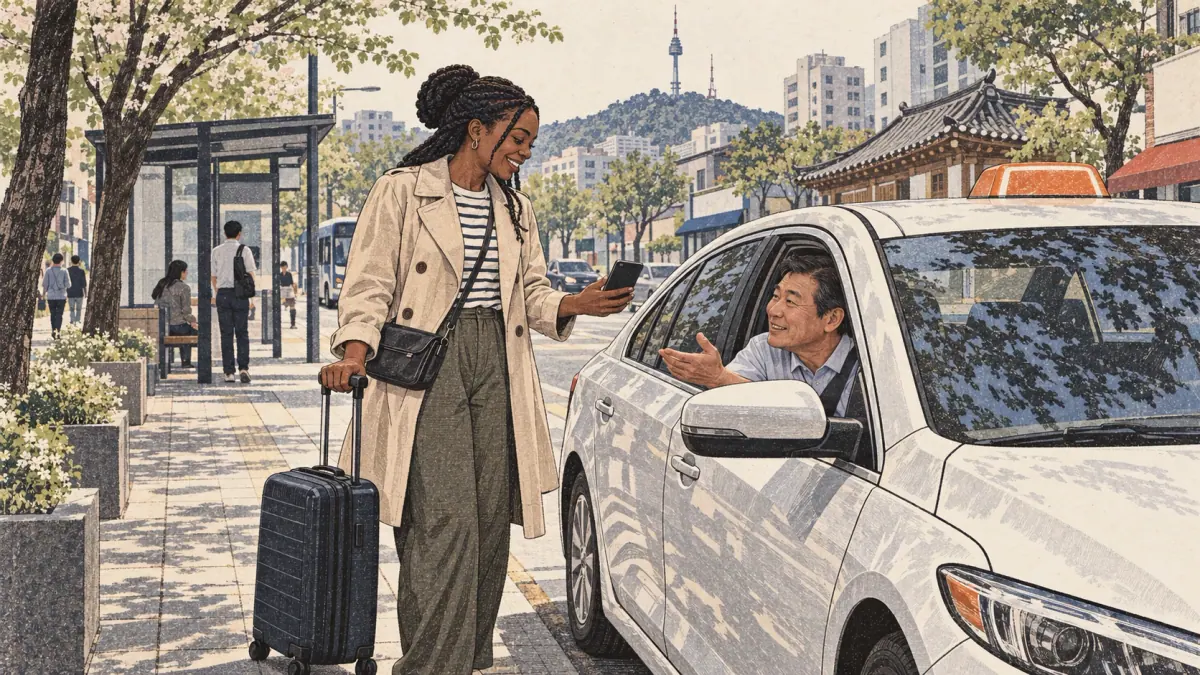
Show the Korean name because Hangul is what taxi drivers, hotel staff and station clerks read fastest. A romanized spelling of a place can differ between maps, signs and apps, so a driver may not recognise it even when you say it correctly. Copy the name or the address from a map app, then say 이 주소로 가 주세요 (i jusoro ga juseyo, "please go to this address") and hold up the screen.
This one habit often saves more time than any spoken phrase. It also removes the pressure of pronunciation: you can speak the sentence slowly, point at the screen, and let the written name do the work. The taxi page in this cluster builds on it.
Next, the numbers that matter most if something goes wrong.
Emergency Numbers for Travellers in Korea
Two numbers cover most emergencies. The police number is 112 (일일이, il-il-i), and the number for an ambulance or the fire service is 119 (일일구, il-il-gu). Dial first, then say 도와주세요 (dowajuseyo, "please help") and name the problem in a few words.
| Problem | Number | Korean you can say |
|---|---|---|
| Crime or danger | 112 | 경찰을 불러 주세요 (gyeongchareul bulleo juseyo, please call the police) |
| Injury or illness | 119 | 구급차를 불러 주세요 (gugeupchareul bulleo juseyo, please call an ambulance) |
| Accident | 112 or 119 | 사고가 났어요 (sagoga nasseoyo, there has been an accident) |
The full emergency set, including a lost passport and a lost phone, is on the Korean emergency phrases page. Now the guide list itself.
All Korean Travel Phrases Guides
The list below has all 7 guides. Three phrase pages come first, then four deeper subhubs in alphabetical order. Each card gives the lead phrase, its meaning and a short audio clip. If you have not yet learned the basics, start with Korean greetings, and use the Korean phrases hub for the other situation clusters.
Start Here
Where Is the Bathroom in Korean
The lead phrase is 화장실이 어디예요? (hwajangsiri eodiyeyo), which means "where is the bathroom." The most-used travel line. The page adds the shorter 화장실 어디예요? and the very polite 화장실 좀 쓸 수 있을까요? for asking permission in a shop.
I'm Lost in Korean
The key phrase is 길을 잃었어요 (gireul ireosseoyo), which means "I'm lost."
Please Take a Photo in Korean
The key phrase is 사진 찍어 주세요 (sajin jjigeo juseyo), which means "please take a photo."
More Phrases
The four subhubs below each hold several smaller guides for one part of a trip.
Airport Phrases in Korean
The lead phrase is 체크인하고 싶어요 (chekeuinhago sipeoyo), which means "I'd like to check in." This subhub holds 4 guides for the taxi to the airport, check-in, the gate and lost luggage, including the lost-luggage line 제 짐이 없어졌어요 (my luggage is missing).
Asking Directions in Korean
The lead phrase is 어떻게 가요? (eotteoke gayo), which means "how do I get there." Asking is easy; understanding the reply is the hard part, so the set teaches 직진 (straight), 왼쪽 (left), 오른쪽 (right) and 멀어요? (is it far?).
Emergency Phrases in Korean
The lead phrase is 도와주세요 (dowajuseyo), which means "please help." It places 112 (police) and 119 (ambulance and fire) beside 구급차를 불러 주세요 (call an ambulance) and 경찰을 불러 주세요 (call the police).
Taxi and Transport Phrases in Korean
The lead phrase is 여기서 세워 주세요 (yeogiseo sewo juseyo), which means "please stop here." Say the destination plus 가 주세요, then end the ride with this line; the set adds 요금이 얼마예요? (how much is the fare?) and 어디서 갈아타요? (where do I transfer?).
How Do You Practise Korean Travel Phrases?
Travel phrases improve fastest when you say them out loud in order, with the place name ready on your phone. Use this routine for ten minutes a day in the week before a trip:
- Play the clip beside each lead phrase above and repeat it twice, matching the speed.
- Say the four rescue phrases without looking, then check them against the table.
- Cover the Romanization and read the Hangul alone, as you would on a sign.
- Drill the whole cluster with the phrase flashcards, which pair each phrase with audio.
Short daily sessions beat one long one, because travel lines must come out without thought when you are tired or stressed. For word lists to go with them, see Korean travel vocabulary and travel in Korean, and for a full plan see the course on Korean for travel. After practice, watch for the mistakes below.
What Mistakes Do Learners Make with Korean Travel Phrases?
Learners most often rely on spelling guides and skip the written place name. Five mistakes appear often:
- Relying on romanization for place names. Fix: keep the Hangul name or address on your phone and show it.
- Spelling 어디예요 as 어디에요. After a vowel the ending is 예요, as in 어디예요 and 얼마예요, while 이에요 follows a consonant.
- Dropping 주세요 from a request. 사진 찍어 (take a photo) is a casual order. Fix: add 주세요 for strangers.
- Mixing the emergency numbers. 112 is for the police, and 119 is for an ambulance or the fire service. Fix: remember 112 as police and 119 as medical and fire.
- Learning one phrase and no reply words. Fix: also learn 직진, 왼쪽 and 오른쪽, because the answer to 어떻게 가요? uses them.
Most of these fixes come down to showing the written Korean first and speaking politely second. The questions below cover details that the cards do not.
Frequently Asked Questions
The answers below add details about Korean travel phrases beyond the guides above.
What Korean phrases should I learn before visiting Korea?
Learn 화장실이 어디예요? (where is the bathroom), 길을 잃었어요 (I am lost), 도와주세요 (help) and 얼마예요? (how much is it) first. Then add 이 주소로 가 주세요 (please go to this address) for taxis and 감사합니다 (thank you). Together they handle most first-day situations.
How do I ask where the bathroom is?
Say 화장실이 어디예요? (hwajangsiri eodiyeyo). The shorter 화장실 어디예요? also works. Inside a shop or café where you need permission, say 화장실 좀 쓸 수 있을까요? (may I use the restroom?). Listen for 저쪽이에요 (it's that way) or 오른쪽 and 왼쪽 (right and left) in the answer.
What do I say in an emergency?
Shout 도와주세요 (please help), then name the problem. Dial 112 for the police or 119 for an ambulance or the fire service. 구급차를 불러 주세요 means "please call an ambulance", and 경찰을 불러 주세요 means "please call the police". Save the full emergency set before you travel.
Can I get by with English in Korea?
In tourist areas, airports and hotels, many staff speak some English or use translation apps. Away from those areas, English is less common, and signs may be Korean only. A handful of Korean phrases and the written place name on your phone make daily travel easier and often earn a warmer reply.
How do I ask for the way in Korean?
Say the place name, then 어떻게 가요? (how do I get there?), or 어디예요? (where is it?). Show the written name on your phone if possible. Listen for 직진 (straight), 왼쪽 (left) and 오른쪽 (right) in the reply, and ask 멀어요? (is it far?) to learn the distance.