
For the grammar side, see Korean vs Japanese grammar, and for the history, see whether Korean is related to Japanese. This page answers one question for Japanese speakers who are learning Korean in English: what carries over, what does not, and in what order to study. It is written for readers who know Japanese well. For the English-speaking learner's view of the same pair, see Is Korean harder than Japanese. For the sister page, see is Korean easy for Mandarin speakers.
Is Korean Easy for Japanese Speakers?
Korean is easy to start and demanding to polish for Japanese speakers. The verdict by area is short:
- Grammar: very high transfer. Word order, particles and verb endings work the same way.
- Vocabulary: high transfer. Many words are Sino-Korean, built from the same Chinese roots as Sino-Japanese words.
- Writing: medium transfer. Hangul is new, but it is small and regular, and hanja match kanji.
- Sounds: low transfer. Korean has more vowels, a three-way consonant contrast and final consonants.
- Speech levels: medium transfer. The idea matches keigo, but the rules differ.
No official figure says how long it takes. The U.S. Foreign Service Institute (FSI) lists Korean in Category IV for native English speakers, and it publishes no separate figure for Japanese speakers. Treat any hour count for a Japanese speaker as an estimate.
What Transfers from Japanese?
Grammar and vocabulary transfer most. The table rates each area and gives a reason.
| Area | Transfer | Why | Example |
|---|---|---|---|
| Word order | High | Both put the verb last | 食べる / 먹다 at the end |
| Particles | High | Both mark roles after the noun | は / 는, を / 을 |
| Dropping the subject | High | Both leave out what is clear | 食べた? / 먹었어? |
| Sino vocabulary | High | Same Chinese roots | 大学 / 대학 |
| Politeness idea | Medium | Both mark respect in the verb | ます / 요 |
| Writing | Medium | Hanja match kanji, Hangul is new | 学 / 學 / 학 |
| Counters | Medium | Both count with counters | 二人 / 두 명 |
| Sounds | Low | Different vowels and consonants | 어, 으, ㄲ, ㅋ |
The particle match is the most useful. The particles line up one to one in most everyday sentences.
| Job | Japanese | Korean |
|---|---|---|
| Topic | は | 은/는 |
| Subject | が | 이/가 |
| Object | を | 을/를 |
| Time or destination | に | 에 |
| Place of an action | で | 에서 |
| With | と | 와/과 |
| Also | も | 도 |
| Possessive | の | 의 |
Two sentences show it. They mean the same, and the structure is almost identical.
| Sentence | |
|---|---|
| Japanese | 私は学校で友達と昼ご飯を食べました。 |
| Korean | 저는 학교에서 친구와 점심을 먹었어요. |
| Reading | jeoneun hakgyoeseo chinguwa jeomsimeul meogeosseoyo |
저는 학교에서 친구와 점심을 먹었어요.
jeoneun hakgyoeseo chinguwa jeomsimeul meogeosseoyo.
I ate lunch with a friend at school.
The Korean sentence is said [저는 학꾜에서 친구와 점시믈 머거써요]. Compared with Japanese, only two things changed: the particles are Korean, and the verb ending is -었어요, which plays the role of ました. The Korean particles guide shows the differences in use.
How Do Sino-Korean and Sino-Japanese Words Compare?
Sino-Korean and Sino-Japanese words come from the same Chinese roots, so the pairs are easy to match. The table shows common words.
| Meaning | Japanese | Hanja | Korean | RR |
|---|---|---|---|---|
| university | 大学 (daigaku) | 大學 | 대학 | daehak |
| school | 学校 (gakkō) | 學校 | 학교 | hakgyo |
| telephone | 電話 (denwa) | 電話 | 전화 | jeonhwa |
| library | 図書館 (toshokan) | 圖書館 | 도서관 | doseogwan |
| time | 時間 (jikan) | 時間 | 시간 | sigan |
| trip | 旅行 (ryokō) | 旅行 | 여행 | yeohaeng |
| airport | 空港 (kūkō) | 空港 | 공항 | gonghang |
| bank | 銀行 (ginkō) | 銀行 | 은행 | eunhaeng |
The Korean sound is often predictable from the Japanese sound. A few patterns hold for many words, though exceptions exist, so use them as hints:
| Japanese ending | Korean ending | Example |
|---|---|---|
| -ku, -ki | -k (ㄱ) | 学 gaku / 학 hak; 国 koku / 국 guk |
| -tsu, -chi | -l (ㄹ) | 月 getsu / 월 wol; 一 ichi / 일 il; 八 hachi / 팔 pal |
| long vowel (ō, ū, ei) | -ng (ㅇ) | 空港 kūkō / 공항 gonghang; 生 sei / 생 saeng |
| -n | -n or -m | 山 san / 산 san; 三 san / 삼 sam |
Which Words Look the Same but Differ in Meaning?
Some words share kanji and hanja but mean different things. Learn these early, so you do not carry the Japanese meaning across.
| Hanja | Japanese | Korean |
|---|---|---|
| 工夫 | kufū: a clever idea or device | 공부: study |
| 愛人 | aijin: lover or mistress | 애인: boyfriend, girlfriend, partner |
| 大丈夫 | daijōbu: all right, OK | 대장부: a manly man (the Korean word for "OK" is 괜찮아요) |
The Korean for "I'm OK" is 괜찮아요, not 대장부. When a Japanese speaker uses a familiar kanji word in Korean, check it once in a dictionary before you trust it.
What Are the Traps?
The traps are all in pronunciation and in the finer points of grammar. These six are the most common.
- Tense, plain and aspirated consonants. Japanese has voiced and voiceless pairs. Korean separates plain ㄱ, tense ㄲ and aspirated ㅋ by tension and breath, and Japanese speakers often hear all three as か.
- Final consonants (batchim). Japanese syllables end in a vowel, ん or a small っ. Korean syllables can end in seven final sounds. A common error is adding a vowel after a final, such as saying 학교 as "ha-ku-gyo".
- Vowel pairs ㅓ/ㅗ and ㅡ/ㅜ. Japanese has five vowels, so Korean's eight or more vowels merge. Learners hear ㅓ and ㅗ both as お, and ㅡ and ㅜ both as う.
- Sound changes. Rules such as nasalization turn 한국말 into [한궁말]. Japanese has no equivalent system.
- Honorifics differ in detail. In Japanese you lower your own boss when you speak to a client. In Korean you generally keep honoring your boss even to outsiders, in most workplaces.
- Particle choices that look the same. 에 and 에서 map to に and で in many sentences, but not in all, and several common verbs take a different particle in Korean, as the next section shows.
For trap 1, listen to three words that differ only in the first consonant.
For trap 3, listen to these pairs and focus on the vowel.
| Pair | Hangul | Meaning |
|---|---|---|
| ㅓ vs ㅗ | 거리 / 고리 | street / ring |
| ㅡ vs ㅜ | 은 / 운 | silver / luck |
The vowel ㅓ is unrounded, so keep your lips relaxed. The vowel ㅡ is also unrounded, so spread the lips slightly. Rounding them is the usual Japanese-speaker error. The batchim pronunciation lessons cover trap 2 in detail.
Which Particles Do Not Match Japanese?
Most particles match, but a few common verbs take a different particle in Korean. These are the traps that Japanese speakers fall into most often, because the Japanese sentence uses に or が and the Korean one uses 을/를.
| Meaning | Japanese | Korean | Note |
|---|---|---|---|
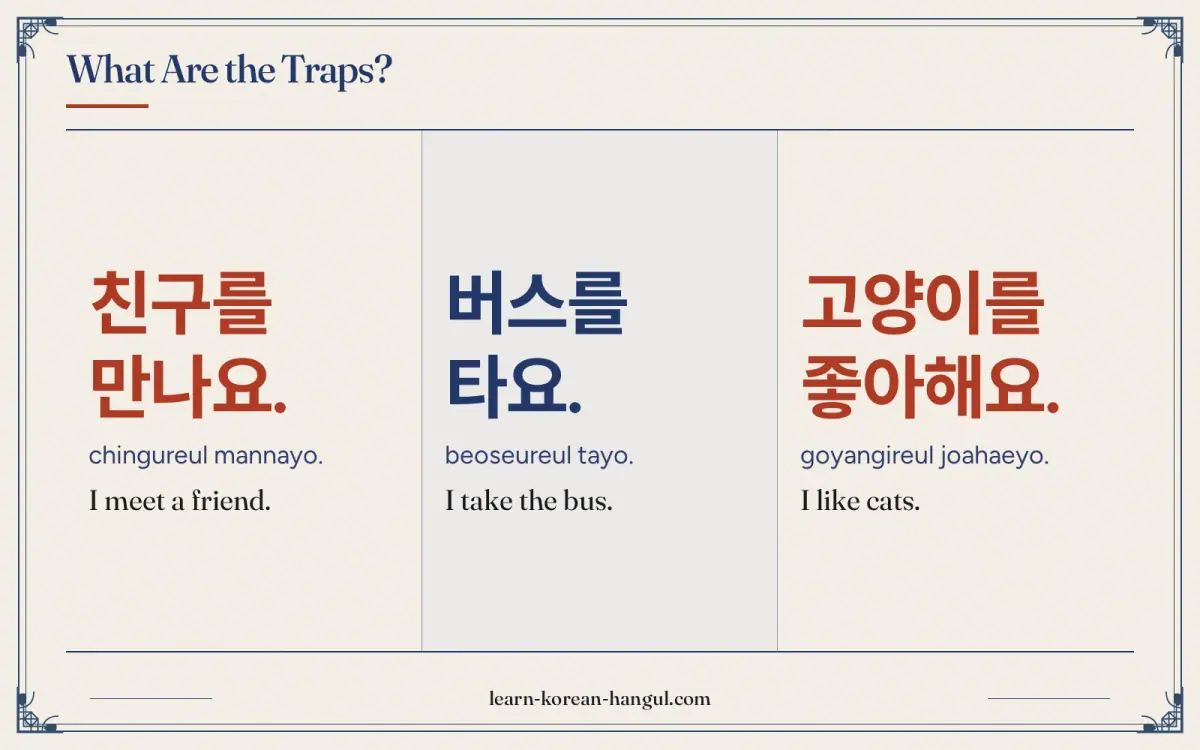
| meet a friend | 友達に会う | 친구를 만나요 | 만나다 takes the object particle 을/를 |
| ride a bus | バスに乗る | 버스를 타요 | 타다 takes 을/를, not 에 |
| like cats | 猫が好きだ | 고양이를 좋아해요 | 좋아하다 takes 을/를 |
| look like a father | 父に似ている | 아버지를 닮았어요 | 닮다 takes 을/를 |
친구를 만나요.
chingureul mannayo.
I meet a friend.
버스를 타요.
beoseureul tayo.
I take the bus.
고양이를 좋아해요.
goyangireul joahaeyo.
I like cats.
The third sentence is said [고양이를 조아해요], because the ㅎ of 좋 is not pronounced before the vowel. The adjective 좋다 behaves differently. It takes 이/가 for the thing that is good: 고양이가 좋아요 means "I like cats" in a softer, feeling-based way. The verb 좋아하다 (to like) takes 을/를, and the adjective 좋다 (to be good, to be pleasing) takes 이/가. A Japanese speaker used to 好きだ with が can confuse the two.
The pattern to remember is this: with Korean action verbs, the thing acted on takes 을/를, even when Japanese uses に. Check each new verb for its particle, and learn the particle together with the verb.
How Should Japanese Speakers Study?
Japanese speakers should spend time on sound first and grammar last. This order gets the most from what transfers.
- Learn Hangul in a week. There are 24 basic letters, and the syllable blocks will feel familiar after kana. The 7-day Hangul course is a short path.
- Train the ear early. Use minimal pairs such as 달, 딸, 탈 and 거리, 고리 before anything else.
- Practise final consonants out loud. Say 학, 밥, 집 and 꽃 with the sound stopped, not followed by a vowel.
- Skip long grammar explanations. You already know SOV order and particles. Learn Korean endings from example sentences.
- Map Japanese politeness onto Korean. ます becomes -요, and the plain form becomes casual 반말. See the table below.
- Use your Sino vocabulary. Match kanji words to Korean words in pairs, and check each one.
- Shadow short audio. Repeat sentences after the audio, then record yourself and compare.
A realistic first month is easier to plan with a weekly focus. Study six days a week for 30 to 45 minutes, which is three to four and a half hours a week.
| Week | Focus | Goal at the end |
|---|---|---|
| 1 | Hangul and the sounds of ㅓ, ㅡ and the consonant trio | Read and say any syllable block aloud |
| 2 | Final consonants and 20 Sino-Korean words from your kanji | Say 10 words with the final sound stopped |
| 3 | 해요 endings, the particles 은/는, 이/가, 을/를, 에, 에서 | Build 10 sentences with the verb last |
| 4 | The particle traps above and a first conversation | Introduce yourself and ask a simple question |
These are targets, not promises, and the pace depends on how often you practise.
The speech levels map as follows.
| Style | Japanese | Korean |
|---|---|---|
| Polite everyday | 食べます | 먹어요 |
| Casual | 食べる | 먹어 |
| Formal | 食べます (no separate form) | 먹습니다 |
| Honorific statement | 召し上がります | 드십니다 |
| Respectful request | 召し上がってください | 드세요 |
The Korean spoken forms are [머거요], [머거], [먹씀니다], [드심니다] and [드세요]. The honorific verb 드시다 replaces 먹다, just as 召し上がる replaces 食べる. The speech levels guide covers the full set.
도서관에서 책을 읽어요.
doseogwaneseo chaegeul ilgeoyo.
I read a book at the library.
This sentence is said [도서과네서 채글 일거요]. The final consonants link to the next vowel, which is the Korean sound change that Japanese speakers meet first.
What about Rhythm and Pitch?
Japanese is timed by mora, and Japanese words carry a pitch accent. Korean (in the Seoul standard) is closer to syllable timing and has no pitch accent on words. Japanese speakers often bring a fixed pitch pattern into Korean words, which can make speech sound sing-song. Let the pitch follow the phrase instead: a yes-or-no question usually ends with a rise, and a wh-question puts the prominence on the question word and does not end with a sharp rise. Listening to short audio clips and repeating them is the best cure.
Japanese speakers also tend to add a small vowel after a final consonant, and to shorten or lengthen vowels where Korean does not. The standard describes vowel length for some words, but most Seoul speakers no longer use it to tell words apart. Say 서울 as two clean syllables, not as "seo-u-ru".
How Do Everyday Phrases Map from Japanese?
Everyday politeness phrases do not map word for word, so learn the Korean phrase as a unit. These five pairs cover the first day.
| Japanese | Korean | RR | Use |
|---|---|---|---|
| すみません (calling someone) | 저기요 | jeogiyo | Call a waiter or a stranger |
| すみません (apology) | 죄송합니다 | joesonghamnida | Apologise formally |
| ありがとうございます | 감사합니다 | gamsahamnida | Thank someone politely |
| お願いします | 주세요 | juseyo | Ask for something ("please give me") |
| いただきます | 잘 먹겠습니다 | jal meokgetseumnida | Before eating |
Spoken, 죄송합니다 is [죄송함니다], with the ㅚ usually said like 웨, 감사합니다 is [감사함니다], and 잘 먹겠습니다 is [잘 먹께씀니다]. The Japanese すみません covers both calling someone and apologising, and Korean splits the two jobs. Using 죄송합니다 to call a waiter sounds odd, and using 저기요 to apologise sounds too casual.
Where Do Kanji Help?
Kanji help with vocabulary, not with daily reading. Everyday Korean is written in Hangul, so you can read menus, signs and messages without hanja. Hanja appear in names, legal text and some scholarly writing. Your kanji knowledge is useful for guessing and remembering Sino-Korean words, which is a large part of the vocabulary.
One caution: Korean uses the traditional forms, and Japanese often uses simplified ones.
| Meaning | Japanese form | Korean hanja |
|---|---|---|
| study | 学 | 學 |
| country | 国 | 國 |
| meeting | 会 | 會 |
| body | 体 | 體 |
A Japanese speaker who knows the older forms from names or classical texts will recognise many of these. Do not spend time learning to write hanja unless you want to. You can read the history in Hangul vs hanja.
How Do Names and Titles Differ?
Japanese -さん does not map to one Korean word. Korean uses 씨 after a full name (김민수 씨), 님 after a title or role (선생님, 사장님), and often avoids "you" altogether. Never add 씨 to your own name. In Japanese you also avoid -さん for yourself, so the rule will feel familiar. The honorifics 씨 and 님 lesson explains the choice.
Korean also puts the family name first, as Japanese does, and writes the full name without a space. A name like 김민수 is read as one unit, and there is no hanja needed to say it.
What Is Easier than You Expect?
Several parts of Korean are easier for a Japanese speaker than for other learners.
- Spacing. Korean puts spaces between words, which Japanese does not. This makes reading easier.
- Numbers. Korean has two number systems, a native one and a Sino-Korean one, just as Japanese has two. You already understand the idea.
- Counters. You already count with counters, and the Korean ones work the same way, though the forms are new.
- Typing. Hangul is typed letter by letter on a standard keyboard layout, and the computer joins the letters into blocks, so you can type after learning the letters.
- Loanwords. Many English-origin words appear in both languages, such as 커피 and コーヒー.
Check Yourself
Try these four questions. Each has one answer.
Practice · 4
Which Korean word matches the Japanese 銀行 (bank)?
Show answer
은행
은행 (eunhaeng) is the Korean word for bank, from the same Chinese roots as 銀行 (ginkō). 공항 means airport and 도서관 means library.
Which particle completes 친구( ) 만나요 (I meet a friend)?
Show answer
를
만나다 takes the object particle 를 after a vowel, even though the Japanese verb 会う takes に.
Which Korean number matches the Japanese 八 (hachi)?
Show answer
팔
Japanese -chi often matches a Korean final ㄹ, so 八 hachi matches 팔 (pal). 칠 is seven and 구 is nine.
Which sentence means "I like cats"?
Show answer
저는 고양이를 좋아해요.
좋아하다 takes the object particle 을/를. 에 and 로 do not fit this verb.
Frequently Asked Questions
Do I Need to Learn Hanja?
No. Everyday Korean is written in Hangul, and you can read signs, menus and messages without hanja. Your kanji knowledge helps you guess and remember Sino-Korean vocabulary, so use it that way. Learn to write hanja only if you have a reason, for example for names or classical texts. Korean uses traditional forms such as 學, not the simplified 学.
Is Korean Hard for Japanese People?
Not in grammar or vocabulary, where transfer is high, but pronunciation takes real work. Korean has more vowels than Japanese, a three-way consonant contrast (plain ㄱ, tense ㄲ, aspirated ㅋ) and final consonants. Most Japanese speakers find reading and basic sentences easy, then spend longer on sounds and speech levels.
How Long Does It Take Japanese Speakers to Learn Korean?
No official figure exists for Japanese speakers. The U.S. Foreign Service Institute lists Korean in Category IV for native English speakers, with about 88 weeks (2,200 class hours) of full-time training, and gives no separate estimate for Japanese. Japanese speakers usually move faster than English speakers on grammar, so treat any exact number as an estimate.
Which Resources Are Best for Japanese Speakers?
Choose materials that match your goal. Textbooks written for Japanese speakers explain the contrasts you need, such as sound pairs and particle differences. Use audio for sounds from day one, and check exam information on the official TOPIK site, topik.go.kr, if you plan to sit the test. Pick a resource you will use daily.
The Bottom Line
Is Korean easy for Japanese speakers? Mostly yes for grammar and vocabulary, and no for sounds. Use your head start to skip basic grammar, check Sino words against the table, and put your hardest work into the three-way consonants, final consonants and vowel pairs. A Japanese speaker who trains the ear early often finds the rest follows quickly.