Korean Clothing Flashcards: Study the 29 Cards
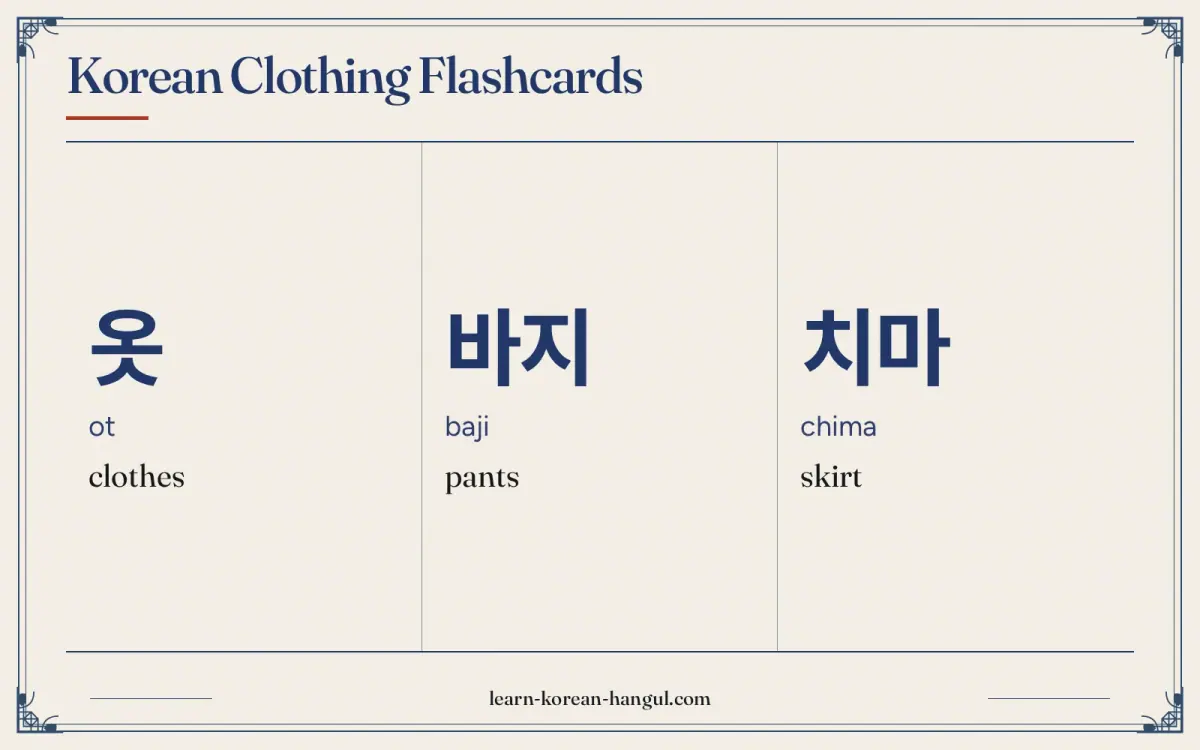
The cards start with the everyday items (cards 1 to 10: 옷, 바지, 치마, 티셔츠, 셔츠, 코트, 원피스, 청바지, 스웨터, 재킷), then traditional and under clothes (11 to 12), head and hand accessories (13 to 18), footwear (19 to 21), bags and other items (22 to 24), and the verbs (25 to 29). Learn each verb with the items it goes with.
How Do I Use These Flashcards?
Use the deck above in four steps. It works with tap, click or keyboard, and nothing plays until you press an audio button.
- Choose a mode. Start with recognition (Hangul to meaning). Switch to recall (meaning to Hangul) or listening (audio to meaning) once recognition feels easy.
- Show the answer. Think of the answer first, then press Show answer (or Space). Turn on the romanization toggle only if you need it; the table below always shows it.
- Grade yourself. Press Got it if you answered correctly without help, or Not yet if you hesitated or guessed.
- Finish the session. A session holds up to 20 cards (you can set 10, 20 or 40). With 29 cards, a first-time learner should expect about 3 days at the default limit of 10 new cards a day, with review sessions on top.
The Three Study Modes
Recognition shows the Hangul and asks for the meaning, so with the first card it shows 옷 and you answer "clothes". Recall reverses this: it shows the meaning and asks for the Hangul, and you may type the answer with your Hangul keyboard or just say it in your head. Listening plays a clip and hides the letters, which trains the ear. Listening mode only uses a card once its audio is approved, and cards without approved audio are skipped in that mode with a note. Recall mode is useful for the verbs: look at the English meaning and say which verb goes with the item.
Got It and Not Yet
Got it moves a card up one Leitner box, so it comes back later. Not yet sends the card back to box 1, so it returns in the same session or within 10 minutes. The grades are your own judgement; the deck does not score you or claim fluency.
Deck Scope: What Is and Is Not Covered
The deck covers clothes, shoes and accessories together with the verbs that say how each item is worn, which is the main trap in this theme. Colors and shopping words are left to their own decks. The words and letters on these cards are explained in the korean clothing vocabulary lesson, so read it first if a card is new.
What This Deck Leaves Out
Colors are in the Korean colors flashcards, and shopping and prices have their own lessons. Beauty and makeup words are not in this deck.
All 29 Cards in One Table
All 29 cards appear below in deck order. The table is plain HTML, so you can use it as a drill without the deck: cover the Meaning column, read each word aloud, then uncover it.
| # | Hangul | Revised Romanization | Meaning | Note | Audio assetId |
|---|---|---|---|---|---|
| 1 | 옷 | ot | clothes | 옷을 입어요 (I put on clothes). | au-pg-flashcards-clothing-1 |
| 2 | 바지 | baji | pants | 바지를 입어요 (I wear trousers). | au-pg-flashcards-clothing-2 |
| 3 | 치마 | chima | skirt | 치마를 입어요 (I wear a skirt). | au-pg-flashcards-clothing-3 |
| 4 | 티셔츠 | tisyeocheu | t-shirt | 티셔츠를 입어요 (I wear a T-shirt). English loanword. | au-pg-flashcards-clothing-4 |
| 5 | 셔츠 | syeocheu | shirt | English loanword. | au-pg-flashcards-clothing-5 |
| 6 | 코트 | koteu | coat | 코트를 입어요 (I wear a coat). English loanword. | au-pg-flashcards-clothing-6 |
| 7 | 원피스 | wonpiseu | dress | 원피스를 입어요 (I wear a dress). English loanword. | au-pg-flashcards-clothing-7 |
| 8 | 청바지 | cheongbaji | jeans | 청 is blue and 바지 is trousers. | au-pg-flashcards-clothing-8 |
| 9 | 스웨터 | seuweteo | sweater | English loanword. | au-pg-flashcards-clothing-9 |
| 10 | 재킷 | jaekit | jacket | English loanword. | au-pg-flashcards-clothing-10 |
| 11 | 한복 | hanbok | hanbok | Traditional Korean dress. | au-pg-flashcards-clothing-11 |
| 12 | 속옷 | sogot | underwear | Said [소곧]. | au-pg-flashcards-clothing-12; slow: au-pg-flashcards-clothing-30 |
| 13 | 모자 | moja | hat | 모자를 써요 (I wear a hat). | au-pg-flashcards-clothing-13 |
| 14 | 안경 | angyeong | glasses | 안경을 써요 (I wear glasses). | au-pg-flashcards-clothing-14 |
| 15 | 넥타이 | nektai | necktie | 넥타이를 매요 (I wear a tie). | au-pg-flashcards-clothing-15 |
| 16 | 목도리 | mokdori | scarf | Verb varies: 하다 or 두르다. | au-pg-flashcards-clothing-16 |
| 17 | 장갑 | janggap | gloves | 장갑을 껴요 (I wear gloves). | au-pg-flashcards-clothing-17 |
| 18 | 반지 | banji | ring | 반지를 껴요 (I wear a ring). | au-pg-flashcards-clothing-18 |
| 19 | 양말 | yangmal | socks | 양말을 신어요 (I put on socks). | au-pg-flashcards-clothing-19 |
| 20 | 신발 | sinbal | shoes | 신발을 신어요 (I put on shoes). | au-pg-flashcards-clothing-20 |
| 21 | 운동화 | undonghwa | sneakers | 운동화를 신어요 (I wear sneakers). | au-pg-flashcards-clothing-21 |
| 22 | 손목시계 | sonmoksigye | wristwatch | 손목시계를 샀어요 (I bought a wristwatch). | au-pg-flashcards-clothing-22 |
| 23 | 가방 | gabang | bag | 제 가방은 무거워요 (My bag is heavy). | au-pg-flashcards-clothing-23 |
| 24 | 우산 | usan | umbrella | 우산을 가져왔어요? (Did you bring an umbrella?). | au-pg-flashcards-clothing-24 |
| 25 | 입다 | ipda | to wear (clothes) | 옷을 입어요. For clothes on the body. | au-pg-flashcards-clothing-25; slow: au-pg-flashcards-clothing-31 |
| 26 | 신다 | sinda | to wear (shoes) | 신발을 신어요. For anything on the feet. | au-pg-flashcards-clothing-26 |
| 27 | 쓰다 | sseuda | to wear (hat) | 모자를 써요. For items on the head or face. | au-pg-flashcards-clothing-27 |
| 28 | 끼다 | kkida | to wear (gloves/rings) | 반지를 껴요. For tight or inserted items. | au-pg-flashcards-clothing-28 |
| 29 | 벗다 | beotda | to take off | 옷을 벗다. The opposite of 입다, 신다 and 쓰다; a ring comes off with 빼다. | au-pg-flashcards-clothing-29 |
Reading the Table
Hangul is the word. Revised Romanization (RR) is a learning aid, so read the Hangul first. RR follows the pronunciation, so 속옷 is written sogot because it is said [소곧]. It does not mark tensing, so 입다 [입따] is written ipda. The Meaning column gives the English gloss, and the Note column gives an example or a sound hint. A second ID in the last column marks a slow clip.
Usage Notes for These Cards
입다 is for clothes on the body. Use it for 바지, 치마, 코트 and 티셔츠: 코트를 입어요 (I wear a coat).
신다 is for anything on the feet. 양말을 신어요 (I put on socks), 운동화를 신어요 (I wear sneakers).
쓰다 covers items on the head or face. 모자를 써요 (I wear a hat). The same verb also means to write and to use, so the object tells you which meaning is meant.
끼다 is for tight-fitting or inserted items. 반지를 껴요 (I wear a ring), and 장갑 (gloves) take it too. 안경을 끼다 is also correct.
벗다 undoes most of them. 옷을 벗다, 신발을 벗다, 모자를 벗다 and 안경을 벗다 all work; only a ring comes off with 빼다.
Which Sounds Do Not Match the Spelling?
속옷 is said [소곧]: the final ㄱ of 속 links to the empty onset of 옷, and the final ㅅ is read as ㄷ at the end of the word.
옷이 is said [오시]: before a vowel particle the ㅅ is pronounced as s instead of the ㄷ sound that 옷 has alone.
입다 is said [입따]: the ㄷ after a ㅂ final is tensified. Revised Romanization writes ipda.
What Mistakes Do Learners Make with Clothing Words?
- Using 입다 for shoes. Say 신발을 신다.
- Using 입다 for glasses. Say 안경을 쓰다 or 안경을 끼다.
- Using 입다 for hats. A hat takes 쓰다: 모자를 쓰다.
- Using 벗다 only for clothes. It works for shoes, hats and glasses too.
These mistakes all come from choosing one English verb, wear, for four Korean verbs, so learn each verb with its items.
How Does the Review Schedule Work?
The deck uses a simplified Leitner system with five boxes. A new card starts in box 1. Each Got it moves it up one box, and each Not yet returns it to box 1. The box sets how long the card waits before it is due again.
| Box | Wait until the next review |
|---|---|
| 1 | same session or 10 minutes |
| 2 | 1 day |
| 3 | 3 days |
| 4 | 7 days |
| 5 | 21 days |
Each session shows due cards first, oldest due first, and then new cards up to the daily limit, which is 10 by default. A deck of 29 cards is introduced in about three days at the default of 10 new cards a day, and the later boxes bring each item back at longer gaps. Progress is saved only in this browser, so clearing site data deletes it. Use the export button to save a small JSON file with card IDs, boxes and due dates, and import it on another device. The file holds no personal data.
Cultural and Practical Context
Core words like 옷 and 신발 are native Korean, while most item names such as 티셔츠 and 코트 are English loanwords. 한복 is the traditional Korean dress and is worn on holidays and at weddings. Taking off your shoes at the door is normal in Korean homes, so 신발을 벗다 is a phrase you will use often.
Limits of This Deck
The deck holds 29 cards, a starting set rather than a clothing dictionary. It has no verbs for necklaces or earrings (목걸이 and 귀걸이 take 하다 or 걸다 and are left out on purpose), and it does not cover sizes or fabrics. The verb for a scarf (목도리) varies by speaker, so check it with a teacher. The Korean text on this page is generated and was reviewed and signed off by Min-ji Park on 15 October 2026.
Next Steps after This Deck
This deck is one of the korean vocabulary flashcards on the site, so browse the full list if you want a different topic. When these cards feel easy, move on to korean daily routine flashcards to keep the same routine. For a related topic, try korean house vocabulary flashcards. After a session, write the same words by hand with the korean daily life vocabulary worksheet. All flashcard decks, including Hangul, vocabulary, phrases, grammar and TOPIK, are listed on the Korean flashcards hub.
Frequently Asked Questions
Do I Say 안경을 쓰다 or 끼다?
Both are correct and both mean to wear glasses, though 쓰다 is heard more often. The deck keeps 쓰다 as the main verb because it also covers hats and other items on the head and face.
How Do I Say Put on a Ring?
반지를 끼다. 끼다 is used for tight-fitting or inserted items such as rings and gloves. To say I am wearing a ring, use 반지를 끼고 있어요. To take it off, use 반지를 빼다.
What Verb Goes with a Scarf?
목도리를 하다 or 두르다, since the scarf is wrapped around the neck. Some speakers use 하다 for most accessories, and 목도리를 두르다 describes the wrapping action. The choice varies by speaker.
What Does 청바지 Mean Literally?
청 is blue and 바지 is trousers, so 청바지 is the word for jeans. Notice that 청바지 is a compound built from a Sino-Korean syllable and a native word. You wear them with 입다: 청바지를 입어요.
Is My Progress Saved If I Close the Page?
Yes, in the same browser on the same device. Card boxes and due dates are stored locally and nothing is sent to a server. Clearing site data, using a private window or switching browsers removes them, so use the export button to keep a backup file. No account is needed.