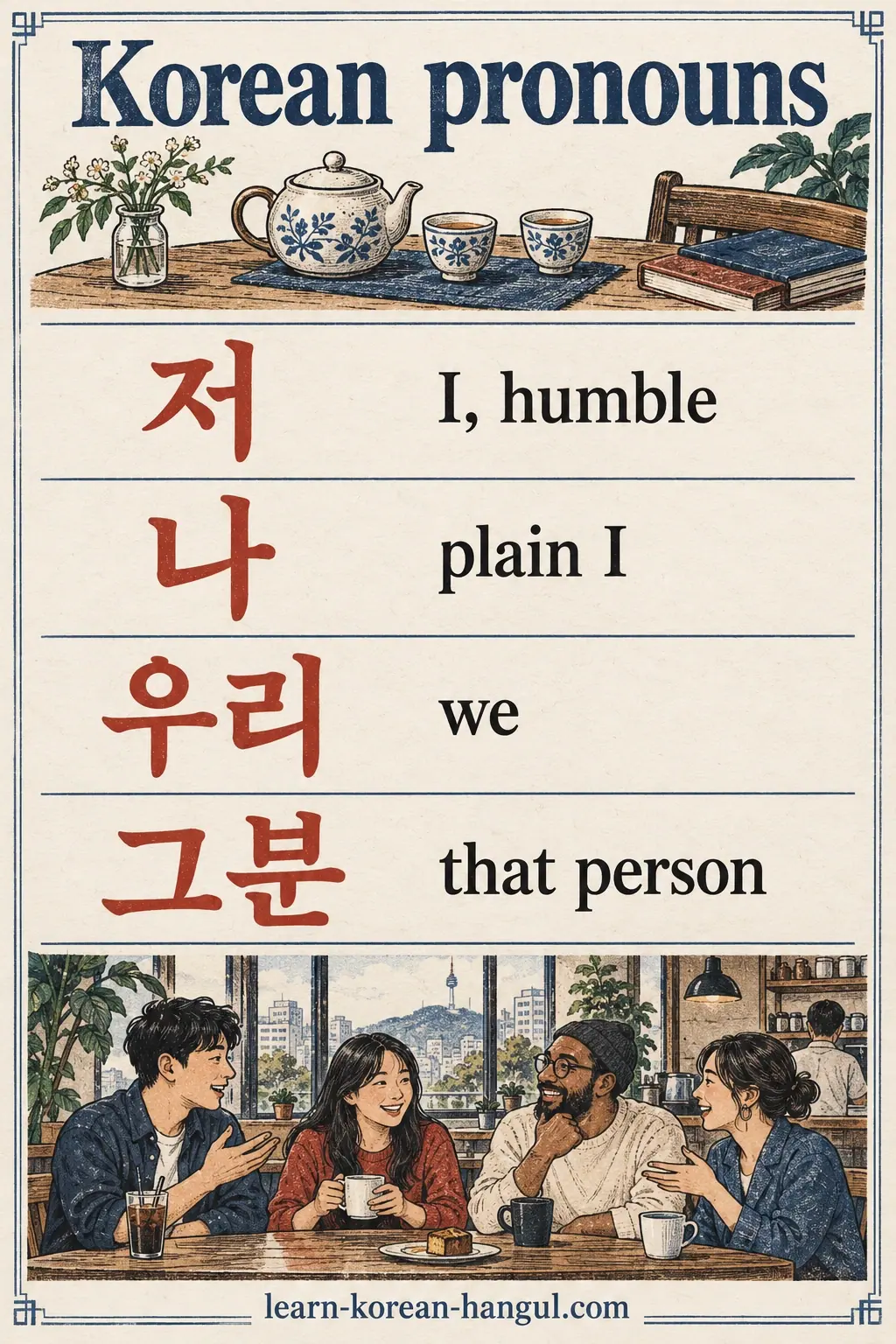
Korean pronouns (대명사) are words that replace nouns, such as 저 and 나 for "I", 우리 for "we" and 그분 for "that person". Korean pronouns change with politeness: 저 is humble "I", 나 is plain "I", and "you" is usually avoided. Speakers also drop pronouns whenever the listener can guess them.
What you'll learn
- Choose between 저 and 나 for "I" by checking who you are speaking to.
- Use 우리 for "we" and "our", including the cases where English says "my".
- Address a person without the word "you", using a name, a title or nothing.
- Drop a pronoun when the context already supplies it.
Prerequisite: you know that Korean adjectives are verbs and can read the polite ending 요. Estimated time: 25 minutes.
What Are Korean Pronouns (대명사)?

Korean pronouns are words that stand in for a noun, such as a person's name or a thing. The grammar term is 대명사 (daemyeongsa), literally "replacement noun". Korean has personal pronouns for people (저, 나, 너), demonstrative pronouns for pointing (이것, 그것, 저것) and question pronouns such as 누구 (who).
Korean pronouns differ from English ones in two ways. First, they carry a politeness level: there are two common words for "I", and the choice tells the listener how you see them. Second, they are optional: a Korean sentence is complete without any pronoun when the context is clear. This lesson teaches how the personal pronouns behave. The full vocabulary list of pronouns is on the Korean pronouns vocabulary page.
A First Look: Two Annotated Examples
Example 1. 저는 민수예요. (jeoneun minsuyeyo.) means "I am Minsu." The parts are 저 (I, humble), 는 (topic particle), 민수 (the name Minsu) and 예요 (am; the polite form of "to be" after a vowel). This is the standard way to introduce yourself.
Example 2. 우리 집은 서울에 있어요. (uri jibeun seoure isseoyo.) means "Our house is in Seoul." The parts are 우리 (our), 집 (house), 은 (topic particle), 서울에 (in Seoul) and 있어요 (exists). Notice that 우리 works as "our" directly before a noun.
The two sentences show the two jobs of a personal pronoun: naming a speaker (저) and marking ownership (우리). The next section lays out which pronoun fits which listener.
How Do Korean Pronouns Work?

Korean pronouns work by matching the word to your relationship with the listener, then adding a particle for the role. Use the polite or humble form with strangers, elders and colleagues, and the plain form with close friends and people younger than you. Then pick the particle by the last sound, as you do with any noun.
| Person | Polite or humble | Plain | Possessive (my, our) | Notes |
|---|---|---|---|---|
| I | 저 | 나 | 제 / 내 | subject forms: 제가 / 내가 |
| We | 저희 | 우리 | 저희 / 우리 | 저희 is humble, 우리 is the common word |
| You | name + 씨, a title | 너 | 네 (your) | 당신 is rare and often rude; 네 is often said [니] |
| You (all) | 여러분 | 너희 | 너희 | 여러분 suits an audience |
| He, she | 그분 (respectful) | 그 사람 | 그 사람의 | 그 and 그녀 sound written |
The subject particle changes the shape of the first-person pronouns. 저 + 가 becomes 제가, and 나 + 가 becomes 내가, never 저가 or 나가. The topic forms stay regular: 저는 and 나는.
The same two words also mark the possessive. 제 이름은 민수예요 (my name is Minsu) uses 제, the possessive form of 저. The full possessive set has its own page on Korean possessive pronouns 내 제 네.
The table is a guide, not a law: politeness depends on age, rank and closeness together, and the same person may switch levels as a relationship changes. With the forms laid out, the next section builds one sentence step by step.
Worked Example: Building 저는 민수예요

Building 저는 민수예요 takes four steps, and each step ends with a check.
- Choose the pronoun by listener. You are meeting someone for the first time, so use the humble 저. Check: a stranger means 저, not 나.
- Attach the topic particle. 저 ends in a vowel, so the particle is 는: 저는. Check: 는 attaches with no space.
- Add your name. 민수 is a noun. Check: a name needs no article or title for yourself.
- Close with the polite "to be". 민수 ends in a vowel, so use 예요, not 이에요: 민수예요. Check: names ending in a consonant take 이에요, as in 지은이에요.
You will know it worked when you can swap in another name and keep the frame: 저는 지은이에요 (I am Jieun). The choice between 예요 and 이에요 is explained in the lesson on 이에요/예요.
The same sentence with the plain pronoun, 나는 민수야, sounds natural between friends. The comparison section explains why.
How Do 저 and 나 Differ?

The pronouns 저 and 나 differ in politeness: 저 lowers yourself in respect to the listener, and 나 is the neutral form for people you are close to or senior to. The pair should match the verb ending in the same sentence.
| Feature | 저 (humble I) | 나 (plain I) |
|---|---|---|
| Listener | stranger, elder, boss, customer | close friend, family, younger person |
| Matching ending | 요 or 습니다: 학생이에요 | 야 or 어/아: 학생이야 |
| Subject form | 제가 | 내가 |
| Possessive | 제 | 내 |
| Example | 저는 학생이에요. | 나는 학생이야. |
Mixing the levels in one sentence sounds odd. 저는 학생이야 pairs a humble pronoun with a casual ending, and 나는 학생이에요 pairs a plain pronoun with a polite ending. The second pairing is less jarring and is used by some speakers, but a learner should keep the pair matched.
How Do 너 and 당신 Differ?
The pronouns 너 and 당신 both mean "you", but neither is a safe default. The word 너 is plain and only fits close friends and people younger than you. The word 당신 sounds cold or confrontational in most conversations. Married couples may use it, it appears in song lyrics, and it appears in formal writing such as notices. Outside those uses, avoid it.
The next section shows what to say instead.
How Do You Say "You" in Korean?

You say "you" in Korean by using the person's name plus 씨, a title, or no word at all. Korean avoids a direct "you" because naming a person's rank or relation is more respectful than pointing at them with a pronoun.
- Name + 씨. 민수 씨, 안녕하세요? means "Minsu, hello." The suffix 씨 is polite for peers and juniors.
- A title. 선생님, 어디 가세요? means "Teacher, where are you going?" Use 선생님 (teacher) for teachers and respected adults, and job titles such as 사장님 (company president) at work.
- A group word. 여러분 means "everyone" and is right for an audience or a class.
- Nothing. 어디 가세요? is complete: the honorific ending 세요 already points to the listener.
The fuller guide to "you" is on the page about the Korean word for you, which sits in the speech-levels section.
When Do Korean Pronouns Behave Differently?

Korean pronouns behave differently from English ones in three edge cases: 우리 for one owner, dropped pronouns, and avoided third-person words. This section covers each. The honest limit: it teaches the common patterns, not every regional or generational variation.
우리 for one owner. The word 우리 means "we" or "our", yet speakers use it for one person's family and places. 우리 엄마예요 means "This is my mom", and 우리 집 means "my home". Using 내 엄마 is not wrong grammar, but it sounds like you are contrasting her with someone else's mom.
Dropped pronouns. Korean drops a pronoun whenever the listener can guess it. 학생이에요 can mean "I am a student" or "You are a student" or "She is a student", depending on the conversation. The lesson on dropping the subject in Korean gives the rules. Using 저는 in every sentence sounds stiff, so add it when you introduce yourself or contrast two people.
We, humble and plain. English has one word for "we"; Korean has two. The word 우리 is the everyday choice among equals and for groups you belong to. The word 저희 is the humble partner of 우리 and fits when you speak for your group to someone of higher status, such as a customer: 저희 회사 (our company). Use 저희 only for a group that leaves the listener out, such as 저희 회사 to a customer or 저희 어머니 (my mother) to a teacher. A common slip is 저희 나라 for Korea when talking to other Koreans, who share that country; the National Institute of Korean Language advises 우리나라.
Third person. Korean speech prefers names and 그 사람 (that person) over he and she. The pointing words 이, 그 and 저 are a separate set of pronouns, taught in the lesson on 이 그 저 Korean demonstratives.
Common Mistakes with Korean Pronouns
Most mistakes come from translating each English pronoun word by word. Each one below follows what learners assume, what is true and why.
Using 당신 for "you". Learners often assume 당신 is the Korean "you"; actually it sounds cold or confrontational outside songs, spouses and angry exchanges, so use a name, a title or nothing.
Saying "I" in every sentence. Learners often assume Korean needs a subject like English; actually the subject is dropped when clear, so 학생이에요 is enough after you have introduced yourself.
Mixing 저 with a casual ending. Learners often write 저는 학생이야; actually the humble pronoun belongs with polite endings, so use 저는 학생이에요 or 나는 학생이야.
Writing 저가 or 나가. Learners often attach the subject particle 가 directly; actually the pronouns change shape, giving 제가 and 내가.
Using "my" for family. Learners often say 제 엄마 for "my mom"; actually 우리 엄마 is the usual choice.
The shared cause is the same: English pronouns carry only person and number, but Korean pronouns also carry a relationship. Check the listener first, then choose the word.
Practice: Choose, Fix, Translate and Write
Try these before reading the answers.
Exercise 1. Choose the pronoun. Write 저 or 나.
- You are talking to your new boss: ___는 민수예요.
- You are talking to your best friend: ___는 학생이야.
Exercise 2. Fix the error.
당신, 어디 가세요? (Meaning: Teacher, where are you going?)
Exercise 3. Translate into Korean. "My mom is a teacher." Use 우리 for "my".
Exercise 4. Write your own. Introduce yourself with the frame 저는 ___예요 or 저는 ___이에요, using your own name.
Sentence
Our house is in Seoul.
Show answer
우리 집은 서울에 있어요
Practice · 3
Which pronoun fits a first meeting with an elder?
Show answer
저
What is the subject form of 나?
Show answer
내가
Which is the natural way to say 'my home'?
Show answer
우리 집
Answers.
- Exercise 1: item 1 is 저는 민수예요 (a boss needs the humble form); item 2 is 나는 학생이야 (a close friend allows the plain form).
- Exercise 2: 선생님, 어디 가세요? Replace 당신 with the title 선생님, or drop it.
- Exercise 3: 우리 엄마는 선생님이에요. The noun 선생님 ends in a consonant, so the ending is 이에요.
- Exercise 4: answers vary. A correct model is 저는 지은이에요 (I am Jieun).
- Bonus: a dropped-pronoun reply to "Are you a student?" is 학생이에요, with the subject understood.
Where to Go after Korean Pronouns
After Korean pronouns, learn the pointing words in 이 그 저 Korean demonstratives, which give Korean its three distances for "this" and "that". Then read dropping the subject in Korean to see when the pronouns in this lesson can disappear. For memorising the pronoun set with audio, use the Korean pronouns vocabulary page, and for the politeness system behind 저 and 나 see the Korean word for you page. The other lessons in this set are in Korean parts of speech.
This lesson does not cover every honorific, regional pronoun or the casual contractions used among friends. Those topics have their own pages.
In short, Korean pronouns are chosen by relationship: 저 for polite "I", 나 for plain "I", 우리 for "we" and "our", names or titles for "you", and often nothing at all.
Frequently Asked Questions
What is the difference between 저 and 나? Both mean 'I', but 저 is the humble, polite form used with strangers, elders and in work settings, while 나 is the plain form used with close friends, family and people younger than you. With a polite ending like 요, choose 저. With a casual ending like 야, 나 is natural.
How do you say 'you' in Korean? Usually you do not. Korean speakers use the person's name with 씨, a title such as 선생님, or drop the word because context shows who is meant. The pronoun 너 is plain and only for close friends or juniors. The pronoun 당신 sounds cold or confrontational in most conversations.
Do Korean sentences always need a pronoun? No. Korean drops pronouns whenever the listener can guess them. 학생이에요 can mean 'I am a student', 'you are a student' or 'she is a student', depending on the context. Adding 저는 each time sounds stiff. Use a pronoun when you introduce yourself, contrast two people or avoid confusion.
Why do Koreans say 우리 for one person's family? Korean treats close relationships and shared places as belonging to the group, so 우리 (we, our) appears in 우리 엄마 (my mom), 우리 집 (my home) and 우리 학교 (my school). Using 제 or 내 for these words is understandable, but 우리 is the usual choice.
Does Korean have he and she? Spoken Korean mostly avoids them. Speakers repeat the name or say 그 사람 (that person), and use 그분 (that person, respectful) for someone older. The words 그 and 그녀 exist as he and she, but they sound written or translated, so beginners should prefer names and 그 사람 in conversation.