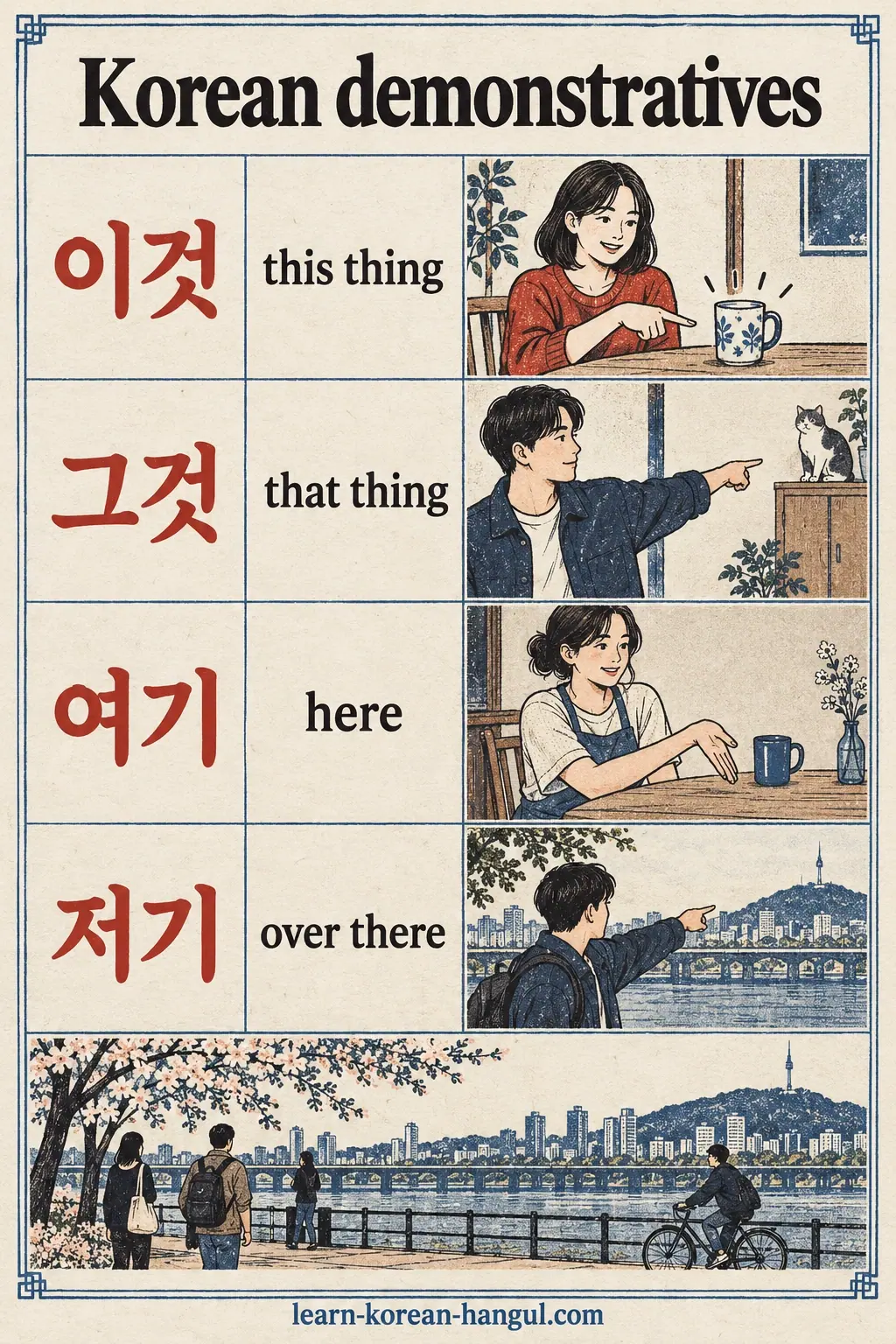
The 이 그 저 Korean demonstratives are three pointing words: 이 means "this", 그 means "that" near you or already mentioned, and 저 means "that over there". Korean has three distances where English has two, and the right word depends on where the listener is, not only where the speaker is.
What you'll learn
- Choose 이, 그 or 저 by checking where the object is relative to speaker and listener.
- Build the fixed words for things, places and polite people from the three roots.
- Use the right particle after 이것, 여기 and similar words.
- Recognise the casual contractions 이건, 이게 and 이걸 in speech.
Prerequisite: you have read about Korean pronouns, because demonstratives are pointing pronouns. Estimated time: 25 minutes.
What Do the 이 그 저 Korean Demonstratives Mean?

The 이 그 저 Korean demonstratives are words that point to something by its distance. A demonstrative (지시어, jisieo) is a word like "this" or "that" that picks out one thing from the rest. Korean uses three roots, and each root has a place in the room.
- 이 means "this": close to the speaker.
- 그 means "that": close to the listener, or already talked about.
- 저 means "that over there": far from both the speaker and the listener.
English has "this" and "that", so the Korean middle zone has no English partner. English speakers often squeeze 그 into "that" and 저 into "that" too, which loses the difference. Keep the three zones separate and the system becomes simple.
A First Look: Two Annotated Examples
Example 1. 이것은 뭐예요? (igeoseun mwoyeyo?) means "What is this?" The parts are 이것 (this thing), 은 (topic particle) and 뭐예요 (what is it?). You point to something near you and ask. Say it as [이거슨 뭐예요].
Example 2. 저기가 화장실이에요. (jeogiga hwajangsirieyo.) means "The restroom is over there." The parts are 저기 (over there), 가 (subject particle), 화장실 (restroom) and 이에요 (is). The sound changes at the end: 화장실이에요 sounds like [화장시리에요].
The first sentence points at something close and the second at something far. Both use the same system, which the next section lays out in one table.
How Do the 이 그 저 Korean Demonstratives Work?

The 이 그 저 Korean demonstratives work by combining one of three roots with a fixed second part. Put the root before a noun to say "this book", or choose a ready-made word for things, places or polite people. Each root forms four common patterns.
| Distance | Before a noun | Thing | Place | Polite person |
|---|---|---|---|---|
| Near me | 이 (this) | 이것 (this thing) | 여기 (here) | 이분 (this person) |
| Near you or known | 그 (that) | 그것 (that thing) | 거기 (there) | 그분 (that person) |
| Far from both | 저 (that over there) | 저것 (that thing over there) | 저기 (over there) | 저분 (that person over there) |
Three rules sit under the table.
- Before a noun, use the short root. Say 이 책 (this book), 그 사람 (that person), 저 건물 (that building over there). Do not add 것 here.
- Without a noun, use the fixed word. Say 이것 for "this one". The word is a noun, so it takes particles: 이것은, 이것이, 이것을.
- Places take particles too. 여기가 (here as subject), 거기에 (at there), 저기로 (toward over there).
Here are three full sentences, one per root.
The sentences mean "This book is interesting", "That person is a student" and "That building over there is a school". The pattern for every one is the same: pointing word, noun, particle, predicate. Now one worked example shows how the choice is made in the moment.
Worked Example: Choosing the Right Word for a Cup
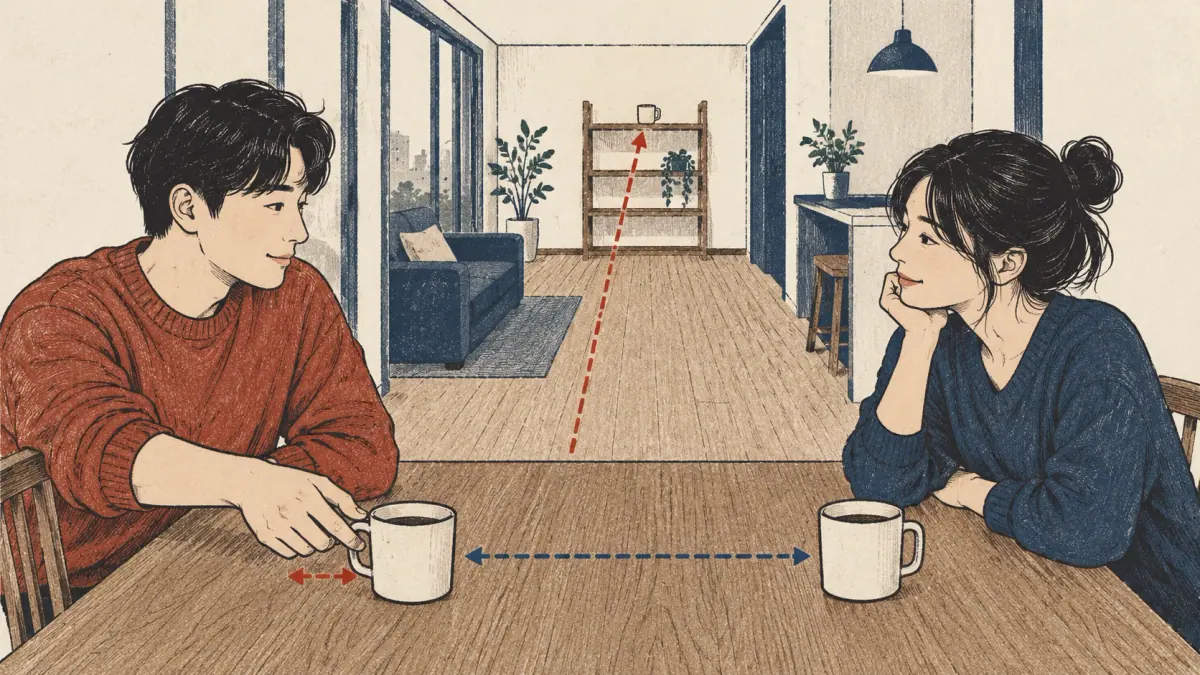
Choosing the right word takes three questions asked in order, and each question has a check.
Imagine two people at a cafe table. A cup sits in front of you, a second cup sits in front of your friend, and a third cup sits on a shelf across the room.
- Is it near the speaker? The cup in front of you is. Use 이: 이 컵 (this cup). Check: if you can touch it, it is 이.
- Is it near the listener, or have you both already talked about it? The cup in front of your friend is. Use 그: 그 컵 (that cup near you). Check: if the listener can touch it, it is 그.
- Is it far from both? The cup on the shelf is. Use 저: 저 컵 (that cup over there). Check: if neither of you can touch it, it is 저.
Say 이것은 뭐예요? for the first cup, 그것은 뭐예요? for the second, and 저것은 뭐예요? for the third. You will know it worked when you can answer "which word?" without translating into English first.
The same logic applies to places. Standing together, say 여기 (here). Talking to a friend on the phone about where they are, say 거기 (there, near you): 거기 날씨가 어때요? means "How is the weather there?"
The phone example shows that 그 and 거기 follow the listener, which is the key difference from English "that". The next section compares the three words directly.
How Are 그 and 저 Different?

The words 그 and 저 differ in who is close to the object: 그 is close to the listener or already known, and 저 is far from both people. English "that" covers both, so English speakers must learn to ask "who is it near?" before choosing.
| Question | 이 | 그 | 저 |
|---|---|---|---|
| Near the speaker? | yes | no | no |
| Near the listener? | no | yes | no |
| Far from both? | no | no | yes |
| Already mentioned? | sometimes | yes (the usual choice) | no |
| English gloss | this | that (near you) | that (over there) |
The second use of 그 is "already mentioned" and it works even for things that are far away. If you say 어제 영화를 봤어요 (I watched a movie yesterday) and continue 그 영화는 재미있었어요 (that movie was fun), 그 refers back to the movie. No physical distance is involved.
A fair limit: this lesson gives the core rule, and spoken Korean has finer uses. Speakers use 이 and 그 for time, feelings and ideas in ways that go beyond pointing, such as 그때 (at that time). Those uses belong to later lessons.
What Are the Casual Contractions?
The casual contractions shorten the fixed word plus a particle into one sound. In speech, 이것은 becomes 이건, 그것은 becomes 그건, and 이것이 becomes 이게. The object forms shorten too: 이것을 becomes 이걸.
| Full form | Contraction | Meaning |
|---|---|---|
| 이것은 / 그것은 / 저것은 | 이건 / 그건 / 저건 | this / that / that over there, as topic |
| 이것이 / 그것이 / 저것이 | 이게 / 그게 / 저게 | as subject |
| 이것을 / 그것을 / 저것을 | 이걸 / 그걸 / 저걸 | as object |
The contractions are normal in everyday speech and appear in dialogues, so learn to hear them early. In careful writing and formal speech, keep the full forms.
When Do the Words Behave Differently?

The demonstratives behave differently in three cases: the homophone 저, plural forms, and polite person words. This section covers each.
The homophone 저. The root 저 (that over there) sounds the same as the pronoun 저 (humble "I"). They are two separate words. In 저는 저 책이 좋아요 (I like that book over there), the first 저 is "I" and the second is "that". The position tells you: a demonstrative comes right before a noun, and the pronoun carries the particle.
Plurals. Add 들 to the fixed noun: 이것들 (these things), 저것들 (those things over there). Before a noun the root stays unchanged, and plural is usually left to context, as the lesson on Korean nouns explains.
People. For a person, 이 사람 (this person) is neutral, and 이분 is respectful. Use 이분, 그분 and 저분 for elders and people you must honour. Never point at an elder with 이것, because 것 means "thing".
The demonstratives also have question partners built on other roots: 어디 (where) asks about 여기, 거기 and 저기, and 뭐 (what) asks about 이것, 그것 and 저것. See the lessons on 어디 where in Korean and 뭐 무엇 what in Korean.
Common Mistakes with 이 그 저 Korean Demonstratives
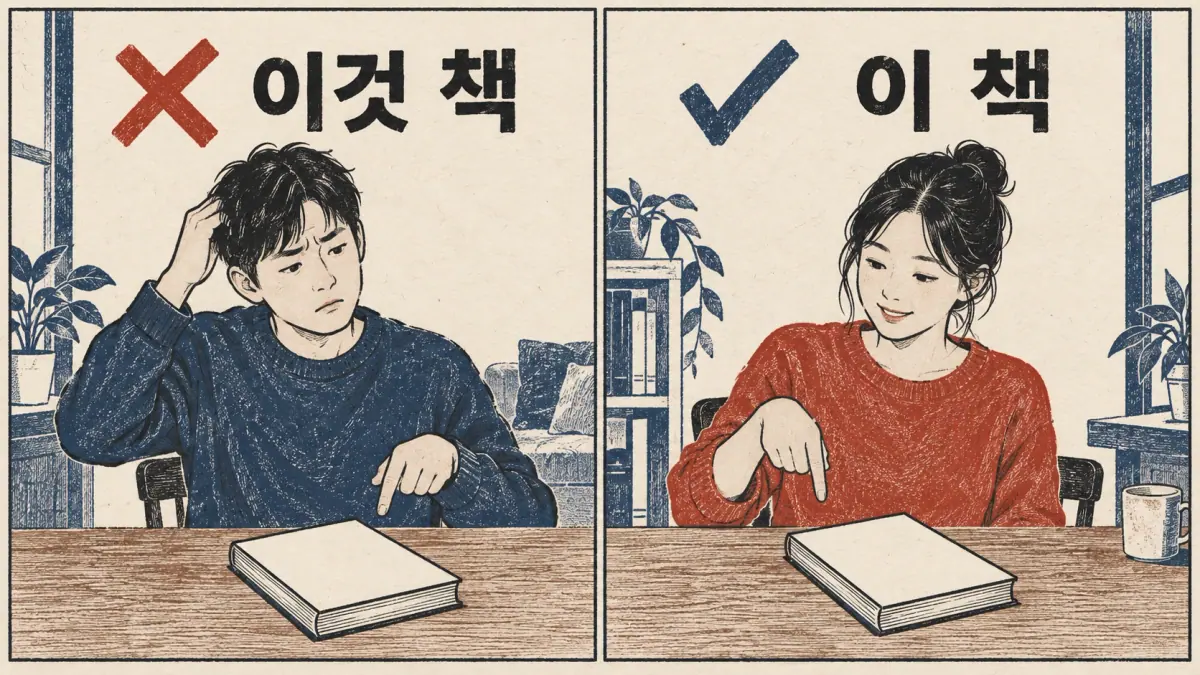
Most mistakes come from mapping Korean onto the two English words. Each mistake below shows what learners assume, what is true and why.
Using 그 for something far from both people. Learners often assume 그 is the usual "that"; actually 그 is near the listener or already known, and something far from both needs 저. Point across a room with 저 건물, not 그 건물.
Writing 이것 before a noun. Learners often write 이것 책 for "this book"; actually 이것 means "this thing" and is already a noun, so write 이 책.
Skipping the listener. Learners often choose the word by distance from themselves only; actually Korean checks the listener too, which is why phone talk uses 거기 for the other person's place.
Mixing up the two 저. Learners often read 저 책 as "my book"; actually 저 before a noun is "that over there", and "my" is 제: 제 책 (my book).
Using 이것 for people. Learners often say 이것 for "this person"; actually people take 이 사람 or the respectful 이분.
Each of these is a three-distance problem. When in doubt, point at the object and ask two questions: near me, near you, or neither?
Practice: Choose, Fix, Translate and Write
Try these before reading the answers.
Exercise 1. Choose 이, 그 or 저.
- The book is in your hand: ___ 책은 재미있어요.
- The building is across the street from both of you: ___ 건물은 학교예요.
- Your friend holds a cup and you ask about it: ___ 컵은 뭐예요?
Exercise 2. Fix the error.
이것 책은 재미있어요. (Meaning: This book is interesting.)
Exercise 3. Translate into Korean. "What is that over there?" Use the fixed word for a far thing.
Exercise 4. Write your own. Use 여기, 거기 or 저기 in one sentence about a place you know.
Sentence
The restroom is over there.
Show answer
저기가 화장실이에요
Practice · 3
Which word means 'that over there' before a noun?
Show answer
저
Which contraction means 'this, as subject'?
Show answer
이게
Which word fits 'the weather where you are'?
Show answer
거기
Answers.
- Exercise 1: item 1 is 이 (near the speaker); item 2 is 저 (far from both); item 3 is 그 (near the listener).
- Exercise 2: 이 책은 재미있어요. The word 이것 is a noun and cannot sit before another noun.
- Exercise 3: 저것은 뭐예요? or, in speech, 저건 뭐예요?
- Exercise 4: answers vary. A correct model is 저기가 제 학교예요 (my school is over there).
Where to Go after the 이 그 저 Korean Demonstratives
After the 이 그 저 Korean demonstratives, learn the "some" and "any" words in Korean indefinite pronouns 누군가 아무, such as 누군가 (someone), built from the question word 누구 (who). Then practise the question words 뭐 and 어디 in 뭐 무엇 what in Korean and 어디 where in Korean. Review the particle choice in topic particle 은/는 if 이것은 versus 이것이 still feels slow. For the memorisation list, use the Korean pronouns vocabulary page, and for the other word classes see Korean parts of speech.
This lesson does not cover the manner forms 이렇게, 그렇게, 저렇게 (like this), the kind forms 이런, 그런, 저런 (this kind of), or direction words such as 이쪽. Those words reuse the same three roots.
In short, the 이 그 저 Korean demonstratives split space into three zones: 이 near the speaker, 그 near the listener or already mentioned, and 저 far from both.
Frequently Asked Questions
What is the difference between 그 and 저? Both mean 'that', but 그 points to something near the listener or already mentioned, while 저 points to something far from both speaker and listener. If a friend holds a cup next to you, call it 그 컵. If a cup sits across the room from both of you, call it 저 컵.
Is 이 the same as 이것? No. The word 이 must come before a noun (이 책, this book), while 이것 means 'this thing' and stands alone as a noun (이것은 책이에요, this is a book). Writing 이것 책 is a mistake. Use 이 책 or 이것 alone, never both together.
How do you say here and there in Korean? Korean uses 여기 (here, near me), 거기 (there, near you) and 저기 (over there, far from both). They mark places and take particles like any noun: 여기가 어디예요? means 'Where is here?' and 저기에 있어요 means 'It is over there.'
Why does 저 mean both 'I' and 'that'? They are two different words that happen to sound the same. The pronoun 저 means a humble 'I', as in 저는 학생이에요. The demonstrative 저 means 'that over there' and comes before a noun, as in 저 건물. Context and word position tell them apart.
Do Korean demonstratives change for plural? The words themselves do not change, but you can add 들 to the fixed nouns: 이것들 (these things) and 저것들 (those things over there). Before a noun, 이 책 can mean this book, and 이 책들 means these books. Natural speech often leaves the plural to context.