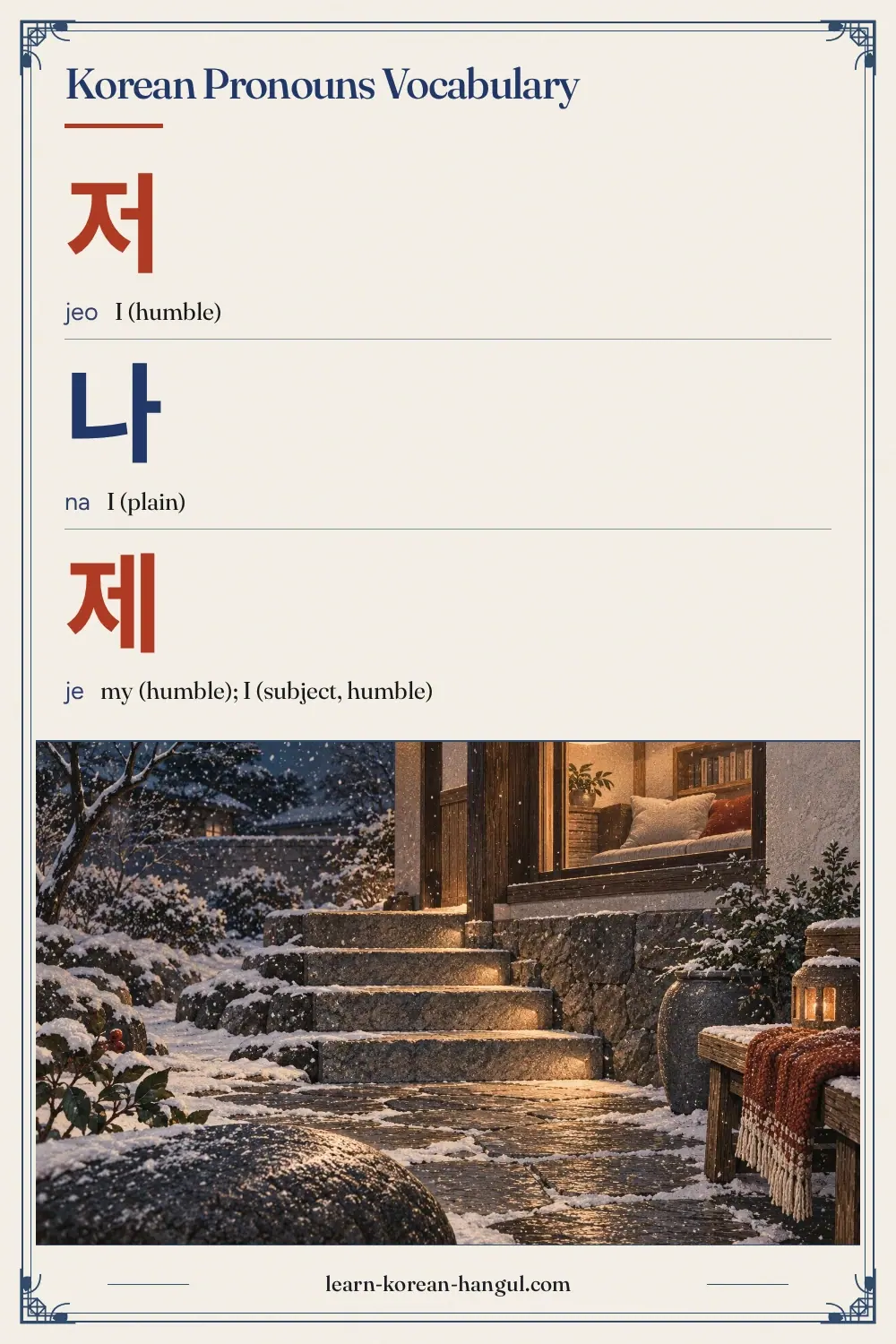
Korean Pronouns Vocabulary at a Glance
A pronoun is a word that stands in for a noun, such as I, you, he or this. Korean has all of these, but it uses them less than English does. A Korean speaker often leaves out the pronoun when the context is clear, and picks between several words for I and you according to how polite the situation is. For you, many speakers avoid the pronoun and use a name, a title or a family word instead.
The list has 30 words in five groups. The two big choices are 저 or 나 for I, and a title instead of 너 or 당신 for you. This page is the vocabulary list for memorising them. For how pronouns behave inside a sentence, see the grammar pages on korean pronouns and parts of speech. The list sits inside Korean Pronouns, Question Words and Connectors.
| Group | Words | Examples |
|---|---|---|
| I and we | 6 | 저, 나, 제, 내 |
| You | 7 | 너, 네, 너희, 당신 |
| He and she | 5 | 그, 그녀, 그분, 걔 |
| This and that | 9 | 이것, 그것, 저것, 이거 |
| Who | 3 | 누구, 아무도, 모두 |
By word origin, the list has 27 native, 2 mixed and 1 Sino-Korean entries. Almost every pronoun is a native Korean word. The exceptions are 당신 (Sino-Korean), 그녀 (그 plus the Chinese-derived 녀, woman) and the title 선생님, and the first two are the words with the most limited use.
Which Pronouns Should You Learn First?
Start with five words: 저, 나, 우리, 너 and 당신. They show you the central rule of Korean pronouns, which is that the word you choose tells the listener how polite you are being. Press play, then the slow button, and say each word aloud.
저 (jeo) means I (humble). It is the humble I, and it is the safe choice with a teacher, a customer, a stranger or anyone older. The topic form is 저는 and the subject form is 제가, in which 저 and the particle 가 join into 제. Example: 저는 학생이에요. (I am a student.)
나 (na) means I (plain). It is the plain I, used with friends, family and people younger than you. The topic form is 나는 and the subject form is 내가, which looks and sounds almost like 네가. Example: 나는 커피를 좋아해. (I like coffee.)
우리 (uri) means we; our. It means we, but it also means our, and Koreans use it where English would say my: 우리 집 (our house, my home), 우리 엄마 (my mom). It is the group-minded word of the language. Example: 우리는 같이 가요. (We go together.)
너 (neo) means you (plain). It is the plain you, used only with close friends and people younger than you. To a person you don't know well it can sound rude. Example: 너는 어디에 살아? (Where do you live?)
당신 (dangsin) means you (formal-looking; spouse). It is the formal-looking you, but it is not a neutral polite you. It is used between spouses, in song lyrics and in ads, and between strangers it can sound sharp. Example: 당신의 꿈을 응원해요. (We cheer on your dream.)
I and We (저, 나, 우리)
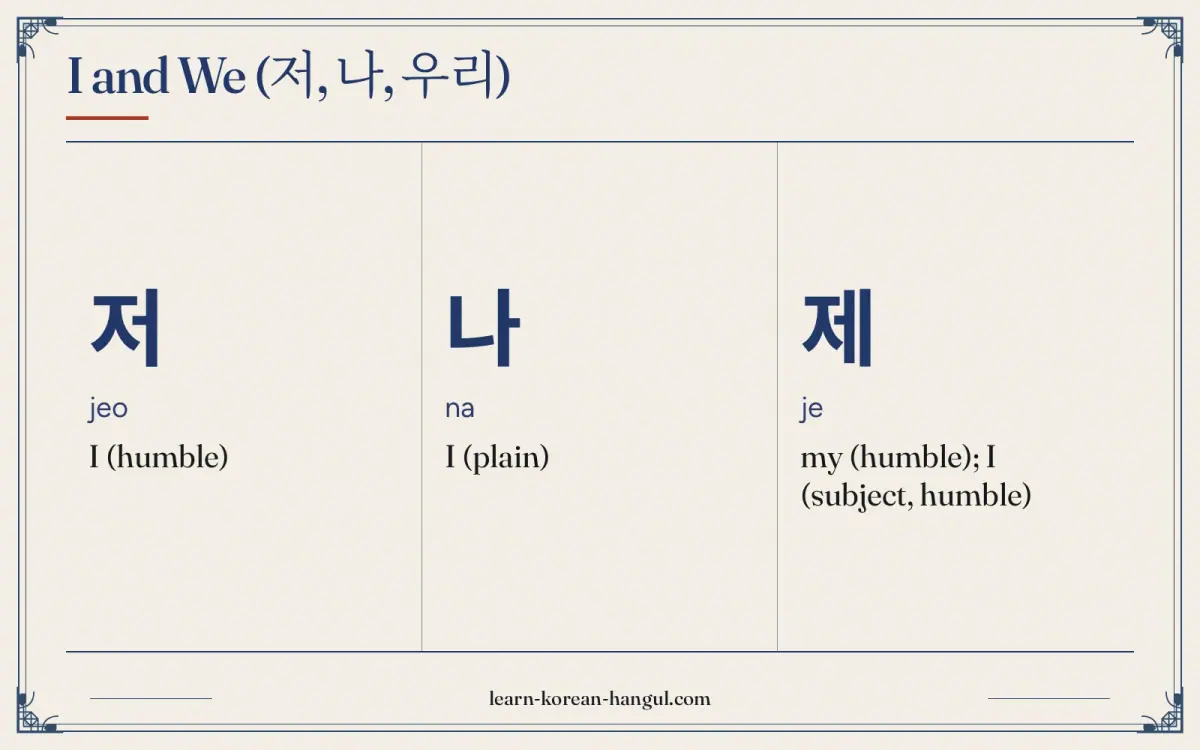
Korean has two words for I, and two for we. The humble set (저, 저희) is for polite or formal speech, and the plain set (나, 우리) is for friends and family. The possessive and subject forms below are the ones you will hear first.
| No. | Hangul | Revised Romanization | Meaning | Origin | Example sentence | Audio assetId |
|---|---|---|---|---|---|---|
| 1 | 저 | jeo | I (humble) | native | 저는 학생이에요. (jeoneun haksaengieyo; I am a student.) | au-pg-vocabulary-function-words-pronouns-1; example: au-pg-vocabulary-function-words-pronouns-101 |
| 2 | 나 | na | I (plain) | native | 나는 커피를 좋아해. (naneun keopireul joahae; I like coffee.) | au-pg-vocabulary-function-words-pronouns-2; example: au-pg-vocabulary-function-words-pronouns-102 |
| 3 | 제 | je | my (humble); I (subject, humble) | native | 제 이름은 민수예요. (je ireumeun minsuyeyo; My name is Minsu.) | au-pg-vocabulary-function-words-pronouns-3; example: au-pg-vocabulary-function-words-pronouns-103 |
| 4 | 내 | nae | my (plain); I (subject, plain) | native | 내 친구는 서울에 살아요. (nae chinguneun seoure sarayo; My friend lives in Seoul.) | au-pg-vocabulary-function-words-pronouns-4; example: au-pg-vocabulary-function-words-pronouns-104 |
| 5 | 우리 | uri | we; our | native | 우리는 같이 가요. (urineun gachi gayo; We go together.) | au-pg-vocabulary-function-words-pronouns-5; example: au-pg-vocabulary-function-words-pronouns-105 |
| 6 | 저희 | jeohui | we; our (humble) | native | 저희 가게는 열 시에 열어요. (jeohui gageneun yeol sie yeoreoyo; Our shop opens at ten.) | au-pg-vocabulary-function-words-pronouns-6; example: au-pg-vocabulary-function-words-pronouns-106 |
- 저: With a teacher, a boss or a stranger, 저 is the usual choice. Pair it with polite endings such as 이에요, which the example uses.
- 나: The verb ending here is the casual 해, used with friends. Using 나 with a teacher would sound blunt.
- 제: It is 저 joined with 의 (of) or with 가. It means my before a noun, and also I when it is the subject (제가).
- 내: It is the plain pair of 제. In speech, 내가 (I as subject) can be confused with 네가 (you as subject), so many people say 네 as [니].
- 우리: Koreans say 우리나라 (our country) and 우리 가족 (our family) even when they mean their own. It is a normal use, not a mistake.
- 저희: It is the humble form of 우리, used by staff to customers. It is not used for 나라: the standard word for your own country is 우리나라, not 저희 나라.
Example Sentences
A short exchange shows the three zones. A customer picks up an item and asks 이거 얼마예요? (How much is this?) because the item is near the customer. If the item is near the seller, the customer asks 그거 얼마예요? (How much is that?). If it is on a shelf across the room, the customer says 저거 얼마예요? (How much is that one over there?). Notice that none of these sentences has an I or a you. Korean drops the pronoun whenever the meaning is clear, so 배고파요 (I am hungry) is more natural than 나는 배고파요.
How Do You Say You (너, 당신) in Korean?
Korean has several words for you and avoids most of them. The seven below are the ones to recognise. The safest choice is to use the person's name or title instead.
| No. | Hangul | Revised Romanization | Meaning | Origin | Example sentence | Audio assetId |
|---|---|---|---|---|---|---|
| 7 | 너 | neo | you (plain) | native | 너는 어디에 살아? (neoneun eodie sara; Where do you live?) | au-pg-vocabulary-function-words-pronouns-7; example: au-pg-vocabulary-function-words-pronouns-107 |
| 8 | 네 | ne | your (plain) | native | 네 가방이 예뻐. (ne gabangi yeppeo; Your bag is pretty.) | au-pg-vocabulary-function-words-pronouns-8; example: au-pg-vocabulary-function-words-pronouns-108 |
| 9 | 너희 | neohui | you (plural, plain) | native | 너희는 몇 학년이야? (neohuineun myeot hangnyeoniya; What year are you in?) | au-pg-vocabulary-function-words-pronouns-9; example: au-pg-vocabulary-function-words-pronouns-109 |
| 10 | 당신 | dangsin | you (formal-looking; spouse) | Sino-Korean | 당신의 꿈을 응원해요. (dangsinui kkumeul eungwonhaeyo; We cheer on your dream.) | au-pg-vocabulary-function-words-pronouns-10; example: au-pg-vocabulary-function-words-pronouns-110 |
| 11 | 여러분 | yeoreobun | everyone; you all (polite) | native | 여러분, 안녕하세요. (yeoreobun annyeonghaseyo; Hello, everyone.) | au-pg-vocabulary-function-words-pronouns-11; example: au-pg-vocabulary-function-words-pronouns-111 |
| 12 | 선생님 | seonsaengnim | teacher; (respectful you) | mixed | 선생님, 질문 있어요. (seonsaengnim jilmun isseoyo; Teacher, I have a question.) | au-pg-vocabulary-function-words-pronouns-12; example: au-pg-vocabulary-function-words-pronouns-112 |
| 13 | 언니 | eonni | older sister (said by a woman) | native | 언니는 회사에 다녀요. (eonnineun hoesae danyeoyo; My older sister works at a company.) | au-pg-vocabulary-function-words-pronouns-13; example: au-pg-vocabulary-function-words-pronouns-113 |
- 너: It is for close friends and for younger people. The standard subject form is 네가, and many speakers say it as [니가] (often written 니가 in chat).
- 네: It is the possessive pair of 너: 네 가방 (your bag). In speech it is often said as [니] so it is not confused with 내 (my). The same spelling 네 also means yes.
- 너희: The ending 희 adds plural. It is for a group of people younger than you or close to you.
- 당신: The word comes from Chinese-derived syllables (literally something like "that self"). It shows up in slogans and lyrics, and between a married couple. A stranger may hear it as confrontational.
- 여러분: This is the polite word to address a group: a teacher to a class, a presenter to an audience. It is the safe plural you.
- 선생님: Koreans use 선생님 as a title and as you for teachers, doctors and other respected people. The ending 님 is an honorific.
- 언니: A woman uses 언니 for an older sister and for an older female friend. A man says 누나. These family words work as you in everyday speech.
He and She (그, 그녀)
Korean has words for he and she, but spoken Korean prefers names and titles. The five words below separate the written words from the spoken ones.
| No. | Hangul | Revised Romanization | Meaning | Origin | Example sentence | Audio assetId |
|---|---|---|---|---|---|---|
| 14 | 그 | geu | he; that (before a noun) | native | 그는 의사였다. (geuneun uisayeotda; He was a doctor.) | au-pg-vocabulary-function-words-pronouns-14; example: au-pg-vocabulary-function-words-pronouns-114 |
| 15 | 그녀 | geunyeo | she | mixed | 그녀는 가수였다. (geunyeoneun gasuyeotda; She was a singer.) | au-pg-vocabulary-function-words-pronouns-15; example: au-pg-vocabulary-function-words-pronouns-115 |
| 16 | 그분 | geubun | that person (honorific) | native | 그분은 우리 선생님이세요. (geubuneun uri seonsaengnimiseyo; That person is our teacher.) | au-pg-vocabulary-function-words-pronouns-16; example: au-pg-vocabulary-function-words-pronouns-116 |
| 17 | 걔 | gyae | that kid; he/she (casual) | native | 걔는 내 동생이야. (gyaeneun nae dongsaengiya; That kid is my younger sibling.) | au-pg-vocabulary-function-words-pronouns-17; example: au-pg-vocabulary-function-words-pronouns-117 |
| 18 | 이분 | ibun | this person (honorific) | native | 이분은 제 어머니세요. (ibuneun je eomeoniseyo; This is my mother.) | au-pg-vocabulary-function-words-pronouns-18; example: au-pg-vocabulary-function-words-pronouns-118 |
- 그: This 그 is the same word as that in 그 사람 (that person). As he, it appears mostly in writing and translation, so the example is in the written -다 style of a story.
- 그녀: The word is 그 plus 녀 (woman). It is mainly written and rare in conversation, where speakers say the name or 그 사람 instead.
- 그분: The 분 is the honorific counter for people. Use it for a person you respect who was mentioned earlier.
- 걔: The word is a short form of 그 아이. It is common in casual speech for a person of your age or younger.
- 이분: The word is how you introduce someone politely. The ending 세요 raises the level of respect.
How Do You Say This and That (이것, 그것, 저것) in Korean?
Korean divides space into three zones. 이 is near me, 그 is near you or already mentioned, and 저 is far from both. The three forms below follow that system for things, and for places.
| No. | Hangul | Revised Romanization | Meaning | Origin | Example sentence | Audio assetId |
|---|---|---|---|---|---|---|
| 19 | 이것 | igeot | this (thing) | native | 이것은 무엇이에요? (igeoseun mueosieyo; What is this?) | au-pg-vocabulary-function-words-pronouns-19; example: au-pg-vocabulary-function-words-pronouns-119 |
| 20 | 그것 | geugeot | that (thing near you) | native | 그것은 제 가방이에요. (geugeoseun je gabangieyo; That is my bag.) | au-pg-vocabulary-function-words-pronouns-20; example: au-pg-vocabulary-function-words-pronouns-120 |
| 21 | 저것 | jeogeot | that (thing over there) | native | 저것은 얼마예요? (jeogeoseun eolmayeyo; How much is that one over there?) | au-pg-vocabulary-function-words-pronouns-21; example: au-pg-vocabulary-function-words-pronouns-121 |
| 22 | 이거 | igeo | this (thing; spoken) | native | 이거 주세요. (igeo juseyo; Please give me this.) | au-pg-vocabulary-function-words-pronouns-22; example: au-pg-vocabulary-function-words-pronouns-122 |
| 23 | 그거 | geugeo | that (thing; spoken) | native | 그거 뭐예요? (geugeo mwoyeyo; What is that?) | au-pg-vocabulary-function-words-pronouns-23; example: au-pg-vocabulary-function-words-pronouns-123 |
| 24 | 저거 | jeogeo | that (thing over there; spoken) | native | 저거 좀 보세요. (jeogeo jom boseyo; Please look at that one over there.) | au-pg-vocabulary-function-words-pronouns-24; example: au-pg-vocabulary-function-words-pronouns-124 |
| 25 | 여기 | yeogi | here | native | 여기가 우리 집이에요. (yeogiga uri jibieyo; Here is our house.) | au-pg-vocabulary-function-words-pronouns-25; example: au-pg-vocabulary-function-words-pronouns-125 |
| 26 | 거기 | geogi | there (near you) | native | 거기에 앉으세요. (geogie anjeuseyo; Please sit there.) | au-pg-vocabulary-function-words-pronouns-26; example: au-pg-vocabulary-function-words-pronouns-126 |
| 27 | 저기 | jeogi | over there | native | 저기가 화장실이에요. (jeogiga hwajangsirieyo; The restroom is over there.) | au-pg-vocabulary-function-words-pronouns-27; example: au-pg-vocabulary-function-words-pronouns-127 |
- 이것: The written form of this thing. It is said [이걷] on its own and [이거슨] with the topic particle.
- 그것: It points to something near the listener or something both of you have just mentioned.
- 저것: It points to something far from both people. In shops it is the word for the thing across the room.
- 이거: This is the short spoken form of 이것, and it is what you actually say in shops.
- 그거: It is the spoken form of 그것. 뭐 is the short form of 무엇.
- 저거: It is the spoken form of 저것. The 좀 softens a request.
- 여기: The place word of the 이 set: near me. It names the spot where the speaker is standing.
- 거기: It names the place near the listener, or a place mentioned before.
- 저기: The word also gets the listener's attention in a restaurant: 저기요. For the full system, see 이 그 저 korean demonstratives.
Who (누구)
Three words give the reach of who and everyone. 누구 asks a question, and the other two refer to all or none of a group.
| No. | Hangul | Revised Romanization | Meaning | Origin | Example sentence | Audio assetId |
|---|---|---|---|---|---|---|
| 28 | 누구 | nugu | who; someone | native | 누구예요? (nuguyeyo; Who is it?) | au-pg-vocabulary-function-words-pronouns-28; example: au-pg-vocabulary-function-words-pronouns-128 |
| 29 | 아무도 | amudo | nobody; anybody (with a negative) | native | 아무도 없어요. (amudo eopsseoyo; There is nobody.) | au-pg-vocabulary-function-words-pronouns-29; example: au-pg-vocabulary-function-words-pronouns-129 |
| 30 | 모두 | modu | everyone; all | native | 모두 여기에 있어요. (modu yeogie isseoyo; Everyone is here.) | au-pg-vocabulary-function-words-pronouns-30; example: au-pg-vocabulary-function-words-pronouns-130 |
- 누구: The subject form is 누가: 누가 왔어요? (Who came?). The same word also means someone in some statements.
- 아무도: It is used with a negative verb or with 없다. Used alone it is incomplete.
- 모두: It can also mean all or entirely, so check which one the sentence needs.
How Do You Pronounce These Words?
Most pronouns are short and say what they spell. Five are worth listening to, based on the Standard Pronunciation rules (표준 발음법) of the 국립국어원.
| Word | Romanization | Said | Rule |
|---|---|---|---|
| 이것 | igeot | [이걷] | the final ㅅ is said as ㄷ at the end of a word |
| 이것은 | igeoseun | [이거슨] | the final ㅅ moves onto the empty ㅇ of the next syllable |
| 저희 | jeohui | [저히] | ㅢ after a consonant is said as ㅣ, so 희 is [히] |
| 걔 | gyae | [걔] | the vowel ㅒ is said like ㅐ with a y in front; in speech many people say it as [게] |
| 여러분 | yeoreobun | [여러분] | no change; the ㄹ between vowels is a light flap |
Revised Romanization is the official romanization system of South Korea, announced on 7 July 2000. It follows most sound changes, but it always writes ㅢ as ui, so 저희 is written jeohui even though it is said [저히]. It is only a learning aid. Always read the Hangul as well.
Audio and Slow Playback
Each headword and each example sentence has its own audio clip, and the 5 words in the first-words section also have a slow clip at 0.8 times the speed. Nothing plays until you press a button. Listen to 이것 and 이것은 one after the other and notice how the ㅅ changes.
What Mistakes Do Learners Make with Pronouns?
- Using 너 or 당신 for a person you do not know well. Use their name with 씨, or a title such as 선생님, instead.
- Putting 나는 or 저는 at the start of every sentence. The pronoun can usually go, and the sentence sounds more natural without it.
- Mixing 저 and 나 in one conversation. Pick one level and stay with it: 저 with polite endings, 나 with casual ones.
- Saying 저희 나라 for your own country. The standard word is 우리나라, even when you say it to a stranger.
- Using 그녀 in speech. It is written Korean. In conversation people say the name, or 그 사람, or 걔.
- Confusing 내 (my) and 네 (your), which sound alike. Many speakers say 네 as [니] to keep them apart.
Practice: Flashcards and Worksheet
Drill all 30 words with the vocabulary flashcard decks: each card shows the Hangul on one side and the meaning on the other, so you can test yourself in both directions. Consult the vocabulary worksheets page for printable sheets; for practice, write the Korean word for each numbered person or object in the scene above by hand. A simple plan is to learn the I and you groups on day one, the third person and demonstratives on day two, and then to say each demonstrative while pointing at three objects at different distances.
Self-Test: 10 Sentences
Fill each blank with a word from this page. Say the whole sentence aloud when you have it. The answers follow the test.
- ___는 학생이에요. (I am a student.)
- ___ 친구는 서울에 살아요. (My friend lives in Seoul.)
- ___는 어디에 살아? (Where do you live?)
- ___의 꿈을 응원해요. (We cheer on your dream.)
- ___는 회사에 다녀요. (My older sister works at a company.)
- ___은 우리 선생님이세요. (That person is our teacher.)
- ___은 무엇이에요? (What is this?)
- ___ 주세요. (Please give me this.)
- ___가 우리 집이에요. (Here is our house.)
- ___예요? (Who is it?)
Answers: 1. 저; 2. 내; 3. 너; 4. 당신; 5. 언니; 6. 그분; 7. 이것; 8. 이거; 9. 여기; 10. 누구.
A score of 8 or more suggests the words are settling in. If you scored lower, reread the groups where you missed words.
Where to Go Next
This Korean pronouns vocabulary list sits inside Korean Pronouns, Question Words and Connectors. Continue with Korean Question Words, which includes 누구 in more detail, and Korean Conjunctions Vocabulary. For how pronouns work inside sentences, see parts of speech.
FAQ
How Do You Say I (humble) in Korean?
Say 저 (jeo). It is the humble I, used with teachers, customers, strangers and people older than you, as in 저는 학생이에요 (I am a student). With friends, family and younger people, use 나 (na) instead. Before the subject particle 가, 저 becomes 제, so I did it is 제가 했어요.
How Do You Pronounce 나 (na)?
Say na, like the first syllable of English "nap" but longer and with a more open mouth. The ㄴ is a light n made by touching your tongue behind your top teeth. The vowel ㅏ is the open ah sound.
How Many Pronouns Should I Learn First?
Learn the five words in the first-words section: 저, 나, 우리, 너 and 당신. Then add 이거, 그거 and 저거, which you will use in shops. The rest of the 30 words can be added a group at a time.
Where Can I Practise Pronouns with Flashcards?
Use the vocabulary flashcard decks. Start with the I and we group and the three spoken forms 이거, 그거 and 저거, then add the rest. Review the older cards before you add new ones, so the earlier words do not fade.
Is the Romanization on This Page Official?
Yes, as a learning aid. It follows the Revised Romanization of Korean, the system South Korea has officially used since 7 July 2000, and the page also gives the Hangul for every word. It follows most sound changes, but it always writes ㅢ as ui: 저희 is jeohui but said [저히]. Treat the Hangul as the real spelling.
Is There a Printable Worksheet for Pronouns?
The vocabulary worksheets page lists the printable sheets. For paper practice, use the illustrated scene on this page as a labelling task and write the Korean word next to each numbered person or object. You can also copy the scene words by hand.