What you'll learn
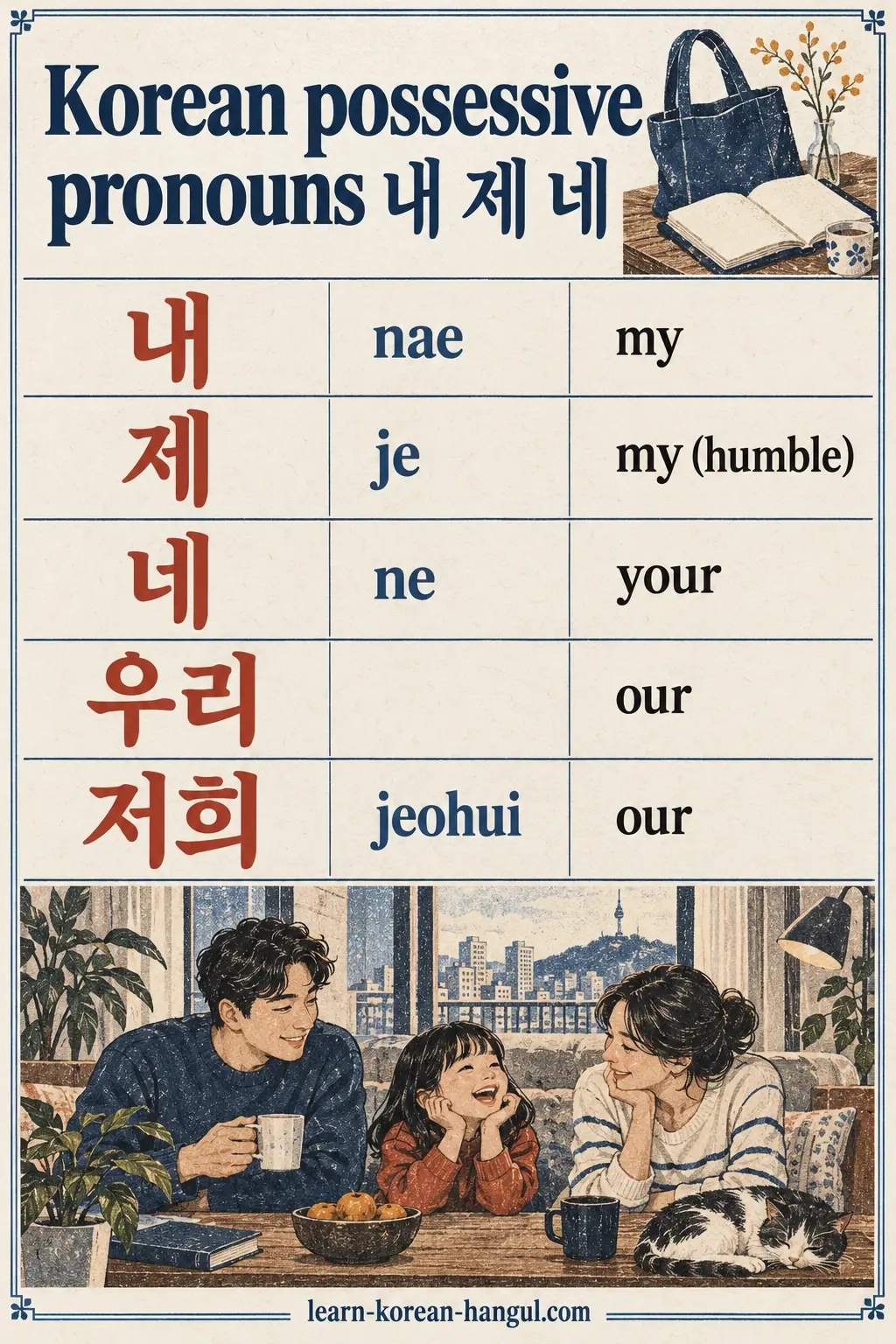
- Form 내, 제 and 네 from the pronouns 나, 저 and 너 plus 의.
- Choose between the plain forms (내, 우리) and the humble forms (제, 저희).
- Tell 내 ("my") from 내가 ("I" as the subject).
- Use 우리 for family and groups, as Korean speakers do.
Before you start: you should know that 의 is the possessive particle (see possessive particle 의). Time: about 25 minutes.
What Do the Korean Possessive Pronouns 내 제 네 Mean?
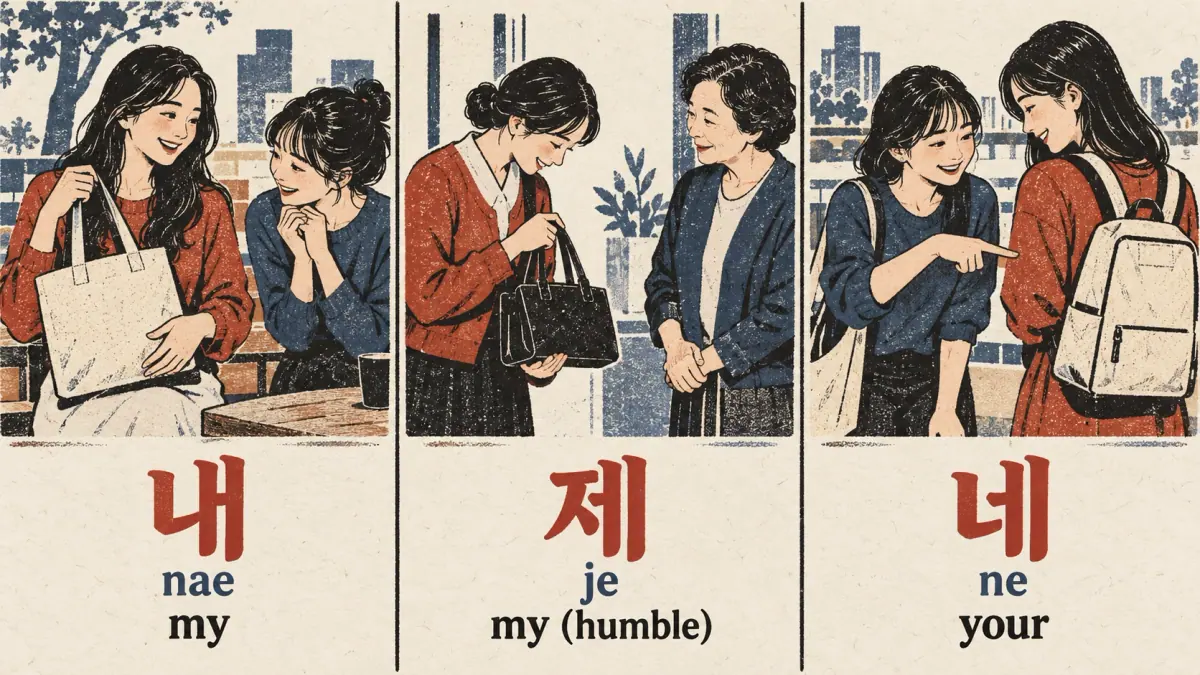
The Korean possessive pronouns 내, 제 and 네 mean "my" and "your", and each one is a pronoun joined to the possessive particle 의. A pronoun is a word that stands in for a noun, such as "I" or "you". A possessive shows who owns something, as "my" does in "my book".
Korean has two words for "I". 나 (na) is plain and used with friends, family and younger people. 저 (jeo) is humble and used in polite speech with strangers, elders and people of higher status. The word for "you" in plain speech is 너 (neo). Each pronoun joins with 의 and contracts:
| Pronoun | + 의 | Contracted form | Meaning |
|---|---|---|---|
| 나 (plain "I") | 나의 | 내 (nae) | my |
| 저 (humble "I") | 저의 | 제 (je) | my (humble) |
| 너 (plain "you") | 너의 | 네 (ne) | your |
The choice between 내 and 제 is a choice about politeness, not about meaning. You can read more about the pair in 나 vs 저.
A First Example
Listen to each sentence at normal speed, then slowly.
1. 제 이름은 민수예요. (je ireumeun minsuyeyo) "My name is Minsu."
Pronunciation: [제 이르믄 민수예요]. The final ㅁ of 이름 moves onto the next syllable, so 이름은 sounds like 이르믄. The name 민수 ends in a vowel, so the ending is 예요, not 이에요.
2. 우리 학교는 커요. (uri hakgyoneun keoyo) "Our school is big."
Pronunciation: [우리 학꾜는 커요]. The ㄱ in 학 is followed by ㄱ in 교, and the second one is pronounced tense, [꾜]. The adjective 크다 ("to be big") loses its ㅡ and becomes 커요 (keoyo).
Both sentences put the owner word directly before the noun. Now look at the full set of forms and the rule that governs them.
How Do the Korean Possessive Pronouns 내 제 네 Work?

The forms work in a single slot: the owner word comes immediately before the noun it owns, with no particle between them. Short forms are standard, so you almost never add 의 after them. Use 제 in polite speech, 내 with friends, 네 for "your" with friends, and 우리 or the humble 저희 for "our".
Pattern Table
| Owner | Plain form | Humble or polite form | Example (plain) | Example (humble) |
|---|---|---|---|---|
| my | 내 | 제 | 내 가방 (my bag) | 제 가방 (my bag) |
| your | 네 (spoken 니) | no 너-form; use a title or name | 네 책 (your book) | 선생님 책 (your book, teacher) |
| our | 우리 | 저희 | 우리 집 (our house) | 저희 집 (our house) |
Sound notes: 내 가방 is [내 가방] (nae gabang), 네 책 is [네 책] (ne chaek), 우리 집 is [우리 집] (uri jip), and 저희 is jeohui, pronounced [저히].
Three details make the table easy to apply.
- There is no humble "your". Korean avoids 너 with people you must respect. To say "your", use the person's name or title plus the noun: 선생님 책 ("your book, teacher"). The lesson on how to say "you" in Korean explains the options.
- The pronouns come before the noun. Unlike English "of mine", there is no after-noun form. Say 내 친구 (my friend), not 친구 내.
- Particles still attach to the noun, not to the owner word. In 제 이름은 민수예요, the topic particle 은 sits on 이름, the owned noun.
The Three-Way Trap: 내, 내가 and 네
Two of these forms have a twin that looks almost the same but does a different job. 나 + 가 and 저 + 가 also contract, but into the subject forms:
| Written | Built from | Meaning | Example |
|---|---|---|---|
| 내 | 나 + 의 | my | 내 친구 (my friend) |
| 내가 | 나 + 가 | I (as the subject) | 내가 해요 (I do it) |
| 제 | 저 + 의 | my (humble) | 제 친구 (my friend) |
| 제가 | 저 + 가 | I (humble, as the subject) | 제가 해요 (I do it) |
| 네 | 너 + 의 | your | 네 친구 (your friend) |
| 네가 | 너 + 가 | you (as the subject) | 네가 해요 (you do it) |
The word ending in 가 is the subject; the bare form is the owner. A reliable test: if a noun follows, you have the owner form. If a verb follows, you have the subject form. That covers the ways the three forms are built; next, here is how to apply them step by step.
How Do You Say "My Name Is Minsu" with 제?

To say "My name is Minsu" politely, put 제 before 이름, add the topic particle 은, and finish with 민수예요: 제 이름은 민수예요. Use these steps to build any "my + noun" sentence.
- Pick the owner. The owner is you, so the pronoun family is 나 or 저.
- Pick the politeness level. You are meeting someone for the first time, so use the humble form: 저.
- Make the possessive form. 저 + 의 contracts to 제 (je).
- Put it before the noun. 제 이름 ("my name").
- Add the topic particle. 이름 ends in the consonant ㅁ, so use 은: 이름은.
- Finish with the copula. The name 민수 ends in a vowel, so the polite ending is 예요: 민수예요.
You'll know it worked when the owner word comes first, the noun and its particle come second, and the name plus 예요 or 이에요 comes last. Common mistake at this step: adding 의 after the contraction, as in 제의 이름. The contracted form already contains the 의, so write 제 이름.
If you were speaking to a close friend, step 2 would give 나, and the sentence would be 내 이름은 민수야. The ending 야 is the casual version of 예요 and 이에요. The same building steps work for 네 and 우리.
How Are 제 and 내 Different from 저희 and 우리?

제 and 내 mean "my", and 저희 and 우리 mean "our". In each pair, one form is humble and one is plain. The table compares them.
| Feature | 내 | 제 | 우리 | 저희 |
|---|---|---|---|---|
| Meaning | my | my | our | our |
| Level | plain | humble | plain | humble |
| Used with | friends, family, younger people | strangers, elders, work | friends, family, group | strangers, elders, work |
| Includes the listener | no | no | often yes | usually no |
| Example | 내 이름 | 제 이름 | 우리 팀 | 저희 팀 |
| Example meaning | my name | my name | our team | our team |
"Includes the listener" needs an example. If you say 우리 회사 to a colleague at the same company, "our company" means yours and mine. If you say 저희 회사 to a customer, "our company" means mine, and the customer is outside it. This is why 저희 is common in shop and business talk.
An expert rule of thumb: when you are unsure, use 제 and 저희. Being too polite rarely causes trouble; being too casual with a stranger can. Politeness decides the choice, and the next section covers how Korean bends the "my" idea.
When Do You Use 우리, and When Is 네 Unclear?

Korean speakers use 우리 ("our") where English uses "my" for family and groups. A speaker says 우리 엄마 (my mom, literally "our mom"), 우리 집 (my home), 우리 회사 (my company), 우리 아이 (my child) and 우리 학교 (my school). Using 제 엄마 or 내 엄마 for "my mom" sounds unusual in plain talk, because 내 stresses "mine, not yours". Treat 우리 as the default for people and places you share with others.
우리나라 ("our country") is a special case. It is written as one word and is the usual way a Korean speaker refers to Korea, the speaker's own country.
네 and 내 sound alike. The standard pronunciation rules (Article 4) still list ㅐ and ㅔ as two vowels, but most Seoul speakers today pronounce them the same, so 내 (my) and 네 (your) are easy to confuse in speech. Speakers often say 니 [ni] for "your" in casual speech to avoid this. Also note that 네 (ne) means "yes", written the same way: context tells you which one you hear.
Particle dropping. In casual speech 내 and 제 are often followed by a noun with no particle at all: 내 친구 왔어요 ("My friend came"). The particles that drop most easily are 은/는 and 이/가, as the lesson on omitting particles in Korean explains; see also topic particle 은/는 and subject particle 이/가.
Full forms. 나의, 저의 and 너의 exist and are correct. They appear in formal writing, speeches and song lyrics. In everyday speech they sound stiff.
Honest limit of this lesson: it covers the first and second person. Third-person possession, such as 그의 (his) and 그녀의 (her), and 당신의 (a "your" that is rarely safe in conversation) are covered in the Korean pronouns lesson.
After the exceptions, here are the mistakes to avoid.
Common Mistakes with 내 제 네
Five mistakes cover most errors. Each follows the pattern "learners often assume X, but actually Y, because Z."
- Using 내 with someone you must respect. Learners often say 내 이름은 민수예요 to a teacher. Actually 내 is plain, so a polite setting needs 제: 제 이름은 민수예요.
- Adding 의 after the contraction. Learners often write 제의 이름 or 내의 책. Actually 제 and 내 already contain the possessive 의, so the extra 의 is redundant: 제 이름, 내 책.
- Mixing up 내 and 네. Learners often hear 네 가방 as "my bag". Actually 네 means "your" and 내 means "my". Listen for 니 in casual speech, and use names when the sound is unclear.
- Reading 내가 as "my". Learners often translate 내가 해요 as "my does". Actually 내가 is 나 + 가, the subject "I", so the sentence is "I do it". Check what follows: a verb means a subject form, a noun means an owner form.
- Saying 저의 in everyday speech. Learners often use the full 저의 in conversation because it looks more "correct". Actually the short 제 is standard in speech and the long form sounds like a written text.
If you can sort a sentence into owner form or subject form, you have the hardest part of this lesson.
Practice and Answers
Try all four items before you read the answers. Each answer has audio, normal and slow.
Practice · 8
You are speaking politely to a new teacher. Which sentence says "My name is Sujin"?
Show answer
제 이름은 수진이에요.
A polite setting needs the humble 제, and 제 already contains 의.
What is 저 + 의 in its contracted form?
Show answer
제
저의 contracts to 제 (my, humble); 나의 gives 내 and 너의 gives 네.
What does 네 mean in 네 책?
Show answer
your (plain)
네 is 너 + 의, "your" in plain speech; a noun follows, so it is the owner form.
What does 내가 mean in 내가 해요?
Show answer
I (as the subject)
내가 is 나 + 가, the subject form; a verb follows it, while the owner form 내 is followed by a noun.
Which phrase is the plain way to say "our house"?
Show answer
우리 집
For "our", 우리 goes directly before the noun, with no 의 needed.
You speak to a customer about your own company. Which form fits best?
Show answer
저희 회사
저희 is humble and usually excludes the listener, so it is common when speaking to customers about your own company.
How do Koreans usually say "my mom" in plain talk?
Show answer
우리 엄마
Korean uses 우리 where English uses "my" for family and groups; 내 or 제 엄마 sounds unusual.
Which phrase correctly says "my friend" in casual speech?
Show answer
내 친구
The owner word comes directly before the noun, and 내 already contains 의.
- Choose the form. (내/제) 이름은 수진이에요. (You are speaking politely to a new teacher.)
- Fix the error. 선생님, 내 이름은 민수예요.
- Translate. "Our house is big." Use the plain form.
- Write your own. Write one casual sentence about your friend, using 내.
Answer Key
- 제 이름은 수진이에요. (je ireumeun sujinieyo) A polite setting needs the humble 제. 수진 ends in a consonant, so the ending is 이에요: [수지니에요].
- 선생님, 제 이름은 민수예요. (seonsaengnim, je ireumeun minsuyeyo) 내 becomes 제 because the listener is a teacher.
- 우리 집은 커요. (uri jibeun keoyo) Pronounced [우리 지븐 커요]. Plain "our" is 우리. 집 ends in a consonant, so the topic particle is 은.
- Sample answer: 내 친구는 학생이에요. (nae chinguneun haksaengieyo) "My friend is a student." Pronounced [내 친구는 학쌩이에요]. Any sentence with 내 directly before the noun is correct.
If an item went wrong, return to the pattern table and say the owner phrase aloud. Then continue with the next lessons.
Next Lessons and Where to Go from Here
After the Korean possessive pronouns 내 제 네, the next lesson in the set is 와/과 and with particle, which joins two nouns with "and". If you want the full possessive particle first, read possessive particle 의. For the other pronouns, see Korean pronouns, and for "this, that, that over there", see the 이 그 저 Korean demonstratives.
For practice, use the grammar quizzes. This page uses Revised Romanization only as a learning aid; the Hangul is the reference. The whole system fits in one sentence: the Korean possessive pronouns 내 제 네 are the pronoun plus 의 in short form, so choose 제 for polite speech and 내 for friends.
Frequently Asked Questions
What Does 내/제/네 Mean?
내 means "my" in plain speech, 제 means "my" in humble, polite speech, and 네 means "your" in plain speech. Each one is a contracted form of a pronoun plus the possessive particle 의: 나의, 저의 and 너의. They come directly before the noun they own.
How Do I Form 내/제/네?
Join the pronoun and 의, then shorten. 나 + 의 gives 내, 저 + 의 gives 제, and 너 + 의 gives 네. For "our", you do not form anything: use 우리 (plain) or 저희 (humble) directly before the noun, as in 우리 학교 and 저희 학교.
What Is the Most Common Mistake with 내/제/네?
The most common mistake is choosing the wrong level of politeness: 내 with a teacher or a stranger instead of 제. A second mistake is confusing 내 (my) with 네 (your), which sound almost the same. Colloquial speakers often say 니 for "your" to keep the two apart.
How Is 제 Different from 내 and 저희 from 우리?
제 and 저희 are humble forms used when you speak politely to someone older or of higher status. 내 and 우리 are plain forms for friends, family and equals. 우리 usually includes the listener, while 저희 usually does not, so 저희 is common when you speak about your own company.
Do I Use 내/제/네 in Speech, Writing or Both?
Both. In speech the contracted forms 내, 제 and 네 are the default, and the full 나의, 저의 and 너의 sound stiff. In formal writing, speeches and song lyrics you may see the full forms. Particle-free 내 이름 is the normal way to say "my name" in speech.