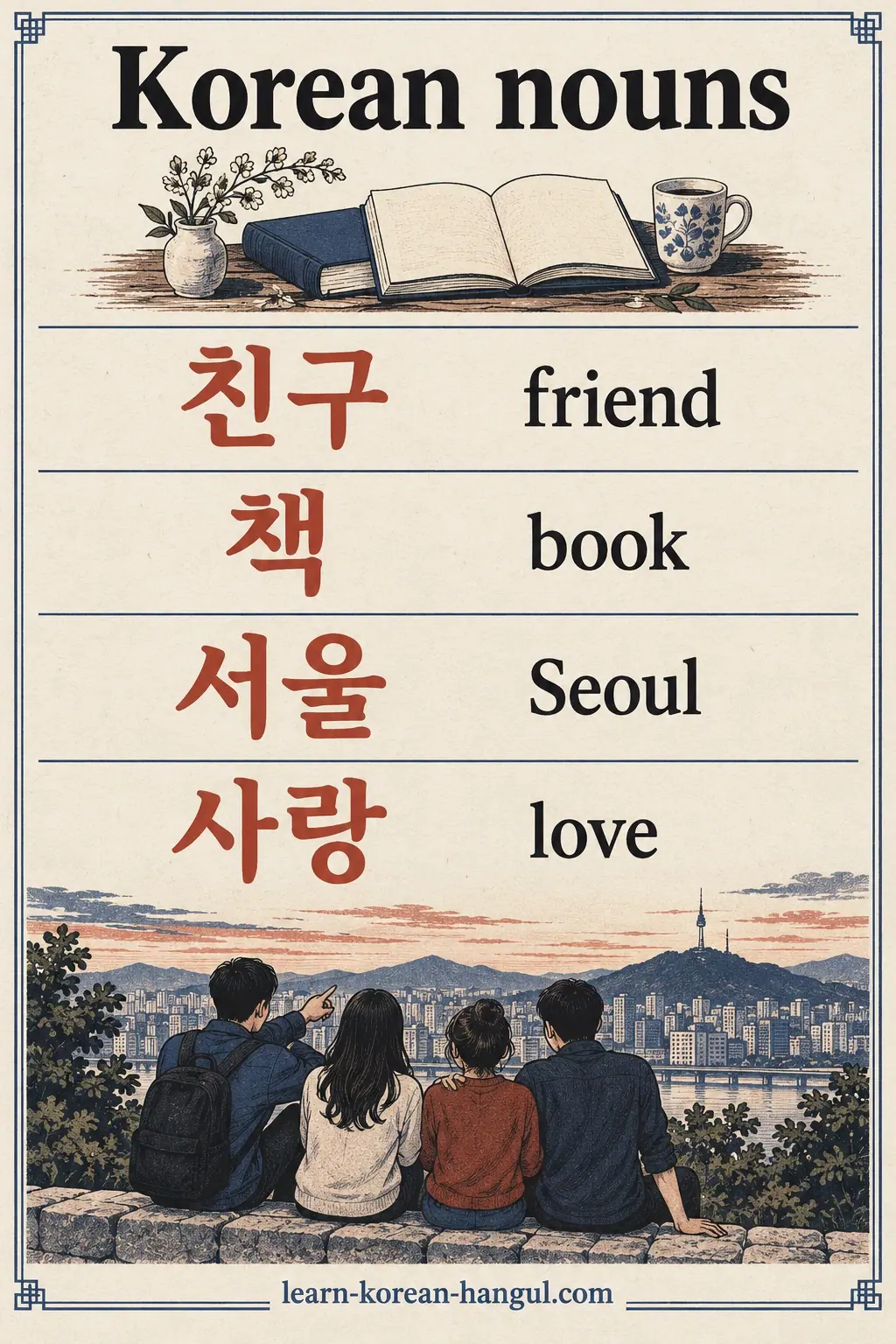
Korean nouns (명사) are words that name people, things, places and ideas. They have no gender, no articles such as "a" or "the", and only an optional plural marker 들, so the word 사과 can mean "an apple", "the apple" or "apples". Particles add the role and counters add the quantity.
What you'll learn
- Explain why a Korean noun has no gender, no article and no required plural.
- Attach the subject, topic and object particles to a noun by checking its last sound.
- Count people, things and bottles with a number word and a counter.
- Decide when 들 is natural and when it is a mistake.
Prerequisite: you can read Hangul and have seen the subject-object-verb sentence pattern. Estimated time: 25 minutes.
What Are Korean Nouns (명사)?

Korean nouns are words that name something: a person (친구, friend), a thing (책, book), a place (서울, Seoul) or an idea (사랑, love). The grammar term is 명사 (myeongsa). A noun can be the subject of a sentence, its object, or the thing a particle points to, and it never changes its own spelling to show number, case or gender.
Korean nouns fall into three groups by origin. Native Korean words (고유어) include 사람 (person) and 물 (water). Sino-Korean words (한자어), built from Chinese-origin roots, include 학생 (student) and 책 (book). Loanwords (외래어) include 커피 (coffee). Nouns also split by job: common nouns such as 책 name a kind of thing, proper nouns such as 서울 name one specific thing, and bound nouns (의존명사) such as 것 (thing) and 수 (way, chance) cannot stand alone and always follow a describing word.
A First Look: Two Annotated Examples
A Korean noun in a sentence is usually a bare word followed by a particle, and the two examples below show the pattern on two different inputs.
Example 1. 친구가 많아요. (chinguga manayo.) means "I have many friends." Word by word it is "friend + subject marker + are many". Korean does not need the word "I" here, because the context shows who has the friends.
Example 2. 사과 두 개 주세요. (sagwa du gae juseyo.) means "Two apples, please." The noun 사과 (apple) comes first, then the number word 두 (two) and the counter 개 (a unit for general things), then the request 주세요 (please give).
In Example 1 the noun carries a particle. In Example 2 the noun carries a counter and no particle at all, which is common in spoken requests. The next section explains how to choose between them.
How Do Korean Nouns Work?

Korean nouns work through three add-ons placed after the noun: a particle for the role, a counter for the quantity, and the plural marker 들 for stressed plurals. The noun itself stays the same. A particle (조사, josa) is a short word attached to a noun that shows its job, such as subject or object. A counter (단위명사) is a unit word that follows a number, like "cups" in "three cups of tea".
Each add-on answers a different question:
- What job does the noun do? Add a particle: 가/이 (subject), 은/는 (topic), 을/를 (object).
- How many are there? Add a number word and a counter: 사과 두 개.
- Do I need to stress "several"? Add 들 only if the context does not already show it.
If you skip all three, the bare noun still works in short spoken sentences. Koreans often drop particles in casual speech, as in 밥 먹었어요 (I ate a meal), but a beginner should learn the full form first.
Pattern Table: Particles and Counters
The particle changes shape by the noun's last sound. After a vowel you use the short form, and after a consonant you use the longer form.
| Role | After a vowel | After a consonant | Example | Meaning |
|---|---|---|---|---|
| Subject | 가 | 이 | 사과가 / 책이 [채기] | the apple / the book (as subject) |
| Topic | 는 | 은 | 사과는 / 책은 [채근] | as for the apple / book |
| Object | 를 | 을 | 사과를 / 책을 [채글] | the apple / book (as object) |
The bracketed forms show how the written final consonant moves to the next syllable when a vowel follows. You write 책이 but you say [채기].
Counters follow the same noun-first order. The counter you choose depends on what you are counting.
| Counter | Used for | Example | Meaning |
|---|---|---|---|
| 개 | general things | 사과 두 개 | two apples |
| 명 | people | 학생 세 명 | three students |
| 병 | bottles | 물 한 병 | one bottle of water |
| 마리 | animals | 강아지 한 마리 | one puppy |
Notice that the number words 한 (one), 두 (two) and 세 (three) are the native Korean forms used before counters. The full counting system has its own page on Korean counters.
The pattern table covers the three particles beginners meet first. Other particles, such as 에 (at, to) and 의 (of), follow the same noun-first order and have their own lessons. With the pieces named, the next section builds one full sentence from them.
Worked Example: Building 친구가 많아요

Building 친구가 많아요 takes five steps, and each step has a check so you know it worked.
- Pick the noun. Choose 친구 (friend). Check: it names a person, so it is a noun.
- Check its last sound. 친구 ends in the vowel ㅜ. Check: a vowel ending means the short subject particle 가.
- Attach the particle. 친구 + 가 = 친구가. Check: the particle is written attached to the noun, with no space.
- Add the describing word. 많아요 (are many) is the polite present form of 많다. Check: the sentence ends with the predicate, as Korean sentences do.
- Decide on 들. The word 많아요 already says "many", so 친구들이 would add little. Check: leave 들 out.
Say it aloud as [친구가 마나요]: the ㅎ in 많 is silent before a vowel, so 많아요 sounds like "ma-na-yo". You will know it worked when you can swap the noun and keep the frame: 사과가 많아요 (there are many apples).
The result 친구가 많아요 is a complete sentence in a frame you will meet again in basic sentence patterns. The frame stays fixed while the noun changes, which is how Korean nouns grow your vocabulary fast.
How Are Korean Nouns Different from English Nouns?

Korean nouns differ from English nouns because English marks definiteness and number on the noun, while Korean leaves both to context and uses particles for the role. The same Korean noun can match three different English phrases.
| Feature | English | Korean | Example |
|---|---|---|---|
| Articles | a, an, the | none | 책 = a book, the book |
| Plural | -s on most nouns | optional 들, often omitted | 책 = book or books |
| Gender | he/she pronouns, some nouns | none on nouns | 친구 = male or female friend |
| Role in the sentence | word order | particle after the noun | 책을 = the book as object |
| Counting | "two apples" | number + counter | 사과 두 개 |
The sentence 책을 읽어요 (chaegeul ilgeoyo) shows the contrast. It can mean "I read a book", "I read the book" or "I read books", and Korean speakers rarely feel the missing information.
Context does the work English articles do. If the book was mentioned earlier, the topic particle 은/는 often marks it as known information, and words like 이 (this) and 그 (that) point to a specific one. The lesson on 이 그 저 demonstratives covers the pointing words.
Korean nouns also keep one fixed form. The noun 학생 stays 학생 in every sentence, and all the grammar sits in what follows it. That is the reason particles deserve early attention, starting with the topic particle 은/는 and the subject particle 이/가.
When Do You Add 들, and When Do You Leave It Out?

Add 들 when you want to stress a group of people or several separate items, and leave it out when a number, a quantity word or the context already shows the plural. The marker 들 is attached directly after the noun, with no space: 친구들 (friends), 사람들 (people).
Use 들 in these situations:
- A group acts together. 친구들이 왔어요 (the friends came) pictures several friends arriving.
- You contrast groups. 학생들은 공부하고 선생님들은 가르쳐요 means "students study and teachers teach".
- People as a group doing something. 사람들이 웃었어요 means "the people laughed". With 많다, though, the bare noun is normal: 사람이 많아요 (there are many people).
Leave 들 out in these situations:
- A number is present. Say 학생 세 명 (three students), not 학생들 세 명.
- A quantity word is present. 많은 친구가 왔어요 (many friends came) is complete, because 많은 means "many". 많은 친구들이 왔어요 is also common, so 들 is optional here.
- Nothing needs stressing. Say 사과를 좋아해요 for "I like apples" in general.
A fair limit: this lesson gives a safe rule of thumb, not every case. Native speakers sometimes add 들 to things for a "each one" feeling, and writers add it for style. When you are unsure, leave it out; a sentence without 들 is rarely wrong, but a sentence with too many 들 sounds translated from English.
This lesson also does not cover bound nouns (의존명사), honorific nouns such as 선생님 (teacher, with the respect suffix 님), or nouns that become verbs with 하다, such as 공부 (study) and 공부하다 (to study). The noun-plus-하다 pattern is explained on the Korean 하다 verbs page.
Common Mistakes with Korean Nouns
The most common mistakes come from carrying English habits into Korean, and each has a short fix.
Adding 들 to every plural. Learners often assume every plural needs 들, as English needs -s; actually Korean leaves plural to context, so 두 사람들 and 학생들 세 명 are over-marked. Write 두 사람 and 학생 세 명. With 많은, both 많은 친구 and 많은 친구들 are heard.
Looking for "a" and "the". Learners often search for a word for "the" before they can translate 책이 있어요; actually Korean has none. Translate with whichever English article fits the story, and let Korean stay bare.
Using a number without a counter. Learners often say 두 사과 by copying "two apples"; actually the natural Korean order is noun, number, counter, as in 사과 두 개. Learn that frame first.
Choosing the particle by meaning, not sound. Learners often write 학생가 because 가 means subject; actually 학생 ends in a consonant, so the subject particle is 이: 학생이.
Forgetting liaison in speech. Learners often say 책이 as "chaek-i" with a hard stop; actually the final consonant moves to the next syllable and the word sounds like [채기].
These errors share one cause: the learner treats the noun as the place where grammar happens. In Korean the grammar sits after the noun, in the particle.
Practice: Choose, Fix, Translate and Write
Try these before checking the answers. Each exercise uses nouns from this lesson.
Exercise 1. Choose the particle (subject). Write 가 or 이.
- 사과 ___ 맛있어요. (The apple is delicious.)
- 책 ___ 있어요. (There is a book.)
- 친구 ___ 와요. (A friend is coming.)
Exercise 2. Fix the error.
두 사람들이 왔어요.
Exercise 3. Translate into Korean. Use a counter: "One bottle of water, please."
Exercise 4. Write your own. Make one sentence of the form noun + 가/이 + 많아요 with a noun you know.
Sentence
Two apples, please.
Show answer
사과 두 개 주세요
Practice · 3
Which particle follows 학생 as a subject?
Show answer
이
Which counter fits people?
Show answer
명
Which phrase is natural for 'three students'?
Show answer
학생 세 명
Answers.
- Exercise 1: (1) 사과가 맛있어요 (사과 ends in a vowel, so 가). (2) 책이 있어요 (책 ends in a consonant, so 이). (3) 친구가 와요 (친구 ends in a vowel, so 가).
- Exercise 2: 두 사람이 왔어요. The number 두 already shows plural, so 들 is removed.
- Exercise 3: 물 한 병 주세요. The counter for bottles is 병 and the number word is 한.
- Exercise 4: answers vary. A correct model is 사람이 많아요 (there are many people); 사람 ends in a consonant, so it takes 이.
Where to Go after Korean Nouns
After Korean nouns, learn how descriptive words behave, because the next lesson, Korean adjectives are verbs, explains why 많아요 in the worked example is a verb form and not an adjective. Then continue with Korean pronouns, where the words 저 (I, humble) and 나 (I, plain) change with politeness.
To go deeper on the add-ons you met here, read the page on the plural marker 들 and the Korean counters page. The full set of word-class lessons sits in Korean parts of speech.
In short, Korean nouns name things without gender or articles, take a particle for their role, take a counter for their quantity, and take 들 only when a plural needs stress.
Frequently Asked Questions
Do Korean nouns have gender? No. Korean nouns have no grammatical gender, so 친구 (friend), 선생님 (teacher) and 책 (book) never change form for male or female. When the sex of a person matters, Korean adds a separate word, such as 남자 친구 (boyfriend) or 여자 친구 (girlfriend).
Do Korean nouns have plurals? Korean has an optional plural marker, 들, but speakers use it far less than English speakers use -s. A noun without 들 can be one or many, and the context decides. Use 들 for a group of people or to stress that you mean several, not by default.
How do you say a or the in Korean? Korean has no words for a or the. The noun 책 can mean a book, the book or books. Listeners work out the meaning from context, from the particle (은/는 often marks known information) or from words such as 이 (this), 그 (that) and 한 (one).
Why does a Korean noun need a particle? A particle tells the listener what job the noun does in the sentence, because Korean word order does not. In 친구가 사과를 먹어요, 가 marks the subject and 를 marks the object, so you can move the words and the meaning stays the same.
Are there different types of Korean nouns? Yes. Common nouns name general things (책), proper nouns name specific people and places (서울), and bound nouns (의존명사) such as 것 and 수 must follow a describing word. Nouns also come from three sources: native Korean (물), Sino-Korean (학생) and loanwords (커피).