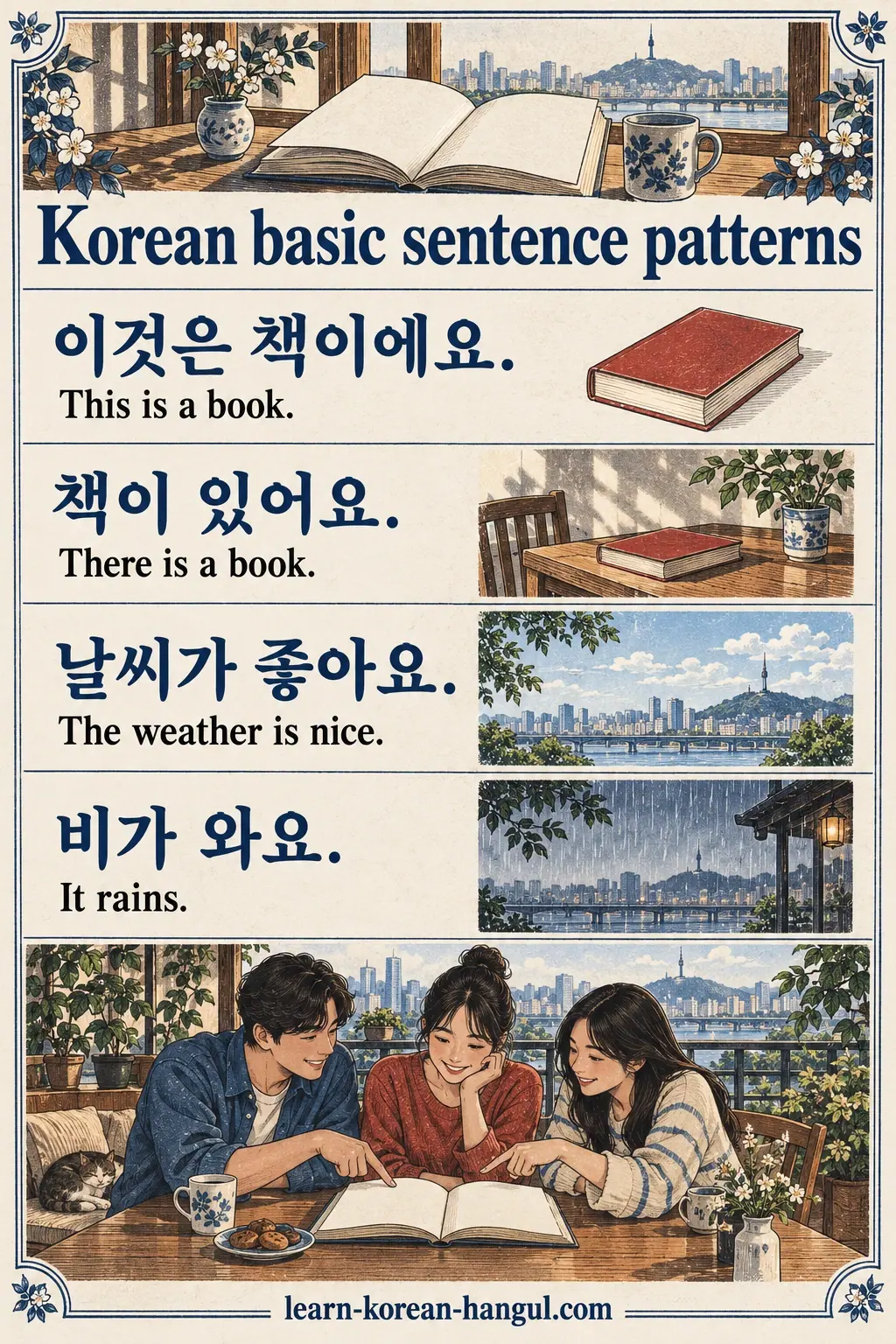
Korean basic sentence patterns are five short frames that cover most beginner speech: "A is B", "there is A", "A is like this", "A happens" and "A does something to B". Every frame ends in a predicate, the verb or verb-like word, and particles on the nouns show their jobs.
What you'll learn
- Name the five frames and the question each one answers.
- Build a sentence in each frame by choosing the right particles.
- Place time words and adverbs without changing the frame.
- Recognise when a sentence uses fewer parts than English would.
Prerequisite: you have seen the subject-object-verb sentence pattern and know what a particle is. Estimated time: 30 minutes.
What Are Korean Basic Sentence Patterns?

Korean basic sentence patterns are short, reusable frames that show where each part of a sentence goes. A sentence pattern (문형, munhyeong) is a skeleton with slots: you fill the slots with nouns and choose the ending. Because Korean puts the predicate last, every frame ends in 이에요, 있어요, an adjective or a verb.
Five frames cover most of what a beginner says. Each answers a different question about the world, so choosing a frame is mostly a matter of choosing a question.
A First Look: Two Annotated Examples
Example 1. 이것은 책이에요. (igeoseun chaegieyo.) means "This is a book." The parts are 이것 (this), 은 (topic particle), 책 (book) and 이에요 (is). Say it as [이거슨 채기에요]. This is frame 1, identity.
Example 2. 날씨가 좋아요. (nalssiga joayo.) means "The weather is nice." The parts are 날씨 (weather), 가 (subject particle) and 좋아요 (is good). This is frame 3, quality. The sentence has only one noun, and that is complete.
The two examples use different frames and different particles, 은 in the first and 가 in the second. The next section lists all five frames side by side.
How Do Korean Basic Sentence Patterns Work?

Korean basic sentence patterns work by pairing one or two nouns with particles and ending in a predicate. The first noun gets 은/는 or 이/가, an optional second noun gets 을/를, and the predicate comes last. The five frames below differ only in which predicate they use and whether an object is present.
| Frame | Shape | Question it answers | Example | Meaning |
|---|---|---|---|---|
| 1. Identity | N은/는 N이에요 | What is it? | 이것은 책이에요. | This is a book. |
| 2. Existence | N이/가 있어요/없어요 | Is there one? | 책이 있어요. | There is a book. |
| 3. Quality | N이/가 adjective | What is it like? | 날씨가 좋아요. | The weather is nice. |
| 4. Action | N이/가 verb | What happens? | 비가 와요. | It rains. |
| 5. Action on a thing | N이/가 N을/를 verb | Who does what to what? | 저는 사과를 먹어요. | I eat an apple. |
Each frame has the same four parts to check: the shape, a use, an example and a trap. The sections below follow that order.
Frame 1: Noun + 은/는 + Noun + 이에요
The shape: topic noun, second noun, and 이에요 after a consonant or 예요 after a vowel. Use it to say what something is or who someone is: 저는 학생이에요 (I am a student). The trap: 이에요 attaches to the noun without a space, and its negative is a separate word, covered in the lesson on 아니에요. For the form of "to be" see 이에요/예요.
Frame 2: Noun + 이/가 + 있어요 or 없어요
The shape: a noun with 이/가 and the existence words 있어요 (there is) or 없어요 (there is not). Use it to say something exists: 책이 있어요 (there is a book). The same frame expresses possession, with the owner as topic: 저는 책이 있어요 means "I have a book", literally "as for me, a book exists". The trap: do not look for a verb meaning "to have"; the existence word does that job. The details are in the lesson on 있어요/없어요.
Frame 3: Noun + 이/가 + Descriptive Verb
The shape: a noun with 이/가 and a descriptive verb, which is what English calls an adjective. Use it to describe: 날씨가 좋아요 (the weather is nice). The trap: no word for "is" is needed, because Korean adjectives are verbs, as the lesson on Korean adjectives are verbs explains.
Frame 4: Noun + 이/가 + Verb
The shape: a noun with 이/가 and a verb that needs no object, such as 오다 (to come) or 가다 (to go). Use it for events and movement: 비가 와요 (it rains, literally "rain comes"), 친구가 와요 (a friend comes). Add a place with 에 to say where: 저는 학교에 가요 (I go to school). The trap: the place word takes 에, not 을/를.
Frame 5: Noun + 이/가 + Noun + 을/를 + Verb
The shape: a subject (with 이/가, or 은/는 when it is the topic, as 저는 is here), an object marked with 을 after a consonant or 를 after a vowel, and a verb that acts on the object. Use it for "who does what": 저는 사과를 먹어요 (I eat an apple). The trap: the object comes before the verb, so English "eat an apple" becomes "apple eat". This is the full subject-object-verb order.
With the five frames named, we can build one in detail.
How Do You Build 이것은 책이에요?

Building 이것은 책이에요 takes five steps, and each step ends with a check.
- Ask the question. "What is this?" is an identity question, so use frame 1. Check: the answer names a thing.
- Choose the topic. 이것 (this thing) points to what you are talking about. Check: it is a noun.
- Add the topic particle. 이것 ends in ㅅ, a consonant, so use 은: 이것은. Check: the particle attaches without a space.
- Add the second noun. 책 (book). Check: it names what the topic is.
- Add 이에요 last. 책 ends in ㄱ, a consonant, so use 이에요: 책이에요. Check: the sentence ends with the predicate.
You will know it worked when you can swap the nouns and keep the frame: 이것은 가방이에요 (this is a bag), and 저것은 의자예요 (that over there is a chair, with 예요 after the vowel ending of 의자).
The same question-first method works for the other frames. Ask "is there one?" and use 있어요, or "what is it like?" and use an adjective. The next section turns that method into a comparison.
How Do the Five Frames Differ?

The five frames differ in the question they answer and in the kind of predicate they use. The first frame states identity, and the other four describe a quality, an existence or an action. Pick the frame by asking what you want to say.
| You want to say | Ask yourself | Frame | Predicate type |
|---|---|---|---|
| X is Y | What is it? | 1 | 이에요/예요 |
| X exists, X is absent | Is there one? | 2 | 있어요/없어요 |
| X is nice, big, quiet | What is it like? | 3 | descriptive verb |
| X comes, X goes, X rains | What happens? | 4 | verb without object |
| X does Y to Z | Who does what to what? | 5 | verb with object |
Frames 3, 4 and 5 look alike on the surface because they all end in 아요/어요 forms. The test is the object: if you can add a noun with 을/를, you are in frame 5. If you cannot, the verb belongs to frame 4, and a quality word belongs to frame 3.
Frame 1 is also different in the particle. It usually takes 은/는 on the first noun because the thing being identified is already in view or under discussion, as 이것 (this thing) is when you point at it. Frames 2 to 5 usually take 이/가 on the first noun when the noun is new information. The lessons on the topic particle 은/는 and the subject particle 이/가 explain the difference in full.
When Can You Add or Drop Words in a Frame?

You can add time words and adverbs before the predicate without changing the frame, and you can drop any noun the listener already knows. Korean frames are flexible at the front and fixed at the end.
Adding a time word. 오늘 날씨가 좋아요 means "Today the weather is nice." The time word 오늘 (today) goes before the subject or just before the predicate, and the frame stays frame 3.
Adding an adverb. 저는 매일 커피를 마셔요 means "I drink coffee every day." The adverb 매일 (every day) sits between the topic and the object, and the frame stays frame 5.
Dropping a noun. If everyone knows who is speaking, 사과를 먹어요 is enough for "I eat an apple". The lesson on dropping the subject in Korean gives the rules.
Swapping the order of earlier parts. The order of the subject, object and time words can shift for emphasis, and the particles keep the meaning clear. The predicate does not move.
A fair limit: these five frames are the beginner core, not a full grammar. Frames with an indirect object (친구에게 책을 줘요, "I give a friend a book"), quoted speech, and sentences that join two predicates are taught in later sections, and the honorific and tense endings change the predicate but not the frame.
What Mistakes Do Learners Make with Korean Basic Sentence Patterns?
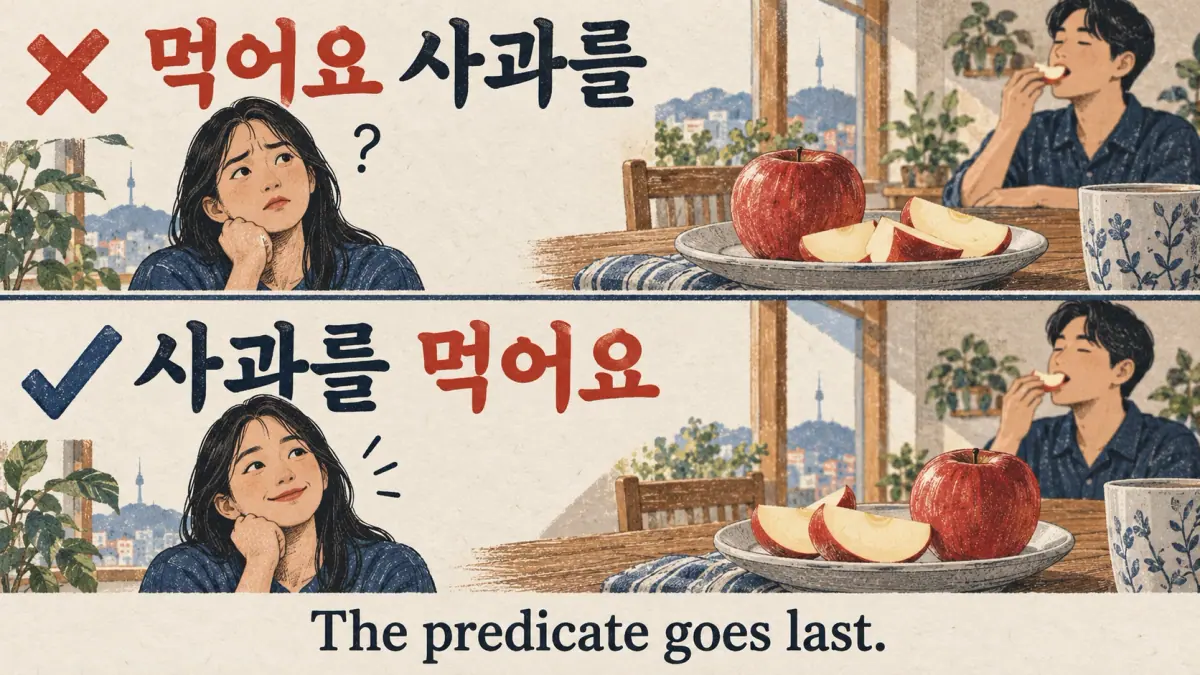
Most mistakes come from carrying English sentence habits into Korean. Each mistake below shows what learners assume, what is true and why.
Thinking every sentence needs a subject and an object. Learners often assume Korean sentences must have both; actually many frames use one noun or none, so 날씨가 좋아요 is complete.
Putting the verb in the middle. Learners often copy English order and say 먹어요 사과를; actually the predicate goes last, so write 사과를 먹어요.
Using 이에요 after an adjective. Learners often write 날씨가 좋이에요 for "the weather is nice"; actually frame 3 uses a descriptive verb alone, so write 날씨가 좋아요.
Dropping the object particle in writing. Learners hear 저는 사과 먹어요 in conversation and copy it into written answers; actually spoken Korean often drops 을/를, but writing and beginner answers keep it: 저는 사과를 먹어요.
Using 을/를 with a place. Learners often write 학교를 가요 for "I go to school"; actually the standard way to mark a destination is 에, so write 학교에 가요. You may hear 학교를 가요 in casual speech, but 에 is the form to learn first.
Most of these errors share a cause: the learner builds the sentence in English order and adds Korean words afterwards. Build from the predicate backward instead: choose the ending, then fill the slots before it.
Practice: Choose, Fix, Translate and Write
Try these before reading the answers.
Exercise 1. Name the frame (1 to 5).
- 책이 있어요.
- 저는 학생이에요.
- 비가 와요.
- 저는 사과를 먹어요.
Exercise 2. Fix the error.
먹어요 사과를 저는. (Meaning: I eat an apple.)
Exercise 3. Translate into Korean. "A friend reads a book." Use frame 5 with 책 (book) and 읽어요 (reads).
Exercise 4. Write your own. Make one sentence in frame 3 about the weather or about a place you know.
Sentence
I eat an apple.
Show answer
저는 사과를 먹어요
Practice · 3
Which frame is 날씨가 좋아요?
Show answer
quality
Where does the predicate go?
Show answer
last
Which particle marks the object of 먹어요?
Show answer
을/를
Answers.
- Exercise 1: item 1 is frame 2 (existence); item 2 is frame 1 (identity); item 3 is frame 4 (action); item 4 is frame 5 (action on a thing).
- Exercise 2: 저는 사과를 먹어요. The predicate goes last.
- Exercise 3: 친구가 책을 읽어요. The subject 친구 ends in a vowel (가), and the object 책 ends in a consonant (을). Say it as [친구가 채글 일거요].
- Exercise 4: answers vary. A correct model is 오늘 날씨가 좋아요 (today the weather is nice).
Where to Go after Korean Basic Sentence Patterns
After Korean basic sentence patterns, study the positive "to be" in 이에요/예요 and the existence words in 있어요/없어요, because those two give you frames 1 and 2 in full. Then learn the negative in 아니에요 and the rules for leaving words out in dropping the subject in Korean. To see why the predicate sits last, return to the Korean SOV sentence pattern lesson. All six lessons in this set are listed in Korean sentence structure.
This lesson does not cover tenses, honorific endings, questions or joined sentences. Those topics have their own lessons.
In short, Korean basic sentence patterns are five frames (identity, existence, quality, action and action on a thing) that all end in the predicate and use particles to show the role of each noun.
Frequently Asked Questions
How many basic sentence patterns does Korean have? Beginners can cover most speech with five frames: identity (이에요), existence (있어요), quality (adjective), intransitive action (verb) and transitive action (object plus verb). Linguists describe more types, but these five match the questions learners meet first: what is it, is there one, what is it like, what happens, who does what.
Does every Korean sentence need a subject and an object? No. Many Korean sentences have one noun or none, because speakers drop what the listener already knows. 날씨가 좋아요 has one noun and no object. 먹어요 can mean 'I eat' with nothing else said. Only the predicate at the end is required in everyday speech.
Where does the verb go in a Korean sentence? The verb or other predicate always goes last in a basic Korean sentence. Time words, place words, subjects and objects come before it, and particles mark their jobs. This is why Korean is called a verb-final or subject-object-verb language. The order of earlier parts can shift, but the predicate stays at the end.
What is the difference between 은/는 and 이/가 in a sentence pattern? Both attach to the first noun, but 은/는 marks the topic (what the sentence is about) and 이/가 marks the subject (who or what does it). Frame 1 usually uses 은/는, and frames 2 to 5 usually use 이/가 for new information. Contrast and context can swap them, which has its own lesson.
Can I use these patterns in the past tense? Yes. Each frame keeps its shape in the past tense and only the ending changes: 이에요 becomes 이었어요, 있어요 becomes 있었어요, and 먹어요 becomes 먹었어요. Learn the present forms first, then add the past endings from the tenses lessons. The frame itself does not change.