
Before you start: you should know the connector -고 ("and") and how to make a simple polite sentence. You should also know how to find a verb stem (the dictionary form without its final 다, such as 하 in 하다). Estimated time: 15 minutes.
What Does -고 나서 Grammar Mean?
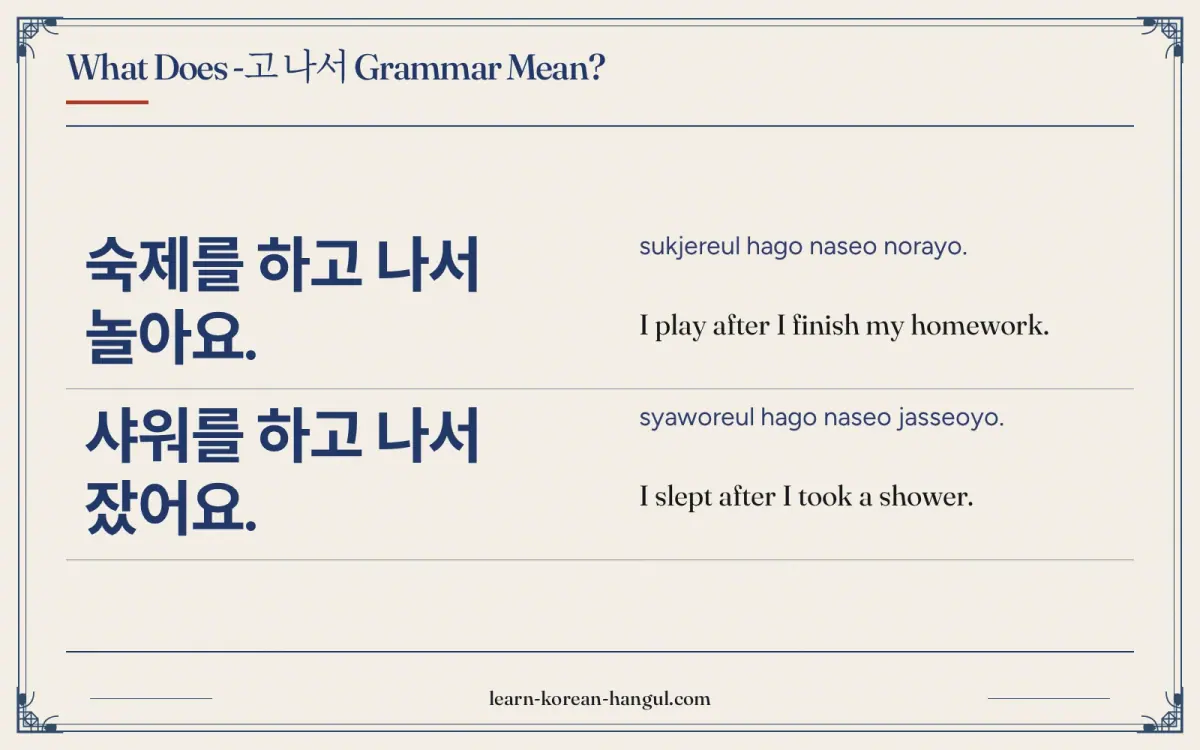
-고 나서 grammar means "after finishing X, then Y". It joins two actions in order and says that the first one is completely done before the second begins. In 숙제를 하고 나서 놀아요, the homework is finished first, and only then does the play start. Learner grammars treat it as a connector: a form that links one clause to the next.
The pattern has two parts. The first is -고, the plain "and" ending. The second is 나서, from the verb 나다 in its sense of "to be done", with a linking ending added. That second part is what adds the idea of "finished". Without it, -고 can mean "and", "and then" or just a list. With it, the first step must be over.
숙제를 하고 나서 놀아요.
sukjereul hago naseo norayo.
I play after I finish my homework.
밥을 먹고 나서 커피를 마셨어요.
babeul meokgo naseo keopireul masyeosseoyo.
After eating, I had coffee.
샤워를 하고 나서 잤어요.
syaworeul hago naseo jasseoyo.
I slept after I took a shower.
Notice that the first verb has no tense in any of the three examples. The second sentence is in the past, yet 먹고 stays bare. The next section shows how to build the form on every kind of verb.
How Do You Form -고 나서?
You form -고 나서 by adding it to the verb stem, with nothing in between and no change to the stem. Like -고, it has only one version, so there is no choice between -고 and -으고.
| Verb | Dictionary form | With -고 나서 | Revised Romanization |
|---|---|---|---|
| Vowel stem | 하다 | 하고 나서 | hago naseo |
| Vowel stem | 마시다 | 마시고 나서 | masigo naseo |
| Consonant stem | 먹다 | 먹고 나서 [먹꼬 나서] | meokgo naseo |
| Consonant stem | 읽다 | 읽고 나서 [일꼬 나서] | ilgo naseo |
| Consonant stem | 씻다 | 씻고 나서 [씯꼬 나서] | ssitgo naseo |
| ㄹ stem | 놀다 | 놀고 나서 | nolgo naseo |
| ㄷ stem | 듣다 | 듣고 나서 [듣꼬 나서] | deutgo naseo |
| ㅂ stem | 돕다 | 돕고 나서 [돕꼬 나서] | dopgo naseo |
| ㅡ stem | 끄다 | 끄고 나서 | kkeugo naseo |
| 하다 verb | 졸업하다 | 졸업하고 나서 [조러파고 나서] | joreopago naseo |
Revised Romanization (RR, the official Latin spelling) is only an aid. It follows the spelling and does not show the tense sound, so 먹고 is written meokgo even though it is said [먹꼬].
Stems Ending in a Vowel
Add -고 나서 after the vowel and say it as written: 하고 나서, 마시고 나서, 보고 나서, 만나고 나서. There is no sound change, because the ㄱ comes right after a vowel.
Stems Ending in a Consonant
Add -고 나서 after the final consonant. The spelling stays, but the sound changes. A tense consonant is a sharper, tighter sound, written ㄲ, ㄸ, ㅃ, ㅆ or ㅉ when it has its own letter. The Standard Pronunciation Rules (표준 발음법, Articles 11 and 23) say that after the final sounds ㄱ, ㄷ and ㅂ, the ㄱ becomes tense. So the ㄱ of -고 is said as ㄲ:
- 먹고 [먹꼬], with final ㄱ.
- 읽고 [일꼬], where ㄺ is said as ㄹ and the ㄱ turns tense.
- 씻고 [씯꼬], where final ㅅ is said as ㄷ.
- 돕고 [돕꼬], with final ㅂ.
- 앉고 [안꼬], where a verb stem ending in ㄵ or ㄻ also makes the next consonant tense (Article 24).
After ㄹ, nothing becomes tense: 놀고 is said as written. In 졸업하고, the final ㅂ of the noun 졸업 meets the ㅎ of 하, and the two sounds merge into ㅍ: [조러파고].
Irregular Stems and Nouns
Irregular verbs do not change before -고. They change their stem only before endings that start with a vowel. The ending -고 starts with a consonant, so 듣다 stays 듣고 (not 들고), 돕다 stays 돕고 (not 도우고), and 모르다 stays 모르고.
You cannot put -고 나서 after a noun or an adjective. For a noun, use 후에 instead (수업 후에, "after class"), or turn the noun into a 하다 verb (졸업하다, 식사하다). For an adjective, there is no "finishing" idea, so no form exists. Next, here is one full sentence built step by step.
Worked Example: Building a Sentence with -고 나서
You build it in five steps, working from the two actions you want to join. This example makes "I wash my hands and then eat".
- Write both actions with their dictionary verbs. 손을 씻다 and 먹다.
- Decide which action comes first. Washing comes first, so it goes into the -고 나서 clause.
- Find the stem of the first verb. Remove 다 from 씻다. The stem is 씻.
- Add -고 나서. 씻 + 고 나서 = 씻고 나서, said [씯꼬 나서].
- Give the last verb its tense and politeness. 먹다 becomes the polite present 먹어요. Put the clause first: 손을 씻고 나서 먹어요.
Sentence
I wash my hands and then eat.
Show answer
손을 씻고 나서 먹어요
Checkpoint. You have it when you can put the sentence into the past without touching 씻고 나서. The answer is 손을 씻고 나서 먹었어요 [소늘 씯꼬 나서 머거써요]. Only the last verb changes. The past tense is explained in past tense -았/었-.
The sentence built here is a statement. The next section shows which tenses and sentence types can follow -고 나서.
Which Tenses and Sentence Types Work with -고 나서?
The main verb can have any tense or sentence type, and the verb in front of 나서 stays bare. The ending carries no tense. The time is read from the final verb, so one tense covers both steps.
| Feature | Where it goes | Example |
|---|---|---|
| Present habit | final verb | 숙제를 하고 나서 놀아요. |
| Past | final verb | 밥을 먹고 나서 커피를 마셨어요. |
| Future | final verb | 졸업하고 나서 뭐 할 거예요? = "What will you do after you graduate?" |
| Command | final verb | 손을 씻고 나서 드세요. |
| Honorific -(으)시- | on the first verb too, if the subject is respected | 할머니께서는 식사를 하시고 나서 주무세요. |
| Tense in the first clause | not allowed | 먹었고 나서 is wrong |
| Adjective in the first clause | not allowed | 예쁘고 나서 is wrong |
The subjects of the two clauses can differ: 제가 나가고 나서 동생이 들어왔어요 means "My younger sibling came in after I went out". The honorific -(으)시- is the ending that shows respect for the subject. See honorific -(으)시- for the ending itself. A question that uses a question word, such as 뭐 ("what"), puts the stress on that word and does not end with a sharp rise.
Next comes the pattern that learners confuse with -고 나서 most often.
How Is -고 나서 Different from -(으)ㄴ 후에?
-고 나서 attaches to a verb stem and stresses that the first action is finished, while -(으)ㄴ 후에 attaches to a modifier form and also works after nouns. Both mean "after". 밥을 먹고 나서 가요 and 밥을 먹은 후에 가요 both mean "I go after eating", and in daily speech they swap freely. The lesson on -(으)ㄴ 후에 gives the full rules, and the page -고 나서 vs -(으)ㄴ 후에 gives a side-by-side decision.
-고 나서
after finishing: verb stem, no tense
-(으)ㄴ 후에
after: modifier ending + 후에
| Comparison | -고 나서 | -(으)ㄴ 후에 |
|---|---|---|
| After a noun | not possible | 수업 후에 |
| With a time length | not possible | 일주일 후에 |
| Example | 먹고 나서 가요. | 먹은 후에 가요. |
| Tone | neutral, spoken and written | neutral, slightly more formal |
Use -고 나서 for two actions in order when the first is finished; use -(으)ㄴ 후에 when you need a noun, a time length or a slightly more formal tone.
The other neighbour is plain -고. -고 links actions or descriptions: it can mean "and", "and then" or a list. 숙제를 하고 놀아요 can mean "I do homework and play", and it does not insist that the homework is finished. 숙제를 하고 나서 놀아요 insists on that. For adjectives only -고 works: 이 집은 크고 예뻐요 ("This house is big and pretty").
A quick test: if you can add "once it is completely done" to the English, -고 나서 is right. If the English says "while", use -(으)면서. Next are the useful variations of the pattern.
Variations: -고서, -고 나니(까) and -고 나면
-고 나서 has three close relatives that all use the same first half: -고서, -고 나니(까) and -고 나면. A topic-marked form, 나서는, is also common.
- -고서. This is the shorter form. 손을 씻고서 먹었어요 means "I ate after washing my hands" [소늘 씯꼬서 머거써요]. Both forms are used in speech and writing, and the two are interchangeable in simple sequences.
- -고 나니(까). This adds the idea of discovery: "after I did it, I found that...". 밥을 먹고 나니 졸려요 means "After eating, I feel sleepy". The first clause is a trigger, and the second is something you noticed.
- -고 나면. This is the "once ... is done" form, used for the future or for general rules. 일을 끝내고 나면 전화할게요 means "I will call once I finish work" [이를 끈내고 나면 전화할께요].
- 나서 with 는. Add the topic marker to put weight on that moment: 밥을 먹고 나서는 바로 눕지 마세요 means "After you eat, do not lie down right away" [바블 먹꼬 나서는 바로 눕찌 마세요].
밥을 먹고 나니 졸려요.
babeul meokgo nani jollyeoyo.
After eating, I feel sleepy.
For more neighbours of this pattern, see Time and Sequence. Next are the errors that appear most often.
What Mistakes Do Learners Make with -고 나서?
Learners make five common mistakes with -고 나서.
- Using it with an adjective. Learners write 예쁘고 나서 마음에 들어요. Actually an adjective cannot be "finished". Use plain -고 for "and": 예쁘고 마음에 들어요.
- Putting a past ending in the first clause. Learners write 먹었고 나서 갔어요. Actually the first verb stays bare, because the final verb already shows the tense.
- Using it for two actions at once. Learners write 음악을 듣고 나서 운전해요 to mean "I drive while listening to music". Actually -고 나서 means "after". Use -(으)면서 for "while".
- Saying 먹고 as a plain [먹고]. Learners follow the spelling. Actually the ㄱ is tense after a consonant stem, so say [먹꼬].
- Writing 고나서 without a space. Learners join the words. Actually 나서 is written as its own word in standard spelling: 고 나서.
Whenever you reach for "after", check whether the first step is a finished action. Now test yourself.
Practice and Answers
These four exercises check the main skills: joining actions, repairing a mistake and choosing the right word. Try each one before you read the answers.
Practice · 5
How do you say "after eating" with 먹다 and -고 나서?
Show answer
먹고 나서
The bare stem 먹 takes -고 나서. The past ending is not added to the first verb.
Which sentence is correct?
Show answer
숙제를 하고 나서 산책했어요.
-고 나서 needs an action verb that can be finished (하다). It does not take adjectives, and the first verb stays bare.
How is 먹고 나서 pronounced?
Show answer
[먹꼬 나서]
After the final consonant ㄱ of 먹, the ㄱ of -고 becomes tense (꼬).
Which pattern means that two actions happen at the same time?
Show answer
-(으)면서
-(으)면서 means "while doing". The other three patterns put the actions in sequence.
Which sentence means "I play after I finish my homework"?
Show answer
숙제를 하고 나서 놀아요.
-고 나서 says the homework is finished first. The first verb stays bare, so 했고 나서 is wrong.
Exercise 1: Join the actions. Make one sentence with -고 나서: 샤워를 하다 + 자다. ("I take a shower" then "I sleep".) Use the polite present.
Exercise 2: Fix the error. A learner writes 밥을 먹었고 나서 커피를 마셔요. Correct it.
Exercise 3: Choose the right word. You want to say "I listen to music while I study". Is -고 나서 right?
Exercise 4: Translate. "After I graduate, I will study in Korea." (graduate = 졸업하다, study = 공부하다, in Korea = 한국에서)
Answer Key
- Exercise 1: 샤워를 하고 나서 자요. The first verb 하 takes -고 나서, and 자요 carries the tense.
- Exercise 2: 밥을 먹고 나서 커피를 마셔요. [바블 먹꼬 나서 커피를 마셔요] The first verb loses its past ending.
- Exercise 3: No. -고 나서 means "after", so the two actions would not overlap. Use -(으)면서: 음악을 들으면서 공부해요.
- Exercise 4: 졸업하고 나서 한국에서 공부할 거예요. [조러파고 나서 한구게서 공부할꺼예요] The bare stem 졸업하 takes -고 나서, and the future -(으)ㄹ 거예요 sits on the last verb.
If you missed Exercise 1 or 2, return to the five building steps. If you missed Exercise 3, reread the comparison with plain -고 and -(으)면서. Next, plan where to go from here.
What Should You Learn Next after -고 나서 Grammar?
The best next lesson is -(으)ㄴ 후에, the noun-friendly "after" pattern, because it can replace -고 나서 in many sentences. Then study -자마자 for "as soon as". The full set of timing patterns is on Time and Sequence. To see where -고 나서 sits in a study plan, use the Beginner Grammar list. The modifier forms behind -(으)ㄴ 후에 are explained in Noun-Modifying Forms.
What this lesson does not cover. It does not cover 나다 as a full verb, the use of -고 나서 with passive verbs, or spoken shortenings. The level given here, A2, is an editorial estimate based on common textbook order and TOPIK I, not an official grading.
In short, -고 나서 grammar attaches to a bare action verb stem, keeps the first clause free of tense, and says that the first step is finished before the second begins.
Frequently Asked Questions
What does -고 나서 mean? -고 나서 means "after finishing X, then Y". It links two actions and stresses that the first one is completely done before the second begins. 숙제를 하고 나서 놀아요 means "I play after I finish my homework". Compared with plain -고 ("and"), it makes the finished first step clear.
How do I attach -고 나서 to a verb or adjective? Remove 다 from an action verb and add -고 나서 to the stem: 하다 becomes 하고 나서, 먹다 becomes 먹고 나서. No stem ever changes, even for irregular verbs such as 듣다 (듣고 나서). It is not used with adjectives, because an adjective is a state and cannot be "finished" and followed by a next step.
Can -고 나서 be used in the past tense? The main verb can be past, present or future, but the verb before 나서 stays bare. Say 밥을 먹고 나서 커피를 마셨어요, "After eating, I had coffee". Do not write 먹었고 나서. The tense marks only the last verb, just as it does with plain -고.
Is -고 나서 used in speech or only in writing? -고 나서 is used in both. It is neutral, so it fits casual talk, polite speech and instructions. In writing you will also see the shorter -고서. In speech the main point is sound: after a consonant stem the ㄱ is tense, so 먹고 is said [먹꼬], and a following 나서 stays separate.
What is the most common mistake with -고 나서? Learners attach it to adjectives, as in 예쁘고 나서, or put a past ending in the first clause, as in 먹었고 나서. Both are wrong. Use -고 나서 only with action verbs that can be finished, and put the tense on the final verb. A third mistake is using it for two actions at the same time, where -(으)면서 fits.
What is the difference between -고 나서 and -(으)ㄴ 후에? Both mean "after", and they often swap in speech. -고 나서 attaches to a verb stem and stresses that the first action is finished. -(으)ㄴ 후에 uses the modifier ending, also works after nouns (수업 후에), and can take a time length (일주일 후에, "a week later"). Use -고 나서 only with a verb.