What you'll learn
- Ask "what kind of" about a person, thing or place with 어떤 plus a noun.
- Answer an 어떤 question with an adjective that describes the noun.
- Tell 어떤 apart from 무슨 and from 어느 (which of a set).
- Read 어떤 as "some" or "a certain" in statements.
- Fix the most common mistake: using 어떤 when the choices are already known.
Before you start: you should know that Korean attaches particles such as 을/를 to nouns and that the verb comes last. If not, read Korean sentence structure first. Audio plays only when you press a button.
What Does 어떤 What Kind of Which Mean?

어떤 is a determiner (관형사, gwanhyeongsa) that asks about the kind, quality or character of a noun. It always stands right before the noun it describes and never takes a particle or an ending. Its meaning is closest to "what kind of" in English. The "which" in the lesson title is a loose gloss: for real choices from a known set, Korean uses 어느, covered in 어느 which in korean.
The word is related to the verb 어떻다 ("to be what like"), which also gives 어떻게 (how) and 어때요 (how is it). Think of 어떤 as the form that attaches to nouns: the "what-like" in "what-like person." That link explains why an 어떤 question is usually answered with a describing word.
A First Example
Two annotated sentences show the pattern.
- 어떤 영화를 좋아해요? (eotteon yeonghwareul joahaeyo?) [어떤 영화를 조아해요] = "What kind of movies do you like?" The parts are 어떤 (what kind of), 영화를 (movies, object), 좋아해요 (like, polite ending).
- 어떤 분이에요? (eotteon bunieyo?) = "What kind of person is he or she?" The parts are 어떤 (what kind of), 분 (person, honorific), 이에요 (is).
In both sentences a noun follows 어떤 directly. 분 is the respectful word for "person," so the second question suits a teacher, a boss or someone you have just met. The next section states the rule behind these examples.
How Does 어떤 What Kind of Which Work?

Put 어떤 immediately before a noun, leave out any particle between the two, and then add the particle and verb that the noun needs. The question has the same shape as a statement. The statement 저는 매운 음식을 좋아해요 ("I like spicy food") becomes 어떤 음식을 좋아해요? when you replace 매운 음식 with 어떤 음식.
The answer is the main difference from many other question words. An 어떤 question asks for a description, so the reply is usually an adjective in modifier form plus the noun. For 어떤 음식을 좋아해요? the reply could be 매운 음식을 좋아해요 ("I like spicy food") or 단 음식을 좋아해요 ("I like sweet food"). The modifier form of an adjective ends in -ㄴ or -은: 매운 (spicy), 단 (sweet), 친절한 (kind).
Pattern Table
The table shows the nouns that follow 어떤 most often, the meaning and a typical answer.
| Phrase | Meaning | Model question | Typical answer |
|---|---|---|---|
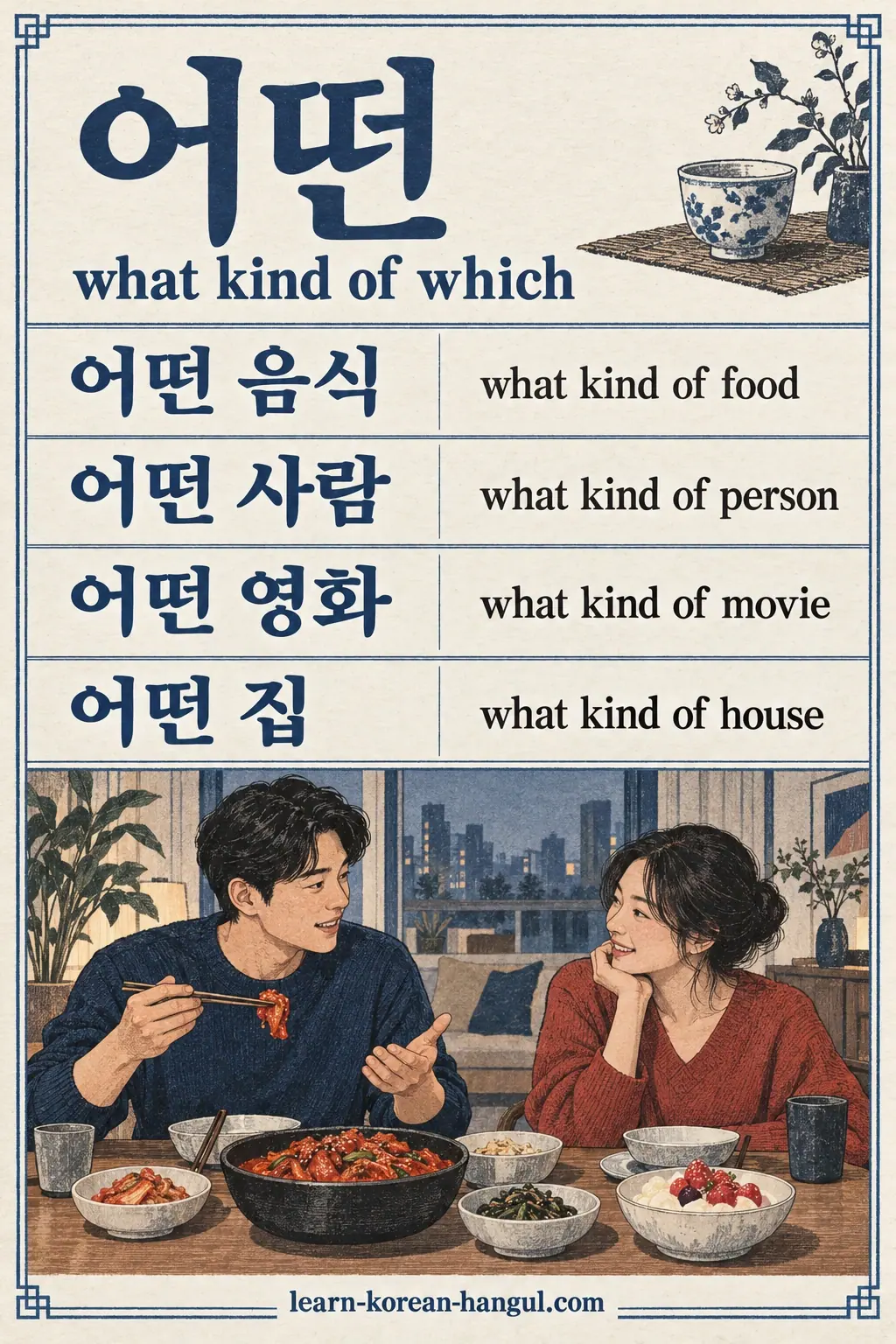
| 어떤 음식 | what kind of food | 어떤 음식을 좋아해요? | 매운 음식을 좋아해요. |
| 어떤 사람 | what kind of person | 어떤 사람이 좋아요? | 친절한 사람이 좋아요. |
| 어떤 영화 | what kind of movie | 어떤 영화를 봐요? | 재미있는 영화를 봐요. |
| 어떤 집 | what kind of house | 어떤 집에서 살아요? | 작은 집에서 살아요. |
| 어떤 일 | what kind of work | 어떤 일을 해요? | 학교에서 일해요. |
The table shows that the question and the answer share the noun and differ in the describing word. A worked example shows how to build one from scratch.
How Do You Build a Question with 어떤 Step by Step?

You build an 어떤 question by finding the noun you want to describe and putting 어떤 in front of it. Follow the steps with the sentence "I like a kind person."
- Start with the statement. 저는 친절한 사람이 좋아요. (jeoneun chinjeolhan sarami joayo.) [저는 친절한 사라미 조아요] = "I like a kind person." The noun is 사람.
- Find the describing word. The word 친절한 ("kind") tells you the quality. This is the part you want to ask about.
- Replace the describing word with 어떤. 친절한 사람 becomes 어떤 사람.
- Drop the subject. Ask about the listener without saying "you": 어떤 사람이 좋아요?
- Say it as a question. 어떤 사람이 좋아요? (eotteon sarami joayo?) = "What kind of person do you like?" The question word already marks the question, so the end often falls rather than rises.
You will know it worked when 어떤 sits where the describing word stood and the noun keeps its particle. The common slip is adding 이 to 어떤 itself, as in 어떤이 사람이 좋아요, which Korean never says. The same method gives 어떤 노래를 좋아해요? ("What kind of songs do you like?"). With the build clear, the next question is how 어떤 differs from its neighbours.
How Is 어떤 Different from 무슨 and 어느?

어떤 asks about the kind or quality of a noun, 무슨 asks about its identity or topic, and 어느 asks which one of a known set. All three go before a noun, so the test is what the speaker wants in the answer: a description, a name or a pick.
| Question word | What it asks | Typical answer | Model sentence |
|---|---|---|---|
| 어떤 | What kind, what quality | An adjective plus the noun | 어떤 영화를 좋아해요? (What kind of movies?) |
| 무슨 | What, which topic | A name or a topic | 무슨 영화를 봐요? (What movie are you watching?) |
| 어느 | Which one of a known set | One item from the set | 어느 영화가 재미있어요? (Which movie is fun?) |
Compare the answers. To 어떤 영화를 좋아해요? you say 액션 영화 ("action movies"). To 무슨 영화를 봐요? you say a title. To 어느 영화가 재미있어요? you point at one of the films in front of you. In everyday speech, 어떤 and 무슨 overlap often, and a learner who swaps them is usually understood. The 무슨 what kind of lesson covers the second determiner, and 무슨 vs 어떤 vs 어느 lines up all three. The differences also show up in uses of 어떤 outside questions.
When Do You Use 어떤, and When Not?

Use 어떤 when you want a description of a type, and avoid it when the choice is already on the table. The word also has uses outside questions, and each changes the meaning, so they are listed here with one example each.
- "Some" or "a certain." In a statement, 어떤 means an unnamed person or thing: 어떤 사람이 찾아왔어요. (eotteon sarami chajawasseoyo.) = "Some person came to see you." The listener understands that the speaker cannot or will not say who.
- "Any," with -든지 or -이든. 어떤 음식이든 좋아요. (eotteon eumsigideun joayo.) = "Any kind of food is fine." The ending turns the question word into "any."
- Asking about people politely. 어떤 분이세요? uses 분 and the honorific ending -세요. It suits a person who is older than you or someone you do not know.
- Asking about things with 것. 어떤 것을 원해요? means "What kind of thing do you want?" In speech, 것을 shortens to 걸: 어떤 걸 원해요?
- Not for a known set. If two phones lie on the table, ask 어느 폰이 좋아요? ("Which phone do you like?"). 어떤 폰이 좋아요? asks what kind of phone you like in general.
- Not for the manner of an action. To ask how to do something, use 어떻게 how in korean, not 어떤.
An honest limit: the "some" meaning looks the same as the question meaning in writing. Only context separates them, so 어떤 사람이 왔어요? with a question tone is "What kind of person came?", while the statement version is "Some person came." Learners need to hear both to build a feel for it. This lesson does not cover every pattern with 어떤 in longer sentences. The usual errors are simpler, and the next section lists them.
What Mistakes Do Learners Make with 어떤?
Learners most often use 어떤 where Korean wants another word. Four mistakes appear again and again, and each has a quick repair.
- Using 어떤 for a choice from a known set. When two items are in front of you, 어느 것이 더 좋아요? ("Which one is better?") is the clear choice question. Native speakers also say 어떤 게 더 좋아요? in casual speech, but 어느 is never wrong for a known set, so make it your default.
- Using 어떤 without a noun. 어떤 먹어요? is wrong because 어떤 has nothing to describe. Say 뭐 먹어요? or 어떤 음식을 먹어요?.
- Putting a particle on 어떤. 어떤이, 어떤을 and 어떤은 do not exist. The noun carries the particle: 어떤 사람이 왔어요?
- Answering with the wrong word class. An 어떤 question wants a description. Answering 어떤 영화를 좋아해요? with 토요일 sounds off. Answer with a describing word plus the noun: 무서운 영화 ("scary movies").
Run through this checklist when an 어떤 sentence feels wrong: Is there a noun right after 어떤? Is the particle on the noun? Is the question about kind, not about a choice? The practice below tests these checks.
Practice and Answers
Try the four items before you read the answer key. Cover the answers with your hand.
- Choose the form. Two shirts hang in front of you. Complete: ___ 옷이 예뻐요? (어떤 / 어느)
- Fix the error. A learner asks 어떤이 음식을 좋아해요? What is wrong?
- Translate. "What kind of music do you like?"
- Write your own. Write one question with 어떤 and the noun 사람, and give a one-line answer with a describing word.
Sentence
What kind of music do you like?
Show answer
어떤 음악을 좋아해요?
Practice · 8
A learner asks 어떤이 음식을 좋아해요? What is wrong?
Show answer
어떤 cannot take a particle; say 어떤 음식을 좋아해요?
어떤 is a determiner, so the noun carries the particle instead.
Translate "What kind of music do you like?"
Show answer
어떤 음악을 좋아해요?
어떤 sits right before the noun 음악, which keeps its own particle.
How do you usually answer 어떤 음식을 좋아해요?
Show answer
매운 음식을 좋아해요.
An 어떤 question asks for a description: an adjective in modifier form plus the noun; a day like 월요일 does not fit.
Two bags are on the table. Which question is the safe way to ask which one someone likes?
Show answer
어느 가방이 좋아요?
For a choice from a known set, 어느 is the standard word.
What does 어떤 mean in the statement 어떤 사람이 찾아왔어요?
Show answer
"some" or "a certain"
In a statement, 어떤 refers to an unnamed person or thing: "Some person came to see you."
Which question asks HOW you eat something?
Show answer
어떻게 먹어요?
어떤 goes before a noun; the manner of an action needs 어떻게.
How do you ask politely about an older person you don't know?
Show answer
어떤 분이세요?
Use the honorific noun 분 and the ending -세요; 어떤 itself never changes.
What does 어떤 음식이든 좋아요 mean?
Show answer
"Any kind of food is fine."
The ending -든 turns the question word into "any".
Answer key
- 어느. The shirts are a known set, so the choice word is needed: 어느 옷이 예뻐요? ("Which shirt is pretty?"). In casual speech you may also hear 어떤 옷, but 어느 is the safe choice here.
- 어떤 cannot take a particle. Delete 이: 어떤 음식을 좋아해요? The noun 음식 carries its own particle 을.
- 어떤 음악을 좋아해요? (eotteon eumageul joahaeyo?) [어떤 으마글 조아해요].
- Answers vary. Check that 어떤 sits right before the noun. An example: 어떤 사람을 좋아해요? 재미있는 사람을 좋아해요. ("What kind of people do you like? I like funny people.").
A rule of thumb to remember: 어떤 asks "what is it like?" about a noun, so expect a describing word in the answer.
What Should You Learn Next after 어떤 What Kind of Which?
After 어떤 what kind of which, study the other noun-modifying question words and then the manner questions. This lesson covers the pattern before a noun and does not teach 어느 or 무슨 in depth. Those live on their own pages.
- Start with 무슨 what kind of if you have not met the second determiner.
- Continue with 어느 which in korean, then compare all three in 무슨 vs 어떤 vs 어느.
- Learn how to ask about a method in 어떻게 how in korean.
- Review the stand-alone "what" in 뭐 무엇 what in korean.
- Return to Korean questions to see every lesson in the set.
With these steps, 어떤 what kind of which becomes automatic: find the noun, put 어떤 in front of it, and expect a description in the answer.
Frequently Asked Questions
What Does 어떤 Mean in Korean?
어떤 means "what kind of" and comes before a noun. 어떤 영화 is "what kind of movie." It asks about type or quality, and the answer is a description such as 무서운 영화 ("scary movie"). In a statement, 어떤 can also mean "some" or "a certain," as in 어떤 사람이 왔어요.
Is 어떤 the Same as 어떻게?
No. 어떤 goes before a noun and asks about its kind, while 어떻게 goes before a verb and asks about the way something is done. 어떤 음식을 먹어요? is "What kind of food do you eat?" and 어떻게 먹어요? is "How do you eat it?" Both come from 어떻다, but they work differently.
Can 어떤 Mean "Which"?
Sometimes, in loose speech, but the standard word for "which of a known set" is 어느. If two bags are on the table, ask 어느 가방이 좋아요?. Use 어떤 when you want the type, such as 어떤 가방이 좋아요? ("What kind of bag do you like?").
How Do I Answer an 어떤 Question?
Answer with a describing word in modifier form plus the noun, or with a short phrase. For 어떤 음식을 좋아해요?, say 매운 음식을 좋아해요 or just 매운 음식이요. A single-word answer like 월요일 does not fit, because the question asks for a kind, not a name or a time.
Can I Use 어떤 When Talking to an Older Person?
Yes, but raise the politeness of the rest of the sentence. 어떤 음식을 좋아하세요? uses the honorific -세요, and 어떤 분이세요? uses 분 for "person." The word 어떤 itself has only one form and does not change for politeness, so respect shows in the noun and the verb ending.