What you'll learn
- Ask "how" with 어떻게 before an action verb in a polite sentence.
- Use the set phrases 어떻게 지내요? and 이름이 어떻게 되세요?.
- Answer a 어떻게 question with a means particle such as 로 or a method phrase.
- Tell 어떻게 apart from 어때요 (how is it) and from 왜 (why).
- Fix the most common mistakes: opinion questions and the spelling 어떡해.
Before you start: you should know the polite ending -아요/-어요 and the basic order subject, object, verb. If not, read Korean sentence structure first. Audio plays only when you press a button.
What Does 어떻게 How in Korean Mean?

어떻게 is an adverb (부사, busa) that means "in what way" or "by what method." It modifies a verb and asks how the action is done: how you go, how you read, how you make something. Because it is an adverb, it takes no particle and sits directly before the verb.
The word comes from the verb 어떻다 ("to be what like"), the same source as 어떤 and 어때요. The ending -게 turns the verb into an adverb, just as English turns "quick" into "quickly." That link explains why 어떻게 asks about a way and why the neighbouring word 어때요 asks about a state.
A First Example
Two annotated sentences show the pattern.
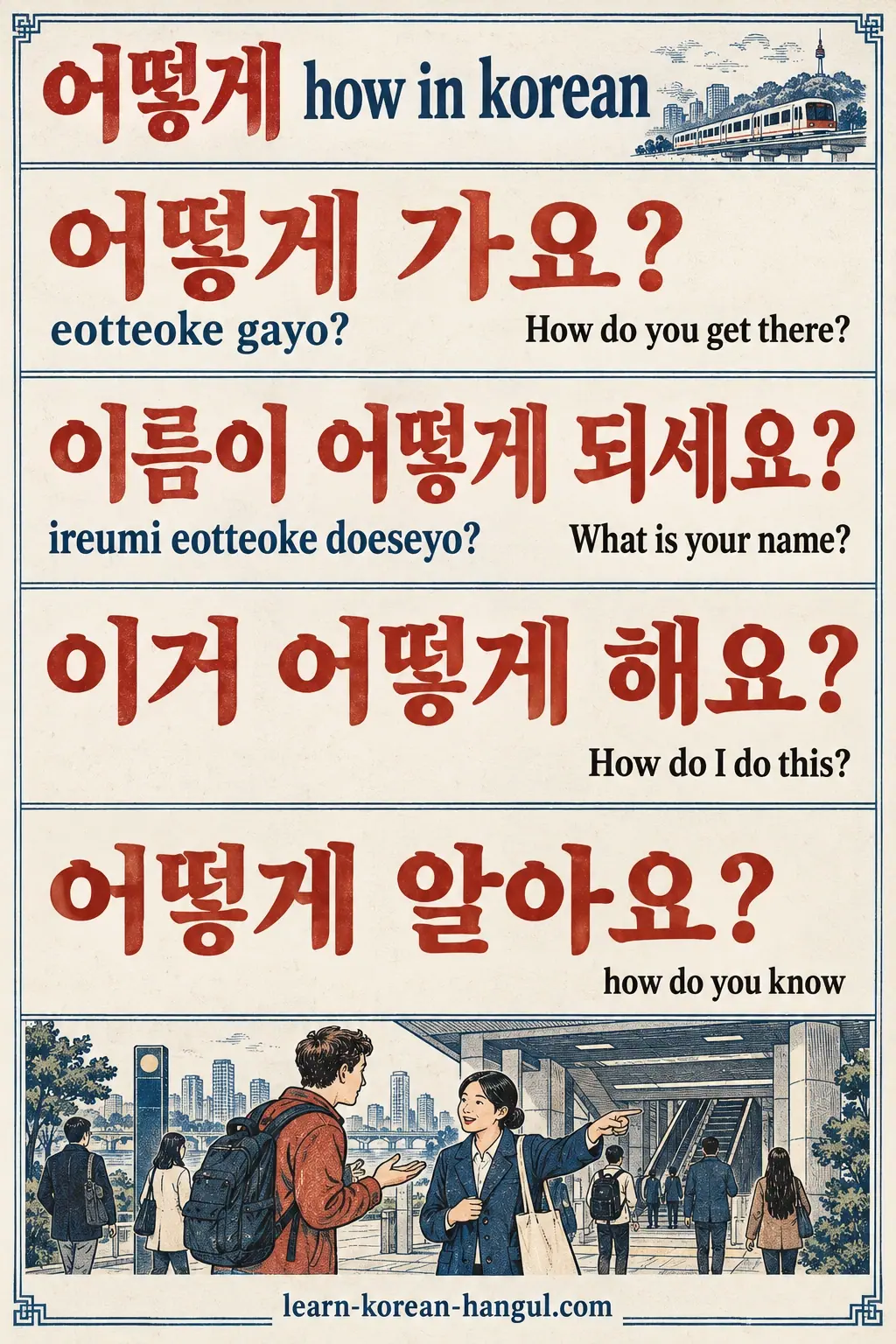
- 어떻게 가요? (eotteoke gayo?) [어떠케 가요] = "How do you get there?" The parts are 어떻게 (how), 가요 (go, polite ending).
- 이름이 어떻게 되세요? (ireumi eotteoke doeseyo?) [이르미 어떠케 되세요] = "What is your name?" The parts are 이름이 (name, subject), 어떻게 (how), 되세요 (becomes, honorific).
The first sentence is a true "how" question. The second is a set phrase: it has no literal "how" meaning, and Koreans use it to ask for a name, an age or a number politely. The next section explains how both are built.
How Does 어떻게 How in Korean Work?

Put 어떻게 directly before the verb and use the ending you would use for a statement. The question then has the same shape as the statement it replaces. The statement 지하철로 가요 ("I go by subway") becomes 어떻게 가요? when you replace 지하철로 with 어떻게.
The pronunciation needs one rule. The letter ㅎ followed by ㄱ merges into a single ㅋ sound, so 어떻게 is spoken [어떠케], not [어떻게]. The standard pronunciation rules (국립국어원 표준 발음법) describe this as aspiration. You do not change the spelling, only the sound. The answer to a 어떻게 question often uses 로/으로 for the means: 버스로 가요 ("I go by bus").
Pattern Table
The table lists the patterns learners use most, with meaning and a model sentence.
| Pattern | Meaning | Model sentence |
|---|---|---|
| 어떻게 + action verb | how, by what method | 어떻게 읽어요? (How do you read it?) |
| 어떻게 해요? | how do you do it | 이거 어떻게 해요? (How do I do this?) |
| 어떻게 지내요? | how are you getting along | 요즘 어떻게 지내요? |
| 이름이 어떻게 되세요? | what is your name (polite) | 성함이 어떻게 되세요? |
| 어떻게 알아요? | how do you know | 어떻게 알아요? |
| 어떻게 + 그럴 수 있어요? | how could you (reproach) | 어떻게 그럴 수 있어요? |
The table shows that the ending changes with the verb and the politeness, while 어떻게 stays the same. Three sister adverbs answer the question: 이렇게 (this way, near me), 그렇게 (that way, near you) and 저렇게 (that way, far from both). A teacher who shows you a method says 이렇게 하세요 ("Do it like this"). A worked example shows how to build a question from a statement.
How Do You Build a Question with 어떻게 Step by Step?

You build a 어떻게 question by replacing the method phrase in a statement with 어떻게. Follow the steps with the sentence "I go to school by bus."
- Start with the statement. 저는 버스로 학교에 가요. (jeoneun beoseuro hakgyoe gayo.) = "I go to school by bus." The method phrase is 버스로.
- Find the method phrase. 버스로 is the part you want to ask about. The particle 로 marks the means.
- Replace the phrase with 어떻게. Take away 버스로 and put 어떻게 in its place. Keep the other parts: 어떻게 학교에 가요?
- Drop the subject. Korean leaves out "you" when the listener is clear. The question is 학교에 어떻게 가요? or the shorter 어떻게 가요?.
- Say it as a question. 학교에 어떻게 가요? (hakgyoe eotteoke gayo?) [학꾜에 어떠케 가요] = "How do you go to school?" The question word already marks the question, so the end often falls rather than rises.
You will know it worked when the verb is unchanged and 어떻게 has no particle. The common slip is adding a particle, as in 어떻게로 가요, which is not Korean. The same method gives 이 단어를 어떻게 읽어요? ("How do you read this word?") and 김치를 어떻게 만들어요? ("How do you make kimchi?"). Here is a short exchange that uses the pattern twice:
- A: 공항에 어떻게 가요? (gonghange eotteoke gayo?) = "How do you get to the airport?"
- B: 지하철로 가요. 그런데 표는 어떻게 사요? (jihacheollo gayo. geureonde pyoneun eotteoke sayo?) = "By subway. But how do you buy a ticket?"
Each question keeps its object or place and swaps only the method for 어떻게. With the build clear, the next question is how 어떻게 differs from its neighbours.
How Is 어떻게 Different from 어때요 and 왜?
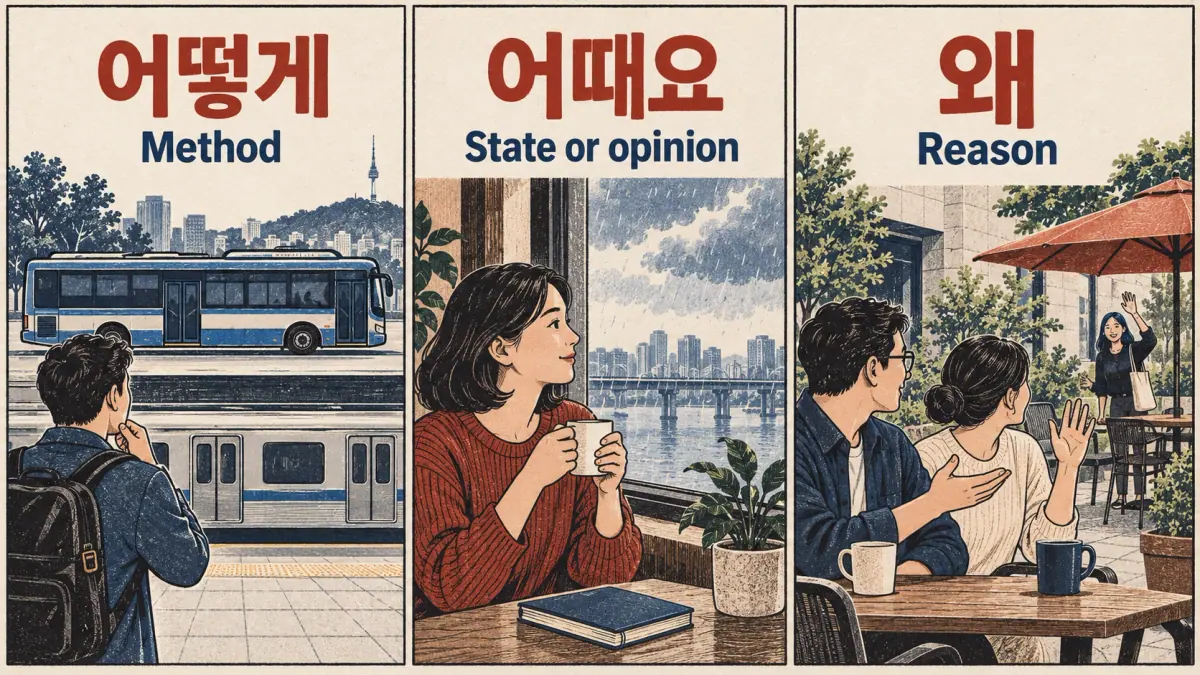
어떻게 asks about the method of an action, 어때요 asks about the state or the opinion of a thing, and 왜 asks for the reason. All three are rendered as "how" or "why" in English, so the position and the answer are the tests.
| Question | Asks about | Typical answer | Model sentence |
|---|---|---|---|
| 어떻게 + verb | Method | A way: 버스로, 이렇게 | 어떻게 가요? (How do you get there?) |
| 어때요? | State or opinion | An adjective: 좋아요, 맛있어요 | 날씨가 어때요? (How is the weather?) |
| 왜 | Reason | 때문에 or -아서/-어서 | 왜 가요? (Why are you going?) |
Compare the replies. To 어떻게 가요? you say 지하철로 가요. To 날씨가 어때요? you say 좋아요. To 왜 가요? you say 친구를 만나서요 ("Because I'm meeting a friend"). The 어떻게 vs 어때요 lesson compares the first two in detail, and the 왜 why in korean lesson covers the reason question. Outside questions, 어떻게 has a few extra uses.
When Do You Use 어떻게, and When Not?

Use 어떻게 for the way an action is done, and avoid it for opinions and for the kind of a noun. Several uses are worth learning as whole phrases.
- Greeting. 어떻게 지내요? or 어떻게 지내세요? (eotteoke jinaeseyo?) = "How are you getting along?" The verb 지내다 means "to spend time," so this is a friendly check-in with a friend or a teacher you have not seen for a while.
- Polite requests for facts. 성함이 어떻게 되세요? ("May I have your name?") and 전화번호가 어떻게 되세요? ("What is your phone number?") are customer-service phrases. They suit shops, offices and phone calls.
- Surprise or reproach. 어떻게 그럴 수 있어요? (eotteoke geureol su isseoyo?) = "How could you do that?" The sentence is not asking for a method. It shows anger or disbelief, so keep it for close relationships.
- Asking for instructions. 이거 어떻게 써요? ("How do I use this?") followed by the answer 이렇게 하세요 ("Do it this way"). To ask someone to try the method, see -아/어 보다 try.
- Not for the kind of a noun. To ask "what kind of food," use 어떤 음식, as in 어떤 what kind of which.
- Not for a thing. To ask "what," use 뭐 무엇 what in korean.
An honest limit: 어떻게 되세요 is a convention, and its wording is not literal. Plain 이름이 뭐예요? is just as correct in casual talk, and you will hear both. Learners should recognise the phrase and need not copy it. This lesson does not cover every set phrase with 어떻게. The usual errors are simpler, and the next section lists them.
What Mistakes Do Learners Make with 어떻게?
Learners most often use 어떻게 for an opinion or mix up its spelling. Four mistakes appear again and again, and each has a quick repair.
- Using 어떻게 to ask for an opinion. 이 음식 어떻게예요? is wrong. Say 이 음식 어때요? ("How is this food?"). 어떻게 asks about a method, and 어때요 asks about a state.
- Writing 어떡해 for 어떻게. 어떡해 is the contraction of 어떻게 해 ("what should I do"), used alone: 어떡해요? ("What should I do?!"). Write 어떻게 before another verb and 어떡해 as a complete cry for help. Native speakers confuse the two spellings, so a careful learner who gets it right stands out.
- Adding a particle. 어떻게가 and 어떻게를 are wrong. The adverb sits bare before the verb.
- Answering with the wrong form. An answer to 어떻게 가요? that is 좋아요 sounds off. Give a method: 버스로 가요.
Run through this checklist when a 어떻게 sentence feels wrong: Is a verb right after 어떻게? Is the question about a method, not an opinion? Is the answer a method? The practice below tests these checks.
Practice and Answers
Try the four items before you read the answer key. Cover the answers with your hand.
- Choose the form. You want an opinion on a new café. Complete: 그 카페 ___ ? (어떻게예요 / 어때요)
- Fix the error. A learner asks 어떻게를 가요? What is wrong?
- Translate. "How do you read this word?"
- Write your own. Write one 어떻게 question about travel and answer it with the particle 로.
Sentence
How do you go to school?
Show answer
학교에 어떻게 가요?
어떻게 학교에 가요?
Practice · 8
You want an opinion on a new café. Complete: 그 카페 ___?
Show answer
어때요
For an opinion, use 어때요; 어떻게 asks about a method, and 어떻게예요 is wrong.
A learner asks 어떻게를 가요? What is wrong?
Show answer
어떻게 takes no particle; say 어떻게 가요?
어떻게 is an adverb, so it sits bare before the verb.
Translate "How do you read this word?"
Show answer
이 단어를 어떻게 읽어요?
어떻게 goes directly before the action verb 읽어요, with no particle.
How is 어떻게 pronounced?
Show answer
[어떠케]
ㅎ followed by ㄱ merges into a ㅋ sound, so it is spoken [어떠케]; [어떠캐] is 어떡해.
공항에 어떻게 가요? Which answer fits?
Show answer
버스로 가요.
A 어떻게 question asks for a method, often with the means particle 로.
What does 성함이 어떻게 되세요? ask for?
Show answer
Your name, politely
어떻게 되세요 is a polite set phrase for names, ages and numbers, with no literal "how".
Which form stands alone as "What should I do?!"
Show answer
어떡해요?
어떡해 is the contraction of 어떻게 해 and is used alone as a cry for help.
Which question asks for a reason rather than a method?
Show answer
왜 가요?
왜 asks for a reason; 어떻게 asks how an action is done.
Answer key
- 어때요. You ask for an opinion, so the sentence is 그 카페 어때요? ("How is that café?").
- 어떻게 takes no particle. Delete 를: 어떻게 가요?
- 이 단어를 어떻게 읽어요? (i daneoreul eotteoke ilgeoyo?) [이 다너를 어떠케 일거요].
- Answers vary. Check that 어떻게 sits before the verb and the answer names a means. An example: 공항에 어떻게 가요? 버스로 가요. ("How do you go to the airport? I go by bus.").
Remember this rule of thumb: 어떻게 plus an action verb asks for a way. If the English is "How is it?", use 어때요.
What Should You Learn Next after 어떻게 How in Korean?
After 어떻게 how in korean, study the opinion question, then the other question words. This lesson covers the method question and does not teach 어때요 in depth. Those live on their own pages.
- Start with 어떻게 vs 어때요, which sets the two side by side.
- Continue with 왜 why in korean to ask for a reason.
- Learn 어디 where in korean to ask where something happens.
- Review the stand-alone "what" in 뭐 무엇 what in korean.
- Return to Korean questions to see every lesson in the set.
With these steps, 어떻게 how in korean becomes automatic: put 어떻게 before an action verb to ask for a method, and use 어때요 when you want an opinion.
Frequently Asked Questions
What Does 어떻게 Mean in Korean?
어떻게 means "how" in the sense of method or manner. It goes before a verb and asks in what way an action is done, as in 어떻게 가요? ("How do you get there?"). It does not ask for an opinion; use 어때요 for that. The answer is usually a means or a way.
How Do You Pronounce 어떻게?
Say [어떠케]. The ㅎ at the end of the second syllable joins the ㄱ that follows and makes a ㅋ sound, so 떻게 sounds like 떠케. The spelling stays 어떻게. Practise with the full question 어떻게 가요? [어떠케 가요], and slow down on the second syllable.
What Is the Difference between 어떻게 and 어떡해?
어떻게 is an adverb that goes before another verb: 어떻게 해요? ("How do I do it?"). 어떡해 is a short form of 어떻게 해 and stands alone as "What should I do?!" Both sound similar, [어떠케] and [어떠캐], so spelling mistakes are common even among native speakers.
Why Do Shop Staff Say 성함이 어떻게 되세요?
It is a customer-service convention that asks politely for a name, age or number. There is no literal "how." The verb 되다 ("to become") and the honorific -세요 soften the request. Casual speech uses 이름이 뭐예요?, which is also correct and more direct.
Is 어떻게 Used in Writing as Well as Speech?
Yes. It appears in speech, messages, articles and instructions, such as 어떻게 신청하나요? ("How do I apply?"). Formal writing uses the same word with a formal ending like -합니까. The word itself has no separate formal form, so only the ending changes.