What you'll learn
- Ask "which one?" with 어느 것 and "which way?" with 어느 쪽.
- Place 어느 correctly before a noun, with the particle on the noun.
- Choose between 어느, 어떤 and 무슨.
- Avoid the most common error: 어느 in a question that has no set of choices.
Before you start: you should know that Korean question words stay in the answer slot (see Korean questions) and understand subject particle 이/가. Time: about 25 minutes.
What Does 어느 Which in Korean Mean?

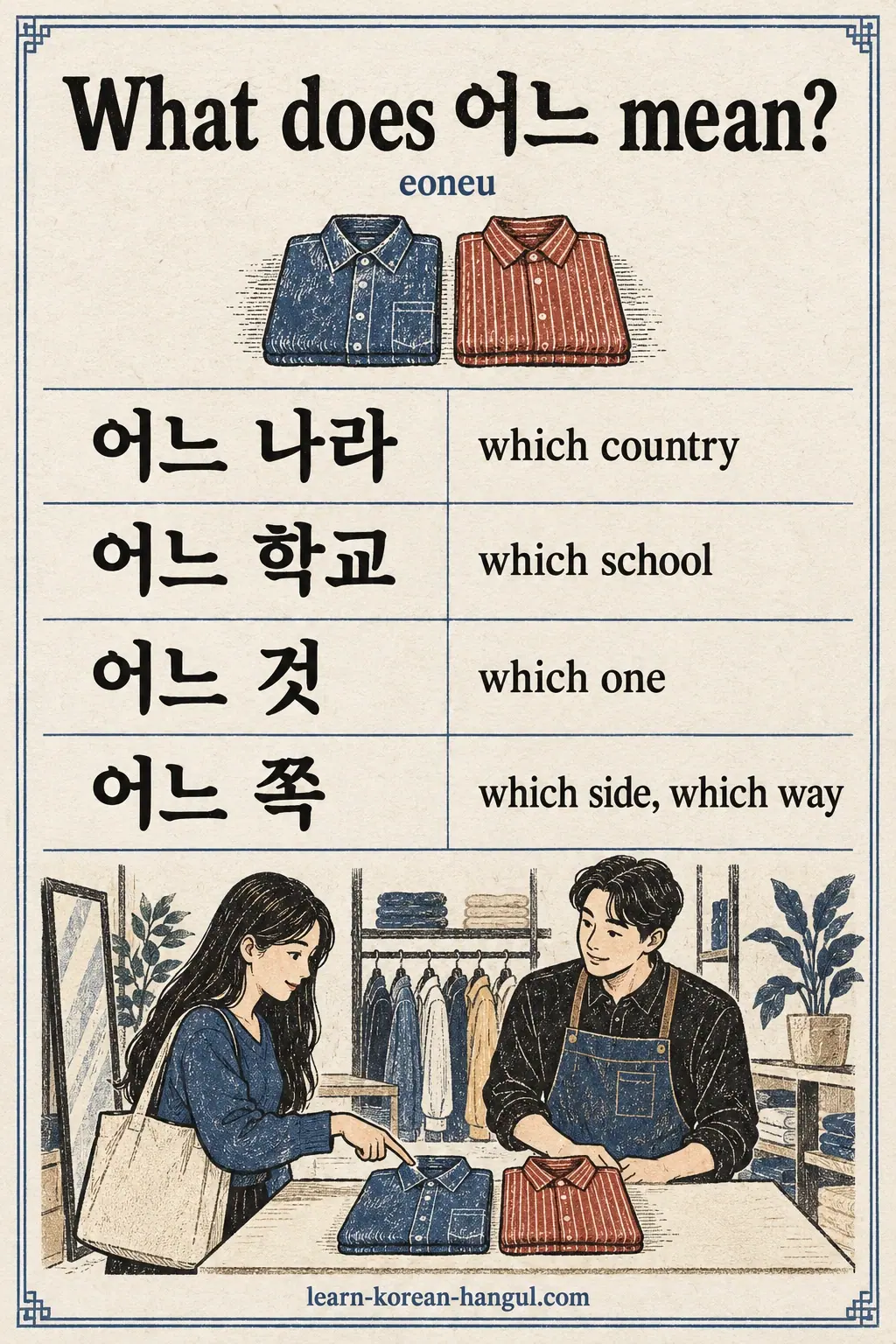
어느 means "which" and asks the listener to pick one thing out of a group. A determiner (관형사) is a word that comes before a noun and describes or points to it, such as "this" or "which" in English. 어느 is a determiner, so it cannot stand alone. English can say "Which?" on its own, but Korean needs a noun after 어느: 어느 나라 (which country), 어느 학교 (which school), 어느 것 (which one).
The key idea is the set. 어느 works when there is a known or limited group of options: the countries of the world, the two shirts in your hands, the three items on a menu. If no such set exists, the question is open, and 무슨 or 어떤 fit better, as the comparison section shows.
A First Example
Listen to each sentence at normal speed, then slowly.
1. 어느 나라 사람이에요? (eoneu nara saramieyo) "Which country are you from?" Literally: "Which country's person are you?"
Pronunciation: [어느 나라 사라미에요]. The final ㅁ of 사람 moves onto the next syllable, so 사람이에요 sounds like 사라미에요.
2. 어느 것이 더 좋아요? (eoneu geosi deo joayo) "Which one is better?"
Pronunciation: [어느 거시 더 조아요]. The word 것 ("thing, one") is followed by the subject particle 이, so the ㅅ moves forward and 것이 sounds like 거시. The word 더 (deo) means "more", so 더 좋아요 is "is better".
In both sentences 어느 sits right before a noun, and the particles belong to the noun. The next section lays out the whole pattern.
How Does 어느 Which in Korean Work?
어느 works as a one-slot rule: put it before a noun, and attach every particle to that noun. Put 어느 before a noun (어느 나라, 어느 것) and drop the noun with 어느 쪽 or 어느 것 when the noun is already obvious.
Pattern Table
| Pattern | Meaning | Example | Meaning of the example |
|---|---|---|---|
| 어느 + noun | which (noun) | 어느 학교에 다녀요? | Which school do you attend? |
| 어느 것 | which one | 어느 것이 더 싸요? | Which one is cheaper? |
| 어느 거 (spoken) | which one | 어느 거 줄까요? | Which one shall I give you? |
| 어느 게 (spoken, 것이) | which one (subject) | 어느 게 맛있어요? | Which one is tasty? |
| 어느 걸 (spoken, 것을) | which one (object) | 어느 걸 사요? | Which one will you buy? |
| 어느 쪽 | which side, which way | 화장실이 어느 쪽이에요? | Which way is the restroom? |
| 어느 분 | which person (polite) | 어느 분이 김 선생님이세요? | Which person is Mr. Kim? |
Pronunciation: 다녀요 is danyeoyo, 쪽이에요 sounds like [쪼기에요] (jjogieyo), and 어느 분이 is [어느 부니]. The spoken contractions 게 and 걸 are normal in conversation.
Three details make the table easy to apply.
- The particle goes on the noun, never on 어느. Say 어느 나라가, 어느 것이, 어느 학교에. Never 어느가 or 어느를. The determiner stays bare.
- Use 것 when no noun follows. 어느 alone is incomplete, so add 것 ("thing") to make "which one". The spoken forms 어느 거, 어느 게 and 어느 걸 are contractions of 어느 것, 어느 것이 and 어느 것을.
- People take 분 in polite speech. 어느 분 ("which person") is the respectful choice for people you do not know well. The plain version is 어느 사람.
Once you know where 어느 goes, you can build the sentence step by step.
How Do You Ask "Which Country Are You from?" in Korean?

To ask "Which country are you from?", put 어느 before 나라, add 사람 ("person"), and end with the copula: 어느 나라 사람이에요? Follow these steps to build any "which" question.
- Start from the statement. Write the answer first: 한국 사람이에요. ("I'm Korean.")
- Replace the missing part with 어느 plus the noun. 한국 is a country, so use 어느 나라: 어느 나라 사람이에요.
- Check that 어느 comes before the noun. The order is determiner, then noun: 어느 + 나라.
- Check the ending. 사람 ends in the consonant ㅁ, so the copula is 이에요 and not 예요: 사람이에요.
- Say it. Use an ordinary falling pitch for a "which" question, and add a friendly 저기요 or 실례지만 ("excuse me") at the start with a stranger.
You'll know it worked when 어느 sits directly before the noun and the answer can be a single country name. Common mistake at this step: putting a particle between 어느 and the noun, as in 어느가 나라. The particle belongs after the noun.
The answer repeats the same frame: 한국 사람이에요, 미국 사람이에요 ("I'm American") or 일본 사람이에요 ("I'm Japanese"). Next, here is how 어느 differs from the other two "what" words.
How Is 어느 Different from 어떤 and 무슨?

어느 asks which one from a set, 어떤 asks what kind or what quality, and 무슨 asks what sort when the field is open. The three all translate loosely as "what" or "which", but each has its own job.
| Feature | 어느 | 어떤 | 무슨 |
|---|---|---|---|
| Asks | which one (of a set) | what kind, what is it like | what, what sort |
| Needs a known set | yes | no | no |
| Example | 어느 음식이 더 맛있어요? | 어떤 음식이에요? | 무슨 음식을 좋아해요? |
| Example meaning | Which food (of these) is tastier? | What kind of food is it? | What food do you like? |
| Typical answer | this one, that one | spicy, sweet | kimchi, pasta |
An expert rule of thumb: point test. If you can point at the choices, use 어느. If you cannot, use 무슨 for "what kind" of category and 어떤 for "what is it like". The full three-way comparison has its own page: 무슨 vs 어떤 vs 어느. For the single words, see 어떤 what kind of which and 무슨 what kind of.
Compare these two sentences about the same topic:
- 어느 음식이 더 맛있어요? The speaker is looking at a menu or two plates and asks about the choices in front of them.
- 무슨 음식을 좋아해요? The speaker asks about any food, and there is no list in front of them.
With the three words sorted, the next step is to see how a 어느 question is answered.
How Do You Answer a 어느 Question?

A 어느 question is answered by pointing, so the answer is usually a demonstrative: 이 (this), 그 (that, near you) or 저 (that over there). 어느 is the question member of this family, which is why the answer has the same shape as the question.
| Question | Answer | Meaning |
|---|---|---|
| 어느 것이 더 좋아요? | 이게 더 좋아요. | This one is better. |
| 어느 것이 더 좋아요? | 저게 더 좋아요. | That one over there is better. |
| 어느 쪽이에요? | 이쪽이에요. | It is this way. |
| 어느 쪽이에요? | 저쪽이에요. | It is that way over there. |
| 어느 학교에 다녀요? | 서울대학교에 다녀요. | I attend Seoul National University. |
The spoken forms 이게, 그게 and 저게 are contractions of 이것이, 그것이 and 저것이, just as 어느 게 contracts 어느 것이. When the question lists the choices, you can also answer with the choice itself: 사과가 더 좋아요 ("The apple is better").
The question and the answer share the same particle slot. If the question uses 이/가 on 것, the answer uses 이/가 as well: 어느 것이 → 이게. If you want to review that particle, see subject particle 이/가. In a dialogue, the exchange sounds like this:
- A: 어느 것이 더 싸요? ("Which one is cheaper?")
- B: 이게 더 싸요. ("This one is cheaper.")
- A: 그럼 이걸로 할게요. ("Then I'll take this one.")
The third line uses 이걸로, a spoken form of 이것으로 (이것 plus the particle 으로), which means "with this one" and is a common way to make a choice in a shop. Having seen how to answer, you can now look at the other uses of 어느.
When Do You Use 어느 in Other Ways?

어느 has a few common uses beyond "which one", and some of them are not questions at all.
Which direction or side. 어느 쪽 asks about direction or side: 어느 쪽으로 가요? ("Which way do you go?"). It is also used to choose between two: 어느 쪽이 좋아요? ("Which one do you prefer?").
"One day". In stories, 어느 날 means "one day" or "a certain day": 어느 날 친구가 왔어요 ("One day a friend came"). Here 어느 is not a question; it names an unspecified item.
"To some extent". 어느 정도 means "to some degree": 어느 정도 알아요 ("I know it to some extent"). The same words with a question ending ask "about how much?": 어느 정도예요?
Choosing in a shop. 어느 것이 마음에 들어요? ("Which one do you like?") is a natural shop question, since there is a set of items on the shelf. The spoken form 어느 게 마음에 들어요? is more common.
Not the adverb 어느새. 어느새 ("before you know it, already") is a separate word written as one, and it is not covered in this lesson.
Honest limit of this lesson: it covers 어느 as a question determiner with polite endings. The indefinite uses (어느 날, 어느 정도) are introduced only so you can recognise them when you read.
With the uses mapped, the next section lists the errors to avoid.
Common Mistakes with 어느
Five mistakes cover most errors. Each follows the pattern "learners often assume X, but actually Y, because Z."
- Using 어느 for an open question. Learners often say 어느 음식을 좋아해요? for "What food do you like?" Actually 어느 expects a limited set, so an open question needs 무슨 or 어떤: 무슨 음식을 좋아해요?
- Using 어느 alone. Learners often say 어느예요? Actually 어느 is a determiner and needs a noun or 것 after it: 어느 것이에요?
- Attaching a particle to 어느. Learners often write 어느가 좋아요? Actually the particle goes on the noun: 어느 것이 좋아요? or 어느 게 좋아요?
- Mixing up 어느 and 어디. Learners often say 어느 가요? for "Where are you going?" Actually 어디 is the place word and 어느 is the "which" determiner: 어디 가요? See 어디 where in korean.
- Answering with 네 or 아니요. Learners often reply 네 to a 어느 question, as if it were a yes-no question. Actually 어느 asks for a choice, so the answer names the choice: 이게 더 좋아요.
If you remember the point test, most of these errors disappear. Now test yourself.
Practice and Answers
Try all four items before you read the answers. Each answer has audio, normal and slow.
Sentence
Which country are you from?
Show answer
어느 나라 사람이에요
Practice · 8
You and a friend look at two dishes on the table. Complete: ___ 음식이 더 맛있어요?
Show answer
어느
There is a known set of two dishes, so 어느 fits; 어디 is the place word.
A speaker asks the open question 어느 음식을 좋아해요? ("What food do you like?"). What is better?
Show answer
무슨 음식을 좋아해요?
There is no set to choose from, so an open question needs 무슨 (or 어떤).
Translate "Which school do you attend?"
Show answer
어느 학교에 다녀요?
어느 comes directly before 학교, and 에 marks the school you attend.
How do you ask which way the restroom is?
Show answer
화장실이 어느 쪽이에요?
어느 쪽 asks about direction; 어느 cannot stand alone or take a particle.
Which sentence correctly asks "Which one is better?"
Show answer
어느 것이 더 좋아요?
The particle goes on the noun 것, never on 어느.
How do you usually answer 어느 것이 더 좋아요?
Show answer
이게 더 좋아요.
어느 asks for a choice, so the answer points at one item; it is not a yes-no question.
Which word asks "Where are you going?"
Show answer
어디 가요?
어디 is the place word; 어느 is the "which" determiner and needs a noun.
What does 어느 날 mean in a story?
Show answer
"one day"
In 어느 날, 어느 is not a question; it names an unspecified day.
- Choose the form. You and a friend look at two dishes on the table. (어느/무슨) 음식이 더 맛있어요?
- Fix the error. 어느 음식을 좋아해요? (The speaker asks an open question: "What food do you like?")
- Translate. "Which school do you attend?"
- Write your own. Ask which way the restroom is, using 쪽.
Answer Key
- 어느 음식이 더 맛있어요? (eoneu eumsigi deo masisseoyo) There is a set of two dishes, so 어느 fits. Pronounced [어느 음시기 더 마시써요].
- 무슨 음식을 좋아해요? (museun eumsigeul joahaeyo) There is no set, so use 무슨. Pronounced [무슨 음시글 조아해요].
- 어느 학교에 다녀요? (eoneu hakgyoe danyeoyo) 어느 comes before 학교, and 에 marks the school you attend. Pronounced [어느 학꾜에 다녀요].
- Sample answer: 화장실이 어느 쪽이에요? (hwajangsiri eoneu jjogieyo) "Which way is the restroom?" Pronounced [화장시리 어느 쪼기에요]. Any 어느 쪽 question is correct.
If an item went wrong, run the point test again: can you point at the choices? Then continue with the next lessons.
Next Lessons and Where to Go from Here
After 어느 which in korean, the next lesson is the three-way comparison 무슨 vs 어떤 vs 어느, which puts the three question determiners side by side with more examples. Before it, make sure you know 어떤 what kind of which. If you want to review the subject and object particles that follow 어느 + noun, see subject particle 이/가 and object particle 을/를. The set overview, Korean questions, lists every lesson in order.
For practice, take the grammar quizzes. This page uses Revised Romanization only as a learning aid; the Hangul is the reference. To remember the idea in one line: 어느 which in korean is a determiner for a limited set, it stands before a noun or 것, and the particle goes on the noun.
Frequently Asked Questions
What Does 어느 Mean?
어느 means "which" and asks the listener to choose one item from a known or limited group. It is a determiner, so it always stands before a noun: 어느 나라 (which country), 어느 학교 (which school). It cannot stand alone, unlike English "which" in "Which?". Add a noun or 것 after it.
How Do I Form Questions with 어느?
Place 어느 directly before the noun and attach the particle to the noun, not to 어느: 어느 나라 사람이에요?, 어느 것이 더 좋아요? For "which one" use 어느 것, shortened to 어느 거 or 어느 게 in speech. For a direction use 어느 쪽.
What Is the Most Common Mistake with 어느?
The most common mistake is using 어느 for an open question with no set to choose from. 어느 음식을 좋아해요 sounds odd for "What food do you like?"; ask 무슨 음식 or 어떤 음식 instead. Use 어느 when the choices are visible or already clear, such as a menu.
How Is 어느 Different from 무슨 and 어떤?
어느 asks which one of a set. 무슨 asks what kind or what sort, with no set in mind, as in 무슨 음식이에요? 어떤 asks about quality or kind, as in 어떤 음식이에요? (what is the food like?). If you can point at the choices, use 어느; if you cannot, use 무슨 or 어떤.
Do I Use 어느 in Speech, Writing or Both?
Both. 어느 is the same in speech and writing. In speech 어느 것이 often becomes 어느 게 and 어느 것을 becomes 어느 걸. In formal speech use 어느 분 for "which person" and the ending -입니까. The meaning of 어느 stays the same in every register.