What you'll learn
- Ask "what" with 뭐 in a polite everyday sentence and with 무엇 in a formal one.
- Use the short forms 뭘 and 뭐가 and explain where each comes from.
- Decide between 뭐 and 무슨 (what kind of) before a noun.
- Hear the difference between a real question 뭐 and the "something" meaning of 뭐.
- Fix the most common mistake: putting 뭐 directly before a noun.
Before you start: you should know the polite ending -아요/-어요 and the basic order subject, object, verb. If not, read Korean sentence structure first. Audio plays only when you press a button.
What Does 뭐 무엇 What in Korean Mean?

뭐 and 무엇 are Korean question words (의문사, uimunsa) for "what" when you ask about a thing or an action. 무엇 is the original word. 뭐 is a spoken contraction of 무엇 (through the shorter form 무어) that learners meet in almost every conversation. A question word replaces the piece of information you want, so the sentence keeps its normal shape.
Korean does not move the question word to the front, as English does with "What are you eating?" The word 뭐 stays exactly where the answer would stand. The answer to 뭐 먹어요? is 비빔밥 먹어요 ("I'm eating bibimbap"), and 비빔밥 sits in the same spot as 뭐. Linguists call this pattern wh-in-situ. You can read more about it in question word position.
A First Example
Two annotated sentences show both levels of the word.
- 뭐 먹어요? (mwo meogeoyo?) [뭐 머거요] = "What are you eating?" The parts are 뭐 (what), 먹어요 (eat, polite ending).
- 이것은 무엇입니까? (igeoseun mueosimnikka?) [이거슨 무어심니까] = "What is this?" The parts are 이것은 (this, as the topic), 무엇 (what), 입니까 (is it? in the formal ending).
Both sentences ask for a thing. The first is relaxed and spoken, the second is stiff and suits announcements, interviews and writing. The next section explains exactly how the two forms are built and when each is used.
How Does 뭐 무엇 What in Korean Work?

Use 뭐 in conversation and 무엇 in writing and formal speech. Put the word where the answer would stand, and add the sentence ending you would use for a statement. Particles attach to 뭐 and 무엇 the same way they attach to any noun, but 뭐 has contracted forms that you will hear all the time.
Three short forms matter most:
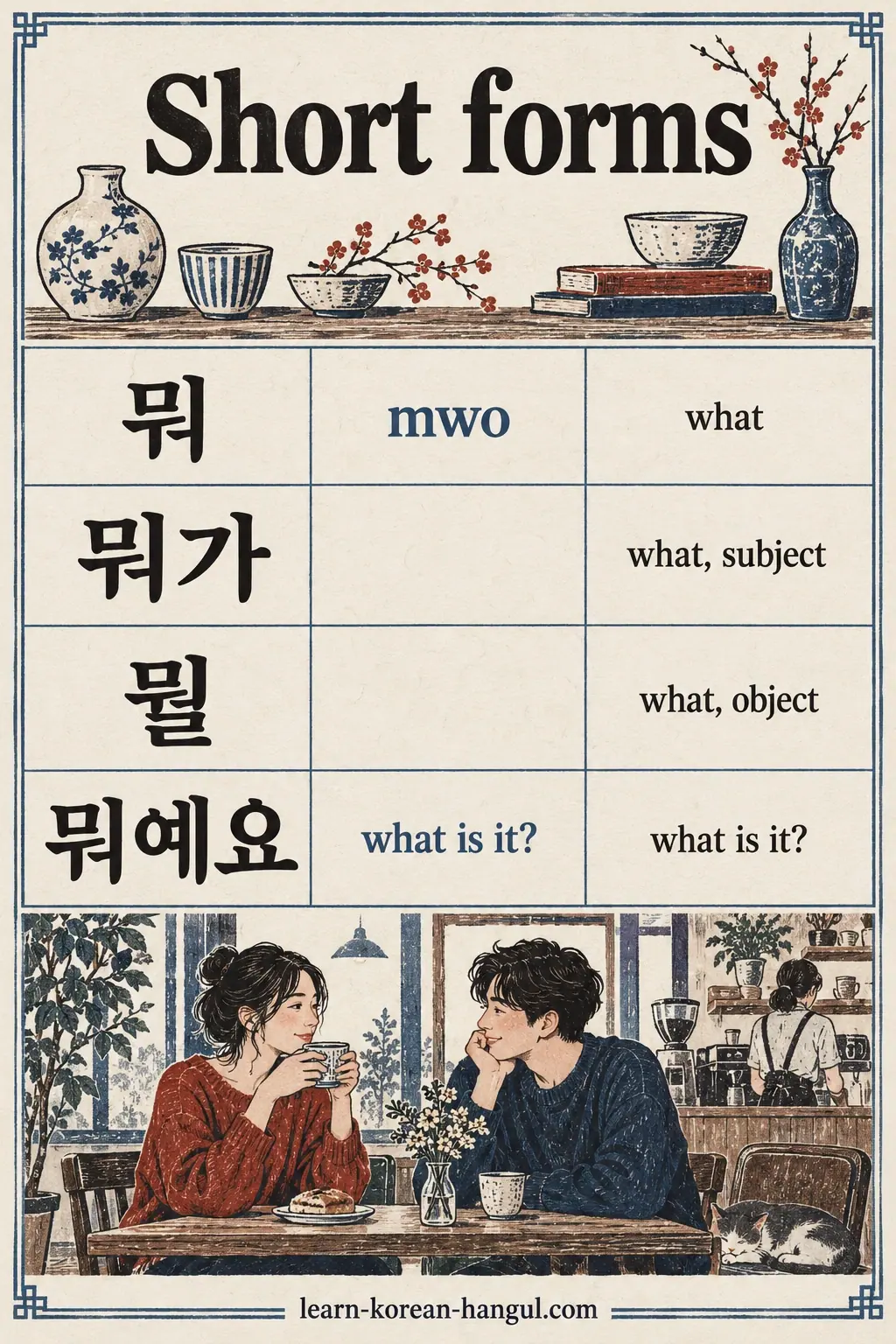
- 뭐가 is 뭐 plus the subject particle 가. 뭐가 맛있어요? = "What is delicious?"
- 뭘 is 뭐 plus the object particle 를, squeezed into one syllable. 뭘 먹어요? = "What are you eating?" It means the same as 뭐를 먹어요? and sounds even more natural.
- 뭐예요 is 뭐 plus 이에요 ("is"). 이게 뭐예요? = "What is this?" The form 이게 is a short version of 이것이.
The formal word 무엇 has a matching set: 무엇이 (what, as subject), 무엇을 (what, as object) and 무엇입니까 (what is it?). A fourth form, 무얼, is a short spoken variant of 무엇을, and you may see it in books and songs.
Pattern Table
The table lays out the forms by role in the sentence. Each row has an everyday form, a formal form and a model sentence.
| Role in the sentence | Everyday form | Formal form | Model sentence |
|---|---|---|---|
| Plain "what" before a verb | 뭐 | 무엇 | 뭐 해요? / 무엇을 합니까? |
| "What" as the subject | 뭐가 | 무엇이 | 뭐가 맛있어요? |
| "What" as the object | 뭘 (뭐를) | 무엇을 | 뭘 마셔요? |
| "What is it?" with "to be" | 뭐예요 | 무엇입니까 | 이게 뭐예요? |
| Asking what someone does for a living | 뭐 하세요? | 무엇을 하십니까? | 직업이 뭐예요? |
The table shows that the word itself barely changes. The ending and the particle carry the politeness. Next, one sentence is built from scratch so you can see where each piece goes.
How Do You Build a Sentence with 뭐 Step by Step?

You build a 뭐 sentence by taking a statement and swapping the answer for 뭐. Follow the steps with the sentence "I am eating bibimbap."
- Start with the statement. 저는 비빔밥을 먹어요. (jeoneun bibimbabeul meogeoyo.) = "I am eating bibimbap." The verb is 먹어요.
- Find the part you want to ask about. Here it is 비빔밥을, the object.
- Replace it with the question word. 비빔밥을 becomes 뭘 (object form). Or keep it simple with 뭐 and drop the particle, which Korean speakers do all the time.
- Drop the subject. Korean leaves out "you" when the listener is clear, so 저는 disappears. Add a time word such as 지금 (now) if you want one.
- Say it as a question. 지금 뭘 먹어요? (jigeum mwol meogeoyo?) [지금 뭘 머거요] = "What are you eating now?"
You will know it worked when the verb ending stays the same as in the statement and the only change is the swapped word. In speech, a wh-question like this one usually puts the stress on 뭐 and often ends on a falling tone, while a yes-no question rises at the end. The common slip at this step is adding an extra "do" word. Korean has no equivalent of the English "do you," so 뭘 먹어요? is complete. The same method works for any verb, such as 뭐 해요? ("What are you doing?") or 뭐 마셔요? ("What are you drinking?"). With the build clear, the next question is how 뭐 differs from other "what" words.
How Is 뭐 무엇 Different from 무슨 and 어떤?

뭐 and 무엇 stand alone and stand for a thing, while 무슨 (museun) and 어떤 (eotteon) come before a noun and ask about its kind. The test is simple: if a noun follows the question word, you need 무슨 or 어떤. If a verb or a particle follows, you need 뭐.
| Question word | Position | What it asks | Model sentence |
|---|---|---|---|
| 뭐 / 무엇 | Alone, before a verb or 이에요 | What thing or what action | 뭐 먹어요? (What are you eating?) |
| 무슨 | Before a noun | What kind of, what | 무슨 음식을 먹어요? (What food are you eating?) |
| 어떤 | Before a noun | What kind of, what sort of | 어떤 음식을 좋아해요? (What kind of food do you like?) |
Both questions get a food answer, but they shape the reply differently. 뭐 먹어요? invites one dish: "Bibimbap." 무슨 음식을 먹어요? invites a category or a name for the food. The 무슨 what kind of and 어떤 what kind of which lessons cover the two determiners, and 무슨 vs 어떤 vs 어느 compares them side by side. The differences also show up in the ways 뭐 can be used outside a plain question.
When Do You Use 뭐, and When Not?

Use 뭐 for questions in conversation, and use 무엇 when the setting is formal or written. The word has several jobs beyond the plain question, and each one changes the meaning, so they are listed here with one example each.
- Formal and written Korean. News, forms, exams and speeches use 무엇: 이 단어의 뜻은 무엇입니까? ("What is the meaning of this word?"). Using 뭐 in an essay sounds like speaking out loud on paper.
- "Something" (indefinite). In a different tone, 뭐 means "something." 뭐 좀 먹을래요? (mwo jom meogeullaeyo?) [뭐 좀 머글래요] = "Shall we eat something?" The tone rises at the end, and the answer is "yes" or "no," not a food name.
- "Huh?" or "What?!" Said alone, 뭐? is a blunt reaction between friends, like "What?" in English. To ask politely for repetition, say 네? ("Sorry?"), or gently 뭐라고요? ("What did you say?").
- Name and job questions. 직업이 뭐예요? = "What is your job?" 이름이 뭐예요? = "What is your name?" These are common in classes, though a more polite name question uses 어떻게 되세요, which the 어떻게 how in korean lesson covers.
- Not for choices. When the options are already on the table, 뭐 is too open. Use 어느 for "which one," as in 어느 which in korean.
An honest limit: the "something" meaning and the question meaning look identical on paper. Only intonation and context separate them, so a written 뭐 먹어요? can mean either "What are you eating?" or "Are you eating something?" Learners need to hear examples to build a feel for it. This lesson gives rules of thumb, not a full account of Korean intonation. These uses lead to the typical errors in the next section.
What Mistakes Do Learners Make with 뭐 무엇?
Learners mix up the position of the word and the level of the word. Four mistakes appear again and again, and each has a quick repair.
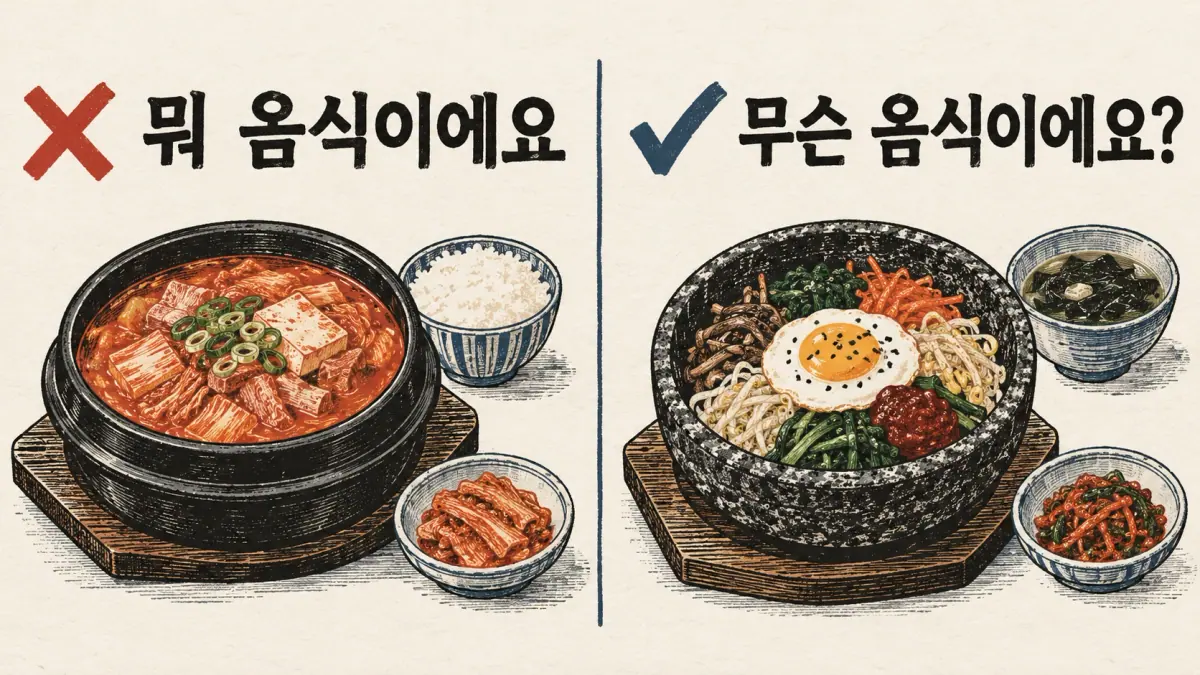
- Putting 뭐 before a noun. 뭐 음식이에요 sounds wrong because 뭐 cannot modify a noun. Use 무슨 음식이에요? ("What food is it?") or 어떤 음식이에요? ("What kind of food is it?"). Say 뭐 only when no noun follows.
- Using 무엇 in a casual chat. 무엇을 먹어요? is grammatical but sounds like a textbook or a news interview. Friends say 뭐 먹어요? or 뭘 먹어요?.
- Writing 뭐이 or 무엇가. The subject form is 뭐가 or 무엇이. The pairs are fixed: 뭐 takes 가, and 무엇 takes 이, because 무엇 ends in a consonant sound.
- Answering the "something" question like a wh-question. If a friend asks 뭐 좀 먹을래요? and you answer 비빔밥이요, they may be confused. Answer 네 or 아니요 first, then add detail.
Run a quick check when a 뭐 sentence feels wrong: Is there a noun right after 뭐? Does the formality of the word match the setting? Does the particle fit the form? The practice below tests these three checks.
Practice and Answers
Try the four items before you read the answer key. Cover the answers with your hand.
- Choose the form. You are chatting with a friend. Complete: 지금 ___ 해요? (뭐 / 무엇)
- Fix the error. A learner says 뭐 음식을 좋아해요? What is the better question, and why?
- Translate. "What is this?" Give one everyday version and one formal version.
- Write your own. Write one question about food and one question about a hobby, using 뭐 or 뭘 in each.
Sentence
What are you eating now?
Show answer
지금 뭘 먹어요?
Practice · 8
You are chatting with a friend. Complete: 지금 ___ 해요?
Show answer
뭐
With a friend you use the everyday word 뭐; 무엇 sounds formal and 무슨 needs a noun after it.
A learner asks 뭐 음식을 좋아해요? What is a better question?
Show answer
무슨 음식을 좋아해요?
뭐 and 무엇 cannot sit before a noun; a noun after the question word needs 무슨 or 어떤.
Which is the formal way to ask "What is this?"
Show answer
이것은 무엇입니까?
Formal speech uses the full word 무엇 with the ending -입니까; 이게 뭐예요? is the everyday version.
What is 뭘 short for?
Show answer
뭐를 (what, object)
뭘 is 뭐 plus the object particle 를 squeezed into one syllable.
Which subject form is correct?
Show answer
뭐가 맛있어요?
The pairs are fixed: 뭐 takes 가 and 무엇 takes 이.
A friend asks 뭐 좀 먹을래요? with a rising tone. How should you start your answer?
Show answer
네 or 아니요
Here 뭐 means "something", so it is a yes/no question: answer 네 or 아니요 first.
What does 뭐가 combine?
Show answer
뭐 + the subject particle 가
뭐가 is 뭐 plus the subject particle 가, as in 뭐가 맛있어요?
How do you politely ask someone to repeat what they said?
Show answer
네?
A bare 뭐? sounds blunt; 네? ("Sorry?") is the safest choice with anyone.
Answer key
- 뭐. With a friend you use the everyday word, so the sentence is 지금 뭐 해요? ("What are you doing now?").
- 무슨 음식을 좋아해요? (or 어떤 음식을 좋아해요?). A noun, 음식, follows the question word, so 무슨 or 어떤 is needed. 뭐 cannot sit directly before a noun.
- 이게 뭐예요? (everyday) and 이것은 무엇입니까? (formal).
- Answers vary. Check that 뭐 or 뭘 stands alone before the verb. An example: 주말에 뭘 해요? ("What do you do on weekends?") and 취미가 뭐예요? ("What is your hobby?").
A rule of thumb to remember: if you can answer with a single thing or action, use 뭐. If you want a type or a category, use 무슨.
What Should You Learn Next after 뭐 무엇 What in Korean?
After 뭐 무엇 what in korean, study the "what kind of" words next, then the other question words. This lesson covers the plain "what" and does not teach the determiners in depth. Those live on their own pages.
- Start with 무슨 what kind of, which covers the pattern before a noun.
- Continue with 어떤 what kind of which, then compare all three in 무슨 vs 어떤 vs 어느.
- Practise questions that need no question word in yes no questions in korean.
- Learn the person question with 누구 누가 who in korean.
- Return to Korean questions to see the whole set.
With these steps, 뭐 무엇 what in korean becomes automatic: swap the answer for 뭐, keep the ending, and match the formality to the setting.
Frequently Asked Questions
What Does 뭐 Mean in Korean?
뭐 means "what" and is the everyday short form of 무엇. It asks about a thing or an action, such as 뭐 해요? ("What are you doing?"). The same word also means "something" in 뭐 좀 먹을래요?, and the tone of the sentence tells you which meaning is intended.
Is 뭐 the Same as 무엇?
They have the same meaning but different levels. 뭐 is the contracted spoken form used with friends, family and in daily talk. 무엇 is the full form used in writing, exams, news and formal speech, usually with the ending -입니까 or -습니까. Both can take the particles 이/가 and 을/를.
Why Do Koreans Say 뭘 Instead of 뭐를?
뭘 is 뭐를 shortened into one syllable, and it is very common in speech. The same contraction applies to 무엇을, which becomes 무얼. In writing, 뭘 appears in dialogue, messages and captions. Formal documents keep the full 무엇을, so match the form to the setting.
Can I Say 뭐 before a Noun, Like 뭐 음식?
No. 뭐 stands for a whole thing, so it cannot modify a noun. Before a noun, use 무슨 or 어떤: 무슨 음식 (what food) or 어떤 음식 (what kind of food). Use 뭐 only when a verb, a particle or 이에요 follows it.
Is It Rude to Say 뭐? to Someone?
Said alone, 뭐? sounds blunt, like "What?!" in English, and suits close friends. To ask someone to repeat, 네? ("Sorry?") is the safest choice with anyone. 뭐라고요? ("What did you say?") is polite in form but can sound challenging in a sharp tone, so say it gently, and avoid the bare 뭐? with elders or strangers.