Key facts
- Level: A1. Estimated study time: 20 minutes.
What you'll learn
- Choose between 누구 and 누가 in a new sentence.
- Ask "who", "whom", "with whom" and "to whom" with the right particle.
- Ask "Whose is this?" with 누구 거예요 and 누구의.
- Avoid the most common error, 누구가.
Before you start: you should know the subject particle 이/가 and that Korean puts the verb last. Time: about 20 minutes.
What Does 누구 누가 Who in Korean Mean?

누구 means "who" and "whom". It is a question word (의문사), a word that replaces the missing information in a question. 누가 is not a different word. It is 누구 joined with the subject particle 가 in a special short form. Korean speakers do not say 누구가.
Compare a statement with its question:
| Sentence | Meaning |
|---|---|
| 민수 씨가 왔어요. | Minsu came. |
| 누가 왔어요? | Who came? |
Only the subject changes. 누가 sits in the slot where 민수 씨가 stood, so the answer to a 누가 question can reuse the same sentence. A name followed by 씨 (ssi) is a polite way to address or mention an adult.
A First Example
Listen to each sentence at normal speed, then slowly.
1. 누가 왔어요? (nuga wasseoyo) "Who came?"
Pronunciation: [누가 와써요]. The final ㅆ of 왔 moves to the next syllable and is spoken as a tense s.
2. 이 가방은 누구 거예요? (i gabangeun nugu geoyeyo) "Whose bag is this?"
Here 누구 is followed by 거, which means "the one that belongs to". Together 누구 거 asks "whose one". The pronunciation is [이 가방은 누구 거예요]; in everyday speech 예요 is often softened to [에요].
The two sentences show the two big jobs of the word: asking about a person who acts, and asking about ownership. The next section explains how the forms are built.
How Does 누구 누가 Who in Korean Work?
누구 behaves like a noun, so it takes the same particles as any person word. The only irregular step is the subject: 누구 plus 가 becomes 누가. Every other particle attaches directly to 누구.
Pattern Table
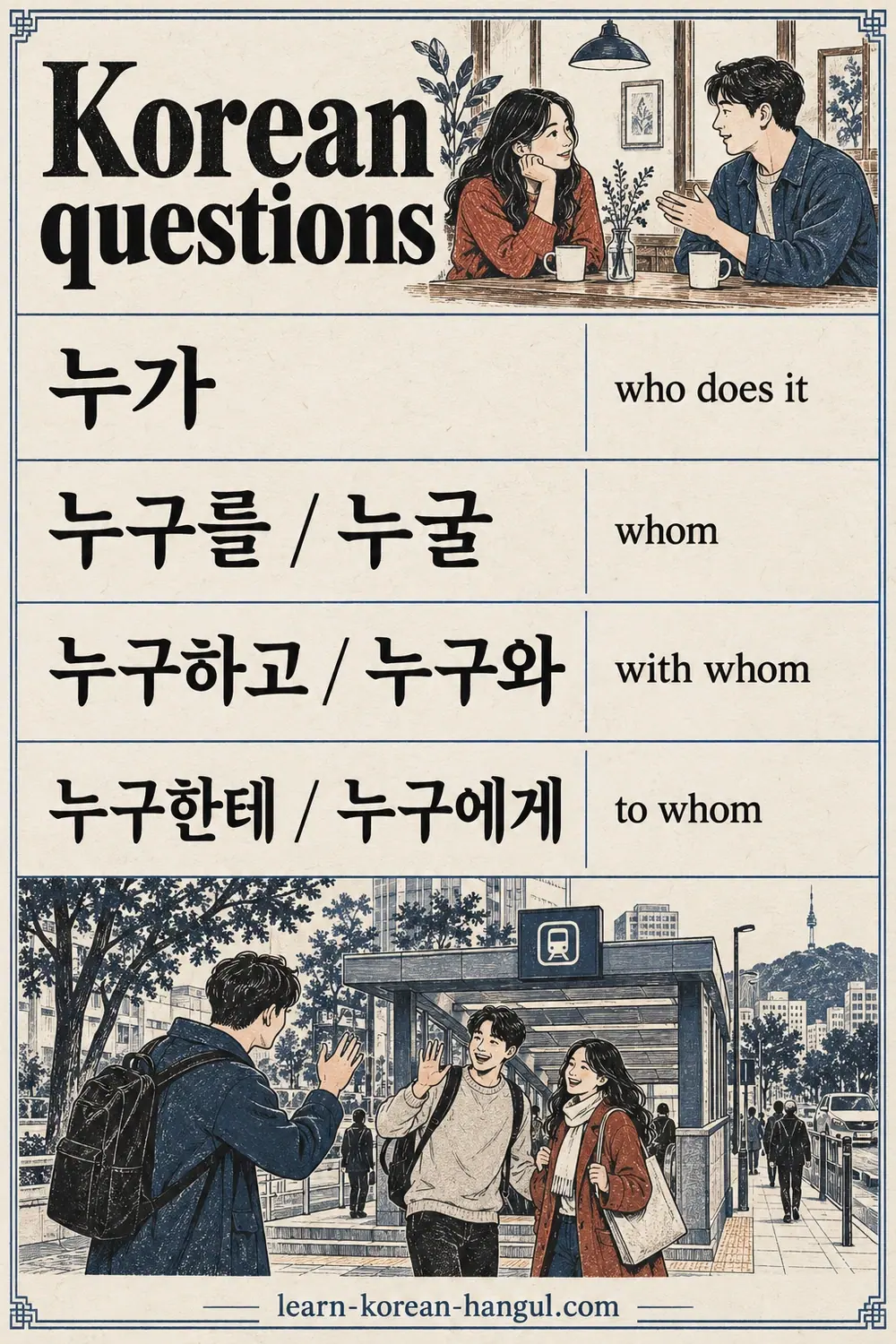
| Job in the sentence | Form | Example | Meaning |
|---|---|---|---|
| subject ("who does it") | 누가 | 누가 왔어요? | Who came? |
| topic ("as for who") | 누구는 | 누구는 가고 누구는 안 가요? | Who goes and who doesn't? (contrast) |
| object ("whom") | 누구를 / 누굴 | 누구를 만나요? | Whom are you meeting? |
| with ("with whom") | 누구하고 / 누구와 | 누구하고 갔어요? | Who did you go with? |
| to ("to whom") | 누구한테 / 누구에게 | 누구한테 줬어요? | Who did you give it to? |
| whose one | 누구 거 | 이거 누구 거예요? | Whose is this? |
| whose + noun | 누구의 / 누구 | 누구 가방이에요? | Whose bag is it? |
| "is" (identity) | 누구예요 / 누구세요 | 이 사람은 누구예요? | Who is this person? |
Pronunciation: 누구를 만나요? is [누구를 만나요] (nugureul mannayo), and 누구하고 갔어요? is [누구하고 가써요] (nuguhago gasseoyo). The short 누굴 is the everyday contraction of 누구를. The formal 누구와 is common in writing, while 누구하고 is the usual choice in speech. For 의 after 누구, the possessive particle is usually dropped in speech, so 누구 가방 is the natural spoken form. See the lesson on the possessive particle 의 for the full picture.
Three details make the table easy to apply.
- Use 누가 whenever "who" does the action. 누가 먹었어요? means "Who ate it?"
- Use 누구 plus a particle for everyone else. The question word is the same, and the particle shows the role. The choice between 이/가 and 은/는 is explained in 은/는 vs 이/가.
- Use 예요 after 누구. 누구 ends in a vowel, so the copula is 예요: 누구예요?
Four Common Endings
| Level | Form | Use |
|---|---|---|
| Formal | 누구입니까? | announcements, service, interviews |
| Polite | 누구예요? | everyday speech with strangers and elders |
| Honorific polite | 누구세요? | asking an unknown person "who is it?", for example at a door or on the phone |
| Casual | 누구야? | friends and family |
Only the ending changes. Once the pieces are clear, you can build a question from scratch.
How Do You Ask "Who Came?" in Korean?
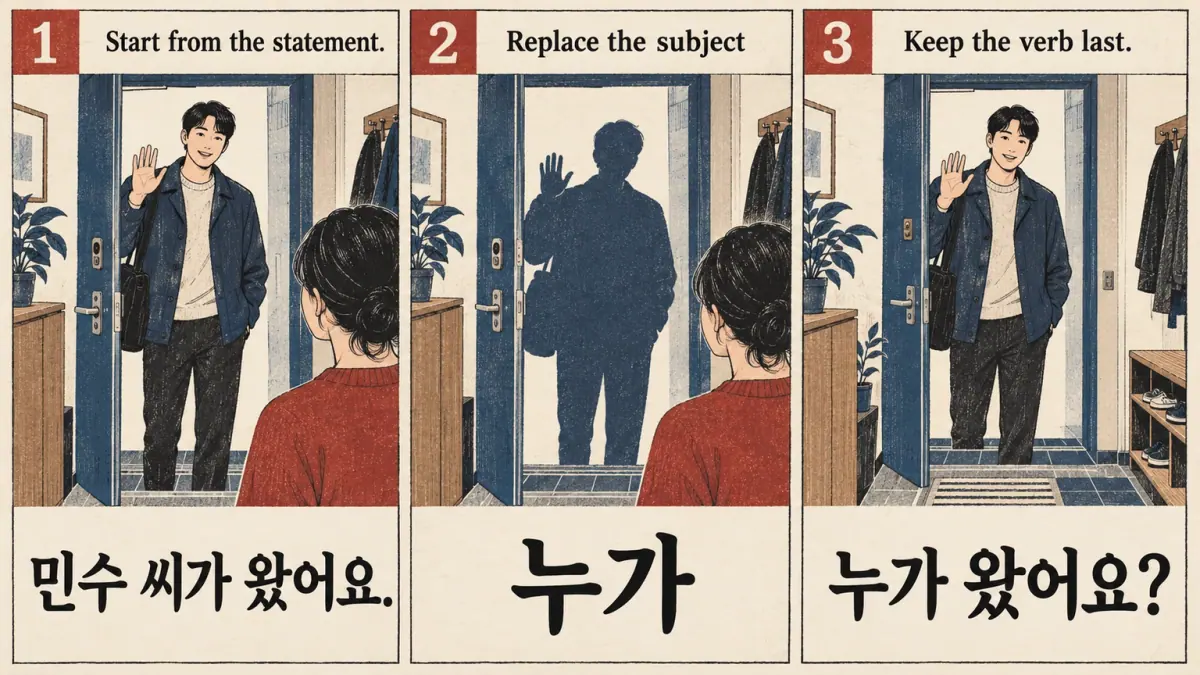
To ask "Who came?" in Korean, write the answer sentence first, then replace the person with 누가: 누가 왔어요? Follow these steps to build any "who does it" question.
- Start from the statement. Write the answer sentence: 민수 씨가 왔어요. ("Minsu came.")
- Replace the subject with 누가. Delete 민수 씨가 and put 누가 in the same place: 누가 왔어요.
- Do not add 가 again. 누가 already contains the particle. Writing 누가가 or 누구가 is wrong.
- Keep the verb last. Nothing moves to the front.
- Say it. End a question-word question with a falling or rise-fall pitch, not a sharp rise, and add a question mark in writing.
You'll know it worked when 누가 stands exactly where the person's name stood, and the verb still ends the sentence. Common mistake at this step: copying English word order for other roles. For an object, English moves "whom" to the front, but Korean keeps 누구를 before the verb: 누구를 만나요?
With the basic build clear, the next question is how 누구, 누가 and 누구의 divide the work.
How Is 누구 Different from 누가 and 누구 거?
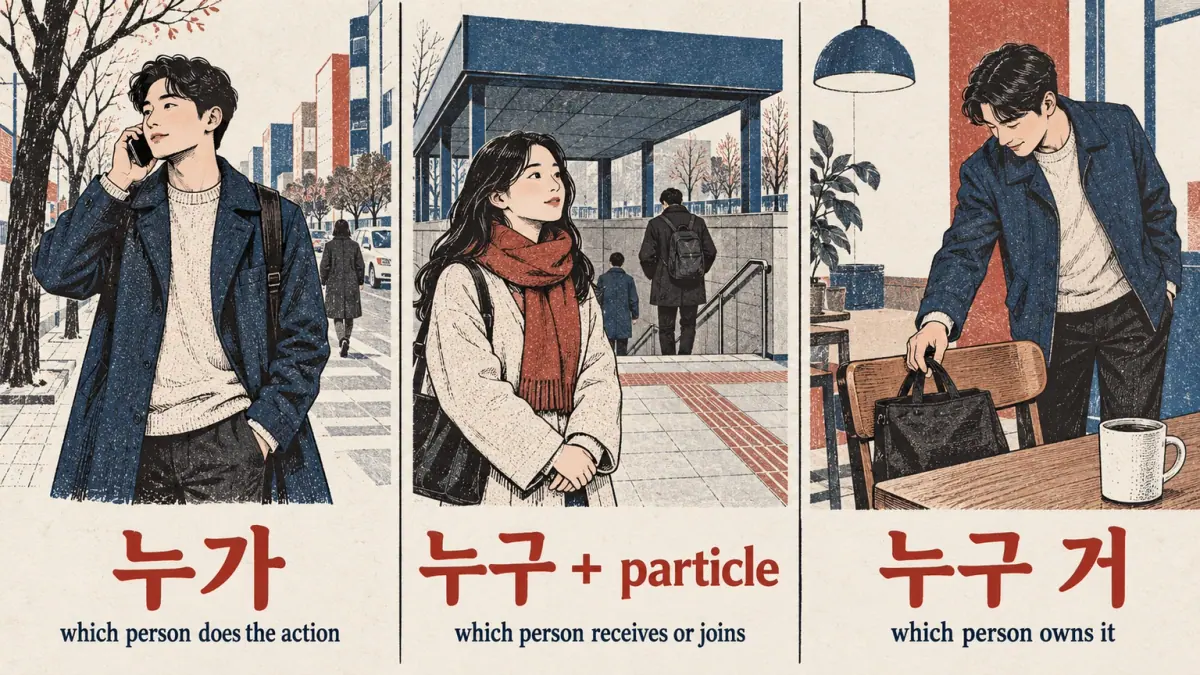
누구 asks about a person in any role except the bare subject. 누가 asks about the person who does the action. 누구의 and 누구 거 ask about ownership. The three share a stem but answer three different questions.
| Form | Question it asks | Example | Typical answer |
|---|---|---|---|
| 누가 | which person does the action | 누가 전화했어요? | 제 친구가 했어요. |
| 누구 + particle | which person receives or joins | 누구를 기다려요? | 친구를 기다려요. |
| 누구 거 | which person owns it | 이거 누구 거예요? | 제 거예요. |
| 누구의 + noun | whose thing | 누구의 책이에요? | 선생님의 책이에요. |
Pronunciation: 전화했어요 is [전화해써요] (jeonhwahaesseoyo), and 제 거예요 is [제 거예요] (je geoyeyo), often softened to [제 거에요] in everyday speech.
In practice 누구 거예요 is the spoken choice, because 거 is short for 것 ("thing"). 누구의 책이에요 is correct but sounds more written. The answers also teach something: a possessive answer uses 제 거예요 ("it is mine") or a name plus 거, such as 민수 씨 거예요 ("it is Minsu's").
An expert rule of thumb: ask yourself "can I put 'the person who' in front?" If yes, use 누가. 누가 왔어요 means "the person who came is who?" and fits. 누구를 만나요 cannot be built that way, so it takes 누구 plus 를. With the main forms clear, the next section covers the cases where 누구 behaves differently.
누가 Versus 누구예요 with the Same Noun
Two questions about one person look alike but ask different things. 이 사람은 누구예요? asks for an identity: "Who is this person?" 누가 이 사람이에요? asks for a selection: "Which of them is this person?" The second form uses 누가 as the subject and expects an answer such as 제가 이 사람이에요 or 저 분이에요. Beginners almost always need the first one.
When Does 누구 Mean "Someone" or Take Other Forms?
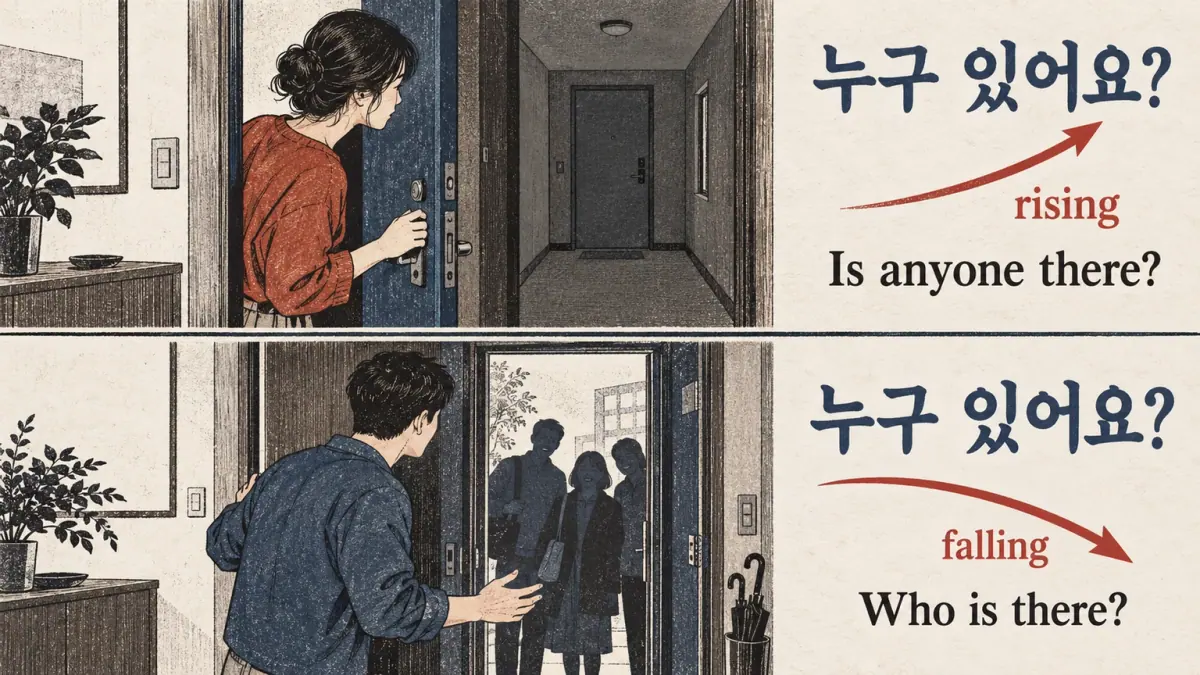
누구 is not always a question. Before a verb with rising pitch it can mean "someone" or "anyone", and the same word appears in set phrases. The meaning changes with intonation, not with a new spelling.
| Sentence | Intonation | Meaning |
|---|---|---|
| 누구 있어요? | rising | Is anyone there? |
| 누구 있어요? | falling | Who is there? |
| 누구도 안 왔어요. | falling | Nobody came. |
| 누구나 할 수 있어요. | falling | Anyone can do it. |
Pronunciation: 누구도 안 왔어요 is [누구도 안 와써요], and 누구나 할 수 있어요 is [누구나 할쑤 이써요]. The pattern 누구도 plus a negative verb means "nobody", and 누구나 plus a positive verb means "anyone". For the tone difference, see the lesson on yes no questions in korean.
Politeness adds one more edge case. Asking an unknown caller 누구야? is rude, so use 누구세요? (nuguseyo), which carries the honorific infix -시-. A very respectful alternative is 어느 분이세요? (eoneu buniseyo), where 분 is the honorific word for "person". When you introduce yourself in answer, use 저는 민수입니다 (jeoneun minsuimnida) in formal speech, and 저는 민수예요 in polite speech.
Limitation: this lesson covers 누구 and 누가 as question words and as "someone". It does not cover 아무 ("any") phrases in depth, or indirect questions such as 누가 왔는지 몰라요 ("I don't know who came"). Both sit in other lessons. The next section shows 누구 and 누가 together in a short dialogue.
A Short Dialogue with 누구 and 누가

Two questions often appear together in real conversation: first who acted, then who came along. Read the lines aloud and notice that each answer reuses the particle of the question.
| Speaker | Korean | Meaning |
|---|---|---|
| A | 누가 왔어요? | Who came? |
| B | 민수 씨가 왔어요. | Minsu came. |
| A | 누구하고 왔어요? | Who did he come with? |
| B | 친구하고 왔어요. | He came with a friend. |
Pronunciation: 왔어요 is [와써요] each time, and 누구하고 is [누구하고] (nuguhago). The particle 하고 in the question returns in the answer as 친구하고, which means "with a friend". The subject 가 in 민수 씨가 matches the 누가 slot of the first question.
The dialogue shows the pattern in use. The next section lists the errors that break it.
What Mistakes Do Learners Make?
Five mistakes cover almost every wrong 누구 sentence.
- Saying 누구가. Learners join 누구 and 가 like any other noun. The subject form is 누가, because the two sounds merged. Say 누가 왔어요?, not 누구가 왔어요?
- Using 누가 for the object. 누가 만나요? means "Who meets (someone)?", not "Whom do you meet?". For an object, use 누구를 만나요?
- Using 누구 for "which one". 누구 asks about people only. For things from a known set, use 어느 것 or 어느 (see 무슨 vs 어떤 vs 어느).
- Forgetting 거 in "Whose is this?" 이거 누구예요? asks "Who is this?" about a thing, which sounds odd. Add 거: 이거 누구 거예요?
- Using 누구야 with elders. Casual forms belong to friends. Use 누구예요? or 누구세요? instead.
Other question words follow the same "stay in place" pattern, so the same habits carry over to 뭐 무엇 what in korean and 어디 where in korean. Now test yourself.
Practice and Answers
Try all four items before you read the answers. Each answer has audio, normal and slow.
Sentence
Whose bag is this?
Show answer
이 가방은 누구 거예요
Practice · 8
Choose the form for "Who came?": ___ 왔어요?
Show answer
누가
누가 is the subject form (누구 + 가 merged); 누구가 is never used.
The speaker wants to ask "Who called?" Fix 누구가 전화했어요?
Show answer
누가 전화했어요?
누가 already contains the subject particle, so do not add 가 again.
Translate "Whose phone is this?"
Show answer
이 휴대폰은 누구 거예요?
Ownership needs 거: 누구 거예요; 누구예요 asks "who is it?".
Ask a friend whom they met yesterday.
Show answer
어제 누구를 만났어요?
"Whom" is the object, so use 누구 plus 를; 누가 is the subject.
How do you ask "Who did you go with?" in speech?
Show answer
누구하고 갔어요?
"With whom" is 누구 plus 하고; 누가 갔어요? asks "Who went?".
Someone knocks on your door. What is the polite way to ask who it is?
Show answer
누구세요?
누구세요? is the honorific polite form for an unknown person; 누구야 is casual and 누구 거예요 asks "whose is it?".
Which polite copula completes 누구___?
Show answer
예요
누구 ends in a vowel, so the copula is 예요: 누구예요?
What does 누구 있어요? mean with a rising tone?
Show answer
"Is anyone there?"
With rising pitch, 누구 means "someone" or "anyone"; with falling pitch it asks "who".
- Choose the form. (누구 / 누가) 왔어요? ("Who came?")
- Fix the error. 누구가 전화했어요? (The speaker wants to ask "Who called?")
- Translate. "Whose phone is this?"
- Write your own. Ask a friend who they met yesterday, using 만나다 (to meet).
Answer Key
- 누가 왔어요? (nuga wasseoyo) 누가 is the subject form, so it replaces 누구가.
- 누가 전화했어요? (nuga jeonhwahaesseoyo) Pronounced [누가 전화해써요]. 누구가 is never used.
- 이 휴대폰은 누구 거예요? (i hyudaeponeun nugu geoyeyo) Pronounced [이 휴대포는 누구 거예요], often [누구 거에요] in everyday speech. 휴대폰 is the common word for a mobile phone.
- Sample answer: 어제 누구를 만났어요? (eoje nugureul mannasseoyo) "Who did you meet yesterday?" Pronounced [어제 누구를 만나써요]. Any 누구를 plus 만났어요 is correct.
If you chose the wrong form, check the role of the person: a doer takes 누가, anything else takes 누구 plus a particle. Then continue with the next lessons.
What Should You Learn Next?
After 누구 누가 who in korean, the natural next lesson is 어디 where in korean, which asks about place with the same "stay in place" pattern. To compare the question words that choose among things and kinds, read 무슨 vs 어떤 vs 어느. If particles still feel uncertain, review 은/는 vs 이/가. The set overview, Korean questions, lists every lesson in order.
This page uses Revised Romanization only as a learning aid; the Hangul is the reference. To remember the idea in one line: 누구 누가 who in korean uses 누가 for the person who acts and 누구 plus a particle for every other role.
Frequently Asked Questions
What Does 누구/누가 Mean?
누구 means "who" or "whom", and 누가 is the same word used as the subject, as in 누가 왔어요? (Who came?). Both stand where the answer would stand. Before a verb with rising pitch, 누구 can also mean "someone", as in 누구 있어요? (Is anyone there?).
How Do I Form 누구/누가?
Use 누가 when "who" does the action, and 누구 plus a particle for every other role: 누구를 for whom, 누구하고 for with whom, 누구한테 for to whom. Add 거예요 to ask about ownership, as in 이거 누구 거예요? (Whose is this?). The word order of the sentence does not change.
What Is the Most Common Mistake with 누구/누가?
The most common mistake is writing 누구가. Learners join 누구 and the subject particle 가 like any noun, but Korean merges them into 누가. Say 누가 전화했어요? (Who called?), never 누구가 전화했어요? The same word still works with other particles, such as 누구를 and 누구는.
How Is 누구/누가 Different from 누구의 and 누구 거?
누구 and 누가 ask which person acts or takes part. 누구의 and 누구 거 ask who owns something. 이 책은 누구 거예요? means "Whose book is this?", and 누구 거 is the natural spoken form. 누구의 책이에요? means the same but sounds more written.
Do I Use 누구/누가 in Speech, Writing or Both?
Both. 누구 and 누가 are the same words in speech and writing. Casual speech may drop particles, so 누구 만났어? can replace 누구를 만났어?. In formal speech the ending changes to 누구입니까?. Only the ending and the optional particle change; the question word does not.