What you'll learn
- Ask where something is with 어디예요 and where someone is going with 어디에 가요.
- Choose between 에, 에서 and (으)로 after 어디.
- Tell the question "where?" from the statement "somewhere".
- Answer a 어디 question with 여기, 거기 and 저기.
Before you start: you should be able to read Hangul and know that Korean puts the verb last. Time: about 25 minutes.
What Does 어디 Where in Korean Mean?

어디 means "where" and asks about location, direction or source. It is a question word (의문사), a word that replaces the missing information in a question. In English the question word moves to the front ("Where is the restroom?"). In Korean it stays in the place of the answer, a pattern called wh-in-situ (the question word stays "in place").
Compare a statement and a question:
| Sentence | Meaning |
|---|---|
| 화장실이 저기예요. | The restroom is over there. |
| 화장실이 어디예요? | Where is the restroom? |
The only change is that 저기 ("over there") becomes 어디 ("where"). That swap is the whole idea. Because 어디 is in the answer slot, the answer to a 어디 question reuses the same sentence: 저기예요, 여기예요 (it's here), 거기예요 (it's there, near you).
A First Example
Listen to each sentence at normal speed, then slowly.
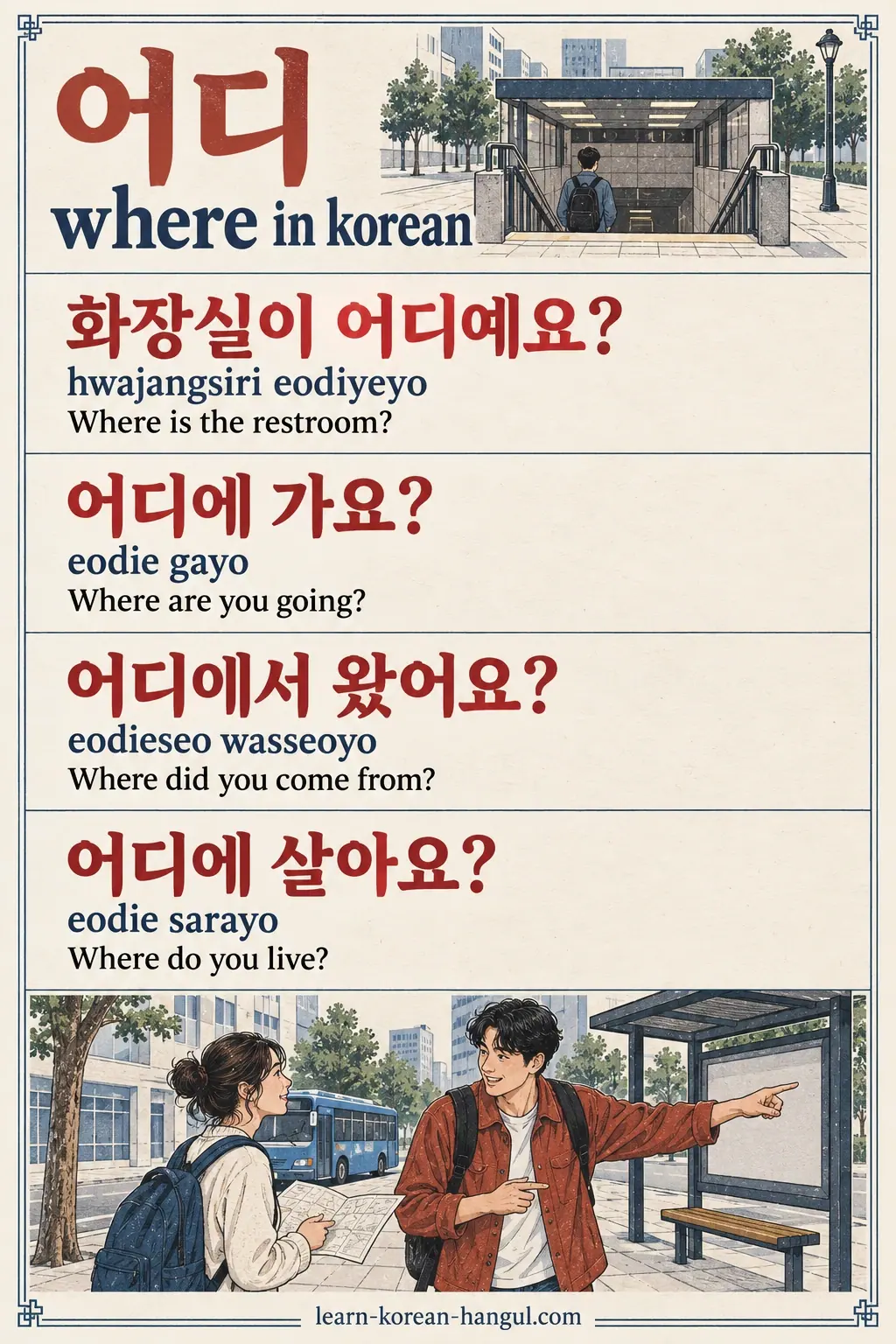
1. 화장실이 어디예요? (hwajangsiri eodiyeyo) "Where is the restroom?"
Pronunciation: [화장시리 어디예요]. The final ㄹ of 화장실 moves onto the particle 이, so 화장실이 sounds like 화장시리. In everyday speech the ending 예요 is often softened to [에요].
2. 어디에 가요? (eodie gayo) "Where are you going?"
Here the particle 에 marks a destination: the place you go to. The subject "you" is understood from context.
The two sentences use different endings and different particles. The next section sorts out how to choose.
How Does 어디 Where in Korean Work?

어디 works like any noun: attach the particle that matches the verb, then end the sentence. The particle tells the listener what kind of "where" you mean. Use 어디 alone or with particles: 어디예요? (where is it), 어디에 가요? (where to), 어디에서 왔어요? (where from), and 어디서 is the short form of 어디에서.
Pattern Table
| Question | What it asks | Pattern | Meaning |
|---|---|---|---|
| 어디예요? | where is it (identification) | 어디 + 예요 | Where is it? |
| 어디에 있어요? | where is it located | 어디 + 에 + 있다 | Where is it / where are you? |
| 어디에 가요? | destination | 어디 + 에 + 가다 | Where are you going? |
| 어디에서 왔어요? | starting point | 어디 + 에서 + 오다 | Where did you come from? |
| 어디에서 공부해요? | place of an action | 어디 + 에서 + verb | Where do you study? |
| 어디로 가요? | direction or route | 어디 + (으)로 + 가다 | Which way are you going? |
Pronunciation: 어디에서 왔어요? is [어디에서 와써요] (eodieseo wasseoyo), and 어디서 is [어디서] (eodiseo). The short 어디서 is common in speech and means the same as 어디에서.
Three details make the table easy to apply.
- Use 에 for "to" and "at (a place something exists)". Verbs of going and existing take 에: 가요, 와요, 있어요. See location particle 에.
- Use 에서 for "from" and for where an action happens. With action verbs such as 공부하다 (to study) or 만나다 (to meet), the place takes 에서. See location particle 에서.
- Use (으)로 for direction. 어디로 가요? asks "Which way?" and fits when you are asking about a route, not a destination.
Three Politeness Levels
| Level | Form | Use |
|---|---|---|
| Formal | 어디입니까? | news, announcements, service |
| Polite | 어디예요? | everyday speech with strangers and elders |
| Casual | 어디야? | friends and family |
All three change only the ending. Once the pieces are clear, you can build a question from scratch.
How Do You Ask "Where Is the Restroom?" in Korean?

To ask "Where is the restroom?" in Korean, say the thing you are looking for, add the subject particle, then 어디예요: 화장실이 어디예요? Follow these steps to build any "where is X" question.
- Start from the statement. Write the answer sentence first: 화장실이 저기예요. ("The restroom is over there.")
- Replace the place with 어디. Swap 저기 for 어디: 화장실이 어디예요.
- Check the subject particle. 화장실 ends in the consonant ㄹ, so the subject particle is 이. A noun that ends in a vowel takes 가 instead: 학교가 어디예요? ("Where is the school?").
- Check the ending. 어디 ends in a vowel, so the copula is 예요, not 이에요.
- Say it. End a wh-question with a falling or rise-fall pitch, not a sharp rise. To open politely, start with 저기요 ("excuse me"): 저기요, 화장실이 어디예요?
You'll know it worked when the 어디 sits where the answer would go, and the sentence still ends with the verb or copula. Common mistake at this step: moving 어디 to the front, as in English. Keep it in the answer slot.
Now that you can ask about location, the next question is how the common 어디 forms differ.
How Is 어디예요 Different from 어디에 있어요 and 어디에서?

어디예요 asks where something is, 어디에 있어요 asks where something exists or is located, and 어디에서 asks where an action takes place or where someone starts. The three share a question word but not a job.
| Question | Verb type | Best for | Example | Meaning |
|---|---|---|---|---|
| 어디예요? | copula (is) | fixed places, things you name | 지하철역이 어디예요? | Where is the subway station? |
| 어디에 있어요? | existence (있다) | people or movable things | 지금 어디에 있어요? | Where are you now? |
| 어디에서 …해요? | action verb | where an action occurs | 어디에서 만나요? | Where shall we meet? |
| 어디에서 왔어요? | motion from | origin | 어디에서 왔어요? | Where did you come from? |
| 어디에 가요? | motion to | destination | 어디에 가요? | Where are you going? |
In practice 어디예요 and 어디에 있어요 overlap: 화장실이 어디예요? and 화장실이 어디에 있어요? both mean "Where is the restroom?" The first is shorter and more common for fixed places. The second is the natural choice for a person or object that can move: 제 가방이 어디에 있어요? ("Where is my bag?").
An expert rule of thumb: if the verb is an action, use 에서; if the verb is going or existing, use 에. This one rule separates 어디에서 공부해요 (study somewhere) from 어디에 가요 (go somewhere). With the main forms clear, the next step is giving the answer.
How Do You Answer a 어디 Question?
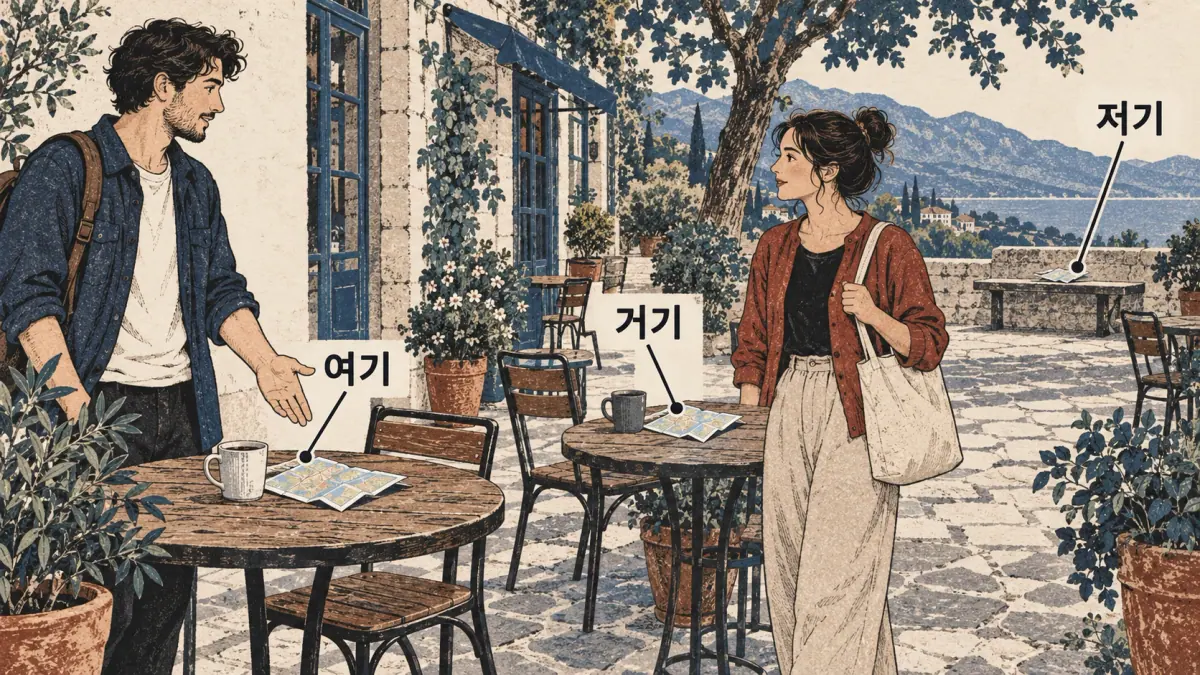
To answer a 어디 question, repeat the same particle and replace 어디 with a place word. The particle in the question tells you which one to use in the answer, so you only need to learn the place words.
| Place word | Meaning | Points to |
|---|---|---|
| 여기 | here | a place near the speaker |
| 거기 | there | a place near the listener |
| 저기 | over there | a place far from both |
| 어디 | where | the unknown place |
The three answer words follow the same pattern as 이, 그 and 저 in the 이 그 저 Korean demonstratives lesson, and 어디 is the question member of the same family.
Here are matching question and answer pairs for each pattern in the table above.
| Question | Answer | Meaning of the answer |
|---|---|---|
| 화장실이 어디예요? | 저기예요. | It is over there. |
| 지금 어디에 있어요? | 학교에 있어요. | I am at school. |
| 어디에 가요? | 도서관에 가요. | I am going to the library. |
| 어디에서 왔어요? | 서울에서 왔어요. | I came from Seoul. |
| 어디에서 공부해요? | 집에서 공부해요. | I study at home. |
Notice that each answer keeps the question's particle: 에 stays 에, and 에서 stays 에서. This is why choosing the right particle in the question matters, because it also sets up the correct answer. Pronunciation notes: 학교에 있어요 is [학꾜에 이써요], 서울에서 왔어요 is [서우레서 와써요], and 집에서 is [지베서].
When you do not know a place word, you can reply with a name and the particle. For example, 어디에서 왔어요? has the short answer 한국이요 ("Korea") in casual talk, and the full answer 한국에서 왔어요. A full answer is always safe, and a short answer is common among friends.
With answers in place, you can also see the other things 어디 can do.
When Does 어디 Mean "Somewhere" or Take Other Particles?
어디 is not always a question. Before a verb, it can also mean "somewhere", and the intonation decides.
| Sentence | Rising pitch? | Meaning |
|---|---|---|
| 어디 갔어요? | falling | Where did you go? |
| 어디 갔어요? | rising | Did you go somewhere? |
Both readings are written the same way. In a yes-no reading the speaker raises the voice at the end, which is the pattern covered in yes no questions in Korean.
Dropping 에. In casual speech the destination particle often drops: 어디 가요? for 어디에 가요? The dropping rules are in omitting particles in Korean.
The greeting 어디 가세요? Literally "Where are you going?", this honorific question is also used as a friendly greeting when you meet someone on the way. The speaker often does not expect a precise answer; "just over there" is enough.
어디가 with feelings and states. 어디가 can appear when 어디 is the subject of the sentence: 어디가 아파요? ("Where does it hurt?") uses 가, because 어디 is the thing that hurts. Treat this as a different pattern from the destination 에.
Negative and "anywhere" meanings. With a negative, 어디 changes to mean "nowhere" or "not anywhere": 어디에도 없어요 ("It isn't anywhere").
Honest limit of this lesson: it covers the common uses of 어디 in the polite style. Indirect questions such as 어디인지 모르겠어요 ("I don't know where it is") are covered with the -(으)ㄴ/는지 pattern.
The exceptions show where learners are likely to slip, so here are the errors to avoid.
Common Mistakes with 어디
Five mistakes cover most errors. Each follows the pattern "learners often assume X, but actually Y, because Z."
- Using 에서 for a destination. Learners often say 어디서 가요? for "Where are you going?" Actually 에서 marks the starting point or the place of an action, so a destination takes 에: 어디에 가요?
- Using 가 for a destination. Learners often say 어디가 가요? Actually 가 marks a subject. 어디가 appears only when 어디 is the subject, as in 어디가 아파요?
- Moving 어디 to the front. Learners often say 어디 화장실이에요? Actually the question word stays in the answer slot: 화장실이 어디예요?
- Using 어디예요 alone for "Where are you from?" Learners often ask a stranger 어디예요? Actually that means "Where is it?" For origin, ask 어디에서 왔어요? or 어느 나라 사람이에요?, which uses 어느 which in Korean.
- Writing 어디이에요. Learners often add 이에요 to every noun. Actually 어디 ends in a vowel, so the polite copula is 예요: 어디예요? Careful speech says [어디예요], and everyday speech often softens it to [어디에요].
Other question words follow the same "stay in place" pattern, so the same habits carry over to 누구 누가 who in korean, 언제 when in korean and 어떻게 how in korean. Now test yourself.
Practice and Answers
Try all four items before you read the answers. Each answer has audio, normal and slow.
Sentence
Where is the restroom?
Show answer
화장실이 어디예요
Practice · 8
Choose the form for "Where do you study?": 어디___ 공부해요?
Show answer
에서
공부하다 is an action verb, so the place takes 에서.
The speaker wants to ask "Where did you come from?" Fix 어디에 왔어요?
Show answer
어디에서 왔어요?
A starting point takes 에서.
Translate "Where is the library?"
Show answer
도서관이 어디예요?
도서관 ends in ㄴ, so the subject particle is 이, and after the vowel of 어디 the copula is 예요.
Ask a friend where they live, using 살다.
Show answer
어디에 살아요?
Any 어디 plus 에 plus 살아요 is correct; 가 would make 어디 the subject.
Which sentence correctly asks "Where are you going?"
Show answer
어디에 가요?
A destination takes 에; 에서 marks a starting point and 가 marks a subject.
Which is the correct polite way to ask "Where is it?"
Show answer
어디예요?
어디 ends in a vowel, so the polite copula is 예요; 어디야 is casual.
How do you answer 화장실이 어디예요? with "It is over there"?
Show answer
저기예요.
Replace 어디 with a place word; 저기 means "over there", far from both speakers.
Which question means "Where does it hurt?"
Show answer
어디가 아파요?
Here 어디 is the subject of the sentence (the thing that hurts), so it takes 가.
- Choose the form. 어디(에/에서) 공부해요? ("Where do you study?")
- Fix the error. 어디에 왔어요? (The speaker wants to ask "Where did you come from?")
- Translate. "Where is the library?"
- Write your own. Ask a friend where they live, using 살다 (to live).
Answer Key
- 어디에서 공부해요? (eodieseo gongbuhaeyo) 공부하다 is an action verb, so the place takes 에서.
- 어디에서 왔어요? (eodieseo wasseoyo) Pronounced [어디에서 와써요]. A starting point takes 에서.
- 도서관이 어디예요? (doseogwani eodiyeyo) Pronounced [도서과니 어디예요]. 도서관 ends in the consonant ㄴ, so the subject particle is 이.
- Sample answer: 어디에 살아요? (eodie sarayo) "Where do you live?" Any 어디 plus 에 plus 살아요 is correct. Pronounced [어디에 사라요].
If you chose the wrong particle, check the verb: going or existing takes 에, an action takes 에서. Then continue with the next lessons.
Next Lessons and Where to Go from Here
After 어디 where in korean, the natural next lesson is 언제 when in korean, which asks about time in the same "stay in place" pattern. To sharpen the particles used with 어디, study location particle 에 and location particle 에서. If the previous question word, "who", is still new, review 누구 누가 who in korean. The set overview, Korean questions, lists every lesson in order.
For practice, take the grammar quizzes. This page uses Revised Romanization only as a learning aid; the Hangul is the reference. To remember the idea in one line: 어디 where in korean replaces the place in the answer, and the particle that follows (에, 에서 or (으)로) says whether the place is a destination, a starting point or a direction.
Frequently Asked Questions
What Does 어디 Mean?
어디 means "where" and also "somewhere" in some sentences. It replaces the place in the answer: 화장실이 어디예요? asks about the place of the restroom, and the answer is 저기예요 (it is over there). Like all Korean question words, it stays in the position of the answer.
How Do I Form Questions with 어디?
Put 어디 where the place would go and add the particle that matches the verb. Use 예요 (어디예요?) for "where is it", 에 for a destination or a location with 있다, 에서 for where an action happens or where someone comes from, and (으)로 for a direction. No word order change is needed.
What Is the Most Common Mistake with 어디?
The most common mistake is using 에서 or 가 where 에 belongs. 어디서 가요 and 어디가 가요 are wrong for "Where are you going?"; the correct sentence is 어디에 가요? (or just 어디 가요? in casual speech). Use 에 for destinations, 에서 for the place of an action or for a starting point.
How Is 어디 Different from 어느?
어디 asks about a place with no limited set, as in 어디에 가요? (where are you going?). 어느 asks which one from a known set, as in 어느 나라 사람이에요? (which country are you from?). Use 어디 for an open place and 어느 when the choices are already clear.
Do I Use 어디 in Speech, Writing or Both?
Both. 어디 is the same word in speech and writing. Casual speech often drops the particle, so 어디 가요? replaces 어디에 가요?. In formal speech the ending changes to 어디입니까?. Only the sentence ending and the optional particle change; the question word does not.