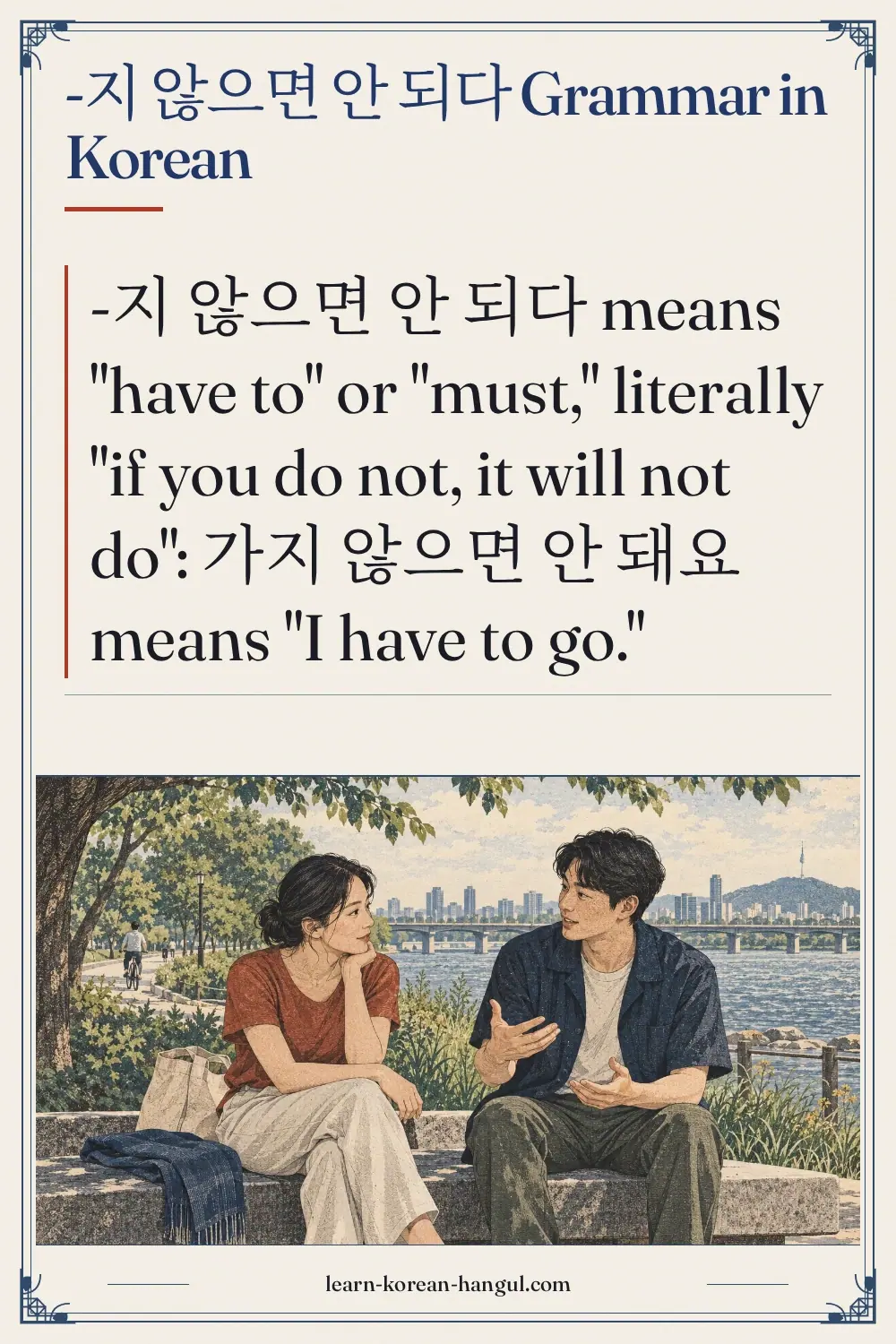
What you'll learn
- Attach -지 않으면 안 되다 to any verb or adjective stem, and to a noun with 이/가 아니면.
- Say "have to" in the polite, formal and casual styles.
- Explain why two negatives make a positive obligation.
- Pronounce the ending correctly: [아느면], with the tensed sound before it.
- Tell it apart from -아/어야 하다/되다, -(으)면 안 되다 and -지 않을 수 없다.
Before you start: you should know how to find a verb stem (drop 다 from the dictionary form) and the negative ending -지 않다. If stems are new to you, read about verb stems first. For the negative itself, see -지 않다 negation. Audio plays only when you press a button.
What Does -지 않으면 안 되다 Grammar Mean?
-지 않으면 안 되다 grammar means "you have to do this" or "it has to be this way." The pattern is built from three parts that you may already know. -지 않다 means "do not." -(으)면 means "if." 안 되다 means "does not work" or "is not okay." Read together, they say: "If you do not do it, it is not okay." The listener understands that the action is required.
Here are the first two examples. The pattern is the same in both, and only the verb changes.
- 내일까지 끝내지 않으면 안 돼요. (naeilkkaji kkeunnaeji aneumyeon an dwaeyo.) [내일까지 끈내지 아느면 안 돼요] = "I have to finish it by tomorrow."
- 약을 먹지 않으면 안 됩니다. (yageul meokji aneumyeon an doemnida.) [야글 먹찌 아느면 안 됨니다] = "You must take the medicine."
The first sentence is a personal deadline. The second is an instruction from a doctor or a label, so it uses the formal ending 안 됩니다. In both, the speaker is not asking for a choice. The word 않으면 [아느면] carries the "if not" idea, and 안 돼요 closes the door on that option.
Why use two negatives at all? Korean often states a necessity by ruling out the alternative. English does the same in "I can't not go" or "it won't do if you don't." The next section shows how to build the pattern.
How Do You Form -지 않으면 안 되다?
-지 않으면 안 되다 is formed by dropping 다 from the dictionary form and adding -지 않으면 안 되다. The stem never needs an extra 으, because the ending begins with the consonant ㅈ, and the part that follows (않으면) is fixed. Add the tense and politeness only to the last word, 되다.
| Dictionary form | Stem | Stem + -지 않으면 | Polite form | Meaning |
|---|---|---|---|---|
| 가다 | 가 | 가지 않으면 | 가지 않으면 안 돼요 | have to go |
| 먹다 | 먹 | 먹지 않으면 | 먹지 않으면 안 돼요 | have to eat |
| 읽다 | 읽 | 읽지 않으면 | 읽지 않으면 안 돼요 | have to read |
| 만들다 | 만들 | 만들지 않으면 | 만들지 않으면 안 돼요 | have to make |
| 돕다 | 돕 | 돕지 않으면 | 돕지 않으면 안 돼요 | have to help |
| 좋다 | 좋 | 좋지 않으면 | 좋지 않으면 안 돼요 | have to be good |
| 제출하다 | 제출하 | 제출하지 않으면 | 제출하지 않으면 안 돼요 | have to submit |
The table shows one rule applied to seven words. The next three parts look at the groups of stems one at a time.
Stems Ending in a Vowel
A vowel stem takes -지 directly: 가다 becomes 가지, 쉬다 becomes 쉬지, and 일어나다 becomes 일어나지. Nothing is added or dropped, and the sound is smooth. Examples:
- 가지 않으면 안 돼요. (gaji aneumyeon an dwaeyo.) [가지 아느면 안 돼요] = "I have to go."
- 이제 공부하지 않으면 안 돼요. (ije gongbuhaji aneumyeon an dwaeyo.) [이제 공부하지 아느면 안 돼요] = "I have to study now."
The second sentence uses a 하다 verb. 공부하다 behaves like any vowel stem: 공부하 + 지 = 공부하지. Vowel stems are the simplest case. A stem with a final consonant changes the sound, though not the spelling.
Stems Ending in a Consonant
A consonant stem also takes -지 directly. The spelling does not change, but the final consonant makes the ㅈ of 지 sound tense. 먹지 is spoken [먹찌], 읽지 is spoken [익찌], 입지 is spoken [입찌], and 앉지 is spoken [안찌]. This follows the standard pronunciation rules (표준 발음법) of the 국립국어원 (National Institute of Korean Language) for tensing after a stem-final consonant.
- 이 책을 읽지 않으면 안 돼요. (i chaegeul ikji aneumyeon an dwaeyo.) [이 채글 익찌 아느면 안 돼요] = "I have to read this book."
- 교복을 입지 않으면 안 돼요. (gyobogeul ipji aneumyeon an dwaeyo.) [교보글 입찌 아느면 안 돼요] = "You have to wear the uniform."
Look at the second part of the ending, too. 않으면 is spelled with the consonant ㅎ, but you do not hear it before 으: 않 + 으면 is spoken [아느면]. A learner who reads the spelling letter by letter will say "an-heu-myeon," and that sounds wrong. Say [아느면] as three smooth syllables. The practice of linking a final consonant to a following vowel is the same rule that you see in 먹어요 [머거요].
Two more groups need a short note, because learners expect trouble with them.
Do ㄹ-Stems, Irregular Stems, Adjectives and Nouns Change?
No. This is the good news of the pattern. In most endings, ㄹ-stems drop their ㄹ and irregular stems change their shape. Because -지 begins with a consonant, none of that happens here.
ㄹ-stems keep the ㄹ: 만들다 gives 만들지 않으면 안 돼요, and 놀다 gives 놀지 않으면 안 돼요.
ㅂ-irregular verbs keep the ㅂ: 돕다 gives 돕지 않으면 안 돼요, not 도와지 않으면.
ㄷ-, ㅅ- and 르-irregular verbs keep their dictionary stem as well: 듣지, 낫지, 모르지.
하다 adjectives behave like 하다 verbs: 건강하지 않으면 안 돼요 ("You have to be healthy").
Adjectives with a final consonant, such as 좋다, keep it: 좋지 is spelled with ㅎ but spoken [조치].
저녁은 제가 만들지 않으면 안 돼요. (jeonyeogeun jega mandeulji aneumyeon an dwaeyo.) [저녀근 제가 만들지 아느면 안 돼요] = "I have to make dinner myself."
친구를 돕지 않으면 안 돼요. (chingureul dopji aneumyeon an dwaeyo.) [친구를 돕찌 아느면 안 돼요] = "I have to help my friend."
이 일은 목소리가 좋지 않으면 안 돼요. (i ireun moksoriga jochi aneumyeon an dwaeyo.) [이 이른 목쏘리가 조치 아느면 안 돼요] = "For this job, your voice has to be good."
Nouns do not take the ending directly. A noun needs 이/가 아니다 ("is not"), so the pattern becomes N이/가 아니면 안 되다, and it means "it has to be N." After a vowel use 가, and after a consonant use 이.
- 이 가방이 아니면 안 돼요. (i gabangi animyeon an dwaeyo.) [이 가방이 아니면 안 돼요] = "It has to be this bag."
Notice that 아니면 already contains the negative, so 않 is not needed. With the formation clear, one sentence can be built step by step.
Worked Example: Building a Sentence with -지 않으면 안 되다
-지 않으면 안 되다 grammar works by turning an action into a requirement. Follow the steps with the idea "You have to submit this document today."
- Start with the verb. The verb is 제출하다 (to submit). Its dictionary form ends in 다.
- Find the stem. Drop 다. The stem is 제출하. It ends in the vowel ㅏ.
- Add -지 않으면. The ending needs no 으, so 제출하 + 지 않으면 = 제출하지 않으면.
- Add 안 되다 in the polite style. 안 되다 becomes 안 돼요. Keep the space.
- Rebuild the sentence. Put the time and object first: 이 서류는 오늘 안에 제출하지 않으면 안 돼요. (i seoryuneun oneul ane jechulhaji aneumyeon an dwaeyo.) [이 서류는 오늘 아네 제출하지 아느면 안 돼요] = "You have to submit this document today."
Sentence
You have to submit this document today.
Show answer
이 서류는 오늘 안에 제출하지 않으면 안 돼요
You will know it worked when 않으면 comes right after the verb with 지, and 안 돼요 comes last. The most common slip at this step is to swap the two negatives, as in 제출하지 안으면 않 돼요. Keep them in the right order: 않 belongs to the first verb, and 안 belongs to 돼요. The sentence is now a requirement, but the pattern has limits on tense and sentence type.
Which Tenses and Sentence Types Work with -지 않으면 안 되다?
-지 않으면 안 되다 works in the present and the past, in statements and in questions. All changes happen on 되다, the last word. The table shows the forms for 가다.
| Sentence type | Form | Meaning |
|---|---|---|
| Polite statement | 가지 않으면 안 돼요 | I have to go. |
| Polite question | 가지 않으면 안 돼요? | Do I have to go? |
| Formal | 가지 않으면 안 됩니다 | One must go. |
| Casual | 가지 않으면 안 돼 | I have to go (to a friend). |
| Past | 가지 않으면 안 됐어요 | I had to go. |
| Honorific | 가시지 않으면 안 돼요 | You (respected person) have to go. |
The past form is spoken [돼써요], and the formal 안 됩니다 is spoken [안 됨니다]. If you are unsure whether to write 되 or 돼, see the page on 되 vs 돼.
- 어제까지 내지 않으면 안 됐어요. (eojekkaji naeji aneumyeon an dwaesseoyo.) [어제까지 내지 아느면 안 돼써요] = "It had to be handed in by yesterday."
- 선생님이 가시지 않으면 안 돼요. (seonsaengnimi gasiji aneumyeon an dwaeyo.) [선생니미 가시지 아느면 안 돼요] = "The teacher has to go."
- 오늘은 가지 않으면 안 돼. (oneureun gaji aneumyeon an dwae.) [오느른 가지 아느면 안 돼] = "I have to go today."
The question form is useful, and it carries feeling. 꼭 가지 않으면 안 돼요? (kkok gaji aneumyeon an dwaeyo?) [꼭 가지 아느면 안 돼요] means "Do I really have to go?" The speaker hopes the answer is no. A reply of 네, 가지 않으면 안 돼요 means "Yes, you have to."
The pattern is not used for commands or suggestions. You cannot turn it into "Go!" or "Let's go." For a command, use a direct form such as 가세요 or a polite request. The most useful contrast for a learner is next to the pattern it is closest to.
How Is -지 않으면 안 되다 Different from -아/어야 하다/되다?
-지 않으면 안 되다 and -아/어야 하다/되다 both mean "have to," but they do not feel the same. -아/어야 하다/되다 is the plain way to state a duty. -지 않으면 안 되다 is firmer. It stresses that nothing else will do, so it suits deadlines, rules and conditions for a goal.
| Point | -지 않으면 안 되다 | -아/어야 하다/되다 |
|---|---|---|
| Meaning | have to, must (no alternative) | must, have to |
| Feeling | firm, insistent | neutral, everyday |
| Attaches to | stem + 지 않으면 안 되다 | stem + 아/어야 하다/되다 |
| Example | 가지 않으면 안 돼요. | 가야 해요. |
| Meaning of example | I absolutely have to go. | I have to go. |
Both sentences are correct in the same situation. A friend can say 가야 해요 about a normal errand. A parent or a doctor is more likely to say 가지 않으면 안 돼요 about something serious. The full rules for the plainer pattern are on the page for -아/어야 하다/되다.
Three other neighbours are worth knowing.
- -(으)면 안 되다 is the exact opposite. 가면 안 돼요 means "You must not go," while 가지 않으면 안 돼요 means "You must go." See -(으)면 안 되다.
- -아/어서는 안 되다 also means "must not," in a formal, principled way. It is not an obligation. See -아/어서는 안 되다.
- -지 않을 수 없다 means "cannot help but," with a feeling or circumstance pushing you. It is built from the same -지 않- but ends in 수 없다. See -지 않을 수 없다. A similar idea, "no choice but to," is on the page for -(으)ㄹ 수밖에 없다.
These contrasts lead to the smaller variations of the pattern itself.
Variations and Edge Cases of -지 않으면 안 되다
-지 않으면 안 되다 has three common variations: a short negative form, a resolution form with 안 되겠다, and the 안 되다 question. Each one appears in real conversation.
- The short negative. Instead of -지 않다, you can use the short negative 안 in front of the verb: 안 먹으면 안 돼요 (an meogeumyeon an dwaeyo) [안 머그면 안 돼요] means "You have to eat." The meaning is the same as 먹지 않으면 안 돼요. The short form is common in speech. The long form, with -지 않으면, is more common in writing and in formal settings. See -지 않다 negation for the difference between the two negatives.
- Resolution with 안 되겠다. Changing 안 돼요 to 안 되겠어요 turns a rule into a decision: 이제 공부하지 않으면 안 되겠어요 (ije gongbuhaji aneumyeon an doegesseoyo) [이제 공부하지 아느면 안 되게써요] means "I really have to study now." The speaker has just realized it.
- The soft complaint. The question 안 가면 안 돼요? means "Can't I just not go?" It asks for relief from a duty. Compare it with 가지 않으면 안 돼요?, which asks "Do I really have to?"
Also keep in mind two points about use. First, the pattern describes something the situation requires. It rarely means a personal wish. Second, with a noun, N이/가 아니면 안 되다 can show a strong preference, as in "It has to be you." A speaker often says it to show that no substitute will do. This lesson covers the usual obligation meaning. The mistakes below show where the boundary causes real errors.
What Mistakes Do Learners Make with -지 않으면 안 되다?

Learners most often get the meaning, the spelling or the pairing wrong. Four mistakes appear again and again.
- Reading the double negative literally. Learners see 않 and 안 and think the sentence means "do not." 가지 않으면 안 돼요 actually means "I have to go." The two negatives cancel each other.
- Spelling the first negative with 안. 가지 안으면 안 돼요 is wrong. The first negative belongs to the -지 않다 pattern, so it is spelled 않: 가지 않으면. Only the word right before 돼요 is 안.
- Mixing it up with -(으)면 안 되다. 먹으면 안 돼요 means "You must not eat." 먹지 않으면 안 돼요 means "You have to eat." One small syllable (지 않) reverses the meaning. Check for 지 않 before you translate.
- Spelling 돼요 as 되요. 안 되요 is wrong. The test is to put 하 or 해 in the same slot: 안 해요 fits and 안 하요 does not, so write 돼요.
A quick check for any requirement: Is the stem followed by -지 않으면? Is 안 a separate word before 돼요? Does the speaker mean "there is no alternative"? If all three answers are yes, the sentence is sound.
The practice set below tests these four points directly.
Practice and Answers
Try the four items before you read the answer key. Cover the answers with your hand.
- Choose the form. Complete: 약을 먹___ 않으면 안 돼요. (지 / 으면 / 어서)
- Fix the error. A learner writes 가지 안으면 안 돼요 to mean "I have to go." Correct it.
- Translate. "You have to take this medicine today." Use 먹다 and the polite style.
- Write your own. Write one requirement from your work, school or travel life with -지 않으면 안 돼요. Then write the same idea as a formal notice with 안 됩니다.
Practice · 6
Which sentence means "I have to go"?
Show answer
가지 않으면 안 돼요.
-지 않으면 안 돼요 is the double negative that means "have to." 가면 안 돼요 means "must not go," and 가도 돼요 means "may go."
Complete the sentence: 약을 먹___ 않으면 안 돼요.
Show answer
지
The pattern is stem + -지 않으면 안 돼요, so the stem 먹 takes -지: 먹지 않으면 안 돼요.
Which spelling is correct?
Show answer
가지 않으면 안 돼요
The first negative is spelled 않 (from -지 않다), and the word before 돼요 is 안.
Which sentence means "It has to be this bag"?
Show answer
이 가방이 아니면 안 돼요.
For nouns, use N이/가 아니면 안 되다. 이 가방이면 안 돼요 means "it must not be this bag," and 아니면 돼요 means "it is fine if it is not this bag."
How is 먹지 않으면 spoken?
Show answer
[먹찌 아느면]
The ㅈ of 지 is tensed after the final ㄱ ([먹찌]), and 않으면 is spoken [아느면] because the ㅎ is silent before 으.
Which sentence means "It had to be handed in by yesterday"?
Show answer
어제까지 내지 않으면 안 됐어요.
The tense goes on 되다: 안 됐어요. 내면 안 됐어요 means "you were not allowed to hand it in," and 내지 않으면 돼요 means "it is fine if you do not hand it in."
Answer key
- 지. The pattern is stem + -지 않으면 안 돼요, so you get 먹지 않으면 안 돼요.
- 가지 않으면 안 돼요. The first negative is spelled 않.
- 오늘 이 약을 먹지 않으면 안 돼요. (oneul i yageul meokji aneumyeon an dwaeyo.) [오늘 이 야글 먹찌 아느면 안 돼요] = "You have to take this medicine today."
- Answers vary. Check that -지 않으면 is attached to the stem, 안 is separate, and the formal version ends in 안 됩니다. An example: 서류를 내지 않으면 안 돼요 → 서류를 내지 않으면 안 됩니다.
If you can complete items 1 to 3 without the key, you can use the pattern in conversation. Next, the lesson hands off to related patterns.
What Should You Learn Next?
You now know a firm way to say "have to." Continue with the plainer pattern -아/어야 하다/되다, which you will use more often in daily speech. Then study its mirror image, -(으)면 안 되다, and the feeling-driven -지 않을 수 없다. For a request to someone else, read -지 마세요 don't. All the related lessons are collected under Obligation and Permission. The pattern also sits at level B2 on the Advanced Grammar list.
This page covers the meaning, the formation and the common mistakes of -지 않으면 안 되다. It does not cover every conditional use of -(으)면 or every use of 안 되다. Level placement here is an editorial estimate from textbook syllabi. For official exam information, see topik.go.kr.
Frequently Asked Questions
What does -지 않으면 안 되다 mean?
-지 않으면 안 되다 means "have to" or "must." It says that there is no acceptable alternative: if you do not do the action, the result is not okay. 내일까지 끝내지 않으면 안 돼요 means "I have to finish it by tomorrow." Although it contains two negatives (않- and 안), the meaning is positive, an obligation.
How do I attach -지 않으면 안 되다 to a verb or adjective?
Drop 다 from the dictionary form and add -지 않으면 안 되다. The ending begins with ㅈ, so no 으 appears and irregular stems do not change: 가다 gives 가지 않으면 안 돼요, 먹다 gives 먹지 않으면 안 돼요, 돕다 gives 돕지 않으면 안 돼요, and the adjective 건강하다 gives 건강하지 않으면 안 돼요. With a noun, say N이/가 아니면 안 돼요.
Can -지 않으면 안 되다 be used in the past tense?
Yes, but the tense goes on 되다, and the sentence describes a past obligation. 어제까지 내지 않으면 안 됐어요 means "It had to be handed in by yesterday." Putting the past on the first verb (내지 않았으면 안 돼요) changes the meaning to a condition about something already done, so it is not the normal way to say "had to."
Is -지 않으면 안 되다 used in speech or only in writing?
Both. In speech it sounds firm and a little formal, and people use it when something truly has to happen: 오늘은 가지 않으면 안 돼요. In notices, rules and explanations it appears as 안 됩니다: 약을 먹지 않으면 안 됩니다. For everyday duties, -아/어야 해요 is the more common choice.
What is the most common mistake with -지 않으면 안 되다?
The most common mistake is reading the two negatives literally and thinking the sentence means "do not." 가지 않으면 안 돼요 means "I must go," not "I must not go." A second mistake is spelling the first negative with 안 instead of 않: write 가지 않으면, not 가지 안으면.
What is the difference between -지 않으면 안 되다 and -아/어야 하다/되다?
Both mean "have to." -아/어야 하다/되다 is the plain, everyday way to state a duty: 가야 해요. -지 않으면 안 되다 is more emphatic. It stresses that nothing else will do, so it suits deadlines, rules and conditions for a goal: 오늘 안에 내지 않으면 안 돼요 sounds firmer than 오늘 안에 내야 해요.