What you'll learn
- Attach -다고 생각하다 to verbs, adjectives, 있다/없다, past forms and nouns.
- Give an opinion in polite, formal and written Korean.
- Say "I don't think so" in two ways.
- Choose between -다고 생각하다, -(으)ㄴ/는 것 같다 and -(으)ㄹ 생각이다.
- Avoid the mistakes 재미있어요고, 가다고 and 선생님이다고.
Before you start: you should know the plain forms of verbs (plain present and plain past). The page on -(이)라고 하다 shows the noun frame. Audio plays only when you press a button.
What Does -다고 생각하다 Grammar Mean?
-다고 생각하다 grammar means "I think that ..." or "I believe that ...". The clause before 고 is the opinion, written in the plain style. The verb 생각하다 ("think") closes the sentence. The speaker owns the opinion, unlike hearsay patterns such as -다고 들었어요, where the news came from someone else.
Two examples show the idea. The first gives a view about a language, and the second about an activity.
한국어가 재미있다고 생각해요.
hangugeoga jaemiitdago saenggakaeyo.
I think Korean is fun.
저는 운동이 중요하다고 생각해요.
jeoneun undongi jungyohadago saenggakaeyo.
I think exercise is important.
Both sentences end with 생각해요, and the opinion comes before 고. Because 생각하다 is a 하다 verb, Revised Romanization shows its ㅎ as an aspirated sound: saenggakaeyo. The next section shows how to build the form.
How Do You Form -다고 생각하다?
-다고 생각하다 is formed by taking the plain-style form of the opinion and adding 고 생각하다. The plain style is the same one used in -대요/-냬요/-재요/-래요: verbs take -ㄴ다 or -는다, adjectives keep -다, and nouns take -(이)라.
| Type | Plain form | With 고 생각해요 | Said as |
|---|---|---|---|
| Verb, vowel stem | 온다 | 온다고 생각해요 | [온다고 생가캐요] |
| Verb, consonant stem | 먹는다 | 먹는다고 생각해요 | [멍는다고 생가캐요] |
| Verb 맞다 | 맞는다 | 맞는다고 생각해요 | [만는다고 생가캐요] |
| Adjective | 바쁘다 | 바쁘다고 생각해요 | [바쁘다고 생가캐요] |
| 있다 / 없다 | 있다 | 있다고 생각해요 | [읻따고 생가캐요] |
| Past | 갔다 | 갔다고 생각해요 | [갇따고 생가캐요] |
| Future | 갈 거라 | 갈 거라고 생각해요 | [갈꺼라고 생가캐요] |
| Noun + 이다 | 선생님이라 | 선생님이라고 생각해요 | [선생니미라고 생가캐요] |
Revised Romanization (RR) writes ondago saenggakaeyo, meongneundago saenggakaeyo, manneundago saenggakaeyo, itdago saenggakaeyo, gatdago saenggakaeyo, gal georago saenggakaeyo and seonsaengnimirago saenggakaeyo. The sound changes follow the 국립국어원 standard pronunciation rules (표준 발음법). The next parts take the stem types one at a time.
Verbs
A vowel verb takes -ㄴ다고: 가다 gives 간다고, 오다 gives 온다고. A consonant verb takes -는다고: 먹다 gives 먹는다고. 맞다 ("be correct") is a verb, so it gives 맞는다고. An ㄹ-stem drops its ㄹ: 만들다 gives 만든다고. A 하다 verb takes -ㄴ다고: 좋아하다 gives 좋아한다고.
민수 씨 말이 맞는다고 생각해요.
minsu ssi mari manneundago saenggakaeyo.
I think what Minsu says is right.
Adjectives and 있다/없다
An adjective keeps its dictionary form in front of 고: 바쁘다고, 어렵다고, 좋다고 (said [조타고]). The words 있다 and 없다 behave the same way, so 재미있다 gives 재미있다고. Some opinions use the negative: 어렵지 않다고 생각해요 means "I think it is not difficult."
한국어 공부가 어렵지 않다고 생각해요.
hangugeo gongbuga eoryeopji antago saenggakaeyo.
I think studying Korean is not difficult.
Past, Future and Nouns
For a thought about the past, put -았/었 before 다고: 그 사람이 틀렸다고 생각해요 ("I think that person was wrong"). For the future, use -(으)ㄹ 거라고. A noun takes -(이)라고, as in -(이)라고 하다: 선생님이라고 after a consonant and 의사라고 after a vowel.
내일 비가 올 거라고 생각해요.
naeil biga ol georago saenggakaeyo.
I think it will rain tomorrow.
그분이 좋은 선생님이라고 생각해요.
geubuni joeun seonsaengnimirago saenggakaeyo.
I think he is a good teacher.
With the forms clear, you can build a full sentence.
Worked Example: Building a Sentence with -다고 생각하다
-다고 생각하다 grammar works the same way every time, so a five-step routine is enough. Follow it to build "I think Korean is fun."
- Write the opinion. The view is: 한국어가 재미있어요. ("Korean is fun.")
- Turn the predicate into the plain style. 재미있다 is an adjective and keeps -다: 재미있다.
- Add 고. 재미있다 + 고 becomes 재미있다고.
- Add 생각해요. 재미있다고 생각해요.
- Put it together. 한국어가 재미있다고 생각해요. (hangugeoga jaemiitdago saenggakaeyo.)
Sentence
I think Korean is fun.
Show answer
한국어가 재미있다고 생각해요
You will know it worked if the opinion is in the plain style, 고 follows with no space, and 생각해요 closes the sentence. The most common slip is writing 재미있어요고 with a polite ending. The next question is which tenses and styles can follow.
Which Tenses and Sentence Types Work with -다고 생각하다?
-다고 생각하다 works with every tense in the opinion, and the thinking verb takes the style you need. The tense of 생각하다 says when you held the thought, not when the event happened.
| Question | Answer |
|---|---|
| Can the opinion be past? | Yes: 갔다고 생각해요 ("I think he went"). |
| Can it be future? | Yes: 갈 거라고 생각해요, said [갈꺼라고 생가캐요]. |
| Can 생각하다 be past? | Yes: 쉽다고 생각했어요 ("I thought it was easy"), said [생가캐써요]. |
| Can the opinion be negative? | Yes: 어렵지 않다고 생각해요 or 안 어렵다고 생각해요. |
| Polite style | 생각해요 |
| Formal style | 생각합니다, said [생가캄니다]. See formal speech. |
| Casual style | 생각해 |
| Written plain style | 생각한다. See plain style. |
| How do I show respect? | Put -(으)시- on 생각하다 for a respected thinker: 선생님은 좋다고 생각하세요. See -(으)시- honorific. |
In essays and speeches, 생각합니다 and 생각한다 are standard. Written arguments often end with 중요하다고 생각한다, and academic prose uses the passive 생각되다: 중요하다고 생각됩니다. For the TOPIK writing test, follow the instructions on topik.go.kr. For a question, use 어떻게 생각해요? ("What do you think?"). Because it has a question word, the end usually falls or rises and falls, without a sharp final rise.
어떻게 생각해요?
eotteoke saenggakaeyo?
What do you think?
저는 이 방법이 효과적이라고 생각합니다.
jeoneun i bangbeobi hyogwajeogirago saenggakamnida.
I think this method is effective. (formal)
The tense rule leads to the question that confuses learners most: how -다고 생각하다 differs from other ways to give an opinion.
How Is -다고 생각하다 Different from -(으)ㄴ/는 것 같다?
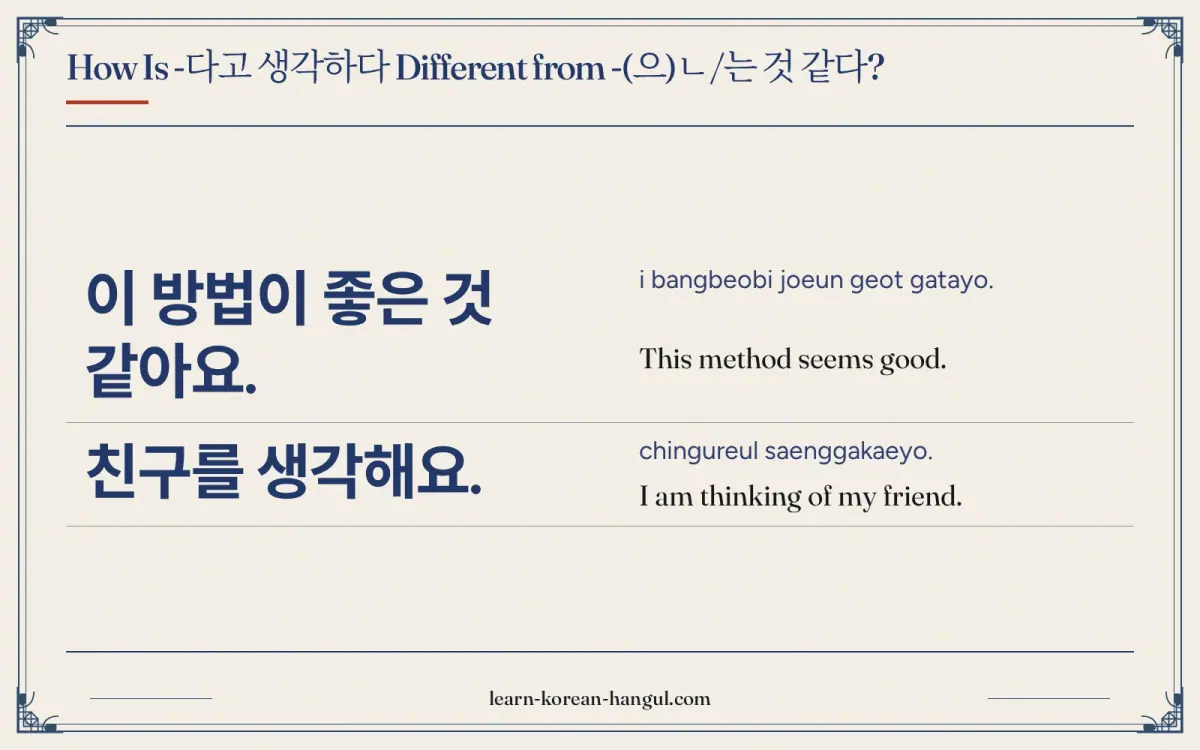
-다고 생각하다 states an opinion firmly, -(으)ㄴ/는 것 같다 softens it into "it seems", and -(으)ㄹ 생각이다 states a plan. Ask yourself one question: how sure am I, and is it a view or an intention?
-다고 생각하다
I think that ... (a view)
-(으)ㄴ/는 것 같다
it seems that ... (an impression)
-(으)ㄹ 생각이다
I intend to ... (a plan)
| Comparison | -다고 생각하다 | -(으)ㄴ/는 것 같다 | -(으)ㄹ 생각이다 |
|---|---|---|---|
| Strength | firm | soft | not an opinion |
| Based on | your own reasoning | what you see or sense | your decision |
| Example | 이 방법이 좋다고 생각해요. | 이 방법이 좋은 것 같아요. | 내일 갈 생각이에요. |
Use -다고 생각하다 for a clear view, -(으)ㄴ/는 것 같다 for a softer impression, and -(으)ㄹ 생각이다 for a plan.
Compare the three. 이 방법이 좋다고 생각해요 says "I hold the view that this method is good." 이 방법이 좋은 것 같아요 says "This method seems good," and it is a little softer. 내일 갈 생각이에요 says "I plan to go tomorrow." The softer pattern is taught in -(으)ㄴ/는 것 같다, and for the future in -(으)ㄹ 것 같다. The plan pattern is -(으)ㄹ 생각이다.
Two meanings of 생각하다 also need care. With 을/를 it means "think about": 친구를 생각해요 ("I am thinking of my friend"). With -다고 it means "think that": 친구가 좋은 사람이라고 생각해요 ("I think my friend is a good person").
이 방법이 좋은 것 같아요.
i bangbeobi joeun geot gatayo.
This method seems good.
친구를 생각해요.
chingureul saenggakaeyo.
I am thinking of my friend.
These contrasts lead to a few variations.
Variations and Edge Cases of -다고 생각하다
-다고 생각하다 has five common variations. Each one helps you read and say real Korean.
- Agreeing and disagreeing. 저도 그렇게 생각해요 means "I think so too." 저는 그렇게 생각하지 않아요 means "I don't think so," said [저는 그러케 생가카지 아나요].
- Two ways to say "I don't think". 어렵지 않다고 생각해요 means "I think it is not difficult." 어렵다고 생각하지 않아요 means "I don't think it is difficult." The meanings are very close, and the second can sound a little softer.
- In my opinion. 제 생각에는 means "in my opinion" and opens the sentence: 제 생각에는 이 방법이 좋아요.
- A noun clause. 중요하다고 생각하는 사람 means "a person who thinks it is important," said [중요하다고 생가카는 사람].
- A thought about someone else. Use the person's name and 생각하다 in the polite style: 민수는 한국 음식이 맵다고 생각해요 ("Minsu thinks Korean food is spicy").
저는 그렇게 생각하지 않아요.
jeoneun geureoke saenggakaji anayo.
I do not think so.
민수는 한국 음식이 맵다고 생각해요.
minsuneun hanguk eumsigi maepdago saenggakaeyo.
Minsu thinks Korean food is spicy.
Think of 생각하다 as a thought bubble: the clause in the bubble is in the plain style, and 고 ties it to the thinker. The variations all keep that frame.
What Mistakes Do Learners Make with -다고 생각하다?
Learners usually keep a polite ending inside the opinion or pick the wrong base form. Four mistakes appear again and again.
- Keeping a polite ending before 고. Wrong: 재미있어요고 생각해요. Right: 재미있다고 생각해요. The opinion must be in the plain style.
- Forgetting -ㄴ/는다 on a verb. Wrong: 가다고 생각해요. Right: 간다고 생각해요. Verbs need -ㄴ다 or -는다: 먹는다고.
- Using the verb rule on an adjective. Wrong: 바쁜다고 생각해요. Right: 바쁘다고 생각해요. An adjective keeps -다.
- Using 이다 on a noun. Wrong: 선생님이다고 생각해요. Right: 선생님이라고 생각해요. A noun takes -(이)라고.
A quick check: Is the opinion in the plain style? Does 고 follow with no space? Does 생각하다 end the sentence? If all three answers are yes, the sentence is sound.
The practice set below tests these points.
Practice and Answers
Try the four items before you read the answer key. Cover the answers with your hand.
- Give an opinion. Say "I think Korean is difficult." Use 어렵다.
- Choose the form. Fill in the blank with 먹다: 민수가 많이 ___고 생각해요 ("I think Minsu eats a lot").
- Fix the error. A learner says 한국어가 재미있어요고 생각해요. Correct it.
- Make it formal. Change 중요하다고 생각해요 into the formal style.
Practice · 5
Which sentence means "I think Korean is fun"?
Show answer
한국어가 재미있다고 생각해요.
재미있다 keeps -다 in the plain style: 재미있다고 생각해요. A polite ending cannot come before 고.
Which sentence means "I think Minsu will come"?
Show answer
민수가 온다고 생각해요.
A vowel verb takes -ㄴ다: 오다 gives 온다고.
Which form fits: 요즘 많이 ___ 생각해요 (바쁘다)?
Show answer
바쁘다고
An adjective keeps -다 in the plain style: 바쁘다고.
Which sentence means "I think he is a teacher"?
Show answer
그분이 선생님이라고 생각해요.
A noun takes -(이)라고. After the consonant of 선생님, it is 이라고.
Which sentence means "I am thinking of my friend"?
Show answer
친구를 생각해요.
With 을/를, 생각하다 means "think about". With -다고, it means "think that".
Answer key
- 한국어가 어렵다고 생각해요. (hangugeoga eoryeopdago saenggakaeyo.) The adjective 어렵다 keeps -다. Said [한구거가 어렵따고 생가캐요].
- 먹는다. The sentence is 민수가 많이 먹는다고 생각해요, said [민수가 마니 멍는다고 생가캐요].
- 한국어가 재미있다고 생각해요. Use the plain style before 고.
- 중요하다고 생각합니다. (jungyohadago saenggakamnida.) Said [중요하다고 생가캄니다].
If you can complete items 1 to 3 without the key, you can give most opinions. The final section points to the next lessons.
What Should You Learn Next after -다고 생각하다 Grammar?
After -다고 생각하다 grammar, learn how to pass on other people's views and how to soften your own. This lesson teaches the opinion frame and does not cover every way to argue in writing.
- Learn -다고 들었어요 to say "I heard that ..."
- Learn -다던데 to pass on hearsay as background.
- Learn -(으)ㄴ/는 것 같다 to soften an opinion with "it seems".
- Learn -(으)ㄹ 생각이다 to talk about plans.
- Review the spoken short forms in -대요/-냬요/-재요/-래요.
- Return to the Intermediate Grammar list for other patterns at this level.
With these steps, the choice becomes automatic: use -다고 생각하다 for a view, -(으)ㄴ/는 것 같다 for an impression, and -(으)ㄹ 생각이다 for a plan. For exam content and levels, check the current guide on topik.go.kr; the level shown here is an editorial estimate.
Frequently Asked Questions
What does -다고 생각하다 mean?
-다고 생각하다 means "I think that ..." or "I believe that ..." The clause before 고 is the opinion, written in the plain style, and 생각하다 closes the sentence. 한국어가 재미있다고 생각해요 means "I think Korean is fun." The speaker owns the opinion.
How do I attach -다고 생각하다 to a verb or adjective?
Use the plain-style form and add 고 생각하다. A vowel verb takes -ㄴ다: 간다고. A consonant verb takes -는다: 먹는다고. An adjective keeps -다: 바쁘다고. 있다 and 없다 keep -다. A noun takes -(이)라고: 선생님이라고. Add -았/었 for the past: 갔다고.
Can -다고 생각하다 be used in the past tense?
Yes, in two places. The opinion can be past: 갔다고 생각해요 ("I think he went"). The thinking can be past: 쉽다고 생각했어요 ("I thought it was easy"), said [쉽따고 생가캐써요]. Use the past of 생각하다 for a thought you held earlier.
Is -다고 생각하다 used in speech or only in writing?
It is used in both. In conversation, say 생각해요. In meetings and speeches, say 생각합니다. In essays, the written plain style ends with 생각한다, and academic writing also uses 생각된다 ("it is thought"). Check the instructions of any exam at topik.go.kr.
What is the most common mistake with -다고 생각하다?
The most common mistake is keeping a polite ending before 고, as in 재미있어요고 생각해요. The opinion must be in the plain style: 재미있다고 생각해요. Other mistakes are 가다고 for 간다고 (verbs need -ㄴ/는다) and 선생님이다고 for 선생님이라고.
What is the difference between -다고 생각하다 and -(으)ㄴ/는 것 같다?
-다고 생각하다 states a clear view: 이 방법이 좋다고 생각해요, "I think this method is good." -(으)ㄴ/는 것 같다 is softer and means "it seems": 이 방법이 좋은 것 같아요. Both can be translated as "I think", but the first is firmer.