What you'll learn
- Name the four short forms and the sentence type each one reports.
- Shrink any full reported form into its short form.
- Attach -대요 correctly to verbs, adjectives, 있다/없다, past forms and nouns.
- Tell the statement -래요 (after a noun) from the command -래요 (after a verb).
- Avoid mistakes such as 가는대요, 바쁜대요 and 있는대요.
Before you start: you should know the plain forms of verbs (plain present) and the basic quote endings in the Reported Speech section. Audio plays only when you press a button.
What Does -대요/-냬요/-재요/-래요 Grammar Mean?
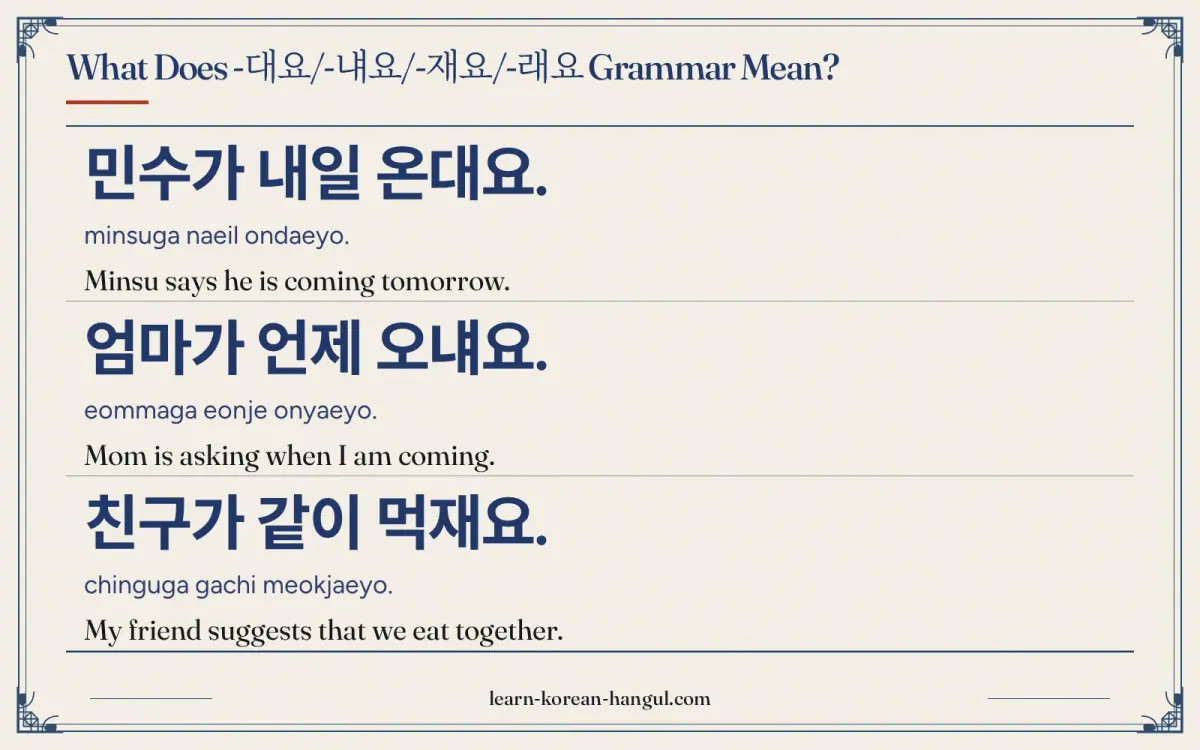
-대요/-냬요/-재요/-래요 grammar means "(someone) says that ...", "(someone) asks whether ...", "(someone) suggests that we ..." and "(someone) tells you to ...". Each short form is a contraction, a shortened version of a longer pattern. The first letter shows the sentence type that is being reported.
| Short form | Long form | Reports a | Example |
|---|---|---|---|
| -대요 | -다고 해요 | statement | 온대요 |
| -냬요 | -냐고 해요 | question | 오냬요 |
| -재요 | -자고 해요 | suggestion | 가재요 |
| -래요 | -(으)라고 해요 | command | 가래요 |
Listen to one example of each. In all four, the person who spoke is somebody else, and you are passing the message on.
민수가 내일 온대요.
minsuga naeil ondaeyo.
Minsu says he is coming tomorrow.
엄마가 언제 오냬요.
eommaga eonje onyaeyo.
Mom is asking when I am coming.
친구가 같이 먹재요.
chinguga gachi meokjaeyo.
My friend suggests that we eat together.
선생님이 조금 기다리래요.
seonsaengnimi jogeum gidariraeyo.
The teacher says to wait a little.
Notice that all four end in 요, so they are polite forms. The next section shows how to build each one.
How Do You Form -대요/-냬요/-재요/-래요?
-대요/-냬요/-재요/-래요 are formed by starting from the full reported form and squeezing it down. The syllables -다고 해, -냐고 해, -자고 해 and -라고 해 each become one syllable: 대, 냬, 재 and 래. Then 요 follows.
| Step | Statement | Question | Suggestion | Command |
|---|---|---|---|---|
| Full form | 온다고 해요 | 오냐고 해요 | 가자고 해요 | 가라고 해요 |
| Squeeze out 고 해 (not a real word) | 온다요 | 오냐요 | 가자요 | 가라요 |
| Short form | 온대요 | 오냬요 | 가재요 | 가래요 |
The easiest rule is to learn the four endings by heart and then attach them to the right base form. The base form is the same one that the long pattern uses, so the work is in the first half. The next parts take the statement ending first, because it is the most common.
-대요: Statements
-대요 needs the plain-style form of the statement, then 대요 replaces -다고 해요. Verbs take -ㄴ다 or -는다 first, and adjectives keep -다. Check the forms with plain present and plain past if they are new.
| Type | Full form | Short form |
|---|---|---|
| Verb, vowel stem | 간다고 해요 | 간대요 |
| Verb, consonant stem | 먹는다고 해요 | 먹는대요 |
| ㄹ-stem verb | 만든다고 해요 | 만든대요 |
| Adjective | 바쁘다고 해요 | 바쁘대요 |
| 있다 / 없다 | 있다고 해요 | 있대요 |
| Past | 갔다고 해요 | 갔대요 |
| Future | 갈 거라고 해요 | 갈 거래요 |
| Noun + 이다 | 학생이라고 해요 | 학생이래요 |
The pronunciation follows the 국립국어원 standard pronunciation rules (표준 발음법). 먹는대요 is said [멍는대요], 갔대요 is said [갇때요], and 있대요 is said [읻때요]. The future form is said [갈꺼래요], with the 꺼 attached to the ㄹ. Revised Romanization (RR) does not show tensing caused by a sound change, so it writes meongneundaeyo, gatdaeyo, itdaeyo and gal georaeyo.
그 식당이 맛있대요.
geu sikdangi masitdaeyo.
I hear that restaurant is good.
어제 비가 왔대요.
eoje biga watdaeyo.
I hear it rained yesterday.
내일은 비가 올 거래요.
naeireun biga ol georaeyo.
I hear it will rain tomorrow.
-냬요, -재요 and -래요: the Other Three
The other three attach to the same base forms as their long patterns.
- -냬요 (questions). Verbs and adjectives take -냐 directly: 가냐고 해요 becomes 가냬요, and 바쁘냐고 해요 becomes 바쁘냬요. Past forms take -았/었냐: 갔냬요, said [간냬요]. A noun takes (이)냐: 학생이냬요.
- -재요 (suggestions). Only action verbs work: 가자고 해요 becomes 가재요. After a final consonant it is said with a tense sound: 먹재요 is [먹째요].
- -래요 (commands). A vowel stem takes -라: 가래요. A consonant stem takes -으라: 먹으래요, 앉으래요 [안즈래요]. The negative command and the request have their own forms: 가지 말래요 (see -지 말라고 하다) and 도와 달래요 (see -아/어 달라고 하다).
For respect, put -(으)시- before the ending: 선생님이 오신대요 ("I hear the teacher is coming"). See -(으)시- honorific.
선생님이 오신대요.
seonsaengnimi osindaeyo.
I hear the teacher is coming.
With the forms clear, you can build a full sentence.
Worked Example: Building a Sentence with -대요/-냬요/-재요/-래요
-대요/-냬요/-재요/-래요 grammar works the same way every time, so a five-step routine is enough. Follow it to turn "Minsu said he is coming tomorrow" into a short form.
- Write the full form. 민수가 내일 온다고 해요.
- Name the sentence type. Minsu made a statement, so you need -대요.
- Check the base form. 오다 is an action verb, and the present plain form is 온다.
- Replace -다고 해요 with -대요. 온다고 해요 becomes 온대요.
- Put it together. 민수가 내일 온대요. (minsuga naeil ondaeyo.)
Sentence
Minsu says he is coming tomorrow.
Show answer
민수가 내일 온대요
You will know it worked if the sentence ends in one short form with no 고. The most common slip is writing 온다고대요 or 온는대요. The next question is which tenses and sentence types the short forms can carry.
Which Tenses and Sentence Types Work with -대요/-냬요/-재요/-래요?
-대요/-냬요/-재요/-래요 work like the long forms, so each short form has the same limits as its source. The tense of the quoted words stays inside the base form, and the reporting itself is in the present tense, "says" or "I hear".
| Question | Answer |
|---|---|
| Can a statement be past? | Yes: 갔대요 ("I hear he went"). |
| Can a statement be future? | Yes: 갈 거래요, said [갈꺼래요]. |
| Can a suggestion be past? | No: a suggestion looks forward, so there is no 갔재요. |
| Can a command be past? | No: a command is about the future, so there is no 갔래요. |
| Can a question be past? | Yes: 갔냬요 ("asked whether I went"), said [간냬요]. |
| Do adjectives work? | Yes in -대요 and -냬요: 바쁘대요, 바쁘냬요. No in -재요 and -래요. |
| Do nouns work? | Yes with -이래요 (statement) and -이냬요 (question). |
| Which style is it? | Polite, and informal in feeling. Drop 요 for casual: 온대. |
Past reporting is also possible. When 했어요 is the long form ("said"), it contracts too: 온다고 했어요 becomes 온댔어요, said [온대써요]. The same applies to the others: -냐고 했어요 becomes -넀어요, -자고 했어요 becomes -쟀어요, and -(으)라고 했어요 becomes -(으)랬어요. In everyday speech, 온대요 means "I hear he is coming," and 온댔어요 means "he said he is coming."
민수가 온댔어요.
minsuga ondaesseoyo.
Minsu said he is coming.
민수가 어제 갔냬요.
minsuga eoje gannyaeyo.
Minsu asks whether I went yesterday.
The tense rules lead to the question that confuses learners most: how the short forms differ from the long ones and from look-alikes.
How Is -대요 Different from -다고 해요 and -(으)ㄴ데요?
-대요 is the spoken short form of -다고 해요, so they mean the same thing. They differ only in register, the level of formality. -(으)ㄴ/는데요 looks similar in writing but is a different ending, and its meaning is background or mild surprise, not hearsay.
-다고 해요
full form of a statement report
-대요
short spoken form
-(으)ㄴ/는데요
a different ending: background, own view
| Comparison | -다고 해요 | -대요 | -(으)ㄴ/는데요 |
|---|---|---|---|
| Meaning | someone says that | someone says that | I am telling you, with a hint of more to come |
| Register | neutral, also written | spoken, informal | spoken |
| Example | 민수가 온다고 해요. | 민수가 온대요. | 민수가 오는데요. |
Use -다고 해요 or -다고 합니다 in writing and careful speech, -대요 in conversation, and -(으)ㄴ/는데요 only when you speak from your own knowledge.
Compare 온대요 ("I hear he is coming") with 오는데요 (oneundeyo, "he is coming, you see"). The first passes on someone else's words, and the second gives your own information. The second pair of look-alikes is -래요 itself, which has two meanings. After a noun it reports a statement, and after a verb it reports a command.
- 학생이래요 = "I hear he is a student." (statement, noun)
- 가래요 = "I hear (someone) says to go." (command, verb)
The related connector -(으)ㄴ/는데 is taught on its own page: -(으)ㄴ/는데. For a noun statement, see -(이)라고 하다.
민수 씨는 학생이래요.
minsu ssineun haksaengiraeyo.
I hear Minsu is a student.
엄마가 일찍 가래요.
eommaga iljjik garaeyo.
Mom says to go early.
These contrasts lead to a few variations.
Variations and Edge Cases of -대요/-냬요/-재요/-래요
-대요/-냬요/-재요/-래요 have five common variations. Each one helps you read and say real Korean.
- Casual speech. Drop 요 between friends: 민수가 내일 온대, 가재, 가래. See casual speech.
- As a question. A rising -대요? asks whether the information is right: 민수가 온대요? ("Is it true that Minsu is coming?"). With a question word it usually falls or rise-falls instead: 누가 온대요? ("Who is coming, they say?").
- Surprise. Said with a rising tone, -(느)ㄴ대 can show surprise at what you just heard: 벌써 간대? ("What, he is leaving already?").
- Spelling of -냬요. The ending is written 냬요 and sounds almost the same as 내요, so check spellings in a dictionary when you write.
- Not for essays. In an essay, report or formal email, write the full form: 온다고 합니다 or 온다고 했습니다. The short forms are for talk and messages.
누가 온대요?
nuga ondaeyo?
Who is coming, they say?
Think of the four endings as the four shortcuts on one road. The long road, -고 하다, takes longer to say, and the shortcut keeps the same meaning.
What Mistakes Do Learners Make with -대요/-냬요/-재요/-래요?
Learners usually pick the wrong base form, apply the verb rule to adjectives, or forget that 있다 behaves differently. Four mistakes appear again and again.
- Using -는대요 on a vowel verb. Wrong: 가는대요. Right: 간대요. The plain present of 가다 is 간다, so the short form is 간대요.
- Using -ㄴ대요 on an adjective. Wrong: 바쁜대요. Right: 바쁘대요. An adjective keeps -다 in the plain style, so it becomes 바쁘대요.
- Using -는대요 on 있다. Wrong: 있는대요. Right: 있대요. 있다 and 없다 keep -다 in the plain present, so 맛있다 gives 맛있대요.
- Adding a past tense to a suggestion. Wrong: 갔재요. A suggestion cannot be in the past, so there is no 갔재요. Use 가자고 했어요 or 가재요.
A quick check: What sentence type was said? Is the base form the plain style of that type? Does 대, 냬, 재 or 래 replace -고 해? If all three answers are yes, the sentence is sound.
The practice set below tests these points.
Practice and Answers
Try the four items before you read the answer key. Cover the answers with your hand.
- Shorten the report. Change 민수가 내일 간다고 해요 into the short form.
- Shorten the command. Change 선생님이 앉으라고 해요 into the short form.
- Fix the error. A learner says 그 식당이 맛있는대요 to mean "I hear the restaurant is good." Correct it.
- Choose the meaning. Which sentence is a suggestion: 가재요 or 가래요?
Practice · 5
What is the short form of 온다고 해요?
Show answer
온대요
A verb in the plain present is 온다, and -다고 해요 contracts to -대요: 온대요.
What is the short form of 바쁘다고 해요?
Show answer
바쁘대요
An adjective keeps -다 in the plain style, so the short form is 바쁘대요.
Which is the short form of 가자고 해요 (suggestion)?
Show answer
가재요
-자고 해요 contracts to -재요: 가재요.
What is the short form of 학생이라고 해요?
Show answer
학생이래요
A noun plus 이라고 해요 becomes 이래요: 학생이래요.
What is the short form of 맛있다고 해요?
Show answer
맛있대요
맛있다 keeps -다 in the plain present, so the short form is 맛있대요.
Answer key
- 민수가 내일 간대요. (minsuga naeil gandaeyo.) 간다고 해요 contracts to 간대요.
- 선생님이 앉으래요. (seonsaengnimi anjeuraeyo.) 앉으라고 해요 contracts to 앉으래요, said [선생니미 안즈래요].
- 그 식당이 맛있대요. 맛있다 keeps -다, so use 맛있대요, said [마싣때요].
- 가재요. -재요 reports a suggestion, and 가래요 reports a command.
If you can complete items 1 to 3 without the key, you can contract most reported speech. The final section points to the next lessons.
What Should You Learn Next after -대요/-냬요/-재요/-래요 Grammar?
After -대요/-냬요/-재요/-래요 grammar, learn how to mark where the news came from and how to check it. This lesson teaches the short forms and does not cover how to ask the listener to confirm hearsay.
- Learn -다고 들었어요 to say "I heard that ..." in a polite way.
- Learn -(느)ㄴ다면서요 to ask "I heard ..., is that true?"
- Review the single patterns: -아/어 달라고 하다, -지 말라고 하다 and -(이)라고 하다.
- Return to the Intermediate Grammar list for other patterns at this level.
- Study the long forms in their own lessons: -(느)ㄴ다고 하다, -냐고 하다, -자고 하다 and -(으)라고 하다. For a side-by-side choice, see -다고 하다 vs -대요.
With these steps, the choice becomes automatic: use the long form in writing and the short form in talk. For exam content and levels, check the current guide on topik.go.kr; the level shown here is an editorial estimate.
Frequently Asked Questions
What do -대요, -냬요, -재요 and -래요 mean?
They are the short forms of reported speech. -대요 passes on a statement: 민수가 온대요, "Minsu says he is coming." -냬요 passes on a question, -재요 a suggestion, and -래요 a command. Each one equals the long form with 고 해, so -대요 equals -다고 해요.
How do I attach -대요 to a verb or adjective?
Start from the plain-style form. A verb takes -ㄴ다 or -는다, so 가다 gives 간대요 and 먹다 gives 먹는대요. An adjective keeps -다, so 바쁘다 gives 바쁘대요. 있다 and 없다 give 있대요 and 없대요, and a noun takes -이래요: 학생이래요.
Can -대요 be used in the past tense?
Yes. Put the past marker inside the quote: 갔대요 means "I hear he went." To say that someone said it, contract the past reporting verb: 온다고 했어요 becomes 온댔어요. A suggestion or a command cannot be in the past, so 갔재요 and 갔래요 do not exist.
Is -대요 used in speech or only in writing?
It belongs to speech and messages. In an essay, report or formal email, write the full form, such as 온다고 합니다 or 온다고 했습니다. Among friends you can drop 요: 민수가 내일 온대. The short forms are polite but informal in feeling.
What is the most common mistake with -대요?
The most common mistake is using the wrong base form: 가는대요 for 간대요, or 바쁜대요 for 바쁘대요. Another is 있는대요; 있다 and 없다 keep -다, so the form is 있대요. Check the plain present first, then add 대요.
What is the difference between -래요 after a noun and after a verb?
After a noun, -이래요 reports a statement: 학생이래요, "I hear he is a student." After a verb stem, -(으)래요 reports a command: 가래요, "I hear (someone) says to go." Context and the word before 래요 tell you which one it is.