
What you'll learn
- Choose 라고 or 이라고 by looking at the last letter of the noun.
- Ask and answer "What is this called in Korean?"
- Introduce a name with -(이)라고 하다.
- Report a noun statement with 학생이라고 했어요.
- Avoid the mistakes 지수이라고, 책라고 and 한국어에.
Before you start: you should know how a noun ends, either in a vowel or in a consonant (a final consonant is called batchim, 받침). The page on Korean nouns is a good warm-up. Audio plays only when you press a button.
What Does -(이)라고 하다 Grammar Mean?
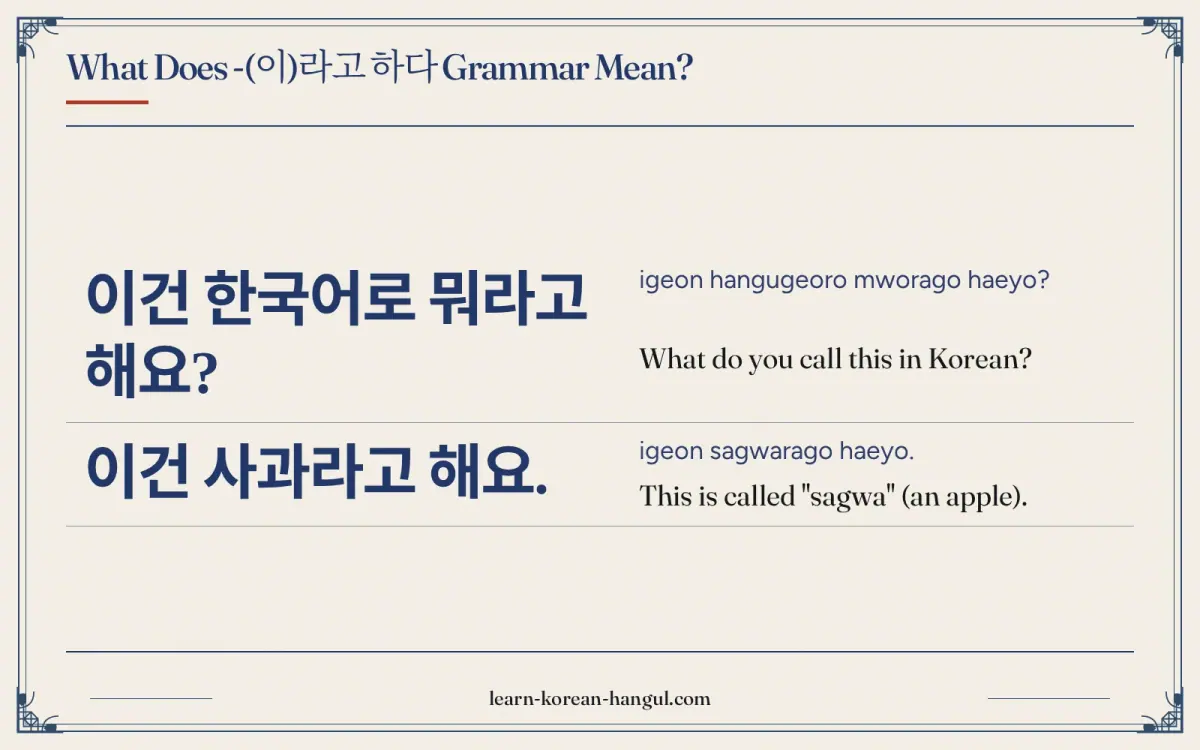
-(이)라고 하다 grammar means "(someone) calls it X" or "it is called X." The noun in front is the name or label, and 하다 ("say") is the verb that does the calling. The literal meaning is "they say that it is X." Korean uses this pattern wherever English says "is called," "is named" or "is known as."
The pattern has two jobs. It names things, and it reports a noun that someone said. The first job is the most useful for beginners.
이건 한국어로 뭐라고 해요?
igeon hangugeoro mworago haeyo?
What do you call this in Korean?
이건 사과라고 해요.
igeon sagwarago haeyo.
This is called "sagwa" (an apple).
In the question, 뭐라고 is 뭐 ("what") + 라고. In the answer, 사과 ("apple") + 라고. Both end in 해요, so the pair works like a small dialogue. The next section shows how to choose between 라고 and 이라고.
How Do You Form -(이)라고 하다?
-(이)라고 하다 is formed by adding 라고 to a noun that ends in a vowel, or 이라고 to a noun that ends in a consonant, and then adding 하다. The extra 이 is the copula 이다 ("to be"), which disappears after a vowel.
| Noun | Ends in | With -(이)라고 | Said as |
|---|---|---|---|
| 사과 (apple) | vowel | 사과라고 해요 | [사과라고 해요] |
| 김치 (kimchi) | vowel | 김치라고 해요 | [김치라고 해요] |
| 의사 (doctor) | vowel | 의사라고 해요 | [의사라고 해요] |
| 책 (book) | consonant | 책이라고 해요 | [채기라고 해요] |
| 물 (water) | consonant | 물이라고 해요 | [무리라고 해요] |
| 학생 (student) | consonant | 학생이라고 해요 | [학쌩이라고 해요] |
| 비빔밥 (bibimbap) | consonant | 비빔밥이라고 해요 | [비빔빠비라고 해요] |
The rule is the same as for 이에요/예요: the 이 is there only to carry a consonant to the next syllable. Revised Romanization shows the liaison: chaegirago, murirago and bibimbabirago. The next parts take the two noun types one at a time.
Nouns Ending in a Vowel
A noun that ends in a vowel takes 라고 with no change: 사과라고, 지수라고, 의사라고. This includes names such as 지수 and 민수.
저는 지수라고 해요.
jeoneun jisurago haeyo.
I am called Jisu.
Nouns Ending in a Consonant
A noun that ends in a consonant takes 이라고. The consonant moves to the next syllable when you speak, so 책이라고 sounds like [채기라고]. Place names work the same way: 서울이라고 is said [서우리라고], and 이태원이라고 is said [이태워니라고].
이 음식은 비빔밥이라고 해요.
i eumsigeun bibimbabirago haeyo.
This dish is called bibimbap.
이 동네는 이태원이라고 해요.
i dongneneun itaewonirago haeyo.
This neighbourhood is called Itaewon.
Question Words and 아니다
Question words work like nouns, so 뭐 becomes 뭐라고 and 누구 becomes 누구라고. The negative partner of 이다 is 아니다, and it joins 라고 as 아니라고: 학생이 아니라고 했어요 ("said he is not a student"). The pattern does not attach to verbs or adjectives; they use the -다고 pattern instead.
With the forms clear, you can build a full sentence.
Worked Example: Building a Sentence with -(이)라고 하다
-(이)라고 하다 grammar works the same way every time, so a five-step routine is enough. Follow it to build "This dish is called bibimbap."
- Choose the noun. The name is 비빔밥.
- Look at the last letter. 밥 ends in the consonant ㅂ.
- Choose the form. A consonant means 이라고: 비빔밥이라고.
- Add 하다. For an everyday statement, use 해요: 비빔밥이라고 해요.
- Add what you are naming. 이 음식은 비빔밥이라고 해요. (i eumsigeun bibimbabirago haeyo.)
Sentence
This dish is called bibimbap.
Show answer
이 음식은 비빔밥이라고 해요
You will know it worked if the noun and 라고 are written together, with no space, and 해요 is a separate word. The most common slip is choosing 이라고 for a vowel noun. The next question is which tenses and sentence types can follow.
Which Tenses and Sentence Types Work with -(이)라고 하다?
-(이)라고 하다 works with nouns, and the politeness and the tense belong to 하다, not to the noun. The naming part is the same in casual speech, polite speech and formal speech.
| Style | Form | Example |
|---|---|---|
| Polite | -(이)라고 해요 | 김치라고 해요. |
| Formal | -(이)라고 합니다 | 김치라고 합니다. |
| Casual | -(이)라고 해 | 김치라고 해. |
| Past (said) | -(이)라고 했어요 | 김치라고 했어요. |
| Question | 뭐라고 해요? | 이건 뭐라고 해요? |
In the past, 했어요 means someone said it, not that the thing was called that long ago: 친구가 학생이라고 했어요 ("My friend said he is a student"). For a noun that was or will be something, the statement pattern adds a tense to 이다, as in 학생이었다고 했어요 ("said he was a student"); see the past of 이다 for the 이다 forms. Questions use 뭐라고 해요?, and a question with a question word usually ends with a fall or rise-fall.
Remember three limits:
- A noun in front of -(이)라고 is a label or a statement, never a verb.
- 아니다 gives 아니라고: 학생이 아니라고 했어요.
- To ask for someone's name, 이름이 뭐예요? is the normal question; 뭐라고 해요? is used mostly for things and words.
친구가 학생이라고 했어요.
chinguga haksaengirago haesseoyo.
My friend said he is a student.
친구가 학생이 아니라고 했어요.
chinguga haksaengi anirago haesseoyo.
My friend said he is not a student.
The tense rule leads to the question that confuses learners most: how this pattern differs from its neighbours.
How Is -(이)라고 하다 Different from -(느)ㄴ다고 하다?
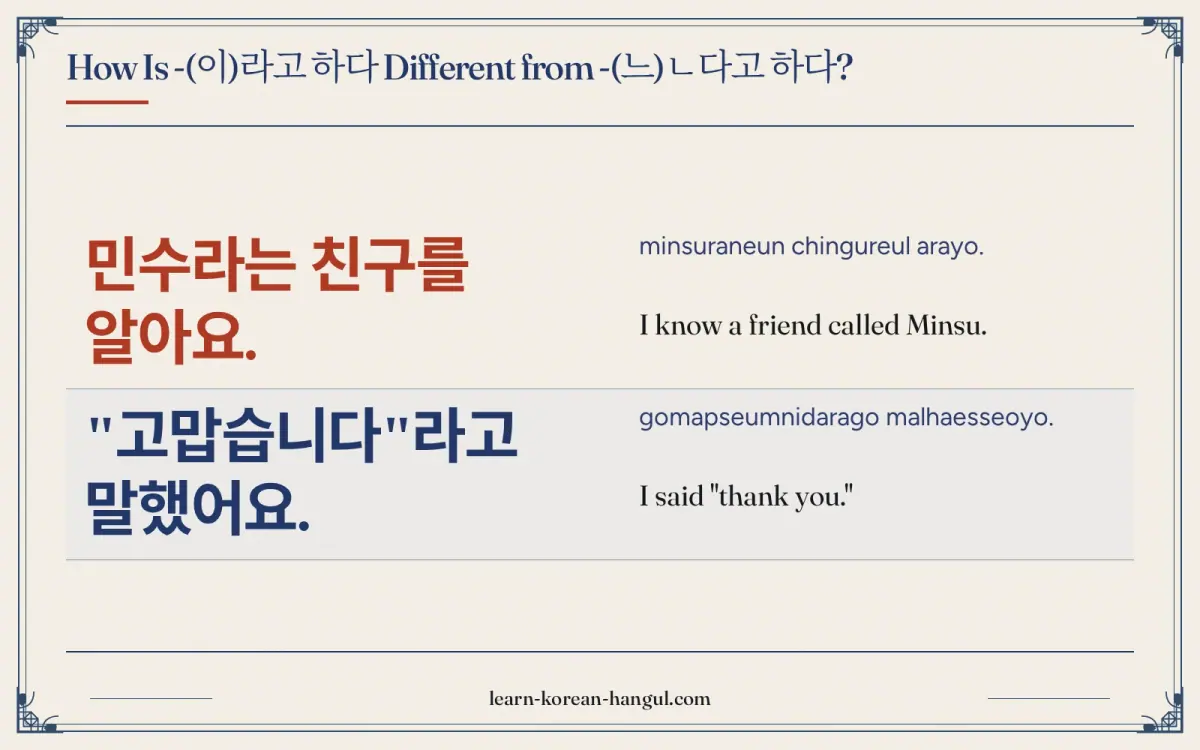
-(이)라고 하다 attaches to nouns, while -(느)ㄴ다고 하다 attaches to verbs and adjectives. Two more look-alikes complete the picture: -(이)라는, which describes a noun, and direct quotation, which repeats someone's exact words.
-(이)라고 하다
is called; said it is X
-(이)라는
a noun called X
직접 인용 + 라고
repeats the exact words
| Comparison | -(이)라고 하다 | -(이)라는 | 직접 인용 + 라고 |
|---|---|---|---|
| Attaches to | a noun | a noun, before another noun | a whole quoted sentence |
| Example | 이건 김치라고 해요. | 김치라는 음식 | "고맙습니다"라고 말했어요. |
| Meaning | it is called kimchi | a food called kimchi | said "thank you" |
Use -(이)라고 하다 for a noun label or a noun statement, -(이)라는 for "a ... called ...", and quotation marks plus 라고 for exact words.
Compare the three. In the first, the noun is the label. In the second, 김치라는 음식 means "a food called kimchi," and the pattern becomes a modifier. In the third, the speaker's exact words sit in quotation marks, and 라고 attaches straight to the quote with no 이. See 이다 as a modifier for the related noun-plus-이다 modifier.
민수라는 친구를 알아요.
minsuraneun chingureul arayo.
I know a friend called Minsu.
"고맙습니다"라고 말했어요.
gomapseumnidarago malhaesseoyo.
I said "thank you."
The lesson on verbs and adjectives is -(느)ㄴ다고 하다. These contrasts lead to a few variations.
Variations and Edge Cases of -(이)라고 하다
-(이)라고 하다 has five common variations. Each one helps you read and say real Korean.
- Calling someone something. With 부르다 ("call"), the pattern says what people call you: 친구들이 저를 지수라고 불러요 ("My friends call me Jisu").
- A polite request for a name. Add -아/어 주세요 to ask people to call you something: 저를 지수라고 불러 주세요 ("Please call me Jisu").
- A noun before another noun. The modifier -(이)라는 means "called": 민수라는 친구 ("a friend called Minsu").
- The definition form. -(이)란 gives a definition: 김치란 한국의 대표적인 음식이에요 ("Kimchi is a typical Korean food"). In speech, -(이)라는 is far more common.
- A short spoken form. In speech, 이라고 해요 often shrinks to 이래요 or 라고 해요 to 래요: 친구가 학생이래요. See -대요/-냬요/-재요/-래요.
친구들이 저를 지수라고 불러요.
chingudeuri jeoreul jisurago bulleoyo.
My friends call me Jisu.
Think of -(이)라고 as a name tag: the noun goes in front, and 하다 or 부르다 says who is wearing it. After this lesson, the same -고 frame carries verbs and adjectives in -(느)ㄴ다고 하다, and later -다고 들었어요 and -다고 생각하다.
What Mistakes Do Learners Make with -(이)라고 하다?
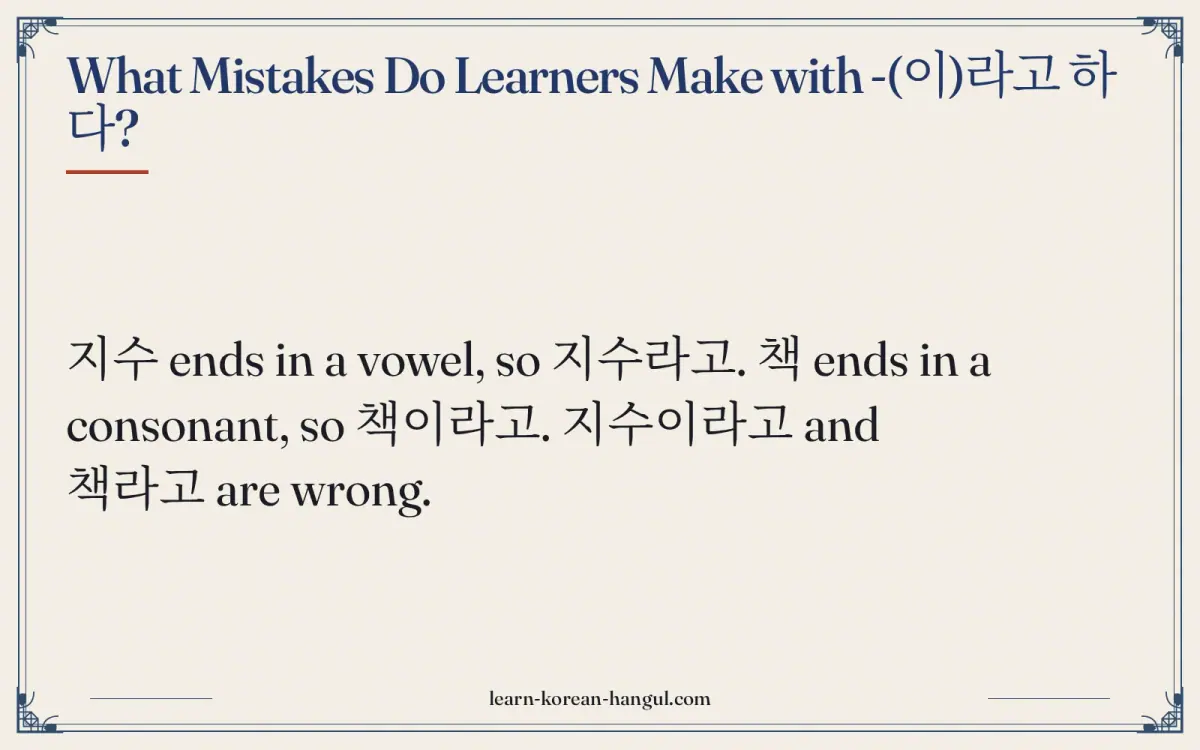
Learners usually choose the wrong form for the last letter, attach the pattern to a verb, or use the wrong particle with the language. Four mistakes appear again and again.
- Using 이라고 after a vowel. Wrong: 저는 지수이라고 해요. Right: 저는 지수라고 해요. A vowel noun takes 라고.
- Using 라고 after a consonant. Wrong: 이건 책라고 해요. Right: 이건 책이라고 해요. A consonant noun takes 이라고.
- Attaching 이라고 to a verb or adjective. Wrong: 날씨가 좋이라고 했어요. Right: 날씨가 좋다고 했어요. Verbs and adjectives use the -다고 pattern.
- Using 에 for "in a language". Wrong: 이건 한국어에 뭐라고 해요? Right: 이건 한국어로 뭐라고 해요? Use 로 ("in, by means of") for languages.
A quick check: Does the noun end in a vowel or a consonant? Did you choose 라고 or 이라고 to match? Is the word before 라고 a noun, not a verb? If all three answers are yes, the sentence is sound.
The practice set below tests these points.
Practice and Answers
Try the four items before you read the answer key. Cover the answers with your hand.
- Introduce yourself. Say "I am called Jisu" using -(이)라고 하다.
- Choose the form. Fill in the blank with 서울: 이 도시는 서울___ 해요.
- Fix the error. A learner says 이건 한국어에 뭐라고 해요? Correct it.
- Report the statement. Change 친구가 학생이에요 into "My friend said he is a student."
Practice · 5
Which sentence means "This is called kimchi"?
Show answer
이건 김치라고 해요.
Kimchi ends in a vowel, so it takes 라고: 김치라고 해요.
Which form fits: 이 음식은 비빔밥___ 해요?
Show answer
이라고
비빔밥 ends in the consonant ㅂ, so it takes 이라고. 이라는 is a modifier and would not end the sentence.
Which noun takes 이라고 rather than 라고?
Show answer
책
책 ends in the consonant ㄱ, so it takes 이라고: 책이라고. The other three end in vowels.
How do you ask "What is this called in Korean?"
Show answer
이건 한국어로 뭐라고 해요?
Languages take 로 ("in, by means of"): 한국어로 뭐라고 해요?
Which sentence means "My friend said he is not a student"?
Show answer
친구가 학생이 아니라고 했어요.
아니다 joins 라고 as 아니라고. 아니다고 and 아니고 are not used to report this.
Answer key
- 저는 지수라고 해요. (jeoneun jisurago haeyo.) 지수 ends in a vowel, so use 라고.
- 이. 서울 ends in the consonant ㄹ, so the sentence is 이 도시는 서울이라고 해요, said [서우리라고 해요].
- 이건 한국어로 뭐라고 해요? Use 로 for a language.
- 친구가 학생이라고 했어요. (chinguga haksaengirago haesseoyo.) 학생 ends in a consonant, so it takes 이라고. Said [친구가 학쌩이라고 해써요].
If you can complete items 1 to 3 without the key, you can name most things. The final section points to the next lessons.
What Should You Learn Next after -(이)라고 하다 Grammar?
After -(이)라고 하다 grammar, learn how Korean reports verbs and adjectives, then the spoken short forms. This lesson teaches names and noun statements and does not cover the other three quote endings.
- Learn the short forms in -대요/-냬요/-재요/-래요, where 이라고 해요 becomes 이래요.
- Learn -다고 들었어요 to say "I heard that ..." and -다고 생각하다 to say "I think that ...".
- Review the request pattern -아/어 달라고 하다.
- Return to the Beginner Grammar list for more A1 and A2 patterns.
- Learn -(느)ㄴ다고 하다 for verbs and adjectives, and read the overview of direct and indirect quotation.
With these steps, the choice becomes automatic: use 라고 after a vowel, 이라고 after a consonant, and 로 for languages. For exam content and levels, check the current guide on topik.go.kr; the level shown here is an editorial estimate.
Frequently Asked Questions
What does -(이)라고 하다 mean?
-(이)라고 하다 means "is called" or "is named," and it also means "(someone) said it is X." 이건 사과라고 해요 means "This is called an apple." 친구가 학생이라고 했어요 means "My friend said he is a student." The noun before it is the name or label.
How do I attach -(이)라고 하다 to a noun?
Look at the last letter of the noun. After a vowel, add 라고: 사과라고, 지수라고. After a consonant, add 이라고: 책이라고, 비빔밥이라고. Then add 하다 in the right style, such as 해요 or 했어요. Verbs and adjectives do not use this form; they take -다고.
Can -(이)라고 하다 be used in the past tense?
The tense belongs to 하다: 학생이라고 했어요 means "said he is a student." To report that someone was something, put the tense on 이다: 학생이었다고 했어요 means "said he was a student." The label itself, such as 사과라고, never changes.
Is -(이)라고 하다 used in speech or only in writing?
It is used constantly in speech. Learners hear 한국어로 뭐라고 해요? in every classroom and shop. In speech it often shrinks to 이래요 or 래요, and in writing it is common in definitions: 김치란 한국의 음식이에요.
What is the most common mistake with -(이)라고 하다?
The most common mistake is choosing the wrong form for the last letter: 지수이라고 and 책라고 are both wrong. Use 지수라고 and 책이라고. A second mistake is writing 한국어에 for "in Korean"; use 한국어로.
What is the difference between -(이)라고 하다 and -(이)라는?
-(이)라고 하다 ends the clause with a verb: 그 사람은 민수라고 해요, "He is called Minsu." -(이)라는 comes before another noun and describes it: 민수라는 사람, "a person called Minsu." Both come from the same frame.