What you'll learn
- Form -아/어 달라고 하다 from any action verb, including irregular verbs.
- Turn a direct request such as 열어 주세요 into a reported one.
- Choose between 달라고 and 주라고 by asking who benefits.
- Use 달래요 and 부탁하다 in speech and writing.
- Avoid the four mistakes that appear most often.
Before you start: you should know -아/어 주세요 (the polite request "please do it for me") and the plain forms taught in the Reported Speech section. Audio plays only when you press a button.
What Does -아/어 달라고 하다 Grammar Mean?
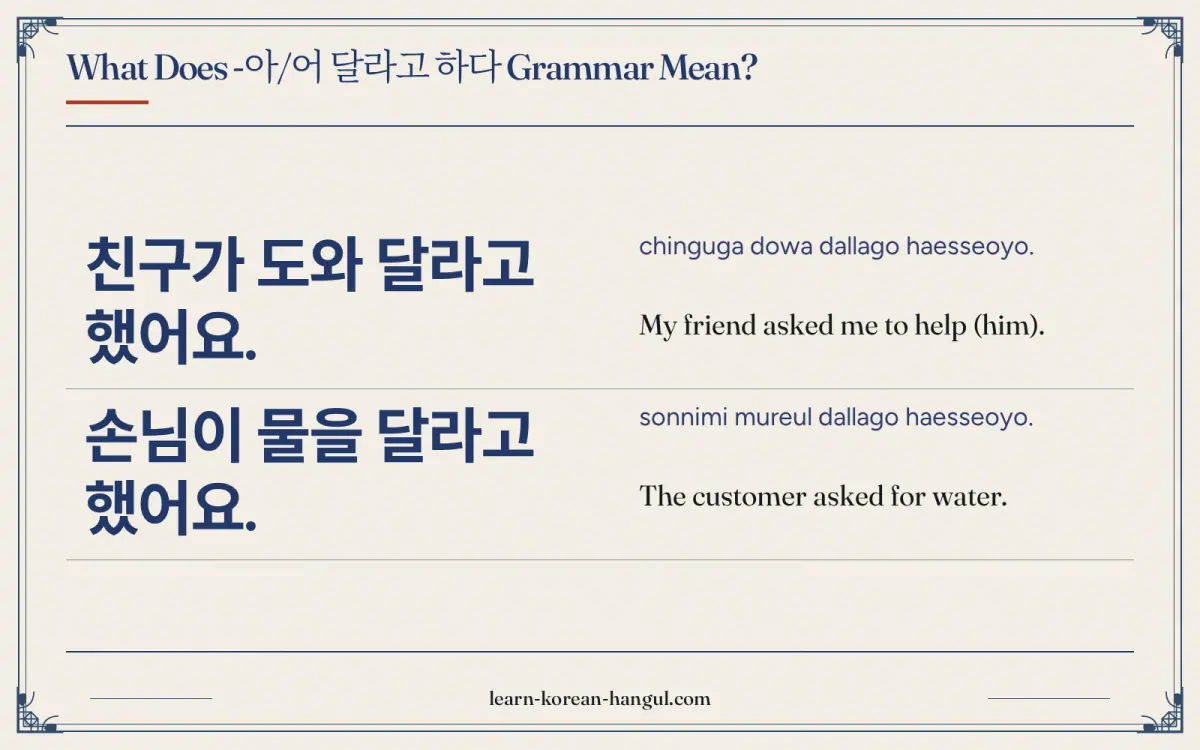
-아/어 달라고 하다 grammar means "(someone) asks (me or another person) to do something for them." It reports the polite request -아/어 주세요 ("please do it for me"). In the report, 주세요 becomes 달라고, because the favour is for the person who asked. The sentence ends with a form of 하다 ("say"), most often 했어요 ("said, asked").
Two examples show the idea. The first reports a request for help, and the second reports a request for an object.
친구가 도와 달라고 했어요.
chinguga dowa dallago haesseoyo.
My friend asked me to help (him).
손님이 물을 달라고 했어요.
sonnimi mureul dallago haesseoyo.
The customer asked for water.
In the first sentence, 달라고 follows a verb (도와). In the second, it follows a noun with the object particle 을/를 (물을), and the meaning is "asked me to give water." This is the plainest use of 달다: a request for something to be given to the speaker. The next section shows how to build the form.
How Do You Form -아/어 달라고 하다?
-아/어 달라고 하다 is formed by taking the verb in its -아/어 form, the same form you use before 요 in polite speech, and adding 달라고 하다. The easiest route is to start from the direct request.
| What the person said | Reported with -아/어 달라고 하다 | Meaning |
|---|---|---|
| 열어 주세요. | 열어 달라고 했어요. | asked (me) to open it |
| 도와주세요. | 도와 달라고 했어요. | asked (me) to help |
| 찍어 주세요. | 찍어 달라고 했어요. | asked (me) to take it (a photo) |
| 설명해 주세요. | 설명해 달라고 했어요. | asked (me) to explain |
| 써 주세요. | 써 달라고 했어요. | asked (me) to write it |
In every row, the part before 주세요 stays the same and 주세요 becomes 달라고. The verb in front of 달라고 is written with a space, as in 열어 달라고, because 달라고 works like a helper verb. The next parts take the stem types one at a time.
Stems Ending in a Vowel
A stem that ends in a vowel takes -아 or -어 following the usual rule, and many stems contract. Use ㅏ and ㅗ stems with -아, other stems with -어, and 하다 verbs with 해.
- 사다 ("buy") becomes 사 달라고: the ㅏ and 아 merge into one 사.
- 보다 ("look") becomes 봐 달라고: 보 + 아 contracts to 봐.
- 오다 ("come") becomes 와 달라고.
- 쓰다 ("write") becomes 써 달라고: 쓰 + 어 contracts to 써.
- 기다리다 ("wait") becomes 기다려 달라고.
- 설명하다 ("explain") becomes 설명해 달라고.
동생이 우유를 사 달라고 했어요.
dongsaengi uyureul sa dallago haesseoyo.
My younger sibling asked me to buy milk.
친구가 숙제를 봐 달라고 했어요.
chinguga sukjereul bwa dallago haesseoyo.
My friend asked me to look over (his) homework.
Stems Ending in a Consonant
A consonant stem takes -아 after ㅏ or ㅗ and -어 after any other vowel. The final consonant moves to the next syllable when spoken.
- 닫다 ("close") becomes 닫아 달라고, said [다다 달라고].
- 읽다 ("read") becomes 읽어 달라고, said [일거 달라고].
- 찍다 ("take, shoot") becomes 찍어 달라고, said [찌거 달라고].
- 열다 ("open") becomes 열어 달라고, said [여러 달라고].
엄마가 문을 열어 달라고 했어요.
eommaga muneul yeoreo dallago haesseoyo.
Mom asked me to open the door.
동생이 사진을 찍어 달라고 했어요.
dongsaengi sajineul jjigeo dallago haesseoyo.
My younger sibling asked me to take a photo.
Irregular Stems and Nouns
Irregular verbs change the same way they do before -아/어요. The reported form is the polite present without 요.
- ㅂ-irregular: 돕다 ("help") becomes 도와 달라고, because ㅂ turns into 우 and merges with 아.
- ㄷ-irregular: 듣다 ("listen") becomes 들어 달라고, because ㄷ turns into ㄹ before a vowel.
- 르-irregular: 부르다 ("call, sing") becomes 불러 달라고.
- ㄹ-stems: 만들다 ("make") becomes 만들어 달라고, with no change.
The pattern does not use the copula 이다, so a noun never goes directly before 달라고 as "be". A noun can come before 달라고 only as the thing requested, with 을/를: 물을 달라고, 계산서를 달라고 ("asked for the bill"). For this use, the person is asking to be given the noun.
손님이 계산서를 달라고 했어요.
sonnimi gyesanseoreul dallago haesseoyo.
The customer asked for the bill.
With the forms clear, you can build a full sentence.
Worked Example: Building a Sentence with -아/어 달라고 하다
-아/어 달라고 하다 grammar works the same way every time, so a five-step routine is enough. Follow it to build "My coworker asked me to send the file."
- Write the direct request. The coworker said: 파일을 보내 주세요. ("Please send the file.")
- Find the main verb. The verb before 주세요 is 보내- ("send"), in its -아/어 form 보내.
- Swap 주세요 for 달라고. 보내 주세요 becomes 보내 달라고.
- Add the reporting verb. Choose 했어요 for a past report: 보내 달라고 했어요.
- Add who asked. 동료가 파일을 보내 달라고 했어요. (dongnyoga paireul bonae dallago haesseoyo.)
동료가 파일을 보내 달라고 했어요.
dongnyoga paireul bonae dallago haesseoyo.
My coworker asked me to send the file.
Sentence
My coworker asked me to send the file.
Show answer
동료가 파일을 보내 달라고 했어요
You will know it worked if 달라고 stands where 주세요 stood and a form of 하다 closes the sentence. The most common slip is keeping 주세요 and adding 고, which gives a form that Korean does not use. The next question is which tenses and sentence types can be used.
Which Tenses and Sentence Types Work with -아/어 달라고 하다?
-아/어 달라고 하다 works with action verbs only, and the tense belongs to the reporting verb 하다, not to the request inside. A request is always about something that has not happened yet, so the part before 달라고 never takes a past or future ending.
| Question | Answer |
|---|---|
| Can the reporting verb be past? | Yes: 달라고 했어요 (asked). See Korean past tense for 했어요. |
| Can it be present? | Yes: 달라고 해요 ("asks, keeps asking") for a habit or a message just received. |
| Can it be future? | Yes: 달라고 할 거예요, said [달라고 할꺼예요] ("will ask"). |
| Can the request carry a tense? | No: 도와줬 달라고 and 도와줄 달라고 do not exist. |
| Do action verbs work? | Yes: 열어 달라고, 설명해 달라고. |
| Do adjectives work? | No: nobody can request a state, so 예뻐 달라고 does not exist. |
| What about statements or questions? | No: the pattern reports requests only. |
| Is respect shown? | Put -(으)시- on 하다 when the asker is respected: 선생님이 도와 달라고 하셨어요. See -(으)시- honorific. |
When the asker is the person you respect, the verb 하시다 shows it: 선생님이 설명해 달라고 하셨어요 ("The teacher asked me to explain"). If you are the one asking a respected person, the verb 말씀드리다 ("tell, humble") is common: 선생님께 도와 달라고 말씀드렸어요 ("I asked the teacher to help me"). These forms keep the same 달라고 pattern.
선생님께 도와 달라고 말씀드렸어요.
seonsaengnimkke dowa dallago malsseumdeuryeosseoyo.
I asked the teacher to help me.
The tense rule leads to the question that confuses learners most: how 달라고 differs from its neighbours.
How Is -아/어 달라고 하다 Different from -(으)라고 하다?
-아/어 달라고 하다 reports a request made for the speaker's own benefit, while -(으)라고 하다 reports a plain command, and -아/어 주라고 하다 reports a request for someone else's benefit. Ask yourself one question: who gets the benefit?
-아/어 달라고 하다
asks for something for themselves
-아/어 주라고 하다
asks for something for another person
-(으)라고 하다
gives a command
| Comparison | -아/어 달라고 하다 | -아/어 주라고 하다 | -(으)라고 하다 |
|---|---|---|---|
| Direct form | 도와주세요 (help me) | 친구를 도와주세요 (help my friend) | 일찍 자세요 (go to bed early) |
| Who benefits | the person who asked | a third person | no one named |
| Example | 친구가 도와 달라고 했어요. | 선생님이 친구를 도와주라고 했어요. | 엄마가 일찍 자라고 했어요. |
Use -아/어 달라고 하다 when the asker benefits, -아/어 주라고 하다 when someone else benefits, and -(으)라고 하다 for a plain command.
Compare the three directly. In the first, the friend asks for help. In the second, the teacher tells me to help someone else. In the third, Mom gives an order that has no object of favour.
선생님이 친구를 도와주라고 했어요.
seonsaengnimi chingureul dowajurago haesseoyo.
The teacher told me to help my friend.
엄마가 일찍 자라고 했어요.
eommaga iljjik jarago haesseoyo.
Mom told me to go to bed early.
The full lesson on commands is -(으)라고 하다. These contrasts lead to a few variations.
Variations and Edge Cases of -아/어 달라고 하다
-아/어 달라고 하다 has five common variations. Each one helps you read and say real Korean.
- The short spoken form. In speech, 달라고 해요 shrinks to 달래요: 친구가 도와 달래요 ("My friend asks me to help"). The full family of short forms is in -대요/-냬요/-재요/-래요.
- Other reporting verbs. 부탁하다 ("ask a favour") is very common and softer: 도와 달라고 부탁했어요. In formal writing you also find 요청하다 ("request") and 요구하다 ("demand"): 환불해 달라고 요구했어요 ("demanded a refund").
- Negative requests. A request not to do something takes 말아 달라고: 시끄럽게 하지 말아 달라고 했어요 ("asked me not to make noise"). The negative command has its own page: -지 말라고 하다.
- With 좀 or 꼭. The words 좀 ("a little") and 꼭 ("without fail") sit before the verb: 좀 도와 달라고 했어요, 꼭 전화해 달라고 했어요.
- A defective verb. 달다 in this meaning has only a few forms: 달라, 달라고 and the old-fashioned 다오 (물 좀 다오, "Give me some water"). It cannot take 요 or 았/었: 달아요 means "it is sweet".
이웃이 밤에 시끄럽게 하지 말아 달라고 했어요.
iusi bame sikkeureopge haji mara dallago haesseoyo.
A neighbour asked us not to make noise at night.
친구가 전화해 달라고 했어요.
chinguga jeonhwahae dallago haesseoyo.
My friend asked me to call (him).
Think of 달라고 as a mirror: the direct request says "do it for me", and the report keeps that meaning with the same 달라고. The edge cases above all keep the benefit on the person who asked.
What Mistakes Do Learners Make with -아/어 달라고 하다?
Learners usually keep the polite ending, swap 달라고 and 주라고, use an adjective, or treat 달다 like a normal verb. Four mistakes appear again and again.
- Keeping the polite request ending. Wrong: 도와주세요고 했어요. Right: 도와 달라고 했어요. The ending 주세요 cannot take -고; it must change to 달라고.
- Swapping 달라고 and 주라고. 친구가 도와주라고 했어요 is a correct sentence, but it means "My friend told me to help someone else." For a request for himself, say 친구가 도와 달라고 했어요.
- Using an adjective. Wrong: 예뻐 달라고 했어요. Right: 예쁘게 해 달라고 했어요 ("asked me to make it pretty"), which turns the adjective into an adverb and uses the verb 하다.
- Treating 달다 as a normal verb. Wrong: 물을 달아요 for "give me water". Right: 물 좀 주세요 in a direct request, and 물을 달라고 했어요 in a report.
A quick check: Is the asker the one who benefits? Is the word before 달라고 an action verb in its -아/어 form? Does 하다 end the sentence? If all three answers are yes, the sentence is sound.
The practice set below tests these points.
Practice and Answers
Try the four items before you read the answer key. Cover the answers with your hand.
- Report the request. Change 창문을 닫아 주세요 into "The guest asked me to close the window."
- Choose the form. Fill in the blank with 쓰다: 선생님이 이름을 ___ 달라고 했어요.
- Fix the error. A learner says 친구가 책을 읽어 주세요고 했어요. Correct it.
- Choose the meaning. Which sentence tells me to help a third person: 도와 달라고 했어요 or 도와주라고 했어요?
Practice · 5
Which sentence means "The customer asked for water"?
Show answer
손님이 물을 달라고 했어요.
달라고 reports a request to be given something. 달아요 means "it is sweet", and -고 cannot follow 주세요.
Which form fits: 엄마가 창문을 ___ 달라고 했어요 (열다)?
Show answer
열어
열다 is an ㄹ-stem, and its -아/어 form is 열어. Then 달라고 follows with a space.
Which form fits: 친구가 저한테 ___ 달라고 했어요 (돕다, "help")?
Show answer
도와
ㅂ-irregular verbs change ㅂ to 우, and 우 + 아 contracts to 와: 도와.
Which word cannot go before 달라고?
Show answer
예쁘
예쁘다 is an adjective. A request needs an action verb, so 예쁘 cannot take 달라고.
Which sentence means "The teacher told me to help my friend"?
Show answer
선생님이 친구를 도와주라고 했어요.
주라고 reports a request for a third person. 달라고 would mean the teacher asked for help for the teacher, and -세요고 is not used.
Answer key
- 손님이 창문을 닫아 달라고 했어요. (sonnimi changmuneul dada dallago haesseoyo.) Take 닫아 from 닫아 주세요 and swap 주세요 for 달라고. Said [손니미 창무늘 다다 달라고 해써요].
- 써. 쓰다 + 어 contracts to 써, so the sentence is 선생님이 이름을 써 달라고 했어요.
- 친구가 책을 읽어 달라고 했어요. 주세요 cannot take 고; it must become 달라고. Said [친구가 채글 일거 달라고 해써요].
- 도와주라고 했어요. 주라고 reports a favour for someone else, while 달라고 reports a favour for the asker.
If you can complete items 1 to 3 without the key, you can report most requests. The final section points to the next lessons.
What Should You Learn Next after -아/어 달라고 하다 Grammar?
After -아/어 달라고 하다 grammar, learn how to report a prohibition, then the spoken short forms. This lesson teaches the reported request and does not cover every way to ask a favour.
- Learn -지 말라고 하다, which reports "do not do it".
- Learn the short forms in -대요/-냬요/-재요/-래요, where 달라고 해요 becomes 달래요.
- Review the direct request in -아/어 주세요.
- Return to the Advanced Grammar list for other patterns at this level.
- Learn -(으)라고 하다, which reports commands.
With these steps, the choice becomes automatic: use 달라고 when the asker benefits, and 주라고 when another person does. For exam content and levels, check the current guide on topik.go.kr; the level shown here is an editorial estimate.
Frequently Asked Questions
What does -아/어 달라고 하다 mean?
-아/어 달라고 하다 means "(someone) asks (me) to do something for them." It reports the request -아/어 주세요. 친구가 도와 달라고 했어요 means "My friend asked me to help (him)." The word 달라고 comes from 달다, a verb that means "give to me" and appears almost only in the forms 달라 and 다오.
How do I attach -아/어 달라고 하다 to a verb?
Take the verb in its -아/어 form, the polite present without 요, and add a space and 달라고 하다: 열어 달라고, 봐 달라고, 도와 달라고, 설명해 달라고. Irregular verbs change as they do before -아/어요: 돕다 gives 도와, 듣다 gives 들어, 쓰다 gives 써.
Can -아/어 달라고 하다 be used in the past tense?
Yes, but the tense goes on 하다, not on the request: 달라고 했어요 means "asked." The request itself takes no tense, so forms such as 도와줬 달라고 do not exist. For the future, say 달라고 할 거예요, said [달라고 할꺼예요].
Is -아/어 달라고 하다 used in speech or only in writing?
It is used in both. In speech the short form 달래요 is common: 친구가 도와 달래요. In formal writing and news reports you often see 달라고 요구했다 or 달라고 요청했다. 부탁하다 ("ask a favour") is a softer reporting verb for both.
What is the most common mistake with -아/어 달라고 하다?
The most common mistake is mixing up 달라고 and 주라고. 달라고 means the asker benefits; 주라고 means someone else does. A second mistake is keeping the polite ending and writing 도와주세요고 했어요, which is wrong. Use 도와 달라고 했어요.
What is the difference between -아/어 달라고 하다 and -(으)라고 하다?
-(으)라고 하다 reports a plain command: 엄마가 일찍 자라고 했어요 means "Mom told me to go to bed early." -아/어 달라고 하다 reports a request for the asker's own benefit: 친구가 도와 달라고 했어요 means "My friend asked me to help (him)."