What you'll learn
- Report a command with any action verb.
- Choose between -라고 and -으라고.
- Make the negative with -지 말라고 하다.
- Use 달라고 and 주라고 correctly.
- Tell it apart from -자고 하다, -(느)ㄴ다고 하다 and -냐고 하다.
Before you start: you should know how to find a verb stem (drop 다 from the dictionary form) and the polite command -(으)세요. If stems are new to you, read about verb stems first. For the command itself, see -(으)세요. Audio plays only when you press a button.
What Does -(으)라고 하다 Grammar Mean?
-(으)라고 하다 grammar means "(someone) tells you to do this." It is built from two parts. The first is the plain-style command ending -(으)라 (as in 자라 "go to sleep!"), plus the quoting particle 고, which marks the words as a report. The second is the verb 하다, which here means "to say." Put together, 자라고 하다 means "to say 'sleep'," or "to tell (someone) to sleep."
Here are the first two examples. The pattern is the same in both, and only the stem changes.
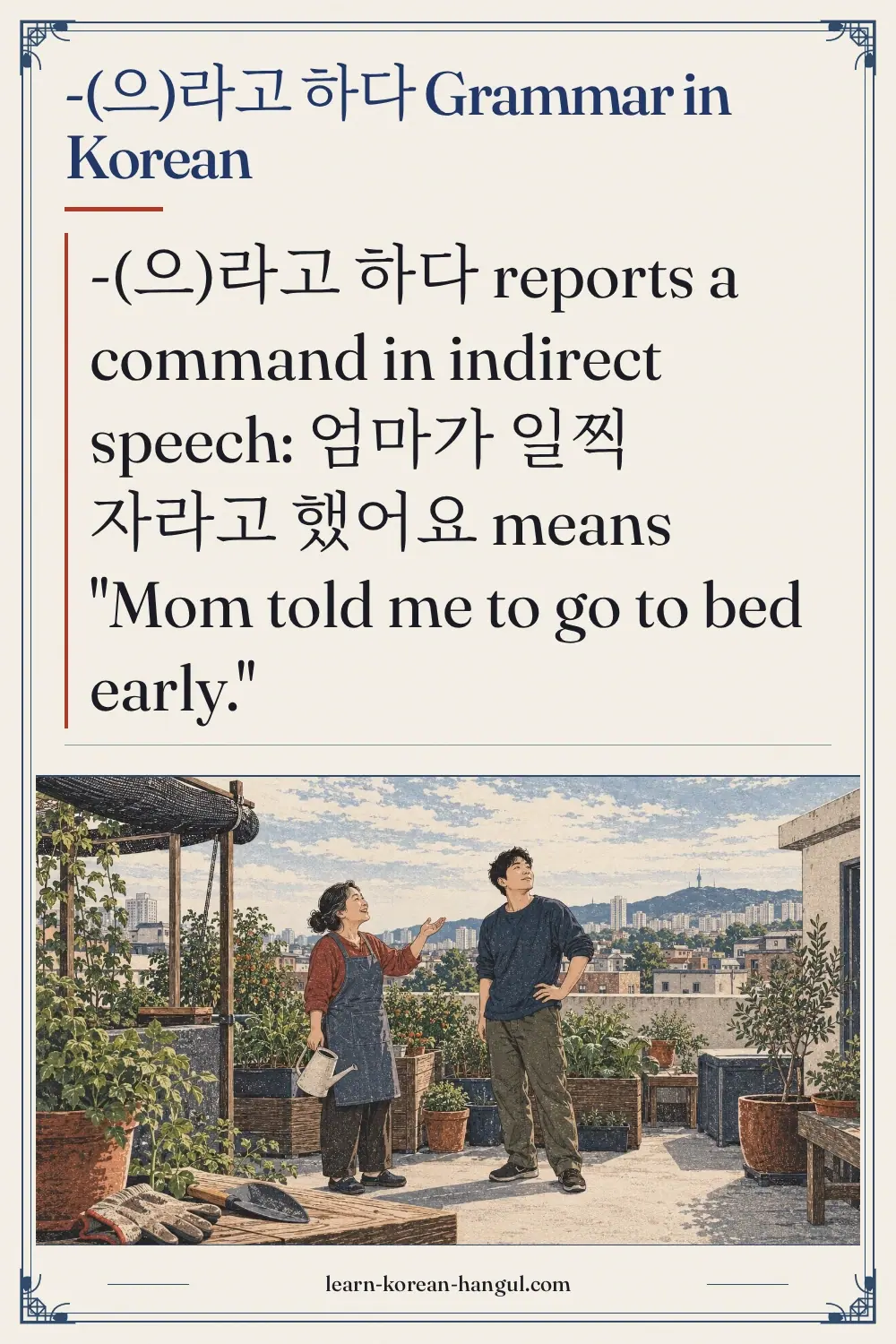
- 엄마가 일찍 자라고 했어요. (eommaga iljjik jarago haesseoyo.) [엄마가 일찍 자라고 해써요] = "Mom told me to go to bed early."
- 선생님이 앉으라고 하셨어요. (seonsaengnimi anjeurago hasyeosseoyo.) [선생니미 안즈라고 하셔써요] = "The teacher told us to sit down."
In both sentences, one person gives the order and another person must carry it out. That is the difference between a command and a suggestion, where both people act. The original words might have been 일찍 자요 or 앉으세요, but the report turns them into the same shape. The next section shows how to build the pattern.
How Do You Form -(으)라고 하다?
-(으)라고 하다 is formed by putting the original command in the plain command form, adding 고, and then adding 하다. The plain command form is the stem plus -(으)라: 자라, 앉으라. After a vowel or ㄹ add 라, and after any other consonant add 으라, so the sounds join smoothly.
| Type | Rule | Example | Reported form |
|---|---|---|---|
| Verb, vowel stem | stem + 라고 | 자다 → 자라고 | 자라고 하다 |
| Verb, ㄹ-stem | stem + 라고 | 놀다 → 놀라고 | 놀라고 하다 |
| Verb, consonant stem | stem + 으라고 | 앉다 → 앉으라고 | 앉으라고 하다 |
| Verb, ㄷ-irregular | ㄷ → ㄹ, add 으라고 | 듣다 → 들으라고 | 들으라고 하다 |
| Verb, ㅂ-irregular | ㅂ → 우, add 라고 | 눕다 → 누우라고 | 누우라고 하다 |
| 하다 verb | stem + 라고 | 공부하다 → 공부하라고 | 공부하라고 하다 |
| Negative | stem + 지 말라고 | 가다 → 가지 말라고 | 가지 말라고 하다 |
The table shows one rule applied to seven types. The next three parts look at the groups one at a time.
Verbs Ending in a Vowel
A verb stem that ends in a vowel takes -라고 directly: 자다 becomes 자라고, 쉬다 becomes 쉬라고, and 공부하다 becomes 공부하라고. Examples:
- 의사가 푹 쉬라고 했어요. (uisaga puk swirago haesseoyo.) [의사가 푹 쉬라고 해써요] = "The doctor told me to rest well."
- 아빠가 열심히 공부하라고 했어요. (appaga yeolsimhi gongbuharago haesseoyo.) [아빠가 열씸히 공부하라고 해써요] = "Dad told me to study hard."
Notice that the report does not copy the politeness of the original. A doctor might have said 푹 쉬세요, a teacher might have said 쉬십시오, and a friend might have said 쉬어. All are reported as 쉬라고. Vowel stems are the simplest case. A stem with a final consonant needs a different linking sound.
Verbs Ending in a Consonant
A verb stem that ends in a consonant takes -으라고: 앉다 becomes 앉으라고, 먹다 becomes 먹으라고, and 읽다 becomes 읽으라고. The 으 helps the consonant link to ㄹ, and the final consonant moves to the next syllable: 앉으라고 is spoken [안즈라고], 먹으라고 is spoken [머그라고], and 읽으라고 is spoken [일그라고]. This follows the standard pronunciation rules (표준 발음법) of the 국립국어원 (National Institute of Korean Language) for linking a final consonant to a following vowel.
- 엄마가 밥을 먹으라고 했어요. (eommaga babeul meogeurago haesseoyo.) [엄마가 바블 머그라고 해써요] = "Mom told me to eat."
- 선생님이 책을 읽으라고 하셨어요. (seonsaengnimi chaegeul ilgeurago hasyeosseoyo.) [선생니미 채글 일그라고 하셔써요] = "The teacher told us to read the book."
The verb 있다 follows the same rule when it means "to stay": 여기 있으라고 했어요 (yeogi isseurago haesseoyo) [여기 이쓰라고 해써요] means "He told me to stay here."
Two more groups need a short note, because learners expect trouble with them.
Do ㄹ-Stems, Irregular Stems and Other Types Change?
Yes, in a few places. The ending begins with ㄹ, so a stem that already ends in ㄹ keeps it, and irregular stems change before the vowel 으.
ㄹ-stems take -라고 and keep the ㄹ: 놀다 gives 놀라고, and 만들다 gives 만들라고. The two ㄹ sounds are read as a double [ㄹㄹ]: 놀라고 is spoken [놀라고] with a long, doubled ㄹ.
ㄷ-irregular verbs change ㄷ to ㄹ before 으: 듣다 gives 들으라고.
ㅂ-irregular verbs change ㅂ to 우: 눕다 gives 누우라고.
Adjectives and 이다 do not take -(으)라고. A command needs an action that a person can choose to do, so there is no reported command 예쁘라고. (학생이라고 does exist, but it is a different pattern: -(이)라고 하다, which reports a noun, as in "He said he is a student.")
엄마가 나가서 놀라고 했어요. (eommaga nagaseo nollago haesseoyo.) [엄마가 나가서 놀라고 해써요] = "Mom told me to go out and play."
선생님이 카드를 만들라고 하셨어요. (seonsaengnimi kadeureul mandeullago hasyeosseoyo.) [선생니미 카드를 만들라고 하셔써요] = "The teacher told us to make a card."
선생님이 잘 들으라고 하셨어요. (seonsaengnimi jal deureurago hasyeosseoyo.) [선생니미 잘 드르라고 하셔써요] = "The teacher told us to listen carefully."
With the formation clear, one sentence can be built step by step.
Worked Example: Building a Sentence with -(으)라고 하다
-(으)라고 하다 grammar works by moving someone's command into your sentence. Follow the steps with the idea "Mom told me to go to bed early." Suppose Mom said to you: "일찍 자" (Go to bed early).
- Find the original command. Mom said 일찍 자요 (or 일찍 자라). The verb is 자다.
- Put the verb in the command form. Drop 다 and add -라: 자 + 라 = 자라. The stem ends in a vowel, so use -라.
- Shift the pronouns. Mom's "you" becomes your "me." If you say the pronoun, it is 저한테 ("to me"), and the subject of the sleeping stays unspoken.
- Add 고 and 하다. 자라 + 고 + 했어요 = 자라고 했어요.
- Rebuild the sentence. Put the speaker first: 엄마가 저한테 일찍 자라고 했어요. (eommaga jeohante iljjik jarago haesseoyo.) [엄마가 저한테 일찍 자라고 해써요] = "Mom told me to go to bed early."
Sentence
Mom told me to go to bed early.
Show answer
엄마가 저한테 일찍 자라고 했어요
You will know it worked when the verb ends in -(으)라고 and 했어요 comes last. The most common slip at this step is to write 자자고 했어요, which means "Mom suggested that we sleep." The report of a command uses 라, not 자. The sentence is now a report, but the pattern has limits on tense and sentence type.
Which Tenses and Sentence Types Work with -(으)라고 하다?
-(으)라고 하다 works in the present and the past of the saying. The command itself has no tense, because a command always looks forward. The time of the saying goes on 하다. The table shows the forms for 가다.
| What was said | Reported form | Meaning |
|---|---|---|
| Past saying | 가라고 했어요 | told me to go |
| Present saying | 가라고 해요 | tells me to go |
| Honorific speaker | 가라고 하셨어요 | (a respected person) told me to go |
| Negative | 가지 말라고 했어요 | told me not to go |
| Honorific listener | 가시라고 했어요 | told (a respected person) to go |
| Short form | 가래요 | (he) says to go |
Do not put -았/었- before -(으)라고. 갔으라고 is wrong. For a negative command, use 말다: 가지 말라고 했어요 (gaji mallago haesseoyo) [가지 말라고 해써요]. The form 안 가라고 is wrong. The original negative command was 가지 마세요, which is explained on the page for -지 마세요 don't.
- 선생님이 떠들지 말라고 하셨어요. (seonsaengnimi tteodeulji mallago hasyeosseoyo.) [선생니미 떠들지 말라고 하셔써요] = "The teacher told us not to make noise."
The reported form of the original polite command 가세요 is 가라고. The pattern is not used for statements, questions or suggestions. Those are reported with other endings, as the comparison shows. The most useful contrast for a learner is the verb that reports a request.
How Is -(으)라고 하다 Different from -아/어 달라고 하다?
-(으)라고 하다 reports a command, while -아/어 달라고 하다 reports a request for the speaker's own benefit. In Korean, "give me" is expressed with the special verb 달다 (used mostly in the forms 달라 and 다오), not 주다, when the receiver is the speaker or the person being quoted. Learners often mix up 달라고 and 주라고.
| Point | -(으)라고 하다 | -아/어 달라고 하다 |
|---|---|---|
| Meaning | (someone) tells you to... | (someone) asks (me) to do it for them |
| Original words | 문을 열어라 | 문을 열어 주세요 |
| Reported form | 문을 열라고 했어요 | 문을 열어 달라고 했어요 |
| Meaning of example | Mom told me to open the door. | Mom asked me to open the door (for her). |
The same split appears with the verb "give." 친구가 책을 달라고 했어요 (chinguga chaegeul dallago haesseoyo) [친구가 채글 달라고 해써요] means "My friend asked me to give him the book." 엄마가 동생한테 책을 주라고 했어요 (eommaga dongsaenghante chaegeul jurago haesseoyo) [엄마가 동생한테 채글 주라고 해써요] means "Mom told me to give the book to my younger sibling."
In the first sentence, the friend is the receiver, so Korean uses 달라고. In the second, the receiver is a third person, so Korean uses the regular 주라고. The full rules for requests are in the lesson on -아/어 달라고 하다, and negative commands have their own lesson on -지 말라고 하다. This page gives only what you need to avoid the mistake.
Two other neighbours are worth knowing.
- -자고 하다 reports a suggestion in which the speaker joins in. 엄마가 가자고 했어요 means "Mom suggested we go." See -자고 하다.
- -(느)ㄴ다고 하다 reports a statement, and -냐고 하다 reports a question. See -(느)ㄴ다고 하다 and -냐고 하다.
These contrasts lead to the smaller variations of the pattern itself.
Variations and Edge Cases of -(으)라고 하다
-(으)라고 하다 has three common variations: the short form -(으)래요, the honorific listener -(으)시라고 and the "I said!" use at the end of a sentence. Each one appears in real conversation.
- The short form. In everyday speech, -(으)라고 해요 is shortened to -(으)래요. 빨리 오라고 해요 becomes 빨리 오래요 (ppalli oraeyo) [빨리 오래요], "(He) says to come quickly." This short form is the sound of passing on an instruction.
- The honorific listener. When the person who must act is respected, add -(으)시-: 할아버지께 앉으시라고 했어요 (harabeojikke anjeusirago haesseoyo) [하라버지께 안즈시라고 해써요] means "I told grandfather to take a seat." Both the listener and the speaker can be honoured in one sentence.
- Repeating a command. A sentence can end on -(으)라고(요) to repeat a command with impatience: 빨리 가라고요! ("I said, go quickly!"). It shows annoyance more than reporting.
Also keep in mind two points about use. First, the clause is always plain, whatever style the original speaker used. 자세요, 자십시오, 자요 and 자라 are all reported as 자라고. Second, politeness is shown only on the last verb: 했어요, 했습니다 or 했어. This lesson covers the usual reporting use. The mistakes below show where the boundary causes real errors.
What Mistakes Do Learners Make with -(으)라고 하다?
Learners most often get the sentence type, the stem or the verb for a request wrong. Four mistakes appear again and again.
- Using -자고 for a command. 자자고 했어요 means "(He) suggested we sleep." For "(He) told me to sleep," write 자라고 했어요.
- Adding 으 after a vowel or ㄹ. 자으라고 and 놀으라고 are wrong. After a vowel or ㄹ, use -라고: 자라고, 놀라고.
- Using 주라고 for a request to you. 친구가 책을 주라고 했어요 means "My friend told me to give the book (to someone)." For "asked me to give him the book," write 달라고.
- Making the negative with 안. 안 가라고 is wrong. Use 가지 말라고 했어요.
A quick check for any reported command: Is the verb an action verb? Does the stem end in a vowel or ㄹ (-라고) or in another consonant (-으라고)? Does 하다 carry the tense and politeness of the saying? If all three answers are yes, the sentence is sound.
The practice set below tests these four points directly.
Practice and Answers
Try the four items before you read the answer key. Cover the answers with your hand.
- Choose the form. Complete: 선생님이 앉___ 하셨어요. (으라고 / 라고 / 자고)
- Fix the error. A learner says 엄마가 안 가라고 했어요 to mean "Mom told me not to go." Correct it.
- Translate. "My friend told me to get up early." Use 일어나다 and 일찍.
- Write your own. Write one instruction a teacher or parent gave you, in indirect speech with -(으)라고 했어요. Then shorten it with -(으)래요.
Practice · 6
Mom said "일찍 자세요." Which report is correct?
Show answer
엄마가 일찍 자라고 했어요.
A command is reported with -(으)라고. 잔다고 reports a statement, and 자자고 reports a suggestion.
Which form is correct for 앉다 (to sit)?
Show answer
앉으라고
A consonant stem takes -으라고: 앉으라고.
Which form is correct for 놀다 (to play)?
Show answer
놀라고
A ㄹ-stem takes -라고 and keeps the ㄹ: 놀라고.
Which sentence means "My friend asked me to give him the book"?
Show answer
친구가 책을 달라고 했어요.
When the speaker is the receiver, Korean uses 달라고. 주라고 means "told me to give it (to someone else)," and 주자고 means "suggested we give."
Which sentence means "He told me not to go"?
Show answer
가지 말라고 했어요.
A negative command uses 말다: 가지 말라고. 안 가라고 and 가지 않으라고 are not used.
Which word cannot be used with -(으)라고 하다?
Show answer
예쁘다
A command needs an action verb. 예쁘다 is an adjective, so 예쁘라고 is not possible.
Answer key
- 으라고. 앉다 ends in a consonant, so it takes -으라고: 앉으라고 하셨어요.
- 엄마가 가지 말라고 했어요. The negative command uses 말다.
- 친구가 일찍 일어나라고 했어요. (chinguga iljjik ireonarago haesseoyo.) [친구가 일찍 이러나라고 해써요] = "My friend told me to get up early."
- Answers vary. Check that the verb is an action verb, -(으)라고 follows the stem and the short version ends in -(으)래요. An example: 선생님이 책을 읽으라고 하셨어요 → 선생님이 책을 읽으래요.
If you can complete items 1 to 3 without the key, you can use the pattern in conversation. Next, the lesson hands off to related patterns.
What Should You Learn Next?
You now know how to report a command. Continue with the other reported endings: -(느)ㄴ다고 하다 for statements, -냐고 하다 for questions and -자고 하다 for suggestions. Then study requests with -아/어 달라고 하다 and negative commands with -지 말라고 하다. For the original, unreported command, read -(으)세요 and -지 마세요 don't. For the styles of speech that the reported clause flattens, read Korean speech levels. All the related lessons are collected under Reported Speech. The pattern also sits at level B1 on the Intermediate Grammar list.
This page covers the meaning, the formation and the common mistakes of -(으)라고 하다. It does not cover direct quotation with quotation marks, nor every contracted form such as -(으)래요 in full. Level placement here is an editorial estimate from textbook syllabi. For official exam information, see topik.go.kr.
Frequently Asked Questions
What does -(으)라고 하다 mean?
-(으)라고 하다 means "(someone) tells you to..." It turns a command or an instruction into a clause inside your own sentence. 엄마가 일찍 자라고 했어요 means "Mom told me to go to bed early." The person who gave the command and the person who must act are different.
How do I attach -(으)라고 하다 to a verb or adjective?
Drop 다 from an action verb. If the stem ends in a vowel or ㄹ, add -라고: 자다 gives 자라고, and 놀다 gives 놀라고. If it ends in another consonant, add -으라고: 앉다 gives 앉으라고, and 먹다 gives 먹으라고. A ㄷ-irregular stem changes to ㄹ: 듣다 gives 들으라고. Then add 하다 in the tense you need. Adjectives and 이다 cannot be used.
Can -(으)라고 하다 be used in the past tense?
The command itself has no tense, but the saying does. Put the past on 하다: 자라고 했어요 means "(He) told me to sleep." The present 자라고 해요 means "(He) tells me to sleep," often as a habit. Do not add -았/었- inside the clause: 잤으라고 is wrong.
Is -(으)라고 하다 used in speech or only in writing?
Both. In everyday speech, people shorten -(으)라고 해요 to -(으)래요: 빨리 오래요 means "(He) says to come quickly." The full form is common in careful speech, news and writing. A related use is 가라고! ("I said, go!") at the end of a sentence, which repeats a command with annoyance.
What is the most common mistake with -(으)라고 하다?
The most common mistake is the wrong verb for a request. When someone asks you to give something to them, use 달라고, not 주라고: 친구가 책을 달라고 했어요 means "My friend asked me to give him the book." 주라고 means "told me to give (it to someone else)."
What is the difference between -(으)라고 하다 and -아/어 달라고 하다?
-(으)라고 하다 reports a command, and -아/어 달라고 하다 reports a request for the speaker's own benefit. 엄마가 문을 열라고 했어요 means "Mom told me to open the door," and 엄마가 문을 열어 달라고 했어요 means "Mom asked me to open the door (for her)."