
Key facts
- ㅋ is written in 2 strokes in standard print.
What you'll learn (about 20 minutes, no prerequisites except knowing the letters ㄱ and ㅏ)
- Say ㅋ with a clear puff of air and without voicing it.
- Write ㅋ in 2 strokes in the correct order.
- Read ㅋ at the start, middle and end of a word, including 부엌에 [부어케].
- Tell 개, 캐다 and 깨 apart by ear in at least 4 of 5 trials.
What Does the Korean Letter ㅋ Sound Like?
The Korean letter ㅋ sounds like a k followed by an audible burst of breath. Linguists call this burst aspiration: air that escapes right after the tongue releases the consonant. The International Phonetic Alphabet (IPA), a worldwide sound-writing system, marks it as [kʰ], where the small raised ʰ stands for the puff.
Put your hand in front of your mouth and say the English word "kite". You feel a puff on the k. That is the same sound ㅋ makes. Now say "sky". The k after s has almost no puff. That quieter k is closer to Korean ㄱ. English speakers already use both versions, but never as separate letters, which is why ㅋ and ㄱ can feel like one letter at first.
Here are the clearest first words with ㅋ. Each one has an audio button, so you can hear the puff.
| Word | Meaning | Revised Romanization | Audio |
|---|---|---|---|
| 커피 | coffee | keopi | |
| 코 | nose | ko | |
| 키 | height; key | ki | |
| 카드 | card | kadeu | |
| 크다 | to be big | keuda | |
| 쿠키 | cookie | kuki |
Revised Romanization (RR) is South Korea's official system for writing Korean in Latin letters. This page shows it only as a learning aid. Always read the Hangul first.
How Is ㅋ Different from the English K?
The Korean ㅋ differs from the English k in two small ways: it always keeps its puff before a vowel, and it has one spelling only. English "cat", "king" and "quick" all start with the same k sound, but English spells it three ways. Korean writes the puffed k as ㅋ every time.
Position also matters. In English, the k in "sky" loses its puff because it follows an s. In Korean, ㅋ keeps its puff even between vowels, as in the last syllable of 케이크 (cake). Plain ㄱ behaves the other way: between vowels it often softens toward [g]. That is why learners hear ㄱ and ㅋ as clearly different once they listen for the puff, not for "k versus g".
The next section explains why the two letters look so alike.
Why Does ㅋ Look Like ㄱ with an Extra Stroke?
The letter ㅋ is built from ㄱ by adding one stroke, and this was the plan from the start. In 훈민정음 해례본 (Hunminjeongeum Haerye), the 1446 commentary that introduced Hangul, the basic consonant shapes are described as pictures of the speech organs, and stronger sounds get an added line. The rule is called 가획 (gahoek, "adding a stroke"). Adding a line to ㄱ gives ㅋ, and the stronger sound matches the stronger breath.
The same trick works for three other pairs. Each aspirated letter is a plain letter plus one stroke:
| Plain | Aspirated | Added stroke |
|---|---|---|
| ㄱ (g/k) | ㅋ (k) | a short bar through the middle |
| ㄷ (d/t) | ㅌ (t) | an extra bar inside the shape |
| ㅂ (b/p) | ㅍ (p) | counted as an added stroke, though the shape is redrawn |
| ㅈ (j) | ㅊ (ch) | a short tick on top |
This pattern is a memory shortcut: if you know ㄱ, you already know most of ㅋ. For the plain letter, see the lesson on the plain letter ㄱ. For the whole family, see Korean aspirated consonants.
Now that the shape makes sense, you can learn to draw it.
How to Write ㅋ in 2 Strokes
Write ㅋ in two strokes: first the ㄱ shape, then a short bar through the middle. The order below is the one used in standard print form. Handwriting in notebooks may look rounder, but the order stays the same.
Practise on Paper
- Stroke 1: Draw a line from left to right along the top, then turn it straight down without lifting your pen. This is exactly ㄱ.
- Stroke 2: Draw a short line from left to right across the middle of the downward line.
- Stroke 1: Draw a line from left to right along the top, then turn it straight down without lifting your pen. This is exactly ㄱ.
- Stroke 2: Draw a short line from left to right across the middle of the downward line.
You will know it worked when the glyph looks like ㄱ with a second bar crossing its vertical line, and the second bar is shorter than the top line.
The most common slip is putting the second bar at the very top or bottom, which can make the letter look like a different shape. Keep it in the middle, about halfway down. When ㅋ sits in a syllable block such as 커 or 코, it shrinks a little so the vowel fits beside or below it.
After the shape, the next question is where ㅋ appears in real words.
ㅋ at the Start, Middle and End of a Word
The letter ㅋ appears at the start of a syllable in almost every word, and the sound stays the same in every position before a vowel. At the end of a syllable it behaves differently. The sections below follow the same order: position, sound, example.
| Position | Sound | Example | Meaning |
|---|---|---|---|
| Start of a word | [kʰ] with a strong puff | 커피 [커피] | coffee |
| Between vowels | [kʰ], stays voiceless | 케이크 [케이크] (the last 크) | cake |
| Start of a later syllable | [kʰ], same puff | 쿠키 [쿠키] | cookie |
| End of a syllable | [k], puff disappears | 부엌 [부억] | kitchen |
Plain ㄱ between vowels often turns into a soft [g], as in 아기 [아기] (baby). ㅋ does not. That is one more cue you can use when listening.
ㅋ as a Final Consonant: [k]
When ㅋ closes a syllable, it is pronounced [k] with no puff. This follows the South Korean standard pronunciation rules (표준 발음법), published by the National Institute of Korean Language (국립국어원), which reduce every final consonant to one of seven sounds. For ㅋ the result is [ㄱ], so it sounds like [k].
The only common everyday word that ends in ㅋ is 부엌 (kitchen), spelled with ㅋ but pronounced [부억]. A few literary words such as 녘 (direction; time of day, as in 새벽녘 "daybreak") also end in ㅋ, but you will rarely need them.
For the complete list of final sounds, see the 7 final sounds. The rule is called batchim (받침), the consonant under a syllable block.
Linking ㅋ into the Next Syllable
When a word ending in ㅋ is followed by a particle that starts with a vowel, the ㅋ moves across and its puff returns. This is called liaison (연음): a final consonant jumps to the empty ㅇ of the next syllable.
- 부엌 + 에 (at, in) is written 부엌에 and pronounced [부어케] (bueoke): "in the kitchen".
- 부엌 + 이 (subject marker) is written 부엌이 and pronounced [부어키].
Compare the two: alone, 부엌 ends in a quiet [k]. Before a vowel, ㅋ is back with its puff: [케]. The written spelling never changes; only the sound does. More on this is in the lesson on liaison.
There is one more way to hear ㅋ without seeing it. When ㄱ meets ㅎ, the two letters merge into a ㅋ sound. This is the aspiration rule. Two examples:
- 축하 (congratulations) is pronounced [추카].
- 국화 (chrysanthemum) is pronounced [구콰].
Revised Romanization keeps the h in nouns like these (chukha, gukhwa), so the puff you hear is not shown in the Latin spelling.
You have now seen ㅋ in every position. The next section puts the pieces together in a worked example.
Worked Example: Reading 커피, 코 and 부엌
The way to read any block with ㅋ is to split it into its parts, say each part, and join them. This example uses three words you already met.
Word 1: 커피 (coffee).
- The first block 커 is ㅋ + ㅓ. ㅋ is [kʰ]; ㅓ is a mid vowel close to the "u" in "cup", so 커 sounds like "kuh".
- The second block 피 is ㅍ + ㅣ, which is "pi" with a puff.
- Join them: 커피 [커피] (keopi). Two puffs, one on each syllable.
Word 2: 코 (nose).
- ㅋ + ㅗ. The vowel ㅗ sits under the consonant because it is a horizontal vowel.
- Say "koh" with a puff on the k. RR: ko.
Word 3: 부엌 (kitchen).
- The first block 부 is ㅂ + ㅜ, "bu".
- The second block 엌 has three parts: silent ㅇ at the start, ㅓ in the middle, ㅋ at the bottom as the final consonant.
- At the end, ㅋ is [k]: 부엌 [부억] (bueok). Say it as "bu-uhk" with no puff.
You can practise building any ㅋ block with the hangul syllable builder and look up every letter in the interactive hangul alphabet.
The three words above show ㅋ in action. The next step is to hear how it differs from its two neighbours.
개 / 캐다 / 깨: Hearing the Difference
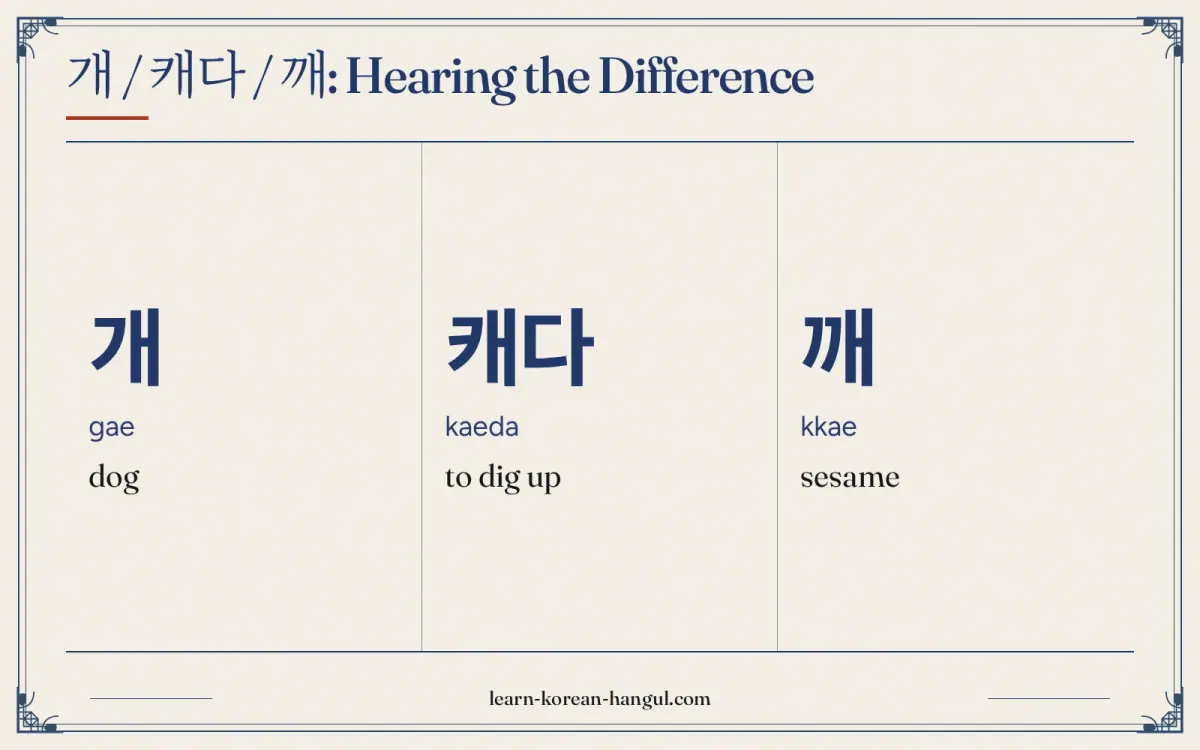
The three-way contrast 개 / 캐다 / 깨 is the best test of whether you hear ㅋ correctly. Korean has three kinds of k-type sounds, and each one changes the meaning of the word. The table lists the three words with their sound cues.
Plain: Light Breath; Aspirated ㅋ: Strong Puff; Tense: No Breath
| Korean | Romanization | Meaning | Sound |
|---|---|---|---|
| 개 | gae | dog | |
| 캐다 | kaeda | to dig up | |
| 깨 | kkae | sesame |
| Word | Meaning | Letter type | Air and tension | RR |
|---|---|---|---|---|
| 개 | dog | plain ㄱ | light breath, relaxed | gae |
| 캐다 | to dig up | aspirated ㅋ | strong puff of air | kaeda |
| 깨 | sesame | tense ㄲ | no puff, tight throat | kkae |
Use this paper-strip test to feel the difference. Hold a thin strip of paper in front of your lips and say each word:
- 캐다: the strip should flutter clearly.
- 개: the strip moves only a little.
- 깨: the strip stays still.
In modern Seoul speech, many speakers also use pitch as a cue. After an aspirated consonant such as ㅋ, the voice at the start of the vowel typically starts a little higher than after plain ㄱ. Treat this as a tendency, not a rule: the puff is the cue to train first.
For a deeper explanation of all three series, see plain, tense and aspirated sounds. To see how tense ㄲ works on its own, open the lesson on the tense letter ㄲ.
Knowing the contrast helps you avoid the mistakes in the next section.
Which Mistakes Do Learners Make with ㅋ?
Most learners make one of five predictable errors with ㅋ. Each has a quick fix.
| Mistake | Why it happens | Quick fix |
|---|---|---|
| Saying ㅋ with no puff | English habit after s, as in "sky" | Hold a hand or paper strip near the lips and check for air |
| Voicing ㅋ like a g | Hearing ㄱ between vowels | Keep the throat quiet: no buzzing on the k |
| Over-puffing every ㄱ | Treating ㄱ as the "weak" k to be avoided | Keep ㄱ light; reserve the strong puff for ㅋ |
| Pronouncing final ㅋ with a puff | Reading 부엌 as [부억크] | Stop the sound at [k]: [부억] |
| Reading ㅋ as "ch" or "c" | Spelling habits from English | Remember: ㅋ is always a k sound |
Common misconception: Learners often assume that ㅋ is simply "the harder k" and ㄱ is "the g". Actually, ㄱ is one letter that can sound like [k], [g] or something between, depending on its position, and ㅋ is not louder or longer. It differs by one thing: the puff of air.
Limitation: Written descriptions of a breath cannot replace hearing a speaker. The audio on this page is generated and awaits review by a Korean specialist, so it is a guide, not a final authority. Use it together with real recordings.
The next section gives you a short practice set.
Practice: Read and Hear ㅋ
Try these exercises first, then check the answers below.
Exercise 1: Read aloud. Say each word with a puff on every ㅋ:
- 카드
- 쿠키
- 케이크 (cake)
- 크다
Exercise 2: Write. Write ㅋ five times in two strokes each, then write 키 and 코.
Exercise 3: Choose. Which one is aspirated: 개, 캐다 or 깨?
Exercise 4: Final sound. How do you pronounce 부엌 when it stands alone? How do you pronounce 부엌에?
Exercise 5: Listening drill. Play the three words in the contrast table above in a random order five times and write which one you heard. A score of 4 out of 5 means you can move on.
Practice · 8
What makes ㅋ different from plain ㄱ?
Show answer
A strong puff of air after the k
ㅋ is aspirated: it differs from ㄱ by one thing, the puff of air.
How many strokes does ㅋ take in standard print?
Show answer
2
ㅋ is the ㄱ shape plus a short bar through the middle: two strokes.
How is 부엌 (kitchen) pronounced when it stands alone?
Show answer
[부억]
At the end of a syllable ㅋ loses its puff and sounds like [k], so 부엌 is [부억].
How is 부엌에 (in the kitchen) pronounced?
Show answer
[부어케]
Before a vowel the ㅋ moves to the next syllable and its puff returns: [부어케].
Which of these words starts with an aspirated consonant?
Show answer
캐다
캐다 (to dig up) has aspirated ㅋ; 개 has plain ㄱ and 깨 has tense ㄲ.
How is 축하 (congratulations) pronounced?
Show answer
[추카]
When ㄱ meets ㅎ, the two merge into a ㅋ sound, so 축하 is said [추카].
In the paper-strip test, what happens when you say 깨?
Show answer
The strip stays still
Tense ㄲ has no puff, so the strip stays still; it flutters for 캐다 and moves a little for 개.
What is the name of the letter ㅋ?
Show answer
키읔
ㅋ is named 키읔 (kieuk); 기역 is ㄱ and 쌍기역 is ㄲ.
Loanwords give extra reading practice, because English k and c sounds usually become ㅋ. For example, 커피 (coffee), 카드 (card), 쿠키 (cookie) and 케이크 (cake) are all written with ㅋ. For more practice, use the Hangul flashcard decks, the Hangul listening quizzes and the aspirated consonants worksheet.
Answers to the Practice
- 카드 (kadeu), 쿠키 (kuki), 케이크 (keikeu), 크다 (keuda). Each ㅋ has a puff.
- Two strokes: the ㄱ shape, then a short middle bar.
- 캐다 (to dig up) is aspirated ㅋ.
- Alone: [부억]. With 에: [부어케].
- A score of 4 or 5 out of 5 means you can hear the difference. Below 4, replay the three words slowly and try the paper-strip test again.
With the practice done, one fun fact connects ㅋ to everyday Korean writing.
Why Do Koreans Type ㅋㅋㅋ?
Koreans type ㅋㅋ or ㅋㅋㅋ to mean "haha". The letters stand for the sound of a chuckle, often read as 크크 (keukeu) or 키키 (kiki). Because ㅋ is the quickest letter to type for that sound, repeating it became a shorthand for laughter in chats and comments. Related shorthand such as ㅎㅎ (soft laughter) works in the same way. Seeing ㅋ in this role helps you recognise the letter in real messages even before you know many words.
This use is informal. In formal writing or speech, it does not appear.
What Should You Learn after ㅋ?
After ㅋ, learn the other aspirated letters and then the tense letters. Continue with the next letter lesson, ㅌ (tieut), which uses the same pattern: a plain letter plus one stroke.
Scope of this lesson: this page covers ㅋ only. It does not cover the full batchim system, which is in the 7 final sounds, or every stroke-order rule, which is in stroke order for consonants.
Suggested path:
- Revisit the plain letter ㄱ if the contrast felt unclear.
- Study the whole Korean consonants chart to see ㅋ beside its partners.
- Learn every consonant name in Korean consonant names.
- Move on to ㅌ, then ㅍ and ㅊ.
Everything on this page boils down to one fact: the Korean letter ㅋ is ㄱ plus a puff of air.
Frequently Asked Questions
Is ㅋ the same as the English k?
Almost. ㅋ matches the English k in a word like 'kite', where a puff of air follows the sound. It differs from the k in 'sky', which has almost no puff and sounds closer to Korean ㄱ. English also spells this sound with c, k and q, while Korean always uses ㅋ.
What is the name of the letter ㅋ?
The letter ㅋ is named 키읔, romanized kieuk. Most consonant names have two syllables: the letter's sound plus the vowel ㅣ, then a syllable that starts with a vowel and ends in the letter itself. For ㅋ that gives 키 plus 읔 (ㅇ, ㅡ and ㅋ). Names are used when spelling words aloud, not when reading.
How many strokes does ㅋ have?
In standard print form, ㅋ has 2 strokes. The first stroke is the ㄱ shape, drawn left to right and then straight down. The second stroke is a short bar from left to right across the middle of the first stroke. Fast handwriting may join the strokes, but the order stays the same.
Does ㅋ ever appear at the end of a word?
Rarely. The only common everyday noun that ends in ㅋ is 부엌 (kitchen), pronounced [부억] because every final ㅋ sounds like [k]. Before a vowel particle the puff returns: 부엌에 is pronounced [부어케]. Most words you will meet with ㅋ have it at the start of a syllable.
Is ㅋ the same as ㄲ?
No. ㅋ is aspirated and ends with a strong puff of air, while ㄲ is tense: the throat tightens and no air escapes. They also look different, because ㅋ is ㄱ plus one stroke and ㄲ is two ㄱ letters side by side. The words 캐다 (to dig up) and 깨 (sesame) differ only in this contrast.