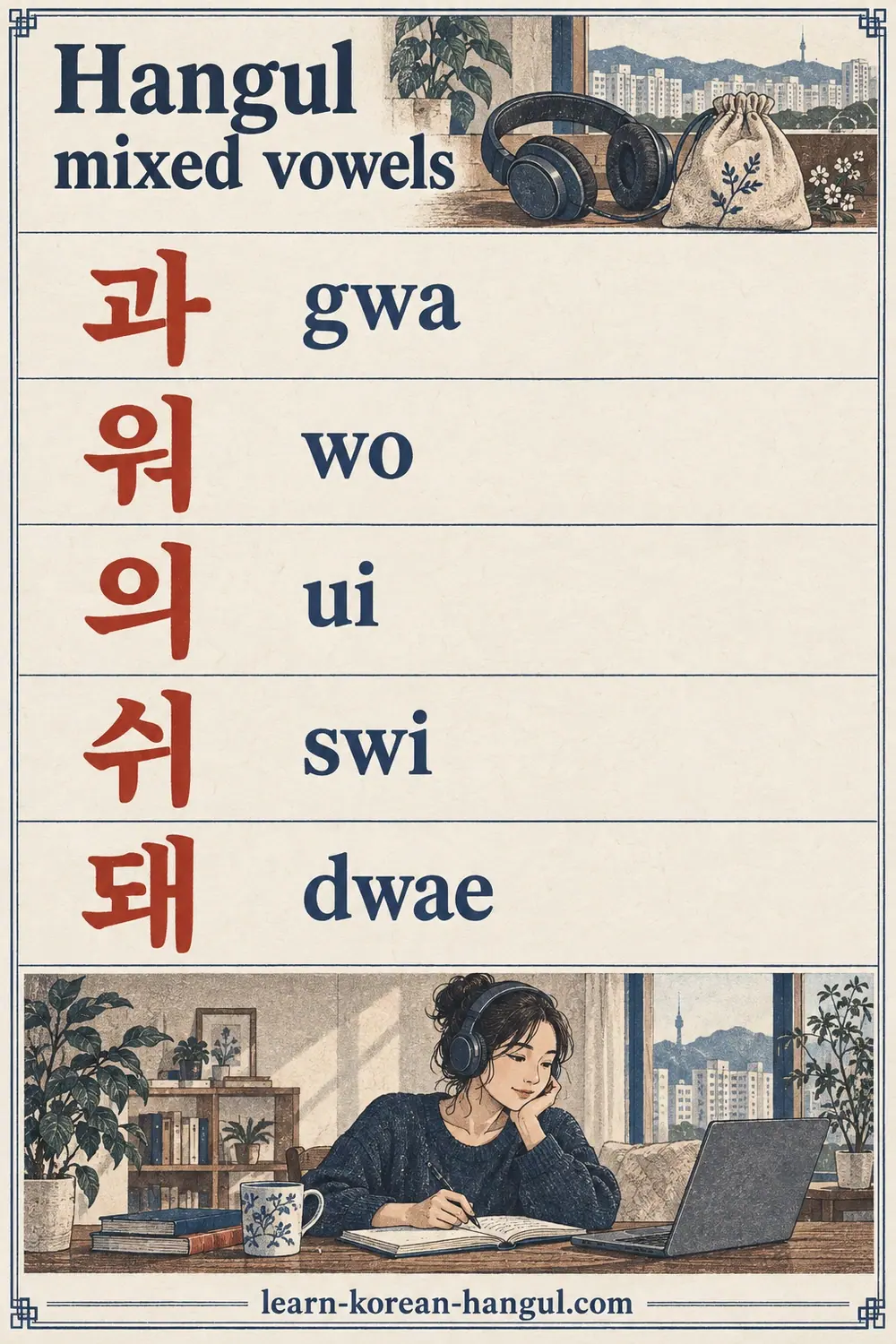
Hangul mixed vowels are the seven compound vowels ㅘ ㅙ ㅚ ㅝ ㅞ ㅟ ㅢ that combine a horizontal and a vertical part, so the vowel wraps below and to the right of the consonant, as in 과. This is the third and last vowel layout, and it builds directly on the first two.
What you'll learn
- Name the seven mixed vowels and the two parts of each.
- Build blocks such as 과, 워, 의, 쉬 and 돼 in four steps.
- Explain why the consonant and the horizontal part shrink in this layout.
- Read six short words: 사과, 뭐, 쉬다, 의자, 회사 and 돼지.
Honest limit: the exact proportions vary by typeface and by hand, and the "quarter of the block" figure is a rough guide for beginners, not a measurement from a standard. The placement rule is what stays fixed.
Prerequisites: horizontal-vowel blocks, because mixed blocks start the same way. Estimated time: 25 minutes.
This layout is one of the six block shapes. Start by seeing which vowels belong to it.
What Are Hangul Mixed Vowels?
Hangul mixed vowels are vowels written with two parts: a flat part (ㅗ, ㅜ or ㅡ) and an upright part (ㅏ, ㅐ, ㅓ, ㅔ or ㅣ). A block with a mixed vowel is the only layout where the vowel occupies two sides of the consonant. The flat part goes under the consonant, and the upright part goes to the right. Think of the vowel as an "L" turned around: it wraps below and to the right.
The consonant is then left alone in the top-left corner. That is the "L-wrap" rule, and it works for all seven vowels.
Which Vowels Are Mixed?
Seven vowels are mixed. Each one is just two simpler vowels written together:
| Mixed vowel | Parts | Revised Romanization | Example block |
|---|---|---|---|
| ㅘ | ㅗ + ㅏ | wa | 과 (gwa) |
| ㅙ | ㅗ + ㅐ | wae | 돼 (dwae) |
| ㅚ | ㅗ + ㅣ | oe | 회 (hoe) |
| ㅝ | ㅜ + ㅓ | wo | 워 (wo) |
| ㅞ | ㅜ + ㅔ | we | 궤 (gwe) |
| ㅟ | ㅜ + ㅣ | wi | 쉬 (swi) |
| ㅢ | ㅡ + ㅣ | ui | 의 (ui) |
Six of these are Korean w-vowels, which begin with a "w" glide. The model vowel for this lesson is the vowel ㅘ. The seventh, the vowel ㅢ, is not a w-vowel at all and has three different pronunciations, but it is written in the same shape as the others, so it belongs here.
Knowing the seven vowels, you can build a block in four steps.
How to Build a Mixed-Vowel Block in 4 Steps
You build a mixed-vowel block by placing the consonant top-left, the flat vowel part under it, and the upright vowel part to its right, then resizing all three to fit one square. The recipe below builds 과.
- Pick the first consonant and put it top-left. For 과, take ㄱ. Checkpoint: the consonant occupies the top-left corner only.
- Place the flat part below it. For 과, take ㅗ and set it under ㄱ. Checkpoint: the flat stroke is directly under the consonant.
- Place the upright part on the right. For 과, take ㅏ and set it to the right, running from the top of the block to the bottom. Checkpoint: the upright stroke is as tall as the whole block.
- Shrink the pieces to fit. Make the consonant and the flat part smaller so the three letters fill the square. Checkpoint: the block is about as wide as it is tall and reads "gwa".
Write the consonant first, then the vowel parts in the order they are spelled. For ㅘ, that means ㅗ first and ㅏ second. The stroke detail is in writing whole syllable blocks.
Common mistake: writing the flat part full-width at the bottom of the block, so that it runs under the upright part too. In a mixed vowel, the flat part stops under the consonant; the upright part owns the right side.
Why Does the Consonant Shrink?
The consonant shrinks because three letters share one square. In 고, the consonant has the whole top row to itself. In 과, the same ㄱ gets only the top-left part of the block, roughly a quarter of the space. The flat ㅗ shortens in the same way: it spans the full width in 고 but only the left half in 과.
This is also why mixed blocks feel crowded. A good typeface keeps small gaps between the three parts. In handwriting, keep the upright stroke tall and the other two parts compact, and the block stays readable.
Next, a few of these vowels need extra reading care.
How Do You Read 의 and 돼?
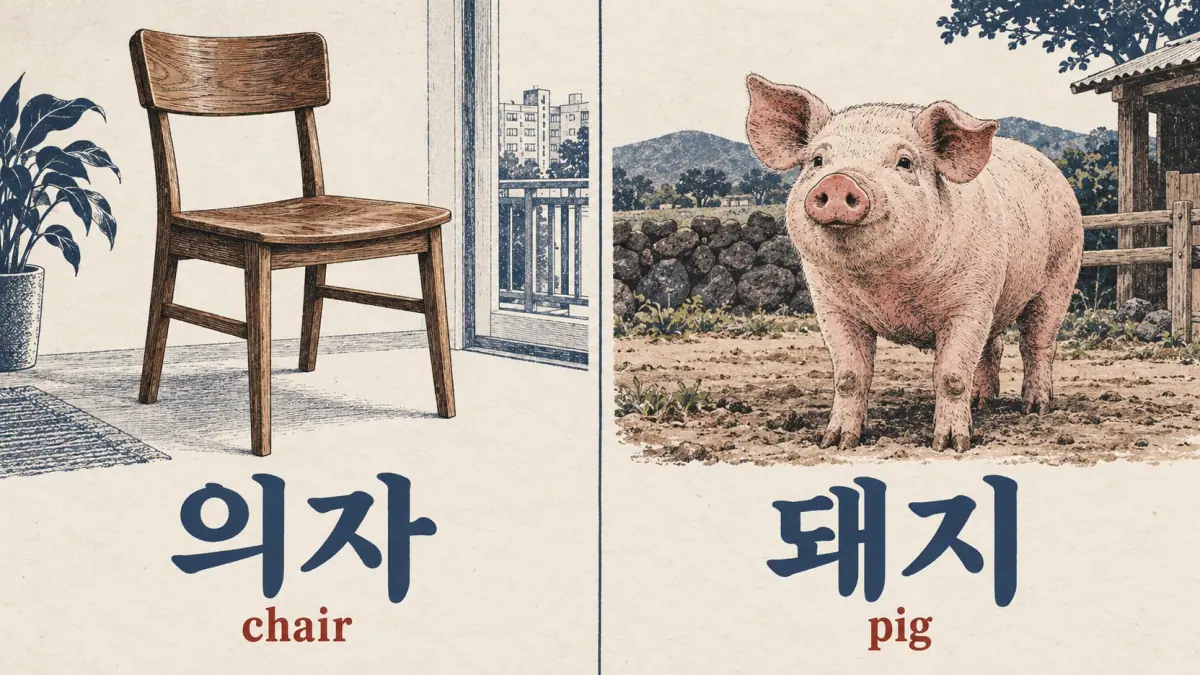
You read 의 as "ui" and 돼 as "dwae", but both have small traps. The block 의 contains ㅢ, a vowel with three common sounds. At the beginning of a word, as in 의자 (chair), it is read "ui". After a consonant, as in 희 (hui), it is read as plain "i": [히]. As the particle 의 meaning "of", it is often read "e". These sound rules follow the National Institute of Korean Language (국립국어원) Standard Pronunciation Rules, and the vowel ㅢ lesson covers them in full. For this lesson, read 의 as "ui".
The block 돼 contains ㅙ, one of three similar vowels: ㅙ (wae), ㅚ (oe) and ㅞ (we). In everyday speech many Koreans pronounce all three almost the same. You do not need to hear the difference yet. You need only to recognise each shape and learn the spelling of common words as you meet them. For example, 돼지 (pig) is spelled with ㅙ, and 회사 (company) is spelled with ㅚ.
With reading pointers in place, the worked examples bring the whole recipe together.
Worked Example: Building Syllables Step by Step

Example 1: build 과 (gwa).
- ㄱ goes top-left.
- ㅗ goes under it.
- ㅏ goes on the right.
- Shrink to fit. Result: 과, read "gwa".
Example 2: build 워 (wo).
- This syllable has no starting sound, so silent ㅇ goes top-left.
- ㅜ goes under it.
- ㅓ goes on the right.
- Result: 워, read "wo". The word 뭐 (mwo, "what") is the same vowel with ㅁ on top.
Example 3: build 의 (ui).
- Silent ㅇ goes top-left.
- ㅡ goes under it.
- ㅣ goes on the right.
- Result: 의, read "ui".
More blocks to scan. Read these 21 syllables, consonant first:
| Vowel | Blocks |
|---|---|
| ㅘ (wa) | 와 (wa), 과 (gwa), 화 (hwa) |
| ㅙ (wae) | 왜 (wae), 돼 (dwae), 괘 (gwae) |
| ㅚ (oe) | 외 (oe), 회 (hoe), 되 (doe) |
| ㅝ (wo) | 워 (wo), 뭐 (mwo), 원 (won, with final ㄴ) |
| ㅞ (we) | 웨 (we), 궤 (gwe), 훼 (hwe) |
| ㅟ (wi) | 위 (wi), 쉬 (swi), 귀 (gwi) |
| ㅢ (ui) | 의 (ui), 희 (hui), 늬 (nui) |
Practice
Expert tip: treat each mixed vowel as a small sum, not as a new letter. ㅘ is ㅗ + ㅏ, so its sound starts like "o" and slides into "a", which sounds like "wa". Learners who read the parts can guess the sound of a vowel they have never met.
You can practise this step with the hangul syllable builder, which gives instant feedback. Now see what happens when a final consonant joins the block.
How Do the Three Vowel Layouts Compare?
The three vowel layouts differ in where the vowel sits relative to the consonant. Use the table to sort any block you meet into the right layout in two seconds.
| Layout | Vowel shape | Consonant goes | Vowel goes | Example |
|---|---|---|---|---|
| Vertical | one upright stroke | left | right | 가 (ga) |
| Horizontal | one flat stroke | top | below | 고 (go) |
| Mixed | flat part plus upright part | top-left | below and right | 과 (gwa) |
To sort a new block, follow three questions in order. First, does the vowel have both a flat part and an upright part? If yes, the layout is mixed. If not, is its main stroke upright? Then it is vertical. Otherwise it is horizontal. Try the method on 위 (flat ㅜ plus upright ㅣ: mixed), 마 (upright: vertical) and 모 (flat: horizontal).
Each of these layouts can also take a final consonant, which gives six block shapes in total. The overview page, the six block shapes, shows all six together.
Adding a Final Consonant to This Layout
A mixed-vowel block can carry a final consonant at the very bottom, under both vowel parts. For example, 과 plus ㄴ makes 관 (gwan), and 워 plus ㄴ makes 원 (won, the Korean currency and also "circle"). The consonant and the two vowel parts keep their places in the upper area, and the new letter takes a bottom row of its own.
The bottom letter is the 받침 (batchim). Read the block in the usual order: top-left consonant, then the vowel, then the bottom letter. The next lesson, batchim (final consonants) in blocks, covers every combination.
Before practising, check the confusions that catch most beginners.
What Mistakes Do Beginners Make?
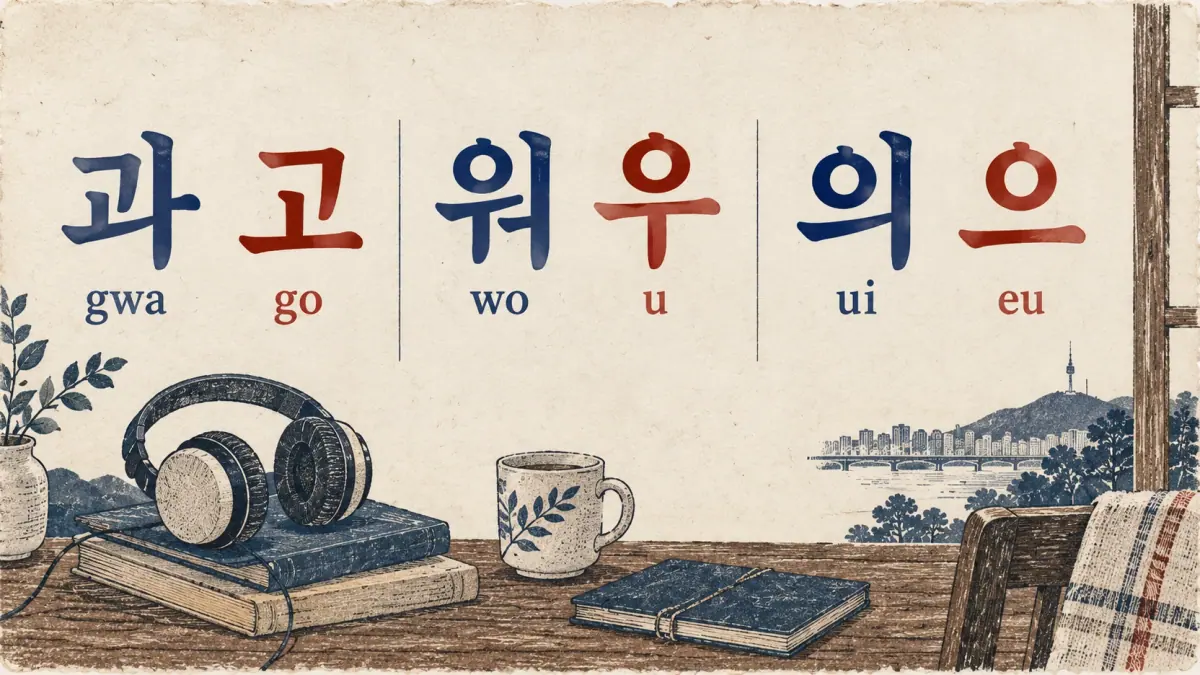
Beginners make five predictable mistakes with mixed-vowel blocks.
- Reading 과 as 고. Look for the upright stroke on the right. If it is there, the vowel is ㅘ (gwa), not ㅗ (go).
- Reading 워 as 우. The extra upright stroke on the right makes it ㅝ (wo), not ㅜ (u).
- Reading 의 as 으. The upright stroke on the right adds the "i" part: 의 (ui), not 으 (eu).
- Drawing the upright part short. The upright stroke must run the full height of the block, even though the consonant and the flat part sit only in the upper-left and lower-left areas. A short upright stroke makes ㅘ look like ㅗ, and the reader will misread 과 as 고.
- Treating the vowel as two letters. ㅘ is one vowel written with two parts. Do not read it as a consonant followed by something else.
Remember: learners often assume that every vowel with two parts must sound like its two parts said one after the other. That is only roughly true. ㅚ, for example, is usually said like "we", not "o" followed by "i", and ㅢ has three pronunciations. Use the audio as your guide, not the spelling alone.
Now try the practice set.
Practice: Build and Read 12 Syllables

Work on paper first, then check the answers.
A. Build the block.
- ㄱ + ㅘ
- ㅇ + ㅝ
- ㅇ + ㅢ
- ㅅ + ㅟ
- ㄷ + ㅙ
- ㅎ + ㅚ
B. Read the block. Say each aloud and write its Revised Romanization.
- 와
- 뭐
- 위
- 외
- 화
- 희
C. Read the words.
- 사과 (apple)
- 뭐 (what)
- 쉬다 (to rest)
- 의자 (chair)
- 회사 (company)
- 돼지 (pig)
Practice · 8
In a mixed-vowel block such as 과, where does the consonant sit?
Show answer
Top-left
The L-wrap rule: the consonant sits top-left, the flat part goes under it and the upright part goes on the right.
Which two simpler vowels make up ㅘ?
Show answer
ㅗ + ㅏ
ㅘ is ㅗ + ㅏ, which is why it starts like o and slides into a, giving wa.
Which block do you get from ㅅ + ㅟ?
Show answer
쉬
ㅟ is ㅜ + ㅣ, so ㅅ sits top-left, ㅜ goes under it and ㅣ goes on the right: 쉬 (swi).
Which of these blocks uses the mixed layout?
Show answer
위
위 has a flat part (ㅜ) and an upright part (ㅣ), so it is mixed; 마 is vertical, and 모 and 우 are horizontal.
What is the Revised Romanization of 뭐?
Show answer
mwo
뭐 is ㅁ with ㅝ (ㅜ + ㅓ), and ㅝ is romanized wo.
In 관, where does the final consonant ㄴ go?
Show answer
At the very bottom, under both vowel parts
A final consonant takes its own bottom row under both parts of the mixed vowel.
A learner reads 과 as 고. What did they miss?
Show answer
The upright stroke on the right, which makes the vowel ㅘ
If an upright stroke stands on the right, the vowel is ㅘ (gwa), not ㅗ (go).
Which spelling does the page give for 돼지 (pig)?
Show answer
With ㅙ, as in 돼
돼지 is spelled with ㅙ; 되 (ㅚ) is a different spelling even though the sounds are close.
Answers. 1. 과 (gwa). 2. 워 (wo). 3. 의 (ui). 4. 쉬 (swi). 5. 돼 (dwae). 6. 회 (hoe). 7. wa. 8. mwo. 9. wi. 10. oe. 11. hwa. 12. hui (said [히], like "hi").
If you missed more than three, return to the vowel table and say each vowel aloud, then rebuild the blocks. Review them later with the Hangul flashcard decks.
What to Learn Next
Learn final consonants next. The batchim lesson shows how a bottom letter fits into all three layouts you now know, and which consonants may appear there.
This lesson does not cover the sound rules between blocks, the full pronunciation of ㅢ, or the spelling rules that separate 되 from 돼. Each has its own lesson.
In short, Hangul mixed vowels follow the L-wrap rule: the consonant sits top-left, the flat part goes under it, and the upright part goes on the right.
Frequently Asked Questions
Is ㅢ really a mixed vowel? Yes, by shape. ㅢ joins the flat ㅡ with the upright ㅣ, so it follows the mixed layout: consonant top-left, ㅡ underneath, ㅣ on the right, as in 의. Its pronunciation is a separate matter. ㅢ has three common sounds depending on position, which the vowel ㅢ lesson explains.
Where does batchim go in 관? The final consonant ㄴ goes at the very bottom of the block, under both parts of the vowel. The consonant ㄱ and the vowel ㅘ share the upper part, and ㄴ takes a row of its own. Reading order is still the same: the top-left consonant first, then the vowel, then the bottom letter.
Why does 과 look crowded? Three letters share one square: the consonant, the flat part and the upright part. Each letter is therefore drawn smaller than it would be alone. The ㅗ in 과 is much shorter than the ㅗ in 고. Crowding is normal, and a good typeface keeps small gaps between the parts.
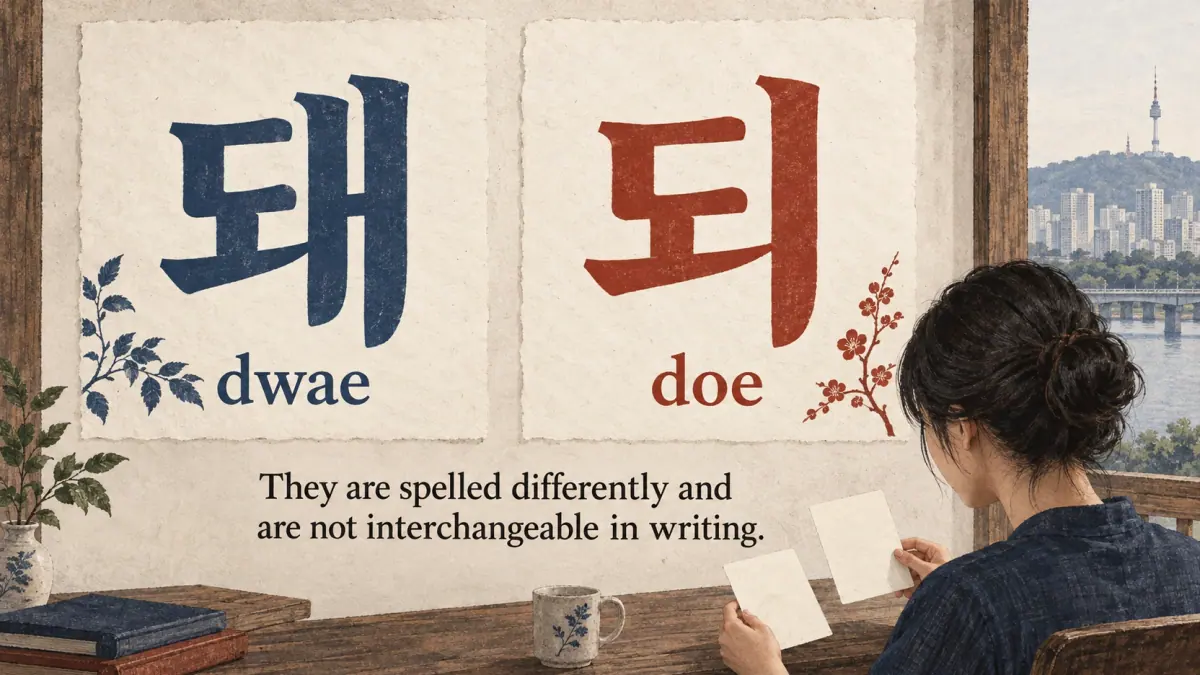
Is 돼 the same as 되? They are spelled differently and are not interchangeable in writing. 되 uses ㅚ and 돼 uses ㅙ. Many speakers pronounce them almost alike, which is why Koreans also mix them up. For now, learn to read and build both blocks; the grammar lessons explain when each spelling is correct.
Do mixed vowels have special stroke order? There is no special rule. Write the consonant first, then the vowel parts in the order their letters are spelled: for ㅘ, the flat ㅗ first and then the upright ㅏ. Each part follows its own normal stroke order, so there is nothing new to memorise beyond the layout.