Hanja (한자) are Chinese characters used in Korean. You do not need them to read modern Korean, but they explain the meaning of Sino-Korean words, which commonly cited estimates put at roughly half or more of dictionary words.
What Are the 1800 Hanja?
The 1800 hanja are a fixed list of characters that the South Korean Ministry of Education treats as the basic set for school study. The Korean name is 한문 교육용 기초 한자 1,800자, usually shortened to 교육용 기초 한자 (basic hanja for education). Students meet the characters in the school subject of 한문 (hanmun, classical Chinese and characters), which is taught in middle school and high school.
The list is a teaching tool, not a count of all characters in use. A large Chinese dictionary such as the Kangxi Dictionary, from the early 1700s, records about 47,000 characters, and no learner needs more than a small slice of them. The 1,800 are the slice chosen for school, and the 100 on this site are a smaller slice chosen for learners of Korean.
| Question | Answer |
|---|---|
| Korean name | 한문 교육용 기초 한자 1,800자, or 교육용 기초 한자 |
| Publisher | Ministry of Education (교육부) |
| Size | 1,800 characters |
| Split | 900 for middle school, 900 for high school |
| Taught in | The school subject of 한문 (hanmun) |
| First set | In the early 1970s, with changes since; check the current edition |
| Used for | School study, hanja textbooks and many learner lists |
The list is not a law and it is not an exam syllabus for foreigners. It does, however, give you a shared yardstick. When a textbook, a teacher or a website says "a basic hanja", it usually means a character on this list. The next section shows how the list is divided.
How Is the List Structured?
The list has two tiers of 900 characters each, one for each stage of secondary school. Together they give 1,800.
| Tier | Characters | Running total | School stage |
|---|---|---|---|
| First half | 900 | 900 | Middle school (중학교) |
| Second half | 900 | 1,800 | High school (고등학교) |
Hanja 900: the Middle-School Half
In general, the first half holds the more concrete everyday characters, such as numbers, body parts, nature, family and school words. That is an editorial summary, so check the published list for any single character. If you search for "hanja 900", this is the set people usually mean.
The High-School Half
In general, the second 900 are rarer and more abstract: characters for ideas, law, history and the sciences. They matter if you read newspapers, textbooks or classical texts. Most TOPIK-level vocabulary needs a handful of them, not all.
Published copies of the list print each character with its 음훈 (meaning word plus sound), usually sorted by Korean reading in Hangul order or by tier. Because editions differ, check which version you are reading. If you want to see how a character is read inside words, the 100 common hanja characters give a model for how the 음훈 and readings work.
How Does It Relate to the 100 Core Hanja?
The 100 core hanja on this site are a subset of the 1,800, chosen to be the best starting point. They are drawn from across the list and grouped by theme rather than by list order. So 1 character in every 18 on the Ministry list is in the 100 (1,800 divided by 100 is 18).
The two lists do different jobs, and it helps to keep them apart.
| The 1,800 school list | The 100 core hanja on this site | |
|---|---|---|
| Made for | Korean students of the subject 한문 | Learners of Korean as a foreign language |
| Organised by | Tier (900 + 900) and the published list order | Ten themes of ten characters |
| Goal | A broad base for reading and writing characters | Recognising characters inside common words |
| Time to finish at 10 a week | 180 weeks | 10 weeks |
| Best used as | A reference and a checklist | A study plan |
What do the other 1,700 look like? The ten characters below are typical. They are everyday characters that did not make the core 100 but turn up in common words. Each is shown with one word.
| # | Korean | Revised Romanization | Meaning | Character note |
|---|---|---|---|---|
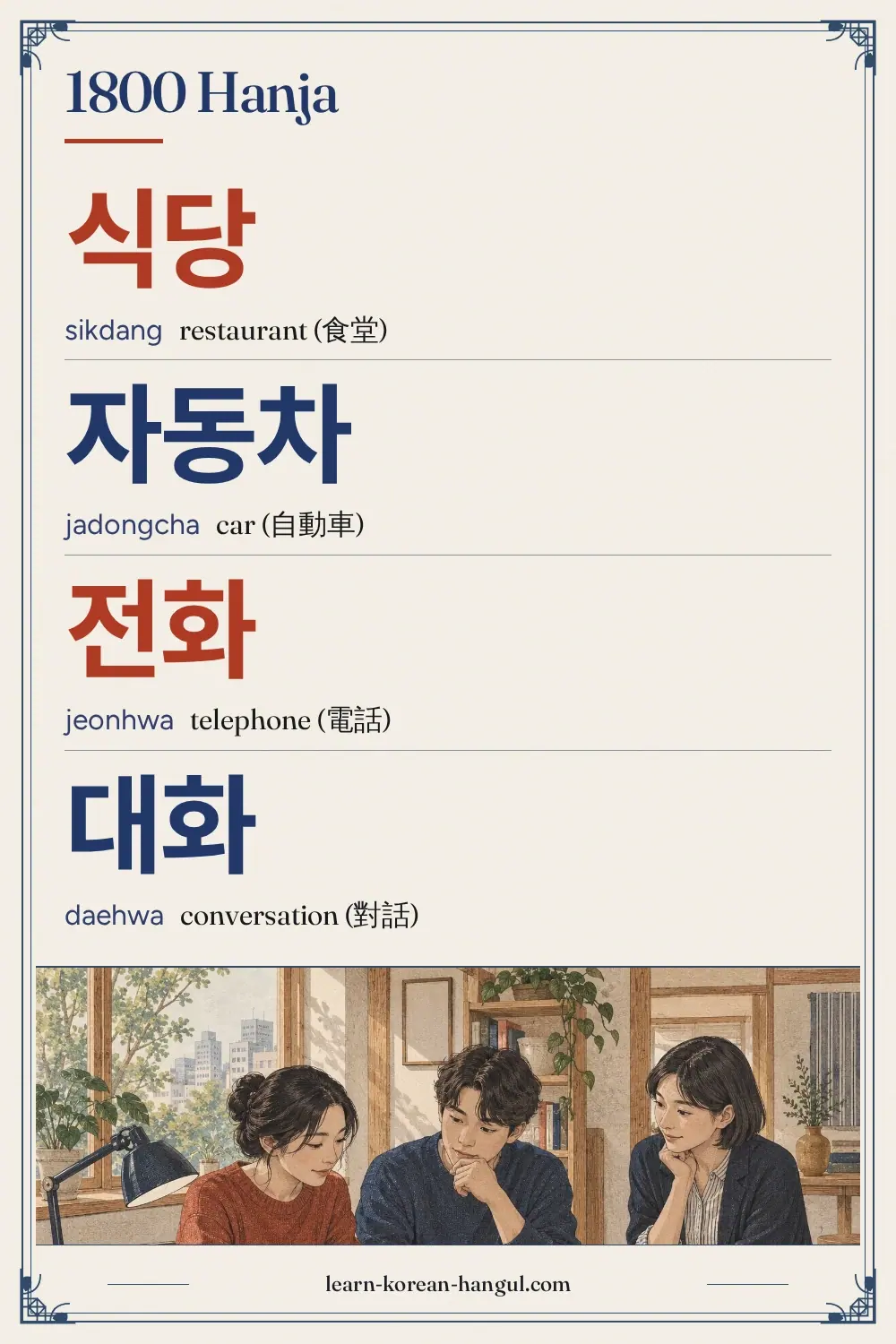
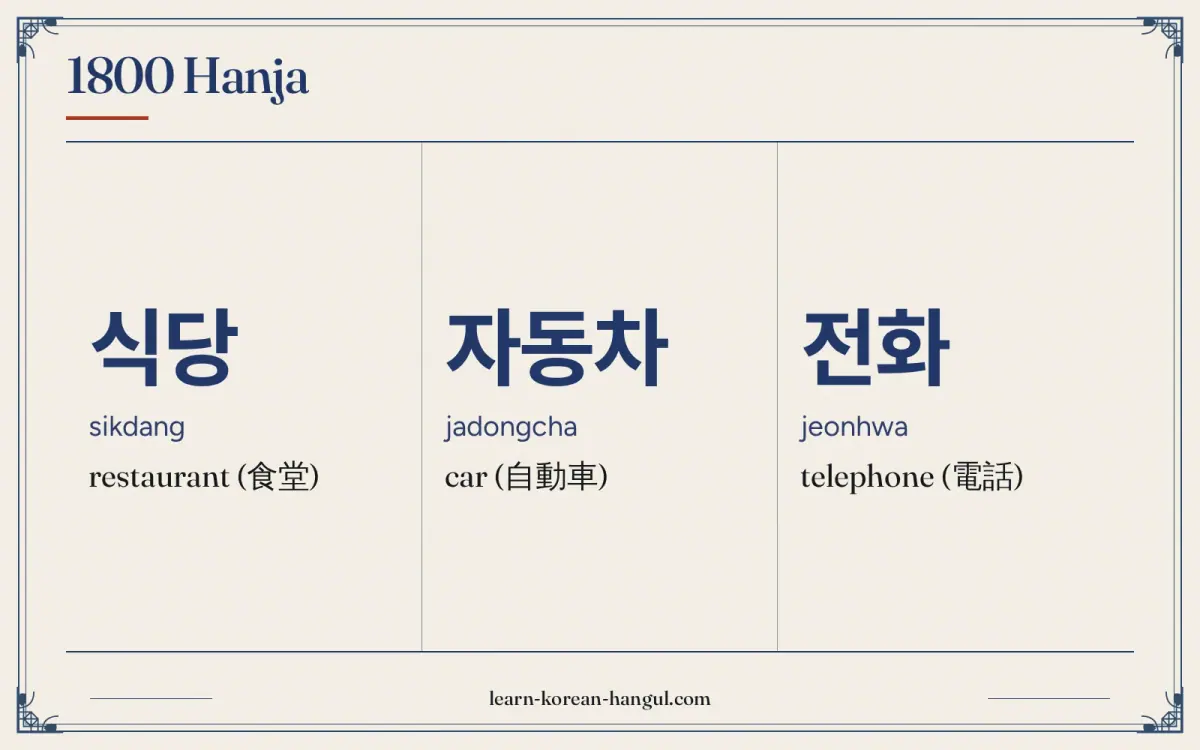
| 1 | 식당 | sikdang | restaurant (食堂) | 食 (먹을 식), read 식. Eat. Also in 식사 (a meal) and 음식 (food). |
| 2 | 자동차 | jadongcha | car (自動車) | 車 (수레 차), read 차. A cart seen from above. 自動 "moves by itself" + 車. |
| 3 | 전화 | jeonhwa | telephone (電話) | 電 (번개 전), read 전. Lightning, so electricity. Also in 전기 (electricity). |
| 4 | 대화 | daehwa | conversation (對話) | 話 (말씀 화), read 화. Speech. The second half of 전화 and the whole idea of 대화. |
| 5 | 안전 | anjeon | safety (安全) | 安 (편안 안), read 안. A woman under a roof: calm. Also in 안심 (relief) and 불안 (anxiety). |
| 6 | 개학 | gaehak | start of a school term (開學) | 開 (열 개), read 개. A gate being opened. Opposite 閉. Also in 개시 (start). |
| 7 | 해외 | haeoe | overseas (海外) | 海 (바다 해), read 해. Water plus every. Also in 동해 (East Sea) and 해변 (beach). |
| 8 | 교실 | gyosil | classroom (敎室) | 室 (집 실), read 실. A roof and a place to arrive. Also in 화장실 (toilet) and 사무실 (office). |
| 9 | 애정 | aejeong | affection (愛情) | 愛 (사랑 애), read 애. A heart inside. Also in 사랑 (native for love) and 애국 (patriotism). |
| 10 | 단점 | danjeom | weak point (短點) | 短 (짧을 단), read 단. Partner of 長 from the size group. Opposite of 장점. |
Practice · 10
- 01식당
Show answer
sikdang
restaurant (食堂)
- 02자동차
Show answer
jadongcha
car (自動車)
- 03전화
Show answer
jeonhwa
telephone (電話)
- 04대화
Show answer
daehwa
conversation (對話)
- 05안전
Show answer
anjeon
safety (安全)
- 06개학
Show answer
gaehak
start of a school term (開學)
- 07해외
Show answer
haeoe
overseas (海外)
- 08교실
Show answer
gyosil
classroom (敎室)
- 09애정
Show answer
aejeong
affection (愛情)
- 10단점
Show answer
danjeom
weak point (短點)
Notice how many of these are the kind of word you meet in a first year of Korean: 식당, 자동차, 전화 and 교실. That is the pattern across the whole list. Many Korean words you already know are built from 1,800-list characters, so each new character you learn upgrades words you already say.
How Should Learners Use the List?
Use the 1,800 as a reference, not a syllabus. The goal for a learner is to recognise characters inside words, not to complete the list. The method below follows that goal.
- Learn the 100 core characters first. They take about ten weeks at ten a week, and they explain hundreds of everyday words.
- Learn from the words you meet. When you meet a new Sino-Korean word, look up its hanja in the Standard Korean Language Dictionary, then learn the character. This follows the words you actually need.
- Choose by yield, not by order. A character that builds twenty words, such as 學 or 生, pays back faster than a rare one that sits early in the list. The hanja word families pages show which characters open the most words.
- Use the list as a checklist. After a few hundred characters, compare what you know against the Ministry list to find gaps, rather than learning in list order.
- Stop when it stops helping. If your aim is conversation, the 100 may be enough. If you aim for TOPIK II or academic reading, a few hundred is a typical suggestion, not a rule.
How long would it take if you did go through the whole list? The table gives the arithmetic at three speeds.
| Pace | The 100 core | One half (900) | The full 1,800 |
|---|---|---|---|
| 5 characters a week | 20 weeks | 180 weeks | 360 weeks |
| 10 characters a week | 10 weeks | 90 weeks | 180 weeks |
| 20 characters a week | 5 weeks | 45 weeks | 90 weeks |
At 10 a week, 180 weeks is about 3.5 years. That is why most learners stop long before the end of the list and why the 100-character core is a better target. If you decide to go further, plan in blocks of 100 and review constantly.
Where Can You Find the List?
Look for the list in four places, and compare editions if you can.
- The Ministry of Education website (moe.go.kr). Search for 교육용 기초 한자 1800자. This is the official source.
- School hanmun textbooks. Middle and high school texts for the subject 한문 print the characters of the relevant half with their readings and example words.
- Hanja dictionaries and apps. Many print the Ministry list and mark which characters belong to it.
- The online Standard Korean Language Dictionary (stdict.korean.go.kr) from the National Institute of Korean Language. It shows the hanja spelling of every Sino-Korean headword, so it is the best tool for looking up a character you meet in a word.
Because the details of the list can be revised, always check the current edition on the ministry's site. This page does not reproduce the 1,800 characters one by one. The site offers the 100 common hanja characters and the basic hanja section instead.
How Do You Read an Entry in the List?
Every entry in a hanja list has the same three parts, and learning to read them is half the work. The first part is the character. The second is the 음훈 (eumhun), a native Korean meaning word followed by the Sino-Korean sound. The third is any extra reading or note. The table shows four entries from the 100 core set.
| Character | 음훈 | Meaning word | Sound | How to read it |
|---|---|---|---|---|
| 學 | 배울 학 | 배울 (to learn) | 학 | "learn, sound hak": 학생, 학교 |
| 山 | 메 산 | 메 (mountain, old native word) | 산 | "mountain, sound san": 등산, 화산 |
| 男 | 사내 남 | 사내 (man) | 남 | "man, sound nam": 남자, 남녀 |
| 大 | 큰 대 | 큰 (big) | 대 | "big, sound dae": 대학, 대소 |
The meaning word is a way of remembering, not a translation to use in a sentence. 메 is an old word that you will almost never hear, and 사내 is rare in modern speech. Use the meaning word to remember the idea, then use the sound to read real words. Some entries also add a second reading, such as 力 (힘 력, 역 at the start of a word) or 金 (쇠 금, 김 as a surname), which is why a good list shows both.
What Can the List Teach You about a Real Word?
A good test of any character list is whether it lets you take a word apart. Here are three words decoded with characters from the list.
| Word | Characters | Pieces | Meaning |
|---|---|---|---|
| 신문 (sinmun) | 新聞 | 新 "new" + 聞 "hear" | newspaper: what is new to hear |
| 대학교 (daehakgyo) | 大學校 | 大 "big" + 學 "study" + 校 "school" | university: a big school of study |
| 지하철 (jihacheol) | 地下鐵 | 地 "ground" + 下 "below" + 鐵 "iron" | subway: the iron line below the ground |
Pieces from the 100 core set (新, 大, 學, 校, 下) make most of these words readable, and the one or two others (聞, 地, 鐵) come from the wider list. That is the practical value of the 1,800: it supplies the second and third pieces once you know the first.
Be careful with one limit. A word can drift away from the sum of its parts, so use decoding to guess, then check in a dictionary. 신문 means newspaper, not "new hearing", and 대학교 is the standard word for a university rather than a description. The characters give a clue, not a proof.
What Mistakes Do Learners Make with the List?
- Learning in list order. The list is a reference, not a study plan. Characters in the middle of the first half are no more useful than some in the second half.
- Treating the meaning word as a translation. 메 for 山 and 사내 for 男 are memory aids. In a sentence, Korean says 산 and 남자.
- Expecting Chinese or Japanese readings. The Korean sound is not the Chinese or Japanese reading. 學 is 학 in Korean, xue in Mandarin and gaku in Japanese. If you know one of those languages, use the shapes but learn the Korean sounds.
- Assuming every Sino-Korean word can be decoded. Many can, but some are fixed expressions, and some changed their meaning over time. Always confirm with a dictionary.
- Mixing up homophones. Dozens of characters share each Korean sound, so 이상 can be 以上, 異常 or 理想. Learn the characters inside words, not alone.
- Trying to write everything. Recognition is faster and more useful than handwriting for most learners.
How Is the 1800 List Used in Tests and in the TOPIK?
The TOPIK does not test hanja. Its papers are printed in Hangul, and the question types are about listening, reading and writing in Korean. For the current specification, check topik.go.kr, which is the official source for the test. Hanja are a vocabulary shortcut for TOPIK II, not an exam requirement; the hanja for TOPIK page lists the characters that pay back fastest.
Korean hanja proficiency tests (한자능력검정시험) are separate. They have their own level lists, and the levels are measured by the number of characters you can read and write. A hanja certificate does not replace a TOPIK level, and the two are taken for different reasons. Check the syllabus of the specific test if you plan to take one.
What Does the 1800 List Not Include?
The list is a school list, so it leaves out three things that learners sometimes expect.
- Characters for personal names. Korean family-registration rules keep a separate, much longer list of characters allowed in given names. If you want the hanja behind a Korean name, you need that list, not this one.
- Characters from other East Asian standards. Japan has its own list of general-use kanji, the jōyō list of 2,136 characters (2010), and China uses simplified characters. The three sets overlap but differ in shape and number.
- Stroke order and handwriting. The list gives characters and readings, not how to write them. The pages on handwriting are separate.
The full 1,800 also cannot show you how characters change sound in words. 力 is 력 inside a word and 역 at the start, 不 is 불 or 부, and 女 is 녀 or 여. These sound rules, such as the initial-sound rule (두음법칙), are best learned from words, as on the common hanja characters page.
Check Yourself
Practice · 6
How many characters are in the Ministry of Education's basic hanja list?
Show answer
1,800
The list has 1,800 characters: 900 for middle school and 900 for high school. 2,136 is the size of Japan's jōyō kanji list.
How is the 1,800 list divided?
Show answer
900 for middle school and 900 for high school
The list is split into two halves of 900: one for middle school and one for high school.
Does TOPIK test hanja directly?
Show answer
No, TOPIK papers are printed in Hangul
TOPIK is written in Hangul and has no hanja questions. Characters are a vocabulary aid, not an exam requirement. Check topik.go.kr for the current specification.
Learning 10 new characters a week, how many weeks does the full 1,800 list take?
Show answer
180
1,800 divided by 10 is 180 weeks, which is about 3.5 years. At 20 a week it would be 90 weeks.
What is the best way to choose which characters to learn first?
Show answer
By how many words each helps you read
Choose by the words they build, not by order in the list. A character that opens many words pays back faster than one that is rare.
Is the 1,800 list a list of all hanja characters?
Show answer
No, large dictionaries list tens of thousands of characters
The 1,800 are a basic school set. Large dictionaries record tens of thousands of characters, and the 100 on this site are a smaller core drawn from the 1,800.
What to Learn Next
The best next step is the core set: common hanja characters lists all 100 with readings and example words, and the group pages break it into themes, starting with Korean numbers in hanja. To see how a single character grows into a family of words, open hanja word families. For the exam view, read hanja for TOPIK. The basic hanja page is the hub for the whole section.
Frequently Asked Questions
Do I need all 1,800?
No. Most learners get the largest benefit from a few hundred high-frequency characters, a typical suggestion of 300 to 500 rather than a rule. The 1,800 is a full school syllabus, built for students who study the subject of hanmun (한문) for years. Start with the 100 core characters, then add the characters your own reading throws up.
Is the list official?
Yes, in the sense that the Ministry of Education (교육부) publishes it for use in school, as the basic hanja for education (교육용 기초 한자). It is not a law that every Korean must know it, and details such as exact membership can change with curriculum revisions, so check the current edition on the ministry's website before relying on one character.
Does TOPIK require it?
No. TOPIK is written in Hangul and does not ask you to read or write hanja. Characters help you guess the meaning of Sino-Korean words, which become more common at higher levels. For the exam specification, check topik.go.kr, which is run by the body that publishes the test.
Where can I find the list?
Search for 교육용 기초 한자 1800자 on the Ministry of Education website (moe.go.kr) or in school hanmun textbooks and hanja dictionaries, which print the list with readings. The online Standard Korean Language Dictionary (stdict.korean.go.kr) shows the hanja spelling for each Sino-Korean word, which helps you check characters in context.
How long does it take to learn 1,800 characters?
At 10 characters a week it takes 180 weeks, about 3.5 years. At 20 a week it takes 90 weeks. Most learners do not study the whole list; they learn the 100 core characters in about ten weeks and add more through words as they meet them.
Are hanja proficiency tests based on the same list?
Not exactly. Korean hanja proficiency tests have their own level lists and syllabi, which overlap with the school list but are not identical. If you plan to take one, check the syllabus of the specific test, and do not assume the 1,800 list covers every level.