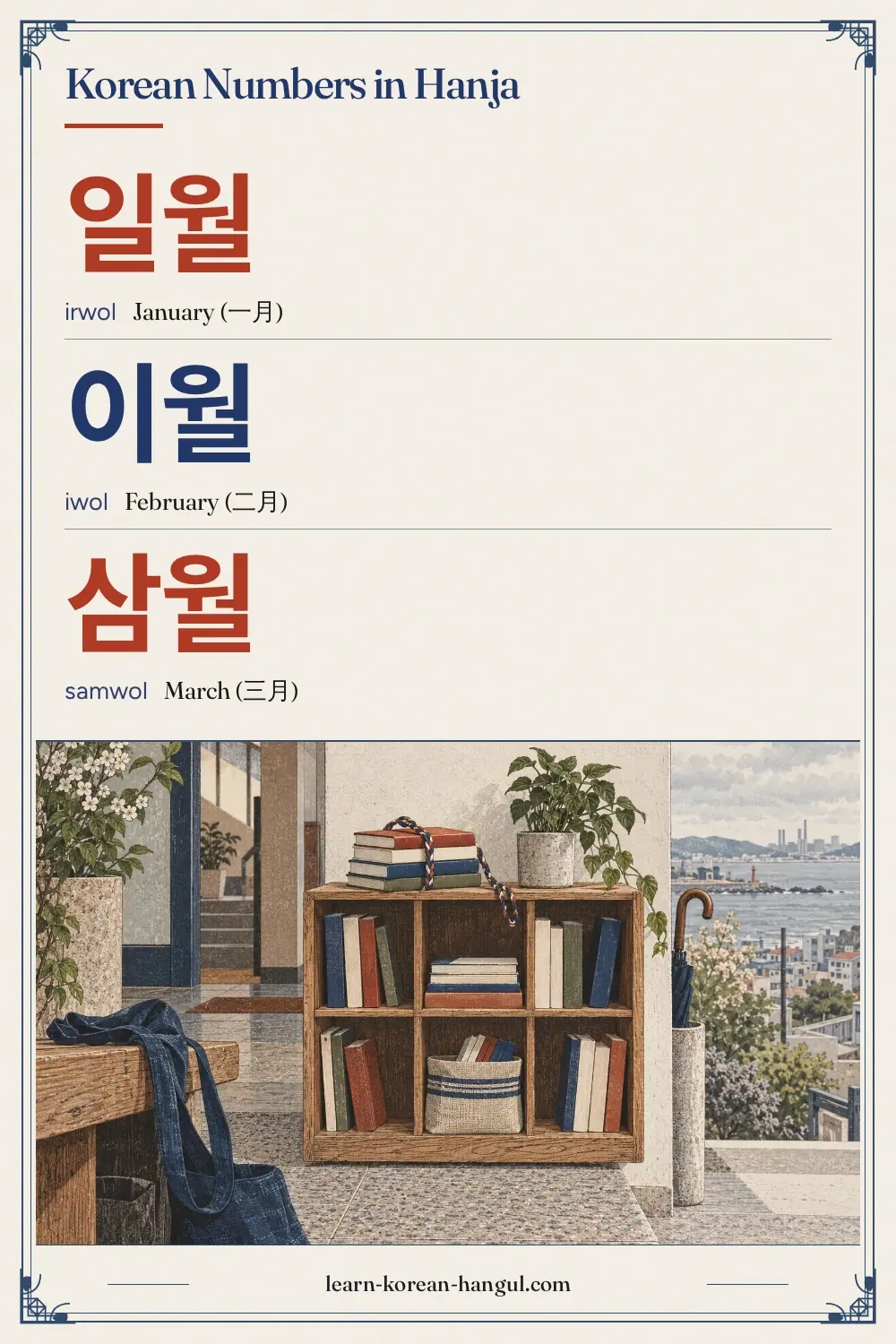
Hanja (한자) are Chinese characters used in Korean. Korean is written in Hangul today, but commonly cited estimates say that roughly half or more of dictionary words are Sino-Korean, meaning they were built from characters like these. Numbers are the gentlest start, because you can already say the sounds and only the shapes are new.
This is the first of ten theme groups in the basic hanja set. Plan about 20 minutes for the whole page, and see Sino-Korean numbers for how to use these sounds with dates, money and phone numbers.
Korean Numbers in Hanja: the Essentials
The table gives each character with its 음훈, the traditional way Korean dictionaries teach a character: a native Korean meaning word, then the Sino-Korean sound. So 三 is "석 삼", "three, sound sam". The last column shows the two words used throughout this page.
| Character | 음훈 (meaning word + sound) | Reading | Core meaning | Two words it builds |
|---|---|---|---|---|
| 一 | 한 일 | 일 | one | 일월, 통일 |
| 二 | 두 이 | 이 | two | 이월, 이십 |
| 三 | 석 삼 | 삼 | three | 삼월, 삼각형 |
| 四 | 넉 사 | 사 | four | 사계절, 사월 |
| 五 | 다섯 오 | 오 | five | 오월, 오감 |
| 六 | 여섯 륙 | 육 | six | 유월, 육십 |
| 七 | 일곱 칠 | 칠 | seven | 칠월, 칠십 |
| 八 | 여덟 팔 | 팔 | eight | 팔월, 팔십 |
| 九 | 아홉 구 | 구 | nine | 구월, 구구단 |
| 十 | 열 십 | 십 | ten | 시월, 십자가 |
Notice that the readings are exactly the numbers you say when you count in Sino-Korean: 일, 이, 삼, 사, 오, 육, 칠, 팔, 구, 십. The only new information is the character. Higher numbers follow the same logic and sit in the next group: 百 (백), 千 (천) and 萬 (만) are on the size and quantity page. Combining characters works like speech: 十一 is "ten-one" (십일, 11) and 二十 is "two-ten" (이십, 20).
How Do You Read Each Character?
Every character here has one reading, so there is nothing to choose between. What helps is a picture for the shape and a note on the sound inside real words. The pictures are memory aids, not strict word histories.
- 一 일 (한 일). One horizontal stroke, so the picture is the meaning. The 일 sound also belongs to 日 (sun, day), which is why 일요일 and 일월 both start with 일 but mean different things. In 통일 (unification) it keeps its sense of "one": 統 "bring together" + 一 "one".
- 二 이 (두 이). Two strokes. It is the 이 of 이월 (February) and 이십 (twenty), which is simply "two" and "two tens". Do not confuse it with 耳 (ear), which is also 이, or with the particle 이 (subject marker).
- 三 삼 (석 삼). Three strokes. In 삼월 the final ㅁ moves onto the next syllable, so it is said [사뭘]. In 삼각형 (triangle) the ㄱ and ㅎ blend into one aspirated sound, [삼가켱]. The parts are 三 "three" + 角 "corner" + 形 "shape".
- 四 사 (넉 사). A box with two short strokes inside, so it looks more complex than 一 二 三. In 사계절 (the four seasons) it counts the seasons: 四 "four" + 季節 "season". Some Koreans avoid the number 4 because 사 also sounds like 死 (death), and a few buildings label the fourth floor F.
- 五 오 (다섯 오). Four strokes that look like a small S with bars. Children's Day falls on 5 May, 오월 오 일, which makes 오월 an easy anchor word. In 오감 (the five senses) the second character 感 means "feeling". The 오 of 午 (noon) is the same sound, so 오전 and 오월 start alike.
- 六 육 (여섯 륙). A lid over two legs. The dictionary sound is 륙, but Korean does not start a word with 륙, so on its own it is 육 (see the initial-sound rule below). In the month name it is irregular: 유월, never 육월. In 육십 the ㅅ after ㄱ is tense, [육씹].
- 七 칠 (일곱 칠). A horizontal stroke that bends down, like a cross with a hooked leg. Say 칠월 as [치뤌], with the ㄹ moving across to the 월 syllable, and 칠십 as [칠씹], with a tense ㅆ. Both are normal sound changes, not exceptions.
- 八 팔 (여덟 팔). Two strokes that open downward like legs. Say 팔월 as [파뤌] and 팔십 as [팔씹]. The shape also looks like the top of 人 (person), which is a useful warning: 八 sits low and apart, 人 leans together.
- 九 구 (아홉 구). A bent stroke with a hook at the end. 구구단 repeats the character, "nine nine steps", because Korean children learn the table from 구구, starting with 2단 (the two times table). The 구 sound is shared with 口 (mouth) in the body group.
- 十 십 (열 십). A plain cross, which makes it the easiest character to remember. The month name is irregular: 시월, never 십월, because the final ㅂ drops. In 십자가 the ㅈ after ㅂ becomes tense, [십짜가], and the word describes the shape: 十 "ten" + 字 "character" + 架 "frame".
The first three characters are strokes you can count. From 四 onward the shapes stop being pictures, so the best method is to attach each shape to a month name you already know: 사월, 오월, 유월 and so on. Months are on the months in Korean page.
Which Words Does Each Character Build?
Each character below builds two common words. The "Said" column shows how the word is actually pronounced when that differs from the spelling, and the Revised Romanization column follows the official romanization rules (it does not show tensing caused by a neighbouring sound).
| Character | Word | Hanja | Revised Romanization | Said | Meaning |
|---|---|---|---|---|---|
| 一 | 일월 | 一月 | irwol | [이뤌] | January |
| 一 | 통일 | 統一 | tongil | as spelled | unification |
| 二 | 이월 | 二月 | iwol | as spelled | February |
| 二 | 이십 | 二十 | isip | as spelled | twenty |
| 三 | 삼월 | 三月 | samwol | [사뭘] | March |
| 三 | 삼각형 | 三角形 | samgakhyeong | [삼가켱] | triangle |
| 四 | 사계절 | 四季節 | sagyejeol | as spelled | four seasons |
| 四 | 사월 | 四月 | sawol | as spelled | April |
| 五 | 오월 | 五月 | owol | as spelled | May |
| 五 | 오감 | 五感 | ogam | as spelled | the five senses |
| 六 | 유월 | 六月 | yuwol | as spelled | June |
| 六 | 육십 | 六十 | yuksip | [육씹] | sixty |
| 七 | 칠월 | 七月 | chirwol | [치뤌] | July |
| 七 | 칠십 | 七十 | chilsip | [칠씹] | seventy |
| 八 | 팔월 | 八月 | parwol | [파뤌] | August |
| 八 | 팔십 | 八十 | palsip | [팔씹] | eighty |
| 九 | 구월 | 九月 | guwol | as spelled | September |
| 九 | 구구단 | 九九段 | gugudan | as spelled | multiplication table |
| 十 | 시월 | 十月 | siwol | as spelled | October |
| 十 | 십자가 | 十字架 | sipjaga | [십짜가] | cross |
Fourteen of the twenty words are month names or number words (the ten months with 月 and the four tens with 十). That is intended: they are the words you will use most, and they show that a month is simply a number plus 月. The other words, such as 통일 (unification), 삼각형 (triangle) and 구구단 (times table), show that the same characters work inside longer words.
Listen to the first word of each pair in the flashcard deck below, and to the second words here:
How Do the Ten Numbers Combine into Bigger Words?
Hanja numbers combine by position, in the same order as spoken Sino-Korean numbers. Read left to right and say each character's sound:
- 十一 = 십일 (sibil), 11. Ten comes first, then the units.
- 二十 = 이십 (isip), 20. The unit comes first, then ten, which means "two tens".
- 二十三 = 이십삼 (isipsam), 23.
- 九十九 = 구십구 (gusipgu), 99.
This positional logic is the same one that builds 삼월 이십일 (March 20): 三月 二十日. The character 日 is read 일 and means "day", so a date is a string of Sino-Korean numbers with unit characters between them. The next two group pages add the missing units: 百 (hundred), 千 (thousand) and 萬 (ten thousand) are on the size page, and 日 (day) and 月 (month) are on the nature and days page. You can now read the structure of 一月一日 (일월 일일, 1 January) even before you know every character.
What Reading or Spelling Traps Should You Know?
- Irregular months: 유월 and 시월. Six and ten drop their final consonant in the month names: 六月 is 유월 and 十月 is 시월. Write them that way. 육월 and 십월 are spelling mistakes.
- The initial-sound rule (두음법칙). Many Sino-Korean sounds that start with ㄹ or ㄴ change at the start of a word. 六 is 륙 in the dictionary, but a word starting with it uses 육: 육십 (sixty). Inside a word it can return: 대륙 (continent) keeps 륙.
- Tense sounds after ㄹ, ㄱ and ㅂ. After a final ㄱ or ㅂ, a following ㅅ or ㅈ is always tense: 육십 [육씹], 십자가 [십짜가]. In Sino-Korean words a ㅅ after ㄹ is tense too: 칠십 [칠씹], 팔십 [팔씹]. Read about the pattern on the Sino-Korean tensification page.
- Linking. A final consonant moves onto a following vowel sound, so 삼월 is [사뭘], 칠월 is [치뤌] and 팔월 is [파뤌]. Spelling stays the same.
- Homophones. Several numbers share a sound with characters in later groups: 일 (一 and 日), 오 (五 and 午, noon), 구 (九 and 口, mouth), 이 (二 and 耳, ear) and 사 (四, 事, 社). Context and the character decide; in Hangul only the surrounding word tells you.
- Do not mix with native numbers. The sounds 일, 이, 삼 belong to the Sino-Korean series. For counting objects Korean uses the native series (하나, 둘, 셋), so you will not see these characters in 세 명 or 두 개.
Practice This Group
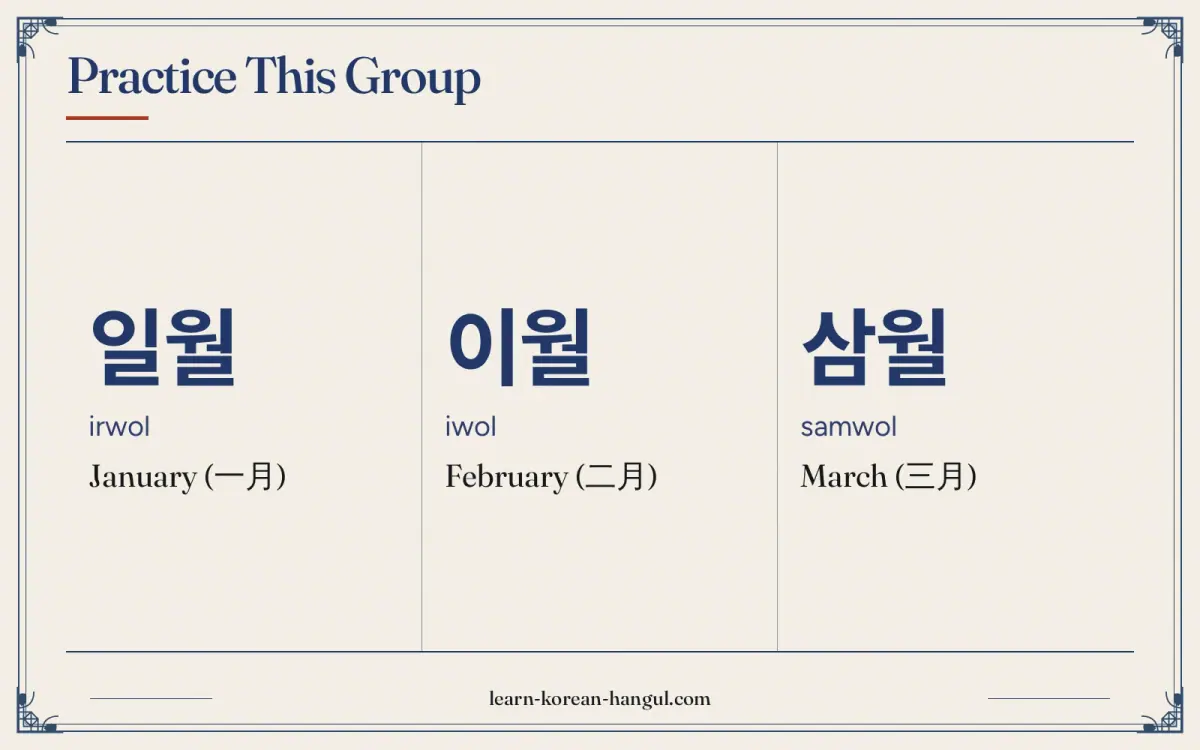
The ten flashcards below use the first word from each pair. The table shows exactly what is in the deck, so you can read it first and then test yourself.
| # | Korean | Revised Romanization | Meaning | Character note |
|---|---|---|---|---|
| 1 | 일월 | irwol | January (一月) | 一 (한 일). One stroke for "one". Also the 일 of 일요일 (Sunday), but that 일 is 日. |
| 2 | 이월 | iwol | February (二月) | 二 (두 이). Two strokes for "two". 二十 reads "two-ten" = 20. |
| 3 | 삼월 | samwol | March (三月) | 三 (석 삼). Three strokes. 三角形 = "three-corner shape", a triangle. |
| 4 | 사계절 | sagyejeol | four seasons (四季節) | 四 (넉 사). A box with strokes inside. 사계절 = spring, summer, autumn, winter. |
| 5 | 오월 | owol | May (五月) | 五 (다섯 오). Four strokes. 오월 is May; 오감 = five senses. |
| 6 | 유월 | yuwol | June (六月) | 六 (여섯 륙). A lid over two legs. June is 유월, not 육월. |
| 7 | 칠월 | chirwol | July (七月) | 七 (일곱 칠). A cross with a hooked leg. 칠월 is July; 칠십 [칠씹] is 70. |
| 8 | 팔월 | parwol | August (八月) | 八 (여덟 팔). Two strokes spreading apart. 팔월 is August; 팔십 [팔씹] is 80. |
| 9 | 구월 | guwol | September (九月) | 九 (아홉 구). A bent hook. 구구단 repeats 九: the times tables. |
| 10 | 시월 | siwol | October (十月) | 十 (열 십). A plain cross. October is 시월, not 십월. |
Practice · 10
- 01일월
Show answer
irwol
January (一月)
- 02이월
Show answer
iwol
February (二月)
- 03삼월
Show answer
samwol
March (三月)
- 04사계절
Show answer
sagyejeol
four seasons (四季節)
- 05오월
Show answer
owol
May (五月)
- 06유월
Show answer
yuwol
June (六月)
- 07칠월
Show answer
chirwol
July (七月)
- 08팔월
Show answer
parwol
August (八月)
- 09구월
Show answer
guwol
September (九月)
- 10시월
Show answer
siwol
October (十月)
Recall drill. Cover the right-hand columns of the table above and, for each Korean word, say the character, the month or number it names and its meaning aloud. Then reverse: look at 三月, 六月, 十月 and say the Hangul with the real pronunciation. Finish by saying 이 더하기 삼은 오 (2 + 3 = 5) and two sums of your own, naming the character for each number.
Check Yourself
Practice · 6
Which character is read 오 and means "five"?
Show answer
五
五 is five, read 오, as in 오월 (May). 四 is 사, 六 is 육 and 九 is 구.
What is the correct Korean for June (六月)?
Show answer
유월
六月 is 유월. The final ㄱ of 육 is dropped in this month name, and the standard spelling follows it.
What is the correct Korean for October (十月)?
Show answer
시월
十月 is 시월. Like June, October drops the final consonant of its number: 십 becomes 시.
How is 삼월 (March) actually pronounced?
Show answer
[사뭘]
The final ㅁ of 삼 moves onto the empty first slot of 월, giving [사뭘].
Two of these characters are both read 일. Which pair?
Show answer
一 and 日
一 (one) and 日 (sun, day) are both 일. Context tells you which: 일월 is January, 일요일 is Sunday.
Which spoken form is correct for 칠십 (seventy)?
Show answer
[칠씹]
After the ㄹ of 칠, the ㅅ of 십 is tense, so the word is said [칠씹].
A Four-Day Plan for This Group
- Day 1. Learn 一 to 五. Say 일월, 이월, 삼월, 사월 and 오월 while writing the character beside each.
- Day 2. Learn 六 to 十. Say 유월, 칠월, 팔월, 구월 and 시월, and mark the two irregular ones.
- Day 3. Add the second word of each pair (통일, 이십, 삼각형 and the rest) and play the ten audio buttons.
- Day 4. Run the flashcards, then the quiz. Revisit anything missed after one day.
What to Learn Next
Your next step depends on what you want from the characters. For the rest of the set, go to common hanja characters, which lists all 100. To keep working with numbers, learn the bigger units on hanja for size and quantity, or return to Sino-Korean numbers to practise dates, money and phone numbers with the sounds you now know in character form. The wider picture of how Sino-Korean words are built is on the Sino-Korean vocabulary page, and hanja word families shows how a single character opens a family of words.
Frequently Asked Questions
Do hanja numbers appear on Korean money?
Everyday Korean money is labelled with digits and Hangul number words, such as 천 원 for 1,000 won, not with 一二三. You will meet hanja numbers on traditional signs, calligraphy, some old documents and in Chinese or Japanese-style writing. Learning the ten characters still helps because the Hangul number words on money are the same sounds.
Why is June 유월 and not 육월?
June is the Sino-Korean number 六 plus 月 (month). The expected form is 육월, but standard spelling follows the spoken form 유월, with the final ㄱ dropped. October is the same: 十月 is 시월, not 십월. The other ten months keep the regular reading, such as 칠월 and 팔월.
Are hanja numbers used for dates in Korean?
Spoken Korean uses the Sino-Korean numbers, which are the readings of these characters, for months, days of the month and years: 삼월 이십일 (March 20). Written dates use digits, like 3월 20일. The characters 一二三 are not written out in daily dates, but the sounds are the ones on this page.
Can I read 一二三 without learning the rest of the hanja?
Yes. The first three characters are simply one, two and three strokes, so you can read them with no study. The remaining seven are worth learning as a set because they are short, appear in month names and number words, and every one of them reappears inside longer words in later groups.
What is the difference between 십 and 시 in 시월?
십 is the normal reading of 十 (ten) and appears in 십일 (ten days) and 십자가 (cross). In the month name the ㅂ drops, so 十月 is 시월. Spelling follows the sound: write 시월, never 십월.