Korean Hanja Radical Explained: the Essentials
A radical is the component of a character that tells a dictionary where to put it. The Korean word 부수 (部首) means "head of a section", and each of the 214 sections holds all the characters that share that head. Compare it to a library: the radical is the shelf label, and the other strokes tell you which book on the shelf.
Look at three characters that all describe bodies of water: 河 (물 하, river), 海 (바다 해, sea) and 池 (못 지, pond). Each has the same three-stroke mark on its left, 氵. That mark is the side form of 水 (water), and it is the radical. Now look at three characters about speech: 話 (말씀 화, talk), 語 (말씀 어, language) and 說 (말씀 설, explain). Each has the same 言 on its left. The table gives the radical, the characters and a word from each.
| Radical | Meaning hint | Characters | 음훈 | A Korean word |
|---|---|---|---|---|
| 氵 (side form of 水) | water | 河 | 물 하 | 하천 (河川, river) |
| 氵 | water | 海 | 바다 해 | 해외 (海外, overseas) |
| 氵 | water | 池 | 못 지 | 건전지 (乾電池, battery) |
| 言 | speech | 話 | 말씀 화 | 대화 (對話, conversation) |
| 言 | speech | 語 | 말씀 어 | 한국어 (韓國語, Korean) |
| 言 | speech | 說 | 말씀 설 | 설명 (說明, explanation) |
The 음훈 column is the traditional Korean label for a character: a meaning word, then the reading. The three water characters read 하, 해 and 지, so the radical gives no hint about sound. It gives a hint about meaning only.
The Korean word for a hanja dictionary is 옥편 (玉篇, okpyeon), and the character dictionary form is 자전 (字典, jajeon). Both organise their entries by radical and by the number of strokes (획, hoek) left after the radical. The system is the 214 radicals of the Kangxi Dictionary (康熙字典), a Chinese dictionary compiled in 1716, and Korean dictionaries follow it. Listen to the two dictionary words.
How Do Radicals Hint at Meaning?
A radical works as a category label. When you see 氵 you can think "liquid", and when you see 言 you can think "talk". This does not tell you the exact meaning, but it narrows the guess. Take the water radical. 海 is the sea, 河 a river, 湖 (호수 호) a lake and 洋 (큰바다 양) an ocean. Even a character you have never met, such as 流 (흐를 류, flow), makes sense as a water word.
The table lists five radicals with the kind of meaning they hint at and a few characters you can test the idea on.
| Radical | Hint | Example characters | What the examples show |
|---|---|---|---|
| 氵 | water, liquid | 海 바다 해, 湖 호수 호, 流 흐를 류 | All are about water or flowing. |
| 言 | speech, words | 話 말씀 화, 語 말씀 어, 計 셀 계 | Talk, language and counting. |
| 木 | tree, wood | 林 수풀 림, 校 학교 교, 植 심을 식 | Trees, wooden buildings and planting. |
| 心 | heart, feeling | 思 생각 사, 情 뜻 정, 愛 사랑 애 | Thought, emotion and love. |
| 手 | hand | 打 칠 타, 持 가질 지 | Things done with the hand. |
Read the table with a sceptical eye. 校 (school) has the tree radical 木, but a school is not a tree. The tree part is a clue to the character's history, not to what a school is. That is a normal pattern, and it is why hints work best when you add the word. In 학교, the 校 means school and the radical is just a filing label.
Radicals also take side forms. 水 becomes 氵, called 삼수변 (samsubyeon, "three-drop side"). 手 becomes 扌, called 재방변 (jaebangbyeon). 人 becomes 亻, called 사람인변 (saraminbyeon, [사라민변]). 心 becomes 忄, called 심방변 (simbangbyeon). 艸 becomes 艹 on top, called 초두머리 (chodumeori). So learn to recognise each common radical in both shapes.
Try It: Split Five Characters
Practise the skill on five characters. For each one, find the radical, name what is left, and make a first guess about the meaning. Then compare with the answer in the last column.
| Character | Radical | The rest | First guess | 음훈 and a word |
|---|---|---|---|---|
| 湖 | 氵 water | 胡 (sound part) | a body of water | 호수 호; 호수 (湖水, lake) |
| 花 | 艹 grass | 化 (sound part) | a plant | 꽃 화; 화분 (花盆, flowerpot) |
| 思 | 心 heart | 田 | a mental act | 생각 사; 사고 (思考, thinking) |
| 林 | 木 tree | 木 | many trees | 수풀 림; 산림 (山林, forest) |
| 休 | 亻 person | 木 | a person by a tree | 쉴 휴; 휴일 (休日, day off) |
The guesses are only guesses, and that is fine. The point is to have a starting idea before you check the 음훈. When the guess and the answer agree, the memory sticks. When they do not, as with 思, where the heart radical sits under a field, the surprise helps you remember too. The person-by-a-tree picture of 休 is a classic memory aid, and it works because the radical and the other part both mean something you can see.
What Is the Difference between Radical and Phonetic Part?
Most hanja are built from two kinds of part: a semantic component (the radical or another meaning part) that hints at meaning, and a phonetic component that hints at the reading. The family of 靑 (푸를 청, blue-green) shows both at work. The sound part 靑 reads 청, and each partner adds a meaning.
| Character | 음훈 | Meaning part | Sound part | What the parts tell you |
|---|---|---|---|---|
| 淸 | 맑을 청 | 氵 water | 靑 청 | clear water, so clear and pure |
| 晴 | 갤 청 | 日 sun | 靑 청 | a clear sky, a day with sun |
| 請 | 청할 청 | 言 speech | 靑 청 | to ask or request, with words |
| 情 | 뜻 정 | 忄 heart | 靑 (sound is now 정) | feeling, from the heart |
Two things to learn from this. First, the same sound part with different radicals gives a family of related readings: 淸, 晴 and 請 are all 청, so once you know one you can guess the readings of the others. Second, sound parts are only close, not exact. 情 is read 정, not 청, because the sounds have drifted over time. So use the sound part as a hint to confirm a reading, not as a rule. Some Korean words made from this family are 청소 (淸掃, cleaning) and 신청 (申請, application).
There is one more term to separate. A component is any recognisable part of a character. A radical is the one component the dictionary chooses as the filing head. In 河, the components are 氵 and 可, and only 氵 is the radical. In 海, the components are 氵 and 每, and again 氵 is the radical. Every radical is a component, but not every component is a radical, so you can learn 可 and 每 as sound parts without adding them to your radical list.
How Many Radicals Should You Learn?
About 30. The full system has 214 radicals, but many are rare, and a small group files a large share of everyday characters. Here is how the three levels compare.
| Level | Radicals | What it is for |
|---|---|---|
| Starter | 10 | Recognise the commonest meaning hints, such as 氵, 木, 口, 言, 心. |
| Working set | 30 | Guess the topic of many characters in basic hanja lists and look characters up. |
| Full system | 214 | Use a printed dictionary for any character, including rare ones. |
The common hanja radicals page lists the 30 with their Korean names, meanings and examples. At five radicals a week, that is six weeks, and each week pairs well with a theme group from basic hanja. Learn the radicals inside real characters, not as a list on its own, and the 214 will take care of themselves.
What Are the Limits of Radicals?
Radicals help, but they have limits, and it is better to know them early.
- They hint at meaning, never define it. 氵 tells you "water-ish", not what the character means. Always read the 음훈.
- The hint can be indirect. 校 (school) sits under 木 (tree) for historical reasons, and 問 (ask) sits under 口 (mouth), not 門.
- The radical is not always on the left. It can be on the top (艹 in 花), at the bottom (心 in 思), on the right, or around the character (門 in 間).
- They do not tell you the reading. Sound parts do, and only roughly.
- Different dictionaries differ. Korean dictionaries use the 214 radicals. Some Chinese dictionaries use a smaller set, so a radical number from a Chinese app may not match a Korean 옥편.
- A few characters are their own radical. 木, 口 and 門 file themselves.
Radicals are a tool for two jobs: guessing the topic of a new character and looking it up. The second job is covered step by step in the guide to Korean hanja lookup. The first job is what makes basic hanja easier to remember. Writing characters is a separate skill, covered in how to write hanja.
Practice: Flashcards and Quiz
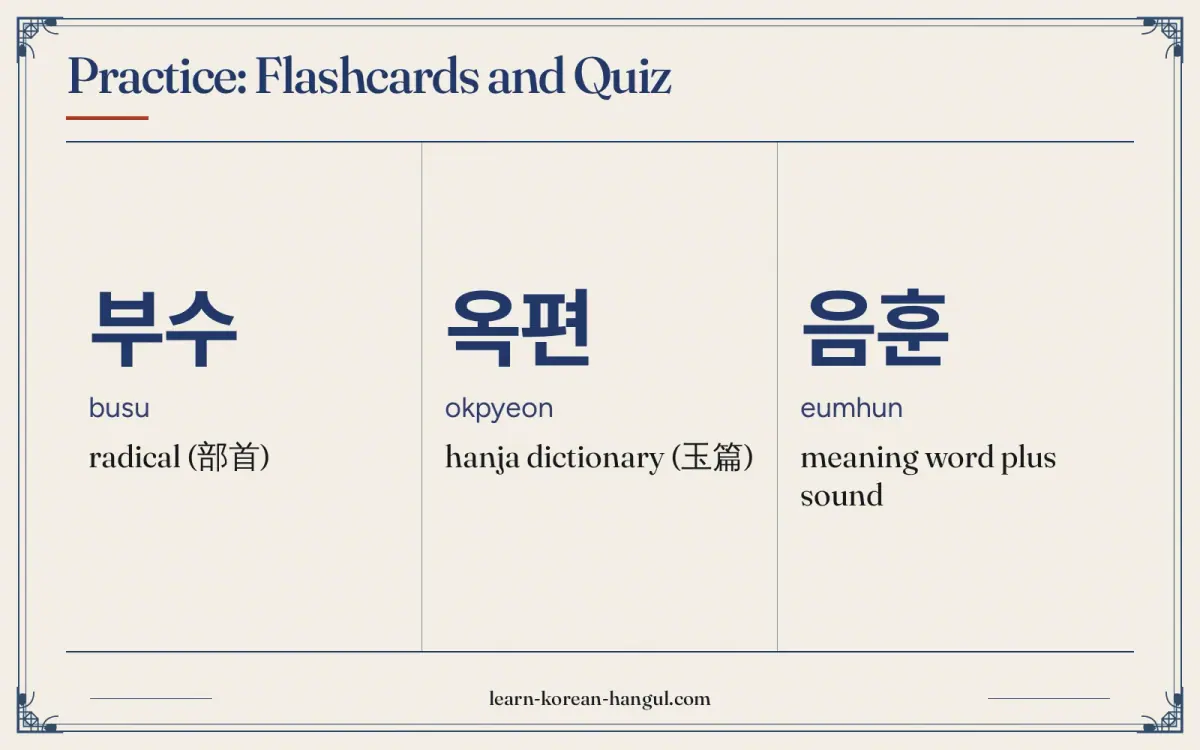
Ten cards cover the words and radical names from this page. Say each one aloud before you reveal the meaning. The table lists all ten cards.
| Korean | RR | Meaning | Note |
|---|---|---|---|
| 부수 | busu | radical (部首) | The head of a section in a hanja dictionary. |
| 옥편 | okpyeon | hanja dictionary (玉篇) | Organised by radical and stroke count. |
| 음훈 | eumhun | meaning word plus sound | For 海 it is 바다 해. |
| 획 | hoek | stroke | One pen movement in a character. |
| 삼수변 | samsubyeon | water radical on the left (氵) | Side form of 水. |
| 재방변 | jaebangbyeon | hand radical on the left (扌) | Side form of 手. |
| 사람인변 | saraminbyeon | person radical on the left (亻) | Said [사라민변]. Side form of 人. |
| 심방변 | simbangbyeon | heart radical on the left (忄) | Side form of 心. |
| 초두머리 | chodumeori | grass radical on top (艹) | Side form of 艸. |
| 자전 | jajeon | character dictionary (字典) | Another word for a hanja dictionary. |
Practice · 10
- 01부수
Show answer
busu
radical (部首)
- 02옥편
Show answer
okpyeon
hanja dictionary (玉篇)
- 03음훈
Show answer
eumhun
meaning word plus sound
- 04획
Show answer
hoek
stroke
- 05삼수변
Show answer
samsubyeon
water radical on the left (氵)
- 06재방변
Show answer
jaebangbyeon
hand radical on the left (扌)
- 07사람인변
Show answer
saraminbyeon
person radical on the left (亻)
- 08심방변
Show answer
simbangbyeon
heart radical on the left (忄)
- 09초두머리
Show answer
chodumeori
grass radical on top (艹)
- 10자전
Show answer
jajeon
character dictionary (字典)
Then check what you learned with six questions.
Practice · 6
What does 부수 mean in a hanja dictionary?
Show answer
the radical used to file a character
A 부수 is the radical, the head of the section where a character is filed.
Which radical do 河, 海 and 池 share?
Show answer
氵 (water)
All three have the water radical 氵 on the left, the side form of 水.
In 淸, 晴 and 請, which part is the sound part?
Show answer
靑
靑 (청) gives the reading. 氵, 日 and 言 are the meaning parts of the three characters.
How many radicals do Korean hanja dictionaries use?
Show answer
214
Korean dictionaries follow the 214 radicals of the Kangxi Dictionary. A beginner needs about 30.
Which statement about radicals is true?
Show answer
A radical hints at meaning but does not define it
A radical gives a hint about meaning. It does not give the reading, can sit anywhere, and each character has one.
Which mark is the side form of 水 (water)?
Show answer
氵
氵 is the side form of 水. 扌 is 手 (hand), 亻 is 人 (person) and 忄 is 心 (heart).
Where to Go Next
To learn the radicals that matter, go to common hanja radicals, where 30 are grouped by theme. To use them, go to Korean hanja lookup. For an overview of the whole section, see hanja radicals, and for the bigger picture of where hanja fit in Korean, return to the hanja hub. The word family of one of your first characters, 學, is on hanja 學.
Frequently Asked Questions
How many radicals do I need?
About 30 are enough to start. The full system has 214 radicals, but the beginner's goal is to guess the topic of a character and look it up, and 30 common radicals cover a large share of the characters in basic lists. Add the rest when you meet them in a dictionary. Learn radicals inside characters you already want to know, not as a separate list.
Is the radical always on the left?
No. The left side is the most common place, as in 海 and 休, but radicals also sit on top (艹 in 花), at the bottom (心 in 思), on the right, or around the other parts (門 in 間). Some characters are radicals by themselves, such as 木 and 口. The dictionary entry is the only sure test.
Can the radical be wrong as a hint?
It can be misleading. The radical is chosen for filing, not for meaning, so the link is sometimes indirect or only historical. 校 (school) is under 木 (tree), and 問 (ask) is under 口 (mouth). Use the radical as a first guess, then confirm the meaning with the 음훈 and the words the character builds.
What is the difference between radical and component?
A component is any recognisable part of a character. A radical is the one component the dictionary uses as the filing head. 河 has two components, 氵 and 可, and only 氵 is the radical. Every radical is a component, but not every component is a radical.
What does 부수 mean?
부수 (部首) is the Korean word for radical. It literally means "head of a section": 部 is a section or division, and 首 is a head. In a hanja dictionary, 부수 is the label under which all characters sharing that component are grouped, and 부수 색인 is the radical index you use to find them.