Common Hanja Radicals: the Essentials
Common hanja radicals are the components that head the largest sections of a hanja dictionary and the characters you meet most in basic vocabulary. The 30 here were chosen for three tests: the radical files many characters, it hints at a clear meaning, and it appears in the 100 core hanja of basic hanja or in the words they build. No official body publishes a ranking of radicals, so treat the list as a practical starting set.
Every row in the tables below has the same five parts. The radical is the full form. The Korean name is its 음훈, the meaning word plus the reading, and, where there is one, the special name used for its side form. The meaning hint is the category it points to. Two example characters follow, each with its 음훈 and a Korean word that uses it. Examples marked with an asterisk are among the 100 core hanja. If the idea of a radical is new, read Korean hanja radical explained first.
Six to Learn First
If you learn only a few, start with these six, which head some of the largest groups in the Kangxi system:
- 氵 (water). Seas, rivers and liquids: 海, 河, 湖.
- 艹 (grass). Plants and herbs: 花, 茶.
- 木 (tree). Trees and wood: 林, 校.
- 口 (mouth). Eating, speaking and openings: 味, 問.
- 亻 (person). People and what they do: 休, 作.
- 言 (speech). Talk and language: 話, 語.
The next five sections give all 30, group by group. The Korean name column is what you will hear if you ask a Korean teacher or look in a Korean dictionary.
Which Radicals Relate to Nature?
Seven radicals cover water, trees, fire, earth, sun, plants and mountains. They are the easiest to remember because you can picture them.
| Radical | Korean name | Meaning hint | Example 1 | Example 2 |
|---|---|---|---|---|
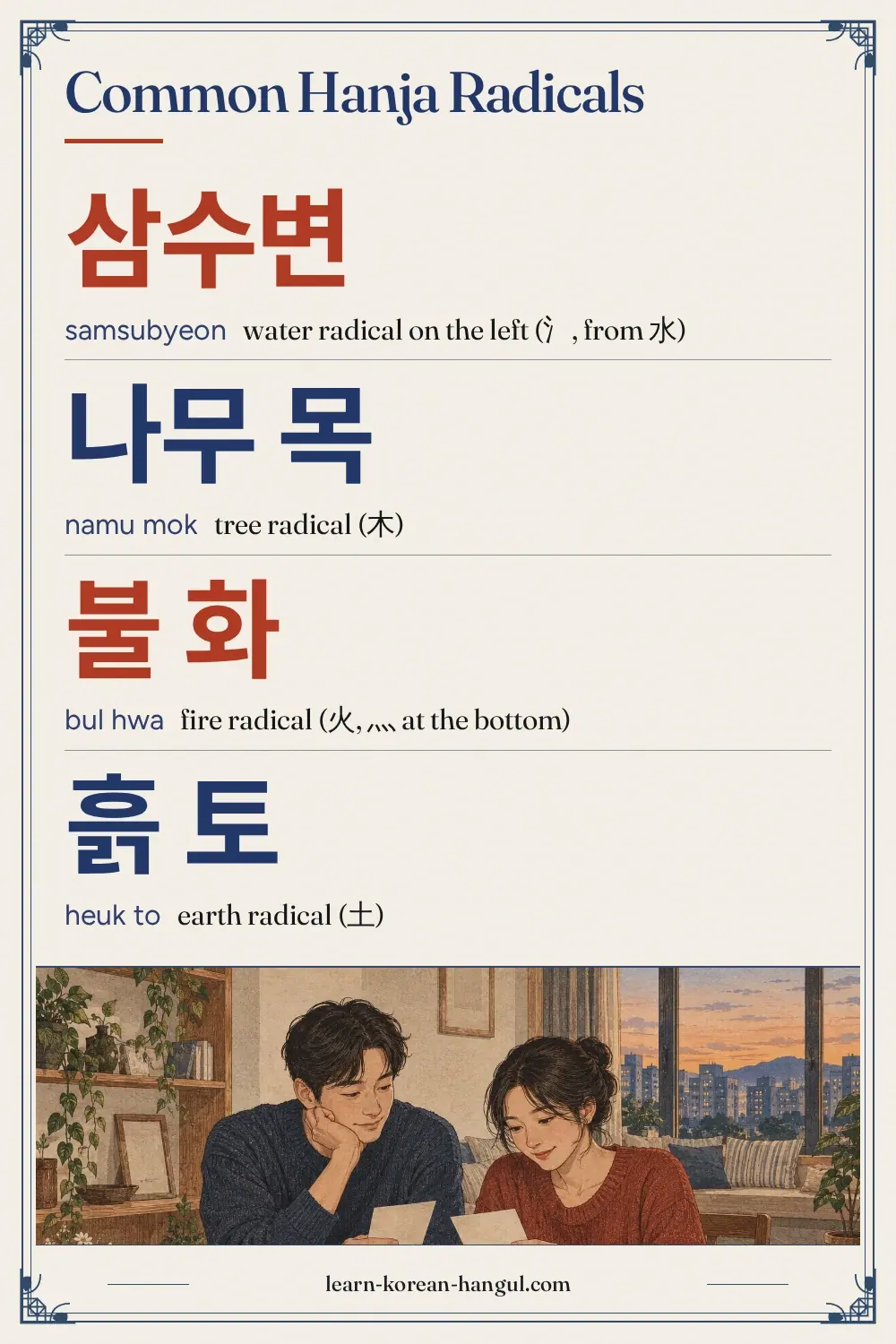
| 水 (氵) | 물 수; 삼수변 (氵) | water, liquid | 海 바다 해: 해외 (haeoe) | 漢 한수 한: 한자 (hanja) |
| 木 | 나무 목 | tree, wood | 校* 학교 교: 학교 (hakgyo) | 林 수풀 림: 산림 (sallim) |
| 火 (灬) | 불 화 | fire, heat | 煙 연기 연: 금연 (geumyeon) | 然 그럴 연: 자연 (jayeon) |
| 土 | 흙 토 | earth, ground | 地 땅 지: 지구 (jigu) | 場* 마당 장: 시장 (sijang) |
| 日 | 날 일 | sun, day | 明 밝을 명: 설명 (seolmyeong) | 時* 때 시: 시간 (sigan) |
| 艸 (艹) | 풀 초; 초두머리 (艹) | grass, plants | 花 꽃 화: 화분 (hwabun) | 茶 차 다/차: 녹차 (nokcha) |
| 山 | 메 산 | mountain | 島 섬 도: 반도 (bando) | 岩 바위 암: 암석 (amseok) |
水. The commonest meaning hint of all. It heads seas, rivers, liquids and flowing. 漢 is the Han river, and the name later came to stand for China, which is why 한자 means "Han characters".
木. Trees and wooden things. It stacks: 林 is two trees, a grove, and 森 is three. 校 is under 木 for historical reasons.
火. Fire and heat. At the bottom of a character it shrinks to four dots, 灬, called 연화발. 자연 (自然) is a word for nature.
土. Soil, ground and places. 地 is land, and 場 is an open place, which is why 土 turns up in so many place words.
日. The sun, light and time. 明 puts sun 日 beside moon 月 for brightness, and 時 is a point in the day.
艸. Plants, grass and herbs. It sits on top of the character, where it looks like a small cross with two ticks. 茶 has two readings, 다 and 차.
山. Mountains, islands and rocks. 메 is an old word for a mountain. 반도 (半島) is half-island, a peninsula, as in 한반도.
You may already know five of these seven without knowing it. The weekday names 월요일, 화요일, 수요일, 목요일, 금요일, 토요일 and 일요일 are built from 月, 火, 水, 木, 金, 土 and 日, so 水, 木, 火, 土 and 日 are the days Wednesday, Thursday, Tuesday, Saturday and Sunday. With 金 (Friday) in the objects group, six of the seven weekday characters are radicals in this list. Only 月 (Monday, the moon) is missing, and it is a radical in its own right.
Which Radicals Relate to the Body?
Five radicals cover the mouth, the hand, the heart, the eye and the foot. They hint at things people do with their bodies and feelings.
| Radical | Korean name | Meaning hint | Example 1 | Example 2 |
|---|---|---|---|---|
| 口 | 입 구 | mouth, opening | 味 맛 미: 의미 (uimi) | 問 물을 문: 질문 (jilmun) |
| 手 (扌) | 손 수; 재방변 (扌) | hand, action | 打 칠 타: 타자 (taja) | 持 가질 지: 지속 (jisok) |
| 心 (忄) | 마음 심; 심방변 (忄) | heart, feeling | 情 뜻 정: 감정 (gamjeong) | 思 생각 사: 사고 (sago) |
| 目 | 눈 목 | eye, seeing | 看 볼 간: 간판 (ganpan) | 眼 눈 안: 안경 (angyeong) |
| 足 | 발 족 | foot, leg | 路 길 로: 노선 (noseon) | 跳 뛸 도: 도약 (doyak) |
口. The mouth, eating, speaking and openings. It is one of the largest groups, and as a plain box it also appears as a sound part in other characters.
手. Things done with the hand: hitting, holding, carrying. On the left it takes the side form 扌, called 재방변.
心. The heart as the seat of feeling and thought. On the left it is 忄, called 심방변. At the bottom it stays 心.
目. The eye and seeing. 看 puts a hand 手 over an eye 目, "to look at". 안경 (眼鏡) is "eye mirror", glasses.
足. The foot, legs and walking. Movement characters that use the whole leg often carry 足.
These five are also body words you can use today. 口 is 입 (mouth) in many speech and eating characters, and it appears as the "opening" in 입구 (entrance) and 출구 (exit). 目 is the eye in 안경 (glasses) and in 목적 (目的, aim, literally "eye target"). 心 stays 心 when it sits at the bottom, as in 思, 愛 (사랑 애, love) and 感 (느낄 감, feel), the last of which gives 감정 and 감사 (感謝, thanks). The hand and foot radicals mark the motion characters.
Which Radicals Relate to People and Speech?
Four radicals cover a person, a woman, a child and speech. They are the radicals of relationships and language.
| Radical | Korean name | Meaning hint | Example 1 | Example 2 |
|---|---|---|---|---|
| 人 (亻) | 사람 인; 사람인변 (亻) | person | 休 쉴 휴: 휴일 (hyuil) | 作 지을 작: 작가 (jakga) |
| 女 | 계집 녀 | woman, female | 好 좋을 호: 호감 (hogam) | 妹 누이 매: 자매 (jamae) |
| 子 | 아들 자 | child, son | 字* 글자 자: 한자 (hanja) | 孫 손자 손: 손자 (sonja) |
| 言 | 말씀 언 | speech, words | 話 말씀 화: 대화 (daehwa) | 語* 말씀 어: 한국어 (hangugeo) |
人. People and what they do. On the left it is 亻, called 사람인변 and said [사라민변]. 休 is a person leaning on a tree.
女. Women and female relatives. 好 puts a woman 女 with a child 子. 계집 is an old word for a woman, and the 음훈 is dated.
子. Children and descendants. 字 puts a child 子 under a roof 宀. The same radical is in 學.
言. Speech, language and words. It is one of the most useful radicals for learners, because it is on so many vocabulary characters.
Be careful with a pair of look-alikes: 亻 (two strokes, person) and 彳 (three strokes, step). One extra stroke changes the meaning. 亻 sits in 休 and 作 and means a person, while 彳 sits in 後 and 待 and means going. The child radical 子 appears in 學, so you have already seen it in the school group. The speech radical 言 is in nearly every word about talking, reading and counting, which makes it one of the most rewarding to know.
Which Radicals Relate to Actions and Movement?
Four radicals cover strength, steps, walking and doing. Characters with these radicals often describe movement or effort.
| Radical | Korean name | Meaning hint | Example 1 | Example 2 |
|---|---|---|---|---|
| 力 | 힘 력 | strength, effort | 動* 움직일 동: 운동 (undong) | 勉 힘쓸 면: 근면 (geunmyeon) |
| 彳 | 자축거릴 척; 두인변 | step, going | 後* 뒤 후: 오후 (ohu) | 待 기다릴 대: 기대 (gidae) |
| 辵 (辶) | 쉬엄쉬엄 갈 착; 책받침 | walking, roads | 道 길 도: 도로 (doro) | 通 통할 통: 교통 (gyotong) |
| 攴 (攵) | 칠 복; 등글월문 | tap, do, teach | 敎* 가르칠 교: 교실 (gyosil) | 改 고칠 개: 개선 (gaeseon) |
力. Strength and effort. 動 is a heavy 重 plus 力. At the start of a word 力 is 역 (역도, weightlifting), and elsewhere 력 (능력, ability).
彳. A step with the left foot. It is the left half of 行 (go) and sits on the left of movement and time words.
辵. Walking, roads and passing through. It wraps around the left and bottom of a character, and is called 책받침.
攴. A hand with a stick, doing or striking. It sits on the right of characters such as 敎, "teach", and 改, "change".
These four often sit on the left or bottom edge and wrap around the character. Take 辶 in 近 (가까울 근, near) and 遠 (멀 원, far), which give 근처 (近處, nearby) and 원거리 (遠距離, long distance). A pair of opposites that share a radical is a good way to remember it. 力 also hides inside 男 (사내 남), the man, although the dictionary files 男 under 田 (field). The right-hand 攵 often means "do" or "make happen", as in 敎 and 改.
Which Radicals Relate to Objects and Buildings?
Ten radicals cover metals, thread, bamboo, shells, carts, food, knives, clothes, gates and roofs. They head the words for things people make and use.
| Radical | Korean name | Meaning hint | Example 1 | Example 2 |
|---|---|---|---|---|
| 金 | 쇠 금 | metal, gold | 銀 은 은: 은행 (eunhaeng) | 鐵 쇠 철: 지하철 (jihacheol) |
| 糸 | 실 사 | thread, silk | 紙 종이 지: 용지 (yongji) | 線 줄 선: 직선 (jikseon) |
| 竹 | 대 죽 | bamboo | 筆 붓 필: 필기 (pilgi) | 算 셈 산: 계산 (gyesan) |
| 貝 | 조개 패 | shell, money | 財 재물 재: 재산 (jaesan) | 買 살 매: 구매 (gumae) |
| 車 | 수레 거/차 | cart, vehicle | 軍 군사 군: 군인 (gunin) | 輪 바퀴 륜: 이륜차 (iryuncha) |
| 食 (飠) | 밥 식; 밥식변 | food, eating | 飮 마실 음: 음료 (eumnyo) | 飯 밥 반: 반찬 (banchan) |
| 刀 (刂) | 칼 도; 선칼도방 | knife, cut | 別 다를 별: 특별 (teukbyeol) | 利 이로울 리: 편리 (pyeolli) |
| 衣 (衤) | 옷 의; 옷의변 | clothing | 表 겉 표: 발표 (balpyo) | 複 겹칠 복: 복잡 (bokjap) |
| 門 | 문 문 | gate, door | 間* 사이 간: 시간 (sigan) | 開 열 개: 개학 (gaehak) |
| 宀 | 집 면; 갓머리 | roof, house | 家* 집 가: 가족 (gajok) | 室 집 실: 욕실 (yoksil) |
金. Metals, money and tools. 金 is also the common surname 김 (Kim) and the word for gold and money, 금.
糸. Thread, cloth and things made of fibre. Paper was once made from fibres, which is why 紙 has this radical.
竹. Bamboo, and things made of it: pens, slips and counting rods. That is why writing and counting characters carry it.
貝. Shells, which were used as money in ancient China, so this radical heads money and trade words.
車. Carts and vehicles. 車 reads 거 or 차: 차 in 자동차 and 거 in 자전거. 軍 is a cover over a cart, a war chariot.
食. Food and eating. Its side form is 飠, called 밥식변. 반찬 are the small dishes served with rice.
刀. Knives, cutting and dividing. On the right it is 刂, called 선칼도방. 別 is cutting things apart, hence "different".
衣. Clothes and coverings. On the left it is 衤, called 옷의변. 表 is the outside layer of a garment, "surface".
門. Gates, doors and openings. It wraps around its contents: 間 is a sun in a gate, and 開 is a gate with a bar.
宀. Roofs and buildings. It sits on top and is called 갓머리, "hat head". 家 is a pig under a roof, an old picture of a home.
Here the radicals name materials and things. 金 appears at the left of many metal characters, including 鏡 (거울 경, mirror), which is the second half of 안경 (眼鏡, glasses). 糸 heads cloth and thread words, 竹 heads writing and counting tools, 貝 heads money words, 車 heads vehicle words, 食 heads food, 刀 heads cutting, 衣 heads clothing, and 門 and 宀 enclose, like a gate or a roof. Group the ten by use, not by shape, and they stick more easily.
How Do Radicals Work inside a Real Character?
Most hanja are built from a meaning part and a sound part. The radical is usually the meaning part. Work through four examples to see the pattern, then use the same method on any character.
| Character | Radical (meaning) | Other part (sound) | Reading | What it tells you |
|---|---|---|---|---|
| 校 | 木 tree | 交 교 | 교 | the sound part matches exactly; the tree is only a filing clue |
| 財 | 貝 shell, money | 才 재 | 재 | the sound part matches exactly; money explains the meaning |
| 語 | 言 speech | 吾 오 | 어 | the sound is close, and speech explains the meaning |
| 情 | 忄 heart | 靑 청 | 정 | the sound has drifted, and the heart explains the meaning |
Read the table from left to right. The radical says what kind of thing it is, the other part says roughly how it sounds, and the reading column is the truth. In 校 and 財 the match is exact. In 語 and 情 it is only close. That is why the sound part helps you confirm a reading but never replaces the 음훈. The radical page on Korean hanja radical explained shows the same method on the 靑 family.
What Are the Variant Forms (compared)?
Eleven radicals change shape when they sit on the left, on the right, on top or at the bottom. The side form is not a new radical. The dictionary still files the character under the full form, so 海 is under 水, not under 氵. The Korean names of the side forms usually end in 변 (side), 머리 (head), 발 (foot) or 방 (right side), which tell you where the radical sits.
| Full form | Variant | Korean name | Position | Example |
|---|---|---|---|---|
| 水 | 氵 | 삼수변 | left | 海 |
| 手 | 扌 | 재방변 | left | 打 |
| 人 | 亻 | 사람인변 | left | 休 |
| 心 | 忄 | 심방변 | left | 情 |
| 艸 | 艹 | 초두머리 | top | 花 |
| 火 | 灬 | 연화발 | bottom | 然 |
| 刀 | 刂 | 선칼도방 | right | 別 |
| 辵 | 辶 | 책받침 | left and bottom | 道 |
| 衣 | 衤 | 옷의변 | left | 複 |
| 食 | 飠 | 밥식변 | left | 飮 |
| 攴 | 攵 | 등글월문 | right | 敎 |
A good habit: when a new character has a mark on its left you do not know, look it up in this table. Most of the time it is a side form of a radical you already know. The side forms of 水, 手, 人 and 心 alone explain a large share of left-hand marks in common hanja. The meaning stays the same: 忄 is still the heart.
Practice Set
The best way to learn the radicals is to study them in small batches. Here is a six-week plan: learn five radicals a week, spend ten minutes a day on five days (50 minutes a week), and finish in 300 minutes, which is five hours in all. Each week, choose one batch from the tables above and pair it with a theme group from basic hanja.
| Week | Radicals | Check word |
|---|---|---|
| 1 | 水, 木, 火, 土, 日 | 설명 (說明) |
| 2 | 艸, 山, 口, 手, 心 | 질문 (質問) |
| 3 | 目, 足, 人, 女, 子 | 휴일 (休日) |
| 4 | 言, 力, 彳, 辵, 攴 | 교통 (交通) |
| 5 | 金, 糸, 竹, 貝, 車 | 지하철 (地下鐵) |
| 6 | 食, 刀, 衣, 門, 宀 | 가족 (家族) |
Thirty flashcards follow, one for each radical. The Korean side shows the name, and the other side shows the meaning and which radical it is. The table lists every card.
| Korean | RR | Meaning |
|---|---|---|
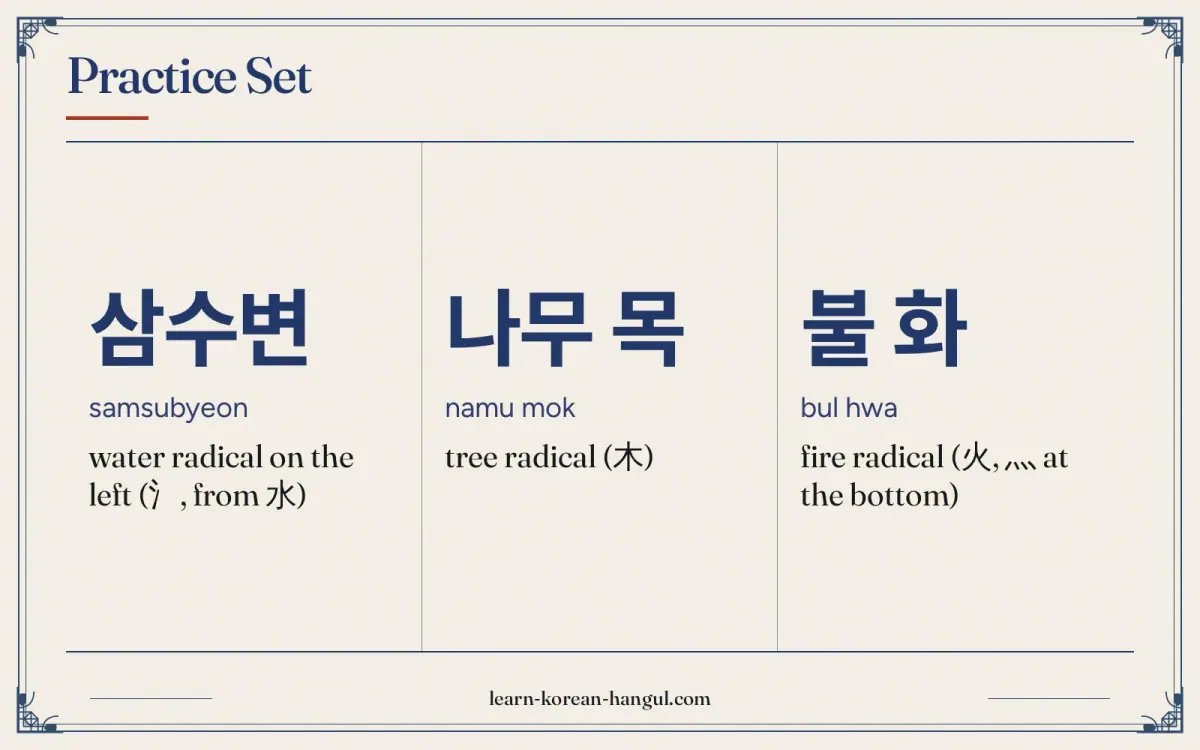
| 삼수변 | samsubyeon | water radical on the left (氵, from 水) |
| 나무 목 | namu mok | tree radical (木) |
| 불 화 | bul hwa | fire radical (火, 灬 at the bottom) |
| 흙 토 | heuk to | earth radical (土) |
| 날 일 | nal il | sun radical (日) |
| 초두머리 | chodumeori | grass radical on top (艹, from 艸) |
| 메 산 | me san | mountain radical (山) |
| 입 구 | ip gu | mouth radical (口) |
| 재방변 | jaebangbyeon | hand radical on the left (扌, from 手) |
| 심방변 | simbangbyeon | heart radical on the left (忄, from 心) |
| 눈 목 | nun mok | eye radical (目) |
| 발 족 | bal jok | foot radical (足) |
| 사람인변 | saraminbyeon | person radical on the left (亻, from 人) |
| 계집 녀 | gyejip nyeo | woman radical (女) |
| 아들 자 | adeul ja | child radical (子) |
| 말씀 언 | malsseum eon | speech radical (言) |
| 힘 력 | him ryeok | strength radical (力) |
| 두인변 | duinbyeon | step radical on the left (彳) |
| 책받침 | chaekbatchim | walk radical on the left and bottom (辶, from 辵) |
| 등글월문 | deunggeurwolmun | strike radical on the right (攵, from 攴) |
| 쇠 금 | soe geum | metal radical (金) |
| 실 사 | sil sa | thread radical (糸) |
| 대 죽 | dae juk | bamboo radical (竹) |
| 조개 패 | jogae pae | shell radical (貝) |
| 수레 거 | sure geo | cart radical (車) |
| 밥 식 | bap sik | food radical (食) |
| 칼 도 | kal do | knife radical (刀, 刂 on the right) |
| 옷 의 | ot ui | clothes radical (衣, 衤 on the left) |
| 문 문 | mun mun | gate radical (門) |
| 갓머리 | ganmeori | roof radical on top (宀) |
Practice · 30
- 01삼수변
Show answer
samsubyeon
water radical on the left (氵, from 水)
- 02나무 목
Show answer
namu mok
tree radical (木)
- 03불 화
Show answer
bul hwa
fire radical (火, 灬 at the bottom)
- 04흙 토
Show answer
heuk to
earth radical (土)
- 05날 일
Show answer
nal il
sun radical (日)
- 06초두머리
Show answer
chodumeori
grass radical on top (艹, from 艸)
- 07메 산
Show answer
me san
mountain radical (山)
- 08입 구
Show answer
ip gu
mouth radical (口)
- 09재방변
Show answer
jaebangbyeon
hand radical on the left (扌, from 手)
- 10심방변
Show answer
simbangbyeon
heart radical on the left (忄, from 心)
- 11눈 목
Show answer
nun mok
eye radical (目)
- 12발 족
Show answer
bal jok
foot radical (足)
- 13사람인변
Show answer
saraminbyeon
person radical on the left (亻, from 人)
- 14계집 녀
Show answer
gyejip nyeo
woman radical (女)
- 15아들 자
Show answer
adeul ja
child radical (子)
- 16말씀 언
Show answer
malsseum eon
speech radical (言)
- 17힘 력
Show answer
him ryeok
strength radical (力)
- 18두인변
Show answer
duinbyeon
step radical on the left (彳)
- 19책받침
Show answer
chaekbatchim
walk radical on the left and bottom (辶, from 辵)
- 20등글월문
Show answer
deunggeurwolmun
strike radical on the right (攵, from 攴)
- 21쇠 금
Show answer
soe geum
metal radical (金)
- 22실 사
Show answer
sil sa
thread radical (糸)
- 23대 죽
Show answer
dae juk
bamboo radical (竹)
- 24조개 패
Show answer
jogae pae
shell radical (貝)
- 25수레 거
Show answer
sure geo
cart radical (車)
- 26밥 식
Show answer
bap sik
food radical (食)
- 27칼 도
Show answer
kal do
knife radical (刀, 刂 on the right)
- 28옷 의
Show answer
ot ui
clothes radical (衣, 衤 on the left)
- 29문 문
Show answer
mun mun
gate radical (門)
- 30갓머리
Show answer
ganmeori
roof radical on top (宀)
Then try to guess the meaning area from the radical. Eight questions follow.
Practice · 8
The characters 湖, 洋 and 流 all share 氵. What area of meaning do they point to?
Show answer
water
氵 is the side form of 水, so these are water words: lake, ocean and flow.
Which radical would you expect in a character about speaking, such as 話?
Show answer
言
言 is the speech radical. 話 means talk.
Which pair is correct?
Show answer
手 → 扌
扌 is the side form of 手 (hand). 氵 is 水, 亻 is 人 and 艹 is 艸.
銀 (silver) and 鐵 (iron) share which radical?
Show answer
金 (metal)
Both are metals, filed under 金.
Where does the grass radical 艹 usually sit?
Show answer
on top of the character
艹 sits on top, as in 花 and 茶. It is called 초두머리, "grass head".
Which radical heads 財 (property) and 買 (buy)?
Show answer
貝 (shell)
Shells were once money, so 貝 heads money and trade words.
Which name belongs to the radical 亻?
Show answer
사람인변
亻 is the side form of 人 (person), called 사람인변. 삼수변 is 氵, 재방변 is 扌 and 심방변 is 忄.
Which word contains the roof radical 宀?
Show answer
가족 (家族)
家 has the roof radical 宀. The other words use 金, 言/日 and 口.
Where to Go Next
Use the radicals in two ways. To look up a character you cannot read, follow the steps in Korean hanja lookup. To understand how a radical works inside a character, with sound parts and meaning parts, return to Korean hanja radical explained. The section overview is at hanja radicals, and the radicals pair well with the groups in basic hanja, starting with hanja for school and learning. The full set of 100 characters is on 100 useful hanja.
Frequently Asked Questions
Which radicals are most common?
The biggest groups in the Kangxi system include grass (艸), water (水), wood (木), mouth (口), hand (手) and heart (心). Person (人), speech (言) and metal (金) are also very frequent. This page's list of 30 starts from those and adds the radicals of the 100 core hanja. No official source ranks the radicals, so treat the order as a teaching choice.
Are variant forms separate radicals?
No. 氵, 扌, 亻, 忄 and 艹 are side forms of 水, 手, 人, 心 and 艸. A dictionary files them under the full form, so the 214 count does not include them. They matter because you will see them in characters far more often than the full forms.
How do I memorise radicals?
Learn them inside characters, not as a bare list. Take five radicals a week and attach each to two characters you want to learn anyway. Say the Korean name aloud, picture the object (water, tree, mouth), and test yourself with the flashcards. Ten minutes a day for six weeks is enough for all 30.
What does the radical 氵 mean?
氵 is the side form of 水, "water". It is called 삼수변 in Korean. Characters with it usually have to do with water, liquids or flowing: 海 (sea), 河 (river), 湖 (lake), 流 (flow). It is only a hint, so confirm the meaning with the character's 음훈.
Do I need to learn the radical numbers?
No. The numbers (1 to 214) are used by printed dictionaries and some apps to order the sections, but you can look up characters without them. If you use an index by radical, the stroke count of the radical matters more than its number.