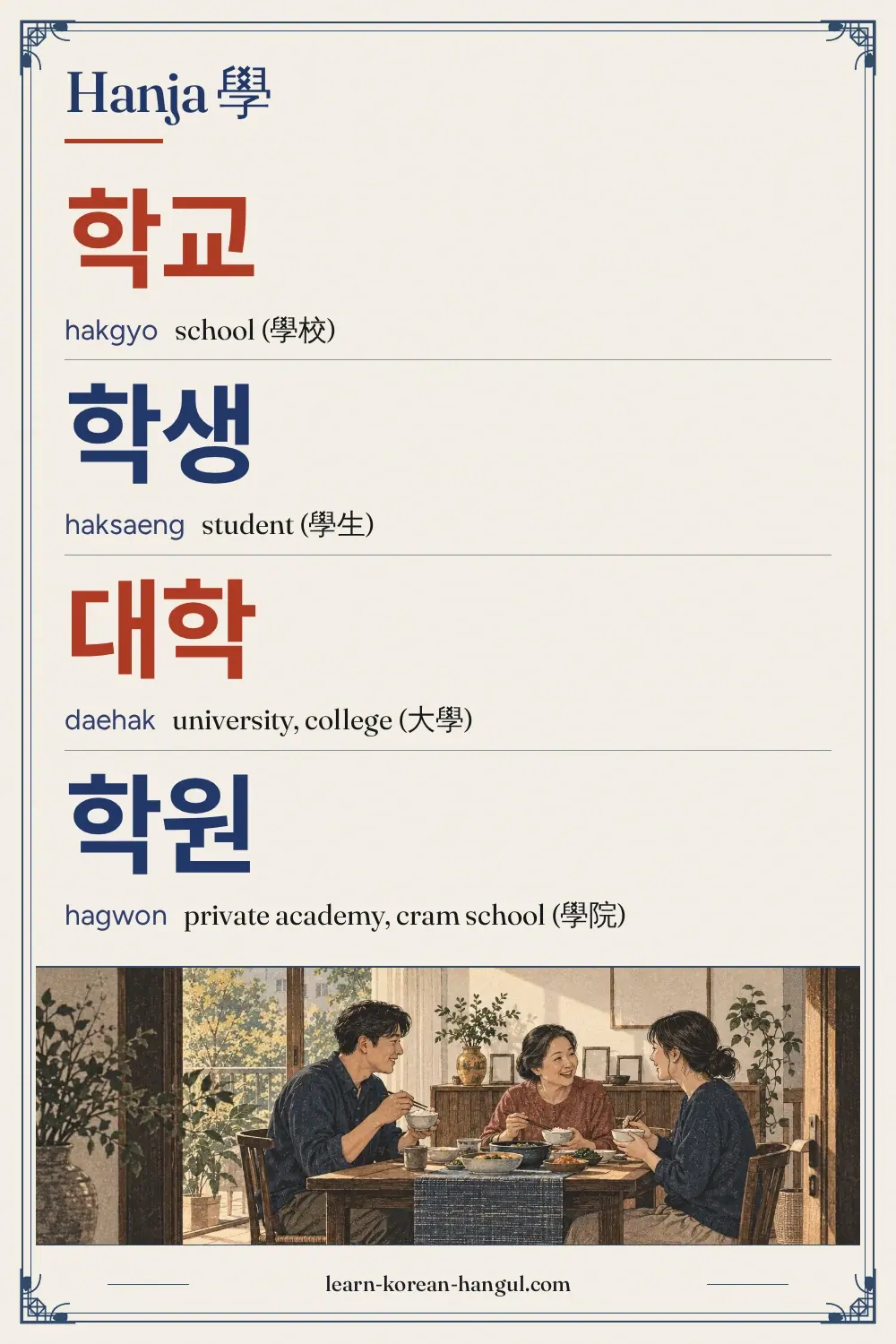
Hanja 學: the Essentials
Here is 學 in one table. The 음훈 (eumhun) is the traditional Korean label for a hanja: a meaning word, then the sound. For 學 it is "배울 학", "to learn" plus the reading 학. A radical (부수) is the part a dictionary uses to file the character, and a stroke is one pen movement. Both are covered in the hanja radicals section.
| Item | Detail |
|---|---|
| Character | 學 |
| 음훈 | 배울 학 |
| Reading | 학 (RR hak) |
| Core meaning | learn, study; a field of study |
| Radical | 子 (child) |
| Strokes | 16 in the traditional form |
| Variants | 学 in Japan and mainland China |
| Pairs well with | 校 (school), 生 (student), 大 (big) |
Why is the child radical there? The top of the character shows two hands and crossed marks, the pattern 爻, and under a roof 冖 sits a child 子. One way to remember the shape is "a child under a roof, being handed knowledge". That is a memory aid, not strict history, but it fits the meaning. The simplified form 学 used in China and Japan is shorter, so you will see it in Chinese and Japanese texts and on some signs. Korean dictionaries print 學.
The character is also one of the 100 basic hanja on this site, in the school and learning group, and it belongs to the set of 16 high-yield characters that have a full family page. The next section lists the words.
Which Words Does 學 Build?
Twelve words cover most of what you will meet. They fall into groups by idea: places of study, people and time, subjects, and money and travel. The table gives the characters, RR, the spoken form where it differs from the spelling, the meaning, and the parts. RR writes linking and nasal sounds as spoken but not tensing, so the spoken form column gives the full sound.
| Word | Characters | RR | Spoken form | Meaning | Parts |
|---|---|---|---|---|---|
| 학교 | 學校 | hakgyo | 학꾜 | school | 學 study + 校 school |
| 학생 | 學生 | haksaeng | 학쌩 | student | 學 study + 生 person, life |
| 대학 | 大學 | daehak | as spelled | university, college | 大 big + 學 study |
| 학원 | 學院 | hagwon | 하권 | private academy, cram school | 學 study + 院 institute |
| 유학 | 留學 | yuhak | as spelled | study abroad | 留 stay + 學 study |
| 학기 | 學期 | hakgi | 학끼 | semester, school term | 學 study + 期 period |
| 수학 | 數學 | suhak | as spelled | mathematics | 數 number + 學 study |
| 과학 | 科學 | gwahak | as spelled | science | 科 subject + 學 study |
| 입학 | 入學 | iphak | 이팍 | entering a school | 入 enter + 學 study |
| 학년 | 學年 | hangnyeon | 항년 | school year, grade | 學 study + 年 year |
| 문학 | 文學 | munhak | as spelled | literature | 文 writing + 學 study |
| 학비 | 學費 | hakbi | 학삐 | tuition, school costs | 學 study + 費 cost |
Places and People
학교 (學校) is a school: 學 plus 校. 대학 (大學) is a university or college, "big study". A longer form, 대학교 (daehakgyo, [대학꾜]), is the full name of a university, while 대학 can also mean a college inside it. 학원 (學院) is a private academy, the after-school cram school where many Korean students study in the evening. 학생 (學生) is a student, "a person who studies". Listen to the four.
Time and School Life
학기 (學期) is a school term, with 期 meaning a period. In Korea the school year is split into two terms, so you ask 몇 학기예요? (which semester are you in?). 학년 (學年) is a school year or grade: 일 학년 is first year. 입학 (入學) is entering a school, and the opening ceremony is 입학식. Together they cover the calendar of school.
Subjects
In 수학 (數學) the character 數 means number, so mathematics is the "study of numbers". 과학 (科學) uses 科, a subject or branch, and means science. 문학 (文學) uses 文 (writing) and means literature. In all three, 學 works as an ending, "the study of". The same pattern gives 언어학 (言語學, eoneohak, linguistics), 경제학 (經濟學, gyeongjehak, economics) and 심리학 (心理學, simnihak, psychology).
Money and Travel
학비 (學費) is the cost of schooling: tuition and fees, from 費 (cost). 유학 (留學) is studying abroad: 留 means to stay, so it is "stay and study". A person who does so is a 유학생 (留學生). You can add 하다 to get 유학하다 (to study abroad), and the word is common in university and visa contexts.
Two Bonus Words
학문 (學問) is scholarship or learning as a whole field: 學 (study) plus 問 (ask), so "study and questioning". 학습 (學習) is learning, with 習 meaning to practise, and it appears in school and software contexts, as in 학습 자료 (study materials). Both show the same 學 in a more formal register than 공부 (study).
Words in Sentences
Seeing the words in short sentences helps the sounds stick. The brackets show what you hear.
| Korean | RR | English |
|---|---|---|
| 저는 대학생이에요. | jeoneun daehaksaengieyo. | I am a university student. |
| 내년에 유학을 갈 거예요. [갈꺼예요] | naenyeone yuhageul gal geoyeyo. | I will study abroad next year. |
| 이번 학기에 수학을 배워요. | ibeon hakgie suhageul baewoyo. | This term I am learning mathematics. |
| 학비가 비싸요. | hakbiga bissayo. | Tuition is expensive. |
A good habit is to learn the word as a pair: 學 plus its partner. 학 + 교 gives the school, 학 + 생 gives the student, 입 + 학 gives the entry. Every time you meet a new 학 word, ask what the other character adds. In a few weeks the family will feel like one set of ideas, not twelve separate words.
How Is 學 Read in Different Words?
The reading 학 never changes to another syllable, which makes 學 one of the easiest characters. What changes is how 학 sounds next to its neighbours. The table shows five patterns with the words on this page; the first four are rules in the standard pronunciation rules of the National Institute of Korean Language (국립국어원).
| Pattern | Words | What happens |
|---|---|---|
| Tensing | 학교 [학꾜], 학생 [학쌩], 학기 [학끼], 학비 [학삐], 학습 [학씁] | The final ㄱ of 학 makes the next consonant tense. |
| Linking | 학원 [하권] | The final ㄱ moves onto the vowel of 원. |
| Aspiration | 입학 [이팍] | The ㅂ and the ㅎ join to make the sound ㅍ. |
| Nasal sound | 학년 [항년], 학문 [항문] | The ㄱ before ㄴ or ㅁ is said ㅇ. |
| No change | 대학, 수학, 과학, 문학, 유학 | 學 is at the end and the next sound does not affect it. |
RR follows two of these as spoken: it writes 학원 as hagwon and 학년 as hangnyeon. It does not write tensing, so 학교 is hakgyo. For a noun such as 입학, RR keeps the h and writes iphak, though you say [이팍]. Learn the spoken form from the table and the audio, and use RR only as a guide.
A last note on the word 학원, which learners often say as [학원]. The standard spoken form is [하권], with the ㄱ linking to the next syllable. Saying it as separate syllables is understood but sounds careful.
What Is Easy to Confuse with 學?
Three kinds of confusion come up: similar shapes, same sounds and similar words.
| Confusable | What it is | How to tell it apart |
|---|---|---|
| 覺 (깨달을 각) | A different character that shares the same top part | 覺 reads 각 and means to realise. The bottom is 見, not 子. |
| 校 (학교 교) | The other half of 學校 | 校 is the institution and has the 木 radical. 學 is the activity. |
| 鶴 (학) | The crane bird, read 학 as well | The sound is the same, but the character is a bird and unrelated. |
| 학교 and 학원 | Two places of study | 학교 is a regular school. 학원 is a private academy outside school hours. |
| 대학 and 대학교 | University words | 대학교 is the full university. 대학 can also be a college inside one. |
| 학년 and 학기 | Two time units | 학년 is the grade or year. 학기 is a term within the year. |
The shapes 學 and 覺 both have the top group of two hands and 爻, which is why they look alike. Look at the bottom: the child 子 is in 學.
Practice This Family
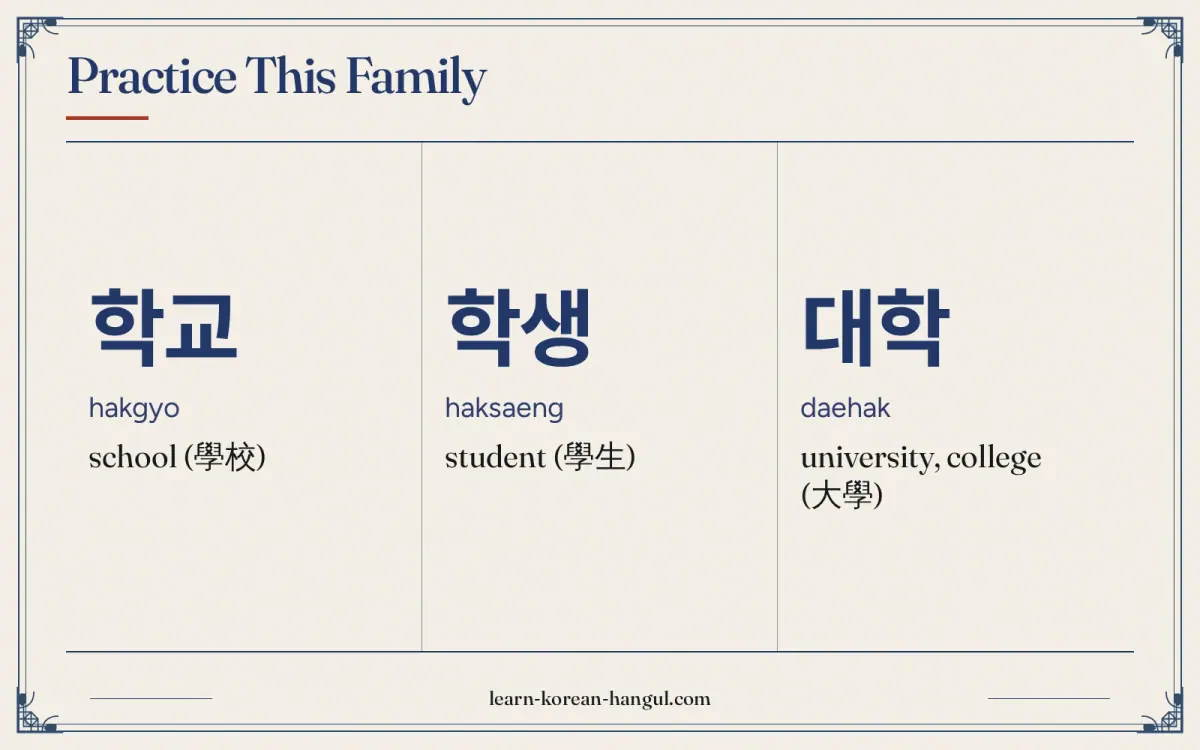
Practice in two steps. First, go through the twelve flashcards, one for each word. Say the Korean aloud before you reveal the meaning. The table shows every card, so you can copy or print it.
| Korean | RR | Meaning | Characters |
|---|---|---|---|
| 학교 | hakgyo | school | 學校 |
| 학생 | haksaeng | student | 學生 |
| 대학 | daehak | university, college | 大學 |
| 학원 | hagwon | private academy, cram school | 學院 |
| 유학 | yuhak | study abroad | 留學 |
| 학기 | hakgi | semester, school term | 學期 |
| 수학 | suhak | mathematics | 數學 |
| 과학 | gwahak | science | 科學 |
| 입학 | iphak | entering a school | 入學 |
| 학년 | hangnyeon | school year, grade | 學年 |
| 문학 | munhak | literature | 文學 |
| 학비 | hakbi | tuition, school costs | 學費 |
Practice · 12
- 01학교
Show answer
hakgyo
school (學校)
- 02학생
Show answer
haksaeng
student (學生)
- 03대학
Show answer
daehak
university, college (大學)
- 04학원
Show answer
hagwon
private academy, cram school (學院)
- 05유학
Show answer
yuhak
study abroad (留學)
- 06학기
Show answer
hakgi
semester, school term (學期)
- 07수학
Show answer
suhak
mathematics (數學)
- 08과학
Show answer
gwahak
science (科學)
- 09입학
Show answer
iphak
entering a school (入學)
- 10학년
Show answer
hangnyeon
school year, grade (學年)
- 11문학
Show answer
munhak
literature (文學)
- 12학비
Show answer
hakbi
tuition, school costs (學費)
Then decode three words you have not seen. The quiz gives the meaning of each part, and you work out the word. Then check your answers.
Practice · 6
休 means "rest" and 學 means "study". What does 休學 (휴학) mean?
Show answer
taking time off from school
休 (rest) + 學 (study) is a break from studies: a leave of absence from school.
開 means "open" and 學 means "study". What does 開學 (개학) mean?
Show answer
the start of a school term
開 (open) + 學 (study) is opening the term. 개학 is the first day back after a break.
者 means "person" and 學 means "study". What does 學者 (학자) mean?
Show answer
a scholar
學 (study) + 者 (person) is a person of learning: a scholar. The word is said [학짜].
How is 학원 (a private academy) pronounced?
Show answer
[하권]
The final ㄱ of 학 links to the vowel of 원, so the word sounds like [하권].
In which word does the ending -학 mean "the study of"?
Show answer
과학
科學 is the study of branches of knowledge, science. 학교, 학생 and 학원 are places and people.
What is the difference between 학기 and 학년?
Show answer
학기 is a term, 학년 is a school year
學期 is a term inside the year; 學年 is the year or grade.
What to Learn Next
After 學, the best next step is the 生 word family, which gives 학생, 선생, 생일 and more, then the 人 family and the 大 family. Before then, read the school and learning group, where 學 sits with nine other characters, and the hanja word families hub for the other 15 families. If you want to know how a character like 學 is filed in a dictionary, see what hanja radicals are. For method, read how to learn hanja, and for the other characters in the core set, see 100 useful hanja.
Frequently Asked Questions
What is the difference between 학교 and 학원?
학교 (學校) is a school: the kindergarten to university system with a set curriculum and a calendar. 학원 (學院) is a private academy that students attend outside school hours for subjects such as English, math or art. Both start with 學, but 校 stresses the school as an institution and 院 a smaller institute. In Korea many students go to 학교 in the day and 학원 in the evening.
Does 學 always mean school?
No. The basic meaning is to learn or to study. In 학교 and 학원 it is tied to places of study, but in 수학, 과학 and 문학 it is the ending "the study of". In 학비 it is part of the cost of schooling, and in 학년 and 학기 it marks the units of the school calendar. Read the whole word, not 學 alone.
What is 學 made of?
The traditional form 學 has 16 strokes. It is filed under the child radical 子 at the bottom. The top has two hands and crossed marks, the pattern 爻, with a roof 冖 above the child. The simplified form 学 is used in mainland China and Japan. Check the stroke count and radical in a dictionary, since different sources may split the parts a little differently.
How do I say "study" with 學?
Use 공부하다 for everyday studying. 學 is for compound words such as 유학하다 (to study abroad), 입학하다 (to enter a school) and 학습 (learning). The formal verb 학습하다 exists, but it is used in schools and software, not in daily speech. For "I study Korean", say 한국어를 공부해요.
Is 학교 said [학꾜] or [학교]?
The standard spoken form is [학꾜]. The final ㄱ makes the next ㄱ tense. Saying [학교] with a plain ㄱ is understood, but it is not the standard sound. Every 학 word where ㄱ, ㄷ, ㅂ, ㅅ or ㅈ follows 학 has the same tensing.