Key facts
- Levels are numbered grades. The numbers count down as difficulty rises, so 8급 is the beginner grade.
What Is the Korean Hanja Proficiency Test?
The Korean hanja proficiency test is a graded exam, usually called 한자능력검정시험 (hanjaneungnyeokgeomjeongsiheom, [한자능녁검정시험]), that checks how many hanja you can read and write. Candidates sit a paper at a test centre several times a year, and the result is a grade, not a pass mark on a single scale. A person who passes a grade receives a certificate (자격증, jagyeokjeung).
Think of the structure as similar to a music grade exam. You pick a grade that matches your level, study the characters set for it and sit that grade. If you pass, you can try the next grade. Many of the people who sit it are Korean school pupils, and some adults take it for study or work. Foreign learners of Korean take it much less often, mostly out of interest in hanja.
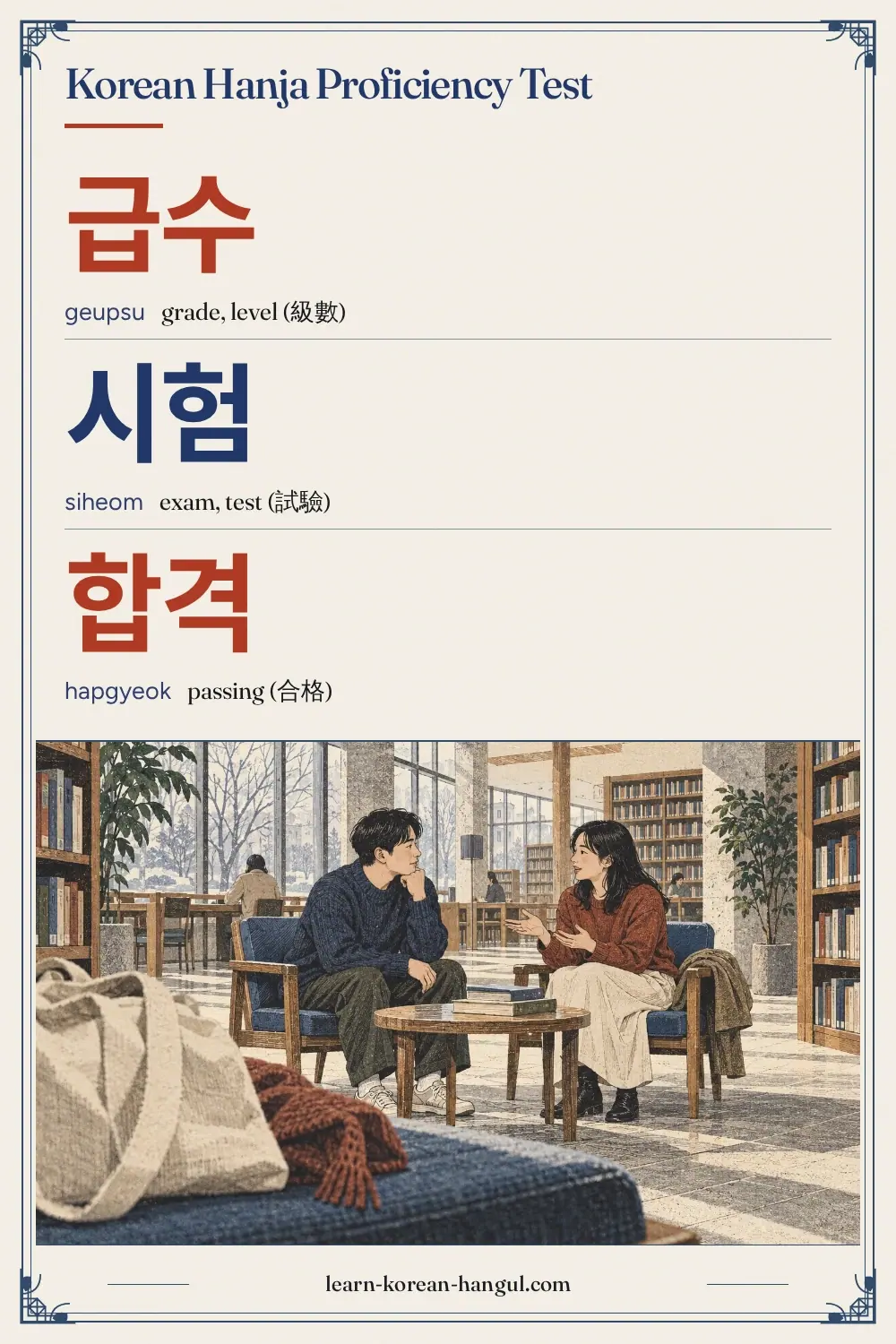
The tests are optional. The word for an exam is 시험 (siheom), and a pass is 합격 (hapgyeok).
Who Runs the Tests?
The tests are run by private associations. The best-known is the test run by 한국어문회 (Hanguk Eomunhoe), a private language association. Several other associations run their own graded hanja exams. The organisers set their own syllabi, dates, fees and grades, so two tests with the same name for a grade can differ.
| Question | What to know |
|---|---|
| Who sets the exam? | A private association, not a ministry |
| Who writes the syllabus? | The association, often based on the school list of 1,800 basic hanja plus extra characters |
| Who recognises the grade? | The organiser; some grades are described as nationally recognised, which can change |
| Where do you check details? | The organiser's current notice and its website |
Details such as the name of a body, its grades, test dates and eligibility are time-sensitive. Always read the current notice from the organiser, and do not rely on a third-party summary, including this one, for dates or fees.
How Are the Levels Structured?
Hanja grades are numbered, and the number falls as the difficulty rises. This is the reverse of what many learners expect. A grade of 8급 is for beginners, 7급 and 6급 cover elementary-school characters, and the middle numbers cover the school list. At the other end, 1급 is advanced and a special grade above it is for experts. Many systems add half-grades marked Ⅱ between the whole grades, so the full ladder has about fifteen rungs. The table gives a general picture, not an official syllabus.
| Grade range | Rough level | What a candidate can do |
|---|---|---|
| 8급 to 6급 | Beginner | Read and write the simplest characters and everyday words |
| 5급 to 4급 | Lower intermediate | Handle a wider set of school characters in common words |
| 3급 | Intermediate | Work near the range of the school list of 1,800 basic hanja |
| 2급 to 1급 | Advanced | Read and write many characters beyond the school list |
| Special grade | Expert | Handle a very large character set and difficult texts |
The grade often compared with the school list is 3급. This comparison is approximate, because the lists are not identical, so check the syllabus. For the school list itself, see basic hanja, which explains the 1,800 characters and the 100 chosen for study.
Which grade should a learner try? If you want a first goal, 8급 is a sensible one. It uses very few characters and takes only a few weeks. At the pace on the how to learn hanja page, ten new characters a week reach the first 50 characters in five weeks. After that you can move to 7급, 6급 and beyond as your interest grows.
What Do the Tests Cover?
The tests cover more than reading. A typical paper mixes several kinds of question, and the weight of each varies by grade. The list below names the common types.
- Reading (읽기, ilgi). See a hanja word and write its Korean reading in Hangul.
- Writing (쓰기, sseugi). See a Korean reading or a sentence and write the hanja.
- Meaning and sound (훈음, 음훈). Give the meaning word and sound of a character, such as 배울 학 for 學.
- Antonyms (반의어, baneuieo). Pick the opposite of a hanja word, such as 出口 and 入口.
- Word completion. Fill a missing character in a compound.
- Four-character idioms (사자성어, sajaseongeo). Read and complete idioms such as 一石二鳥.
- Radicals (부수, busu). Name the radical of a character.
- Long and short vowels. Some tests ask whether a Sino-Korean syllable is said long or short.
For a learner, the reading questions are the realistic goal. Writing from memory takes much longer, as the how to write hanja page explains, and the exam rewards it at higher grades. If you do not plan to write by hand, you may find a test with a large writing share a poor fit. Read the sample papers on the organiser's site first.
Do Learners Need One?
No. A learner of Korean needs no hanja grade for daily life, for TOPIK or for most work in Korean. Here is a short verdict by situation.
| Your situation | Do you need a hanja grade? | Why |
|---|---|---|
| Beginner or A2 learner | No | Learn Hangul, grammar and common words first |
| TOPIK candidate | No | TOPIK has no hanja items; see TOPIK hanja |
| Chinese or Japanese speaker | Rarely | You know many characters already; the Korean reading is the new part |
| Learner who likes goals | Optional | A grade gives structure and a certificate |
| Student in Korea in a hanja-related subject | Check | A school may value it; ask the school |
| Job seeker | Rarely | A language test result usually matters more |
The best reason to take a test is that you want a goal. A grade can turn vague study into a plan with a date. If you do not feel that pull, spend the same hours on vocabulary and word families, which give a more direct return for a Korean learner. See hanja word families.
How Does It Compare with Tests in Japan and China?
Japan and China have their own character exams, and each tests a different language. Knowing the difference avoids buying the wrong book.
| Test | Country | Language tested | What it checks |
|---|---|---|---|
| Korean hanja proficiency tests | Korea | Korean | Hanja readings, meanings and writing in Korean words |
| Kanji Kentei | Japan | Japanese | Kanji readings and writing in Japanese |
| HSK | China | Mandarin Chinese | Chinese language skills in general |
| TOPIK | Korea | Korean | Korean language skills; no hanja items |
Two things follow. A strong score on the Japanese kanji test shows you know many characters, but it does not tell you the Korean readings. And the HSK is a general Chinese test and not a character test. Of the four, only the first is a hanja test for Korean words. For a closer look at how the three scripts compare, see hanja vs kanji vs hanzi.
How Could You Prepare?
Prepare by choosing a grade, getting its syllabus and practising in short daily sessions. A simple plan for a beginner grade looks like this.
- Pick a grade. Start with the lowest, 8급, and check how many characters it uses on the organiser's site.
- Get the list. Many organisers publish the character list and sample papers for each grade.
- Study by word. Use the word-family method on the how to learn hanja page.
- Practise the question types. Do reading, meaning and antonym questions first, writing last.
- Take a mock paper. Time yourself and check which question type loses marks.
Here is the arithmetic for a first grade. If a beginner grade has 50 characters and you learn 10 a week, you finish the list in 5 weeks. Add 2 weeks for mock papers and review, and you reach about 7 weeks. If you study 15 minutes on six days a week, the total is 6 × 15 = 90 minutes a week, or about 10.5 hours over 7 weeks. These are estimates for planning, not a promise of a pass.
Which Hanja Are on the TOPIK Side Instead?
TOPIK does not test hanja, but you can use hanja study as a booster for TOPIK vocabulary. If your goal is TOPIK II, follow the 20-character plan on the TOPIK hanja page rather than aiming at a hanja grade. It targets words in TOPIK reading passages, and it takes far less time than a hanja grade. The hanja grade is for people who want hanja as a subject in itself.
What Does a Sample Question Look Like?
The question types are easier to picture with examples. The items below are made up to show the format; they are not taken from any real paper.
| Type | Question | Answer |
|---|---|---|
| Reading | Write the reading of 學校. | 학교 |
| Writing | Write 학교 in hanja. | 學校 |
| Meaning and sound | Give the meaning and sound of 學. | 배울 학 |
| Antonym | Give the opposite of 出口. | 入口 (입구) |
| Completion | Fill the blank: 一石二□. | 鳥 (일석이조) |
Notice that every item uses words you already know from Hangul. The test turns a word you can say into characters you can see, or the other way round. That is why learning characters through words, as in the word-family method, prepares you better than memorising a chart.
How Do You Read an Exam Notice?
An exam notice is a short page or poster that lists everything you need to apply. Even if you read Korean well, the vocabulary is formal, so it helps to know the key words before you open it. Check each item against the current notice, because dates, fees and rules change from one session to the next.
| Notice item | Korean word | What to check |
|---|---|---|
| Registration | 접수 (jeopsu, [접쑤]) | Opening and closing dates, and how to apply online or in person |
| Exam day | 시험일 (siheomil) | Date, start time and when to arrive |
| Fee | 응시료 (eungsiryo) | The amount for your grade and how to pay |
| ID | 신분증 (sinbunjeung, [신분쯩]) | Which documents are accepted at the door |
| What to bring | 준비물 (junbimul) | Pens, erasers and any items that are banned |
| Results | 결과 발표 (gyeolgwa balpyo) | When and where the grade is announced |
| Pass line | 합격 기준 (hapgyeok gijun) | The score needed to pass a grade |
The two words most worth practising are 접수 and 신분증, because you need both to enter the room. If you can read this table in Hangul, you can read most exam notices.
How Is a Hanja Test Different from a Hanja Class at School?
A school hanja class teaches characters as part of Korean education, while a proficiency test measures what you already know. In school, the subject is 한문, which includes reading short passages of classical Chinese and learning the basic hanja. A proficiency test usually leaves out classical texts and focuses on characters and words. A test also gives you a grade you can carry with you, while a school class gives marks in a report.
For a learner outside Korea, this difference matters. You do not need a class to take a test, and you do not need a test to learn the characters. Many people use a grade syllabus as a reading list: they take the lowest grades' character lists as a study guide and never sit the exam. That is a sensible use of the structure.
What Mistakes Do Candidates Make?
Five mistakes cost candidates marks or time. Avoid them from the start.
- Using an old syllabus. The character lists and question types can change. Always download the list for the session you plan to sit.
- Studying shapes without words. A candidate who has only seen characters in lists struggles with word questions. Learn each character with two or three words.
- Skipping writing practice when the grade needs it. If your grade includes writing, recognition alone is not enough. Allow weeks for it, as explained on the writing page.
- Mixing up homophones. Many Sino-Korean syllables stand for several characters. Group words by character, not only by sound.
- Ignoring the notice. Missing ID or arriving late are avoidable problems that have nothing to do with hanja.
Are There Alternatives to Taking the Test?
Yes. If you want the benefit of structure without a fixed exam date, you can build your own. Use the 100 characters on the basic hanja page as your syllabus, test yourself with the three recall directions from the how to learn hanja page, and check progress with the quiz on each page. Keep a log of the characters you know, add a few new ones each week and revisit old ones on a schedule. A self-made plan will not give you a certificate, but it costs nothing and fits any timetable.
If you need an official proof of Korean ability, TOPIK is the exam to take. For hanja, proof is rarely needed. Keep a simple record while you prepare: the grade you aim for, the date you plan to sit, the number of characters you can read, and the number you can also write. Update it every Sunday. A short record like this shows progress, keeps the target realistic and tells you when to book the exam.
Treat any hanja grade as a personal milestone and a good excuse to build a habit.
Practice: Cards and Quiz
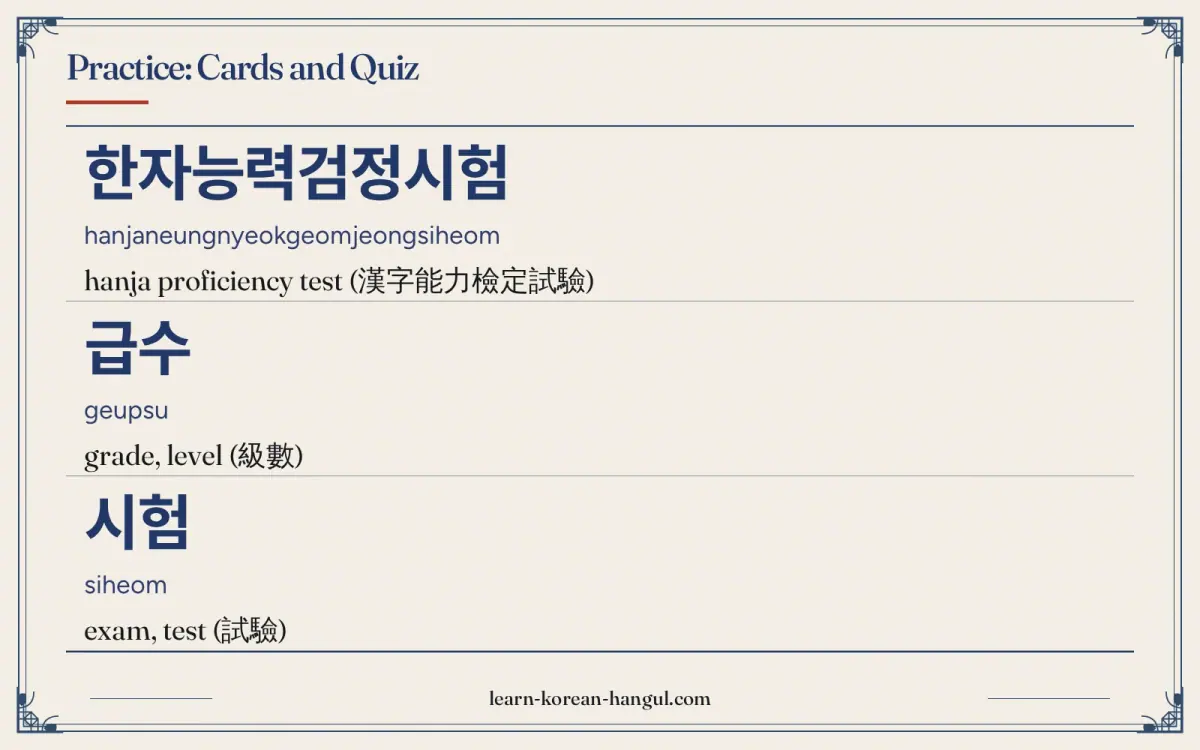
These ten cards cover the words you need to read a hanja test notice.
| Korean | RR | Meaning | Note |
|---|---|---|---|
| 한자능력검정시험 | hanjaneungnyeokgeomjeongsiheom | hanja proficiency test (漢字能力檢定試驗) | Said [한자능녁검정시험]. The usual name for the graded hanja exams. |
| 급수 | geupsu | grade, level (級數) | Said [급쑤]. Hanja grades count down as difficulty rises. |
| 시험 | siheom | exam, test (試驗) | Also the second half of the test name. |
| 합격 | hapgyeok | passing (合格) | Said [합껵]. The result you want on a test. |
| 읽기 | ilgi | reading | Said [일끼]. A native word; the reading part asks you to write the Hangul reading of hanja words. |
| 쓰기 | sseugi | writing | A native word; the writing part asks you to write the hanja. |
| 자격증 | jagyeokjeung | certificate, licence (資格證) | Said [자격쯩]. What a passing grade may earn. |
| 사자성어 | sajaseongeo | four-character idiom (四字成語) | A common test topic. |
| 반의어 | baneuieo | antonym (反義語) | Said [바늬어]. Tests ask for opposite words such as 출구 and 입구. |
| 부수 | busu | radical (部首) | Tests ask which radical a character belongs to. |
Practice · 10
- 01한자능력검정시험
Show answer
hanjaneungnyeokgeomjeongsiheom
hanja proficiency test (漢字能力檢定試驗)
- 02급수
Show answer
geupsu
grade, level (級數)
- 03시험
Show answer
siheom
exam, test (試驗)
- 04합격
Show answer
hapgyeok
passing (合格)
- 05읽기
Show answer
ilgi
reading
- 06쓰기
Show answer
sseugi
writing
- 07자격증
Show answer
jagyeokjeung
certificate, licence (資格證)
- 08사자성어
Show answer
sajaseongeo
four-character idiom (四字成語)
- 09반의어
Show answer
baneuieo
antonym (反義語)
- 10부수
Show answer
busu
radical (部首)
Check your understanding with six questions.
Practice · 6
Who runs the Korean hanja proficiency tests?
Show answer
Private associations
The graded hanja tests come from non-governmental associations. TOPIK is a different exam.
In the Korean grade system, which end is the easiest level?
Show answer
The highest number
Grades count down as difficulty rises, so 8급 is an easy entry grade and low numbers and the special grade are harder.
Which skill do hanja tests commonly check in addition to reading?
Show answer
Writing hanja from their readings
Many hanja tests include writing, meaning words, antonyms, idioms and radicals.
Does TOPIK test hanja directly?
Show answer
No
TOPIK has no hanja items. Hanja help with vocabulary only indirectly.
Is the hanja proficiency test the same as HSK?
Show answer
HSK is for Mandarin Chinese, not Korean hanja
HSK tests Mandarin Chinese. The Korean hanja tests are separate exams.
Who is most likely to need a hanja grade?
Show answer
Someone who wants a goal or a certificate in hanja
A grade is optional. It helps people who want structure, a goal or a certificate.
Frequently Asked Questions
Is the test official?
The tests are run by private associations, not by the government. Some associations describe certain grades as nationally recognised qualifications, and the status of a grade can change. Check the current notice on the organiser's own website before you rely on a grade for study or work.
Do I need it for jobs?
Usually not. Some Korean schools, universities and employers have valued hanja grades in the past, especially for roles in publishing, law, education or the media, but practice varies and changes. For a learner of Korean, a TOPIK result is far more widely recognised. Ask the institution you care about.
Can foreigners take it?
Often yes, but rules about registration, ID and test venues are set by each organiser. Check the current registration notice for the exam you want. If you live outside Korea, find out whether any venue is available to you before you plan.
Is it the same as HSK?
No. HSK is a Mandarin Chinese language test. The Korean hanja tests check Korean readings and meanings of Chinese characters in Korean words. A person can pass one without the other. Japan has its own kanji test, which is another separate exam.
Is this test useful for TOPIK?
Only indirectly. TOPIK does not test hanja, but hanja knowledge helps you guess abstract vocabulary. If you need TOPIK, spend time on vocabulary first and use hanja study as a booster, as explained on the TOPIK hanja page.