What you'll learn
- Count one to ten servings with 인분, using Sino-Korean numbers.
- Order grilled meat and ask 몇 인분 to find out how many.
- Write 인분 with digits (1인분) and follow the minimum-order custom.
- Explain why 인분 differs from 잔, 병 and 그릇.
Prerequisites: Sino-Korean numbers 1-100. Estimated time: 30 minutes.
Korean Counter Inbun: the Essentials
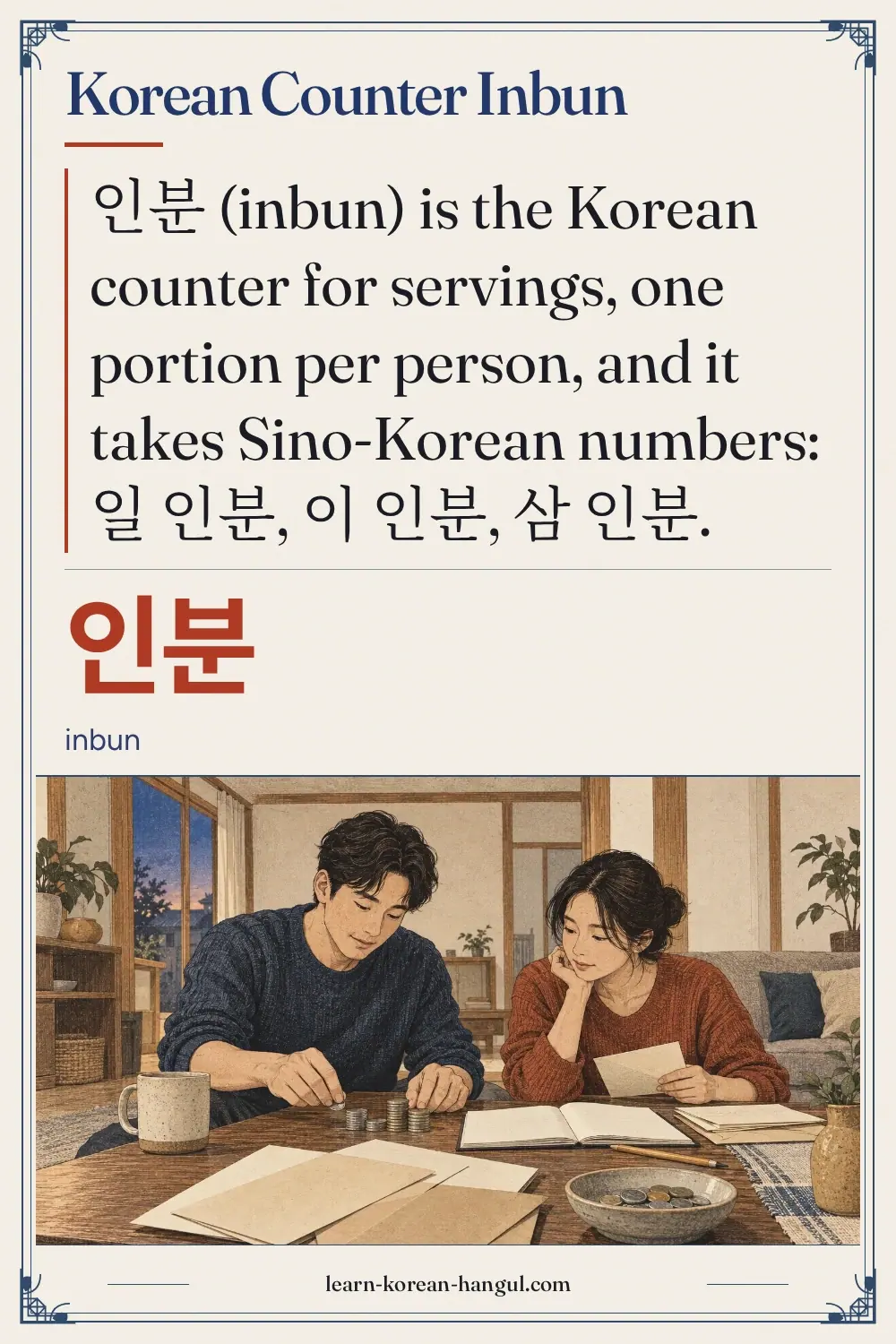
The Korean counter inbun (인분) is a short word that follows a number and means "servings of". A counter is a word that tells you what kind of unit a number refers to. English uses "servings" or "portions" in a similar way: "two servings of pork belly". Korean needs the counter almost every time, and 인분 is the one for food measured in portions per person.
The pattern is: dish + Sino number + 인분.
| Dish | Number + 인분 | Meaning |
|---|---|---|
| 삼겹살 (samgyeopsal) | 삼겹살 이 인분 | two servings of pork belly |
| 불고기 (bulgogi) | 불고기 삼 인분 | three servings of bulgogi |
| 갈비 (galbi) | 갈비 일 인분 | one serving of ribs |
| 닭갈비 (dakgalbi) | 닭갈비 사 인분 | four servings of dakgalbi |
The word 인분 is built from two Chinese-origin parts. 인 (人) means "person", and 분 (分) means "share" or "portion". So 인분 is literally a "person share". The 분 here is the same character as 분 for minutes (分), but with its other meaning, "share". It is unrelated to the polite 분 for people, a native Korean word that only shares the spelling.
Most other food counters take native numbers, so 인분 is the exception to learn. 잔 (cups), 병 (bottles) and 그릇 (bowls) all use 한, 두, 세. 인분 uses 일, 이, 삼. The system is explained in how Korean counters work. The next section puts the counter into sentences.
How Do You Use 인분 in a Sentence?
To use 인분 in a sentence, put the dish first, then the Sino-Korean number, then 인분: 갈비 이 인분을 시켰어요 (I ordered two servings of ribs). English puts the number before the noun, but Korean puts the counter phrase after the noun, and the counter is an extra word that English does not need.
Three patterns cover almost every real sentence.
| Job | Pattern | Example |
|---|---|---|
| Ordering | Dish + number + 인분 + 주세요 | 삼겹살 이 인분 주세요. |
| Reading a menu | Dish + 1인분 + price | 삼겹살 1인분 |
| Planning | Number + 인분 + particle + verb | 삼 인분이면 충분해요. |
More sentences to hear and repeat:
- 세 명이니까 불고기 삼 인분 시킬게요. (There are three of us, so I will order three servings of bulgogi.)
- 고기 이 인분이랑 냉면 두 그릇 주세요. (Two servings of meat and two bowls of cold noodles, please.)
- 이 집은 일 인분에 얼마예요? (How much is one serving at this restaurant?)
The second sentence mixes two counters: 이 인분 for the meat and 두 그릇 for the noodles. The meat follows the Sino rule, and the noodles follow the native rule. This mixing is normal in a Korean restaurant. A particle can attach to the counter phrase, such as 이/가 or 에 (per) in 일 인분에, but you never put a particle between the number and 인분.
Now you can build a full sentence. Next comes the number rule that makes 인분 different.
Why Does 인분 Take Sino-Korean Numbers?
The counter 인분 takes Sino-Korean numbers because it belongs to the 인 ("person") family of unit words, such as 1인 (one person) and 2인실 (double room), which are always read with Sino numbers. Word origin alone does not decide the number system: 잔, 병 and 개 are also Chinese-origin but take native numbers. Counters that behave like measuring units, such as 분 for minutes, 층 for floors, 원 for won and 인분, take Sino numbers.
| Number | Before 인분 | Spoken | Revised Romanization | Meaning |
|---|---|---|---|---|
| 1 | 일 인분 | [이린분] | il inbun | one serving |
| 2 | 이 인분 | [이인분] | i inbun | two servings |
| 3 | 삼 인분 | [사민분] | sam inbun | three servings |
| 4 | 사 인분 | [사인분] | sa inbun | four servings |
| 5 | 오 인분 | [오인분] | o inbun | five servings |
| 6 | 육 인분 | [유긴분] | yuk inbun | six servings |
| 7 | 칠 인분 | [치린분] | chil inbun | seven servings |
| 8 | 팔 인분 | [파린분] | pal inbun | eight servings |
| 9 | 구 인분 | [구인분] | gu inbun | nine servings |
| 10 | 십 인분 | [시빈분] | sip inbun | ten servings |
Look at the "Spoken" column for 1, 3, 6, 7, 8 and 10. When a number ends in a consonant and 인분 starts with a vowel sound (the silent ㅇ), the consonant moves over to the next syllable. This linking is called liaison (연음), and it is part of the National Institute of Korean Language (국립국어원) standard pronunciation rules (표준 발음법). So 삼 인분 sounds like [사민분], with the ㅁ of 삼 landing on 인. The same happens in 몇 인분, which is pronounced [며딘분] because the final ㅊ of 몇 is said as [ㄷ] first.
Do Sino Numbers Shorten before 인분?
No. Sino-Korean numbers do not shorten before a counter. The five short forms (한, 두, 세, 네, 스무) belong to native numbers only. So 이 인분 stays 이 and 삼 인분 stays 삼. This is why learners find 인분 easier than 잔 or 병 once they know the Sino numbers up to 10.
| Native counter | Sino counter |
|---|---|
| 두 잔 | 이 인분 |
| 세 병 | 삼 인분 |
| 네 그릇 | 사 인분 |
How High Can You Count with 인분?
Sino numbers continue past 10 without a break: 십 인분 (10), 십오 인분 (15), 이십 인분 (20) and 백 인분 (100). Large numbers appear in catering and school meals, where 백 인분 (100 servings) is a real order. Everyday restaurant tables stay between 일 인분 and 십 인분.
How Do You Write 인분 with Digits?
With digits, attach 인분 directly to the number without a space: 1인분, 2인분, 10인분. This is how you see it on almost every menu and delivery screen. In Hangul, keep the space: 이 인분, not 이인분. The spacing rule comes from Article 43 of the 한글 맞춤법 (Hangul spelling rules), which allows counters to attach to Arabic numerals.
| Written form | Read aloud | Meaning |
|---|---|---|
| 1인분 | 일 인분 | one serving |
| 2인분 | 이 인분 | two servings |
| 3인분 | 삼 인분 | three servings |
| 2인분 이상 | 이 인분 이상 | two servings or more |
| 2인분부터 | 이 인분부터 | from two servings |
On a menu, you may also see the weight next to the serving, such as 삼겹살 1인분 150g. The weight is a menu detail, so it differs from restaurant to restaurant. Read the menu line, not just the counter, if portion size matters to you.
How Do You Ask How Many with 몇 인분?
To ask how many servings there are, say 몇 인분이에요? The word 몇 means "how many", so 몇 인분 means "how many servings". It is pronounced [며딘분] because the final ㅊ of 몇 is said as [ㄷ] and moves onto the next syllable.
| Situation | Question | Answer |
|---|---|---|
| Server asks you | 몇 인분 드릴까요? | 삼 인분 주세요. |
| Friend asks you | 고기 몇 인분 시킬까요? | 사 인분 시켜요. |
| Checking the menu | 이건 몇 인분이에요? | 이 인분이에요. |
| Takeout | 몇 인분 포장할까요? | 이 인분 포장해 주세요. |
The answer repeats the same pattern: Sino number + 인분 + 이에요 or a verb. After 인분 the copula takes the 이에요 form because 인분 ends in a consonant, so you say 이 인분이에요.
Grill Restaurant Dialogue
The dialogue below uses 인분 the way a real grill restaurant does. The server asks 몇 인분, the customer answers, and the server mentions the minimum.
- 직원: 어서 오세요. 몇 분이세요? (Welcome. How many people?)
- 손님: 두 명이에요. (Two.)
- 직원: 삼겹살은 이 인분부터 주문하실 수 있어요. (Pork belly can be ordered from two servings.)
- 손님: 그럼 삼겹살 이 인분이랑 된장찌개 하나 주세요. (Then two servings of pork belly and one soybean stew, please.)
- 직원: 네. 고기 더 필요하시면 말씀해 주세요. (Yes. If you need more meat, please tell me.)
- 손님: 나중에 일 인분 더 시킬게요. (I will order one more serving later.)
Notice three counters in one short scene. 몇 분 and 두 명 count people. 이 인분 counts the meat. 된장찌개 하나 uses the bare number 하나 for a stew that comes in its own pot. The bare number is common when the dish is clear from context. For more lines like these, see Korean restaurant phrases.
What Is the Minimum-Order Rule?
Many Korean grill restaurants ask for a minimum order, often 2인분, and this is a shop custom rather than a law. The phrase 이 인분부터 주문 가능 means "orders start from two servings". Menus and staff state the rule in a few set phrases, shown in the table below.
| Phrase | Meaning | What to do |
|---|---|---|
| 이 인분부터 주문 가능해요. | Orders start at two servings. | Order two or more. |
| 일 인분은 안 돼요. | One serving is not possible. | Add a second serving or choose another dish. |
| 인원수대로 시켜 주세요. | Please order as many as there are people. | Match servings to guests. |
| 일 인분 추가할게요. | I will add one serving. | Order more later. |
If you are alone, you can ask 혼자 먹을 수 있는 메뉴가 있어요? (Is there a menu I can eat alone?). Some restaurants have one-person sets, and many do not. The custom differs by restaurant and neighbourhood, so read the menu board first.
How Do You Ask for a Smaller or Bigger Portion?
To change the portion size, ask for more servings (일 인분 더) or choose a size label on the menu. Some dishes, such as stews and braised chicken, are sold as 소 (small), 중 (medium) and 대 (large) instead of servings.
| Request | Phrase | Meaning |
|---|---|---|
| One more serving | 일 인분 더 주세요. | One more serving, please. |
| Smaller size | 소로 주세요. | A small, please. |
| Larger size | 대로 주세요. | A large, please. |
| Half a serving | 반 인분도 돼요? | Is half a serving possible? |
The last phrase is a question because most restaurants do not split servings. Ask politely and accept a no. Next, look at where the same 인 appears outside food.
Where Else Does 인 Appear?
The syllable 인 (人, person) appears in many words that count people by group size, always with Sino numbers. This family explains why 인분 takes Sino numbers, and it helps you read signs and forms.
| Word | Meaning | Example |
|---|---|---|
| 1인분 | one serving | 불고기 1인분 |
| 1인 가구 | one-person household | 1인 가구가 늘고 있어요. |
| 2인실 | double room | 2인실을 예약했어요. |
| 4인 가족 | family of four | 4인 가족이에요. |
| 3인용 | for three people | 3인용 소파 |
These words are read with Sino numbers: 일인 가구, 이인실, 사인 가족, 삼인용. They count capacity, not food. For counting actual people in speech, use 명 with native numbers instead, as covered in how to count people in Korean.
Daily-Life Phrases with 인분
Most real uses of 인분 fall into a few scenes: grill dinners, delivery, home cooking and cafeterias. Learn these phrases as whole chunks, because the number and counter then come out together without thinking.
| Scene | Phrase | Meaning |
|---|---|---|
| Grill | 삼겹살 삼 인분 주세요. | Three servings of pork belly, please. |
| Delivery | 이 인분 세트로 주문했어요. | I ordered the two-serving set. |
| Home cooking | 사 인분 레시피예요. | It is a recipe for four servings. |
| Cafeteria | 일 인분에 오천 원이에요. | One serving costs 5,000 won (example). |
| Packing | 이 인분 포장해 주세요. | Please pack two servings to go. |
| Asking | 몇 인분 시킬까요? | How many servings shall we order? |
The particle 로 in 세트로 means "as" or "by means of". The phrase 일 인분에 오천 원 uses the particle 에 to mean "per serving". Recipe books also use 인분 at the top of the page, so you will see 2인분 or 4인분 next to the ingredient list.
Misconceptions about 인분
Learners often assume that every food counter takes native numbers, or that 인분 counts people. Both ideas are wrong.
Misconception 1: all food counters take native numbers. 잔, 병 and 그릇 do, but 인분 takes Sino numbers. Learn it as the exception.
Misconception 2: 인분 means the number of people. 인분 counts portions. If two people eat, they may order three portions because of appetite. The people count uses 명.
Misconception 3: one 인분 is the same weight everywhere. The amount differs by restaurant and dish. Menus usually print it in grams, and the counter does not fix it.
Misconception 4: 일 인분 is rude to order alone. Ordering one serving is fine where the menu allows it. The only limit is the shop's minimum.
Common Mistakes and Fixes
The most frequent errors with 인분 are about number forms and counter choice. Each one has a simple fix.
| Mistake | Why it is wrong | Fix |
|---|---|---|
| 삼겹살 두 인분 주세요. | Native number with a Sino counter | 삼겹살 이 인분 주세요. |
| 삼겹살 세 인분 주세요. | Native number with a Sino counter | 삼겹살 삼 인분 주세요. |
| 인분 이 삼겹살 주세요. | Counter before the dish | 삼겹살 이 인분 주세요. |
| 삼겹살 이 명 | 명 counts people, not portions | 삼겹살 이 인분 |
| 냉면 이 인분 | Noodle bowls use 그릇 | 냉면 두 그릇 |
| 이인분 (in Hangul text) | Missing space in Hangul | 이 인분 |
Notice that the first two mistakes use 두 and 세, which are right for 잔, 병 and 그릇 but wrong here. Say the counter first in your mind: Sino counter, Sino number.
Practice Set
Try these five questions before you check the answers below.
- Fill in the blank: 삼겹살 ___ 인분 주세요. (two)
- How do you write "three servings" with digits?
- Which counter fits two bowls of cold noodles?
- How do you say 3인분 aloud?
- Correct this sentence: 불고기 세 인분 주세요.
Practice · 8
Complete the order for two servings: 삼겹살 ___ 인분 주세요.
Show answer
이
인분 takes Sino-Korean numbers, so two servings is 이 인분. 두 is the native short form used with 잔, 병 and 그릇.
How is "three servings" written with digits on a menu?
Show answer
3인분
With digits, 인분 attaches with no space (3인분). In Hangul you keep the space: 삼 인분.
Which phrase fits two bowls of cold noodles?
Show answer
냉면 두 그릇
Noodle bowls are counted with 그릇 and native numbers, so 냉면 두 그릇.
Which counter phrase is correct for four servings?
Show answer
사 인분
인분 takes Sino-Korean numbers, and Sino numbers never shorten, so four servings is 사 인분.
How do you ask how many servings someone wants?
Show answer
몇 인분 드릴까요?
몇 인분 asks "how many servings". 몇 분이세요? and 몇 명이에요? ask how many people.
What does 이 인분부터 주문 가능해요 mean?
Show answer
Orders start at two servings.
부터 means "from", so the phrase states the minimum order: two servings or more.
What does 인분 count?
Show answer
Portions of food, one per person
인분 counts portions. People are counted with 명, and bowls with 그릇.
Why does 인분 take Sino-Korean numbers?
Show answer
It belongs to the 인 (person) family of unit words, like 1인 and 2인실.
인분 follows the 인 unit family, read with Sino numbers. Word origin alone does not decide: 잔 and 병 are Chinese-origin but take native numbers.
Answers
- 이. The sentence is 삼겹살 이 인분 주세요.
- 3인분, with no space.
- 그릇, as in 냉면 두 그릇.
- 삼 인분.
- 불고기 삼 인분 주세요. 인분 needs a Sino number, so 세 becomes 삼.
What This Lesson Does Not Cover
This lesson covers 인분 for servings. It does not cover drinks in cups (see the 잔 counter), bottles (see the 병 counter) or bowls (see the 그릇 counter). It also leaves out grams and kilograms on butcher labels, which use 그램 and 킬로그램, and the full Sino number system beyond 100.
What to Learn Next
The next step is the whole food and drink group: return to Counting Food and Drinks to compare 잔, 병, 그릇 and 인분 side by side, then review the 그릇 counter for the contrast between bowls and portions. Once the korean counter inbun feels natural, practise it with Korean shopping phrases and the numbers in Sino-Korean numbers 1-100.
Frequently Asked Questions
Does 인분 mean "per person"?
Yes, in effect. 인분 names the amount of food meant for one person, so 삼겹살 이 인분 is the meat portion for two people. The actual weight depends on the restaurant, and menus usually print it, such as 1인분 150g. Ask the staff if you are unsure whether one portion is enough for you.
Can I say 한 인분?
The standard form is the Sino-Korean 일 인분, written 1인분. You may hear 한 인분 in casual speech, but it is not the form teachers and dictionaries present for this counter. As a learner, use 일 인분, 이 인분, 삼 인분. The same rule applies to every other number with 인분.
How do I order half a portion?
Ask 반 인분도 돼요? meaning "Is half a portion possible?". Many grill restaurants do not offer it because meat is cut by weight and minimum orders apply. Menus for stews and chicken dishes often use size labels 소, 중 and 대 (small, medium, large) instead, so choose a smaller size.
Is 인분 used for delivery orders?
Yes. Delivery apps and menus list set meals as 1인분 or 2인분 so you can match the order to the number of eaters. A label such as 1인 메뉴 means a set for one person. The counter works the same way: say or read the Sino number, then 인분, and check what the portion includes.
Can I count people and servings in the same phrase?
Do not stack them for one noun. 인분 already counts per-person portions, so 세 명 삼 인분 is redundant. Say the guests and the food in separate phrases: 세 명이에요. 삼겹살 삼 인분 주세요. The first sentence counts people with 명, and the second counts portions with 인분.