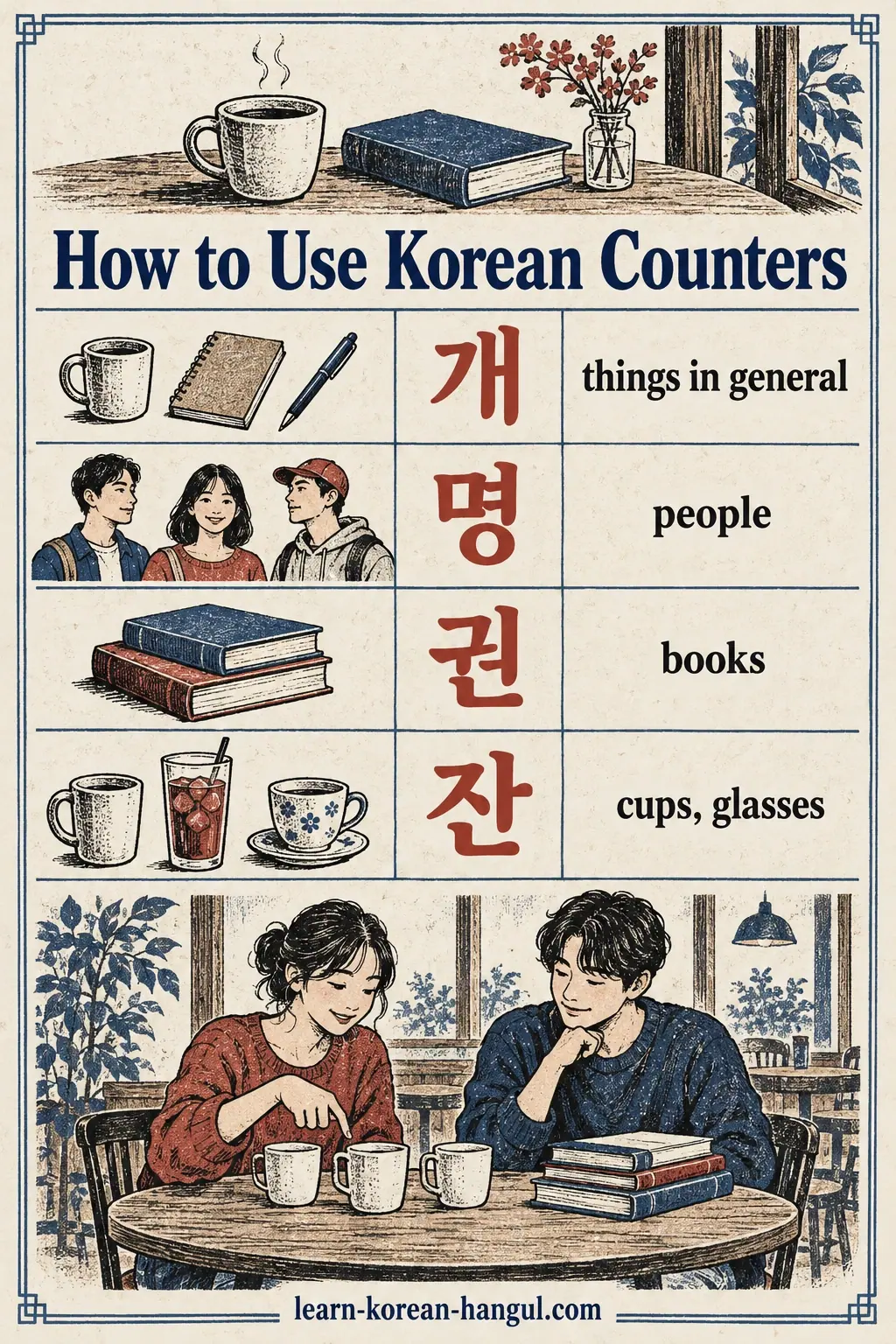
What you'll learn
- Build correct counter phrases for five object types: things, people, animals, books and drinks.
- Pick the right number system for each common counter and use the short forms 한, 두, 세, 네, 스무.
- Place particles such as 을/를 and 이/가 correctly in a counter phrase.
- Write counters with the correct spacing in Hangul and with Arabic numerals.
- Spot and fix three common counter errors.
- Prerequisites: native Korean numbers 1-10. Estimated time: 20 minutes.
How to Use Korean Counters: the Core Idea
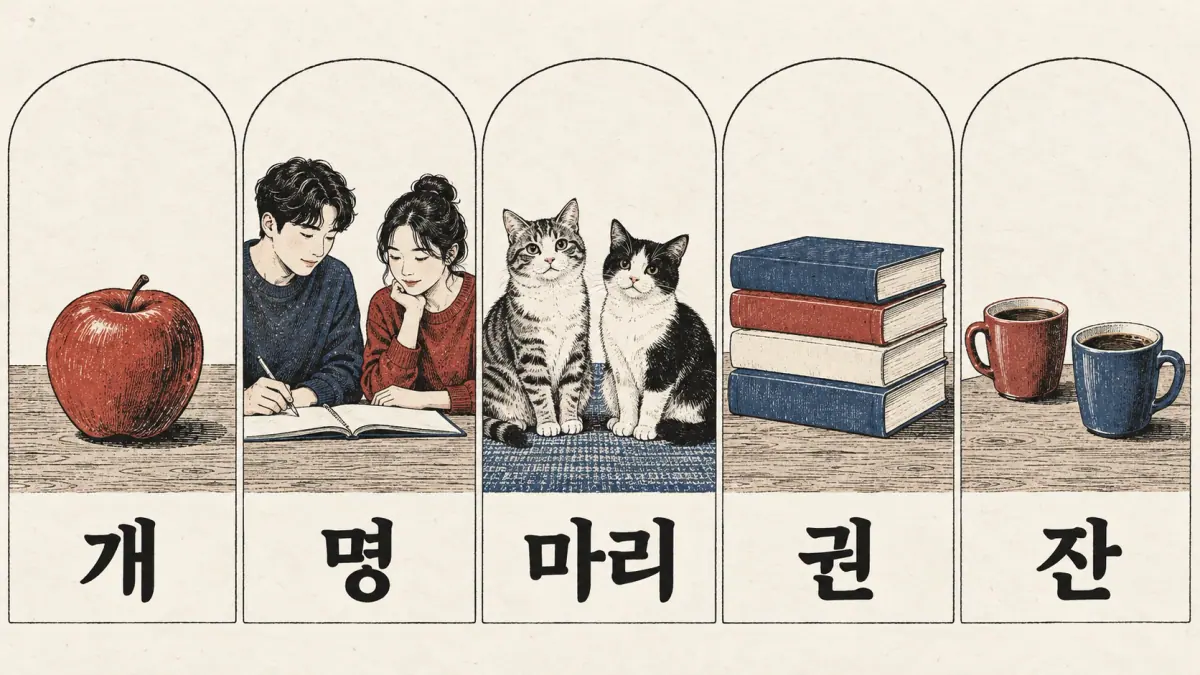
A Korean counter (단위 명사, "unit noun") is a word that follows a number and tells the listener what kind of unit is being counted. English has a few of these: "two cups of coffee", "three sheets of paper", "ten head of cattle". Korean uses one in almost every counting phrase, even for ordinary objects such as apples.
Grammatically, most counters are bound nouns (의존 명사): nouns that cannot stand alone and need a word in front of them. 개 alone means nothing in a counting sense; 세 개 means "three items". Linguists call languages that work this way numeral classifier languages. Chinese, Japanese and Thai are others.
| Phrase | Counter | What the counter tells you |
|---|---|---|
| 사과 세 개 | 개 | three apples: general things |
| 학생 두 명 | 명 | two students: people |
| 고양이 두 마리 | 마리 | two cats: animals |
| 책 네 권 | 권 | four books: bound volumes |
| 커피 두 잔 | 잔 | two coffees: cups or glasses |
Counters solve a real problem: they carry meaning that the number alone does not. 두 명 and 두 마리 both mean "two", but the first is two people and the second is two animals. Once you know what a counter does, the next step is assembling a full phrase in the right order.
How Is a Counter Phrase Built?

A counter phrase is built in six steps, and after a few days of practice the steps run together without thought.
- Name the noun. Start with what you are counting: 사과 (apple).
- Pick the counter. Choose the counter for that kind of thing: 개 for general objects.
- Choose the number system. Check which system the counter takes. 개 takes native numbers.
- Use the short native form. If the number is 1, 2, 3, 4 or 20, shorten it: 하나 → 한, 둘 → 두, 셋 → 세, 넷 → 네, 스물 → 스무.
- Put the three parts in order. Noun + number + counter: 사과 세 개.
- Add a particle or verb. Finish the sentence: 사과 세 개 주세요 ("Three apples, please").
You'll know the phrase is right when you can say it aloud as one unit, with no pause between the number and the counter. The short forms in step 4 apply only to the last part of a number: 21 is 스물하나, and before a counter it becomes 스물한, as in 스물한 개. Twenty on its own is 스무 개.
| Number | Full form | Before a counter | Example |
|---|---|---|---|
| 1 | 하나 | 한 | 한 개 |
| 2 | 둘 | 두 | 두 개 |
| 3 | 셋 | 세 | 세 개 |
| 4 | 넷 | 네 | 네 개 |
| 5 | 다섯 | 다섯 | 다섯 개 |
| 20 | 스물 | 스무 | 스무 개 |
| 21 | 스물하나 | 스물한 | 스물한 개 |
Worked Example: Books and Coffee in One Sentence
Take the English sentence "I bought three books and two coffees." Build each counter phrase separately, then join them.
- Books are 책. Bound volumes take 권, which takes native numbers. Three is 셋, shortened to 세: 책 세 권.
- Coffee is 커피. Drinks in cups take 잔, also native. Two is 둘, shortened to 두: 커피 두 잔.
- Join the two phrases with 하고 ("and"), mark the whole object with 을, and add the past-tense verb 샀어요 ("bought").
Result: 책 세 권하고 커피 두 잔을 샀어요.
The common mistake at step 3 is putting 을 after 책 and again after 잔. One object particle at the end covers the whole joined phrase. Step 3 of the method, choosing the number system, needs its own reference table.
Which Number System Goes with Which Counter?
Each counter takes one number system, and you learn it together with the counter. Most counters for physical things, people and animals take native numbers. Counters for money, floors, minutes, dates and measurements take Sino-Korean numbers.
| Counter | Counts | Number system | Example |
|---|---|---|---|
| 개 | things in general | Native | 사과 세 개 |
| 명 | people | Native | 학생 두 명 |
| 분 | people (honorific) | Native | 손님 세 분 |
| 마리 | animals | Native | 개 한 마리 |
| 권 | books | Native | 책 네 권 |
| 잔 | cups, glasses | Native | 커피 두 잔 |
| 병 | bottles | Native | 물 한 병 |
| 장 | flat sheets, tickets | Native | 종이 다섯 장 |
| 대 | cars, machines | Native | 차 한 대 |
| 살 | age | Native | 스무 살 |
| 시 | hour on the clock | Native | 세 시 |
| 층 | floors (as a label) | Sino | 삼 층 |
| 원 | won (money) | Sino | 천 원 |
| 분 | minutes | Sino | 십 분 |
| 개월 | months | Sino | 육 개월 |
| 인분 | servings | Sino | 이 인분 |
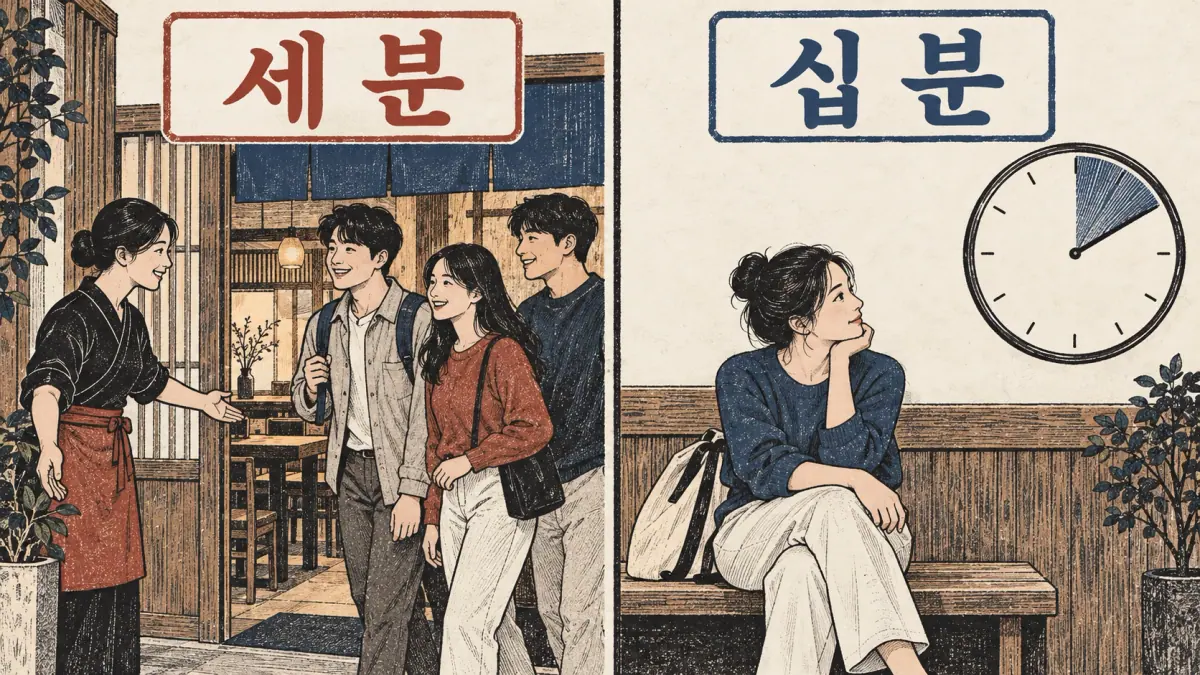
Notice 인분. It counts food servings, and food counters are usually native, yet 인분 takes Sino numbers: 삼겹살 이 인분 ("two servings of pork belly"). Notice also that 분 appears twice: as a polite people counter it is native (세 분), and as minutes it is Sino (십 분).
One rule overrides the table. Native numbers stop at 99, so from 100 upward every counter takes Sino numbers: 백 개 (100 items), 백 명 (100 people).
The full decision rule, with ten everyday situations, is on Sino vs native Korean numbers. For a printable list by object type, use the Korean counters chart. With the number settled, the remaining question is how the phrase fits into a sentence.
Where Do Particles and Plurals Go?
Particles can attach either to the noun or to the counter, and plural 들 is normally left out once a counter is present. Particles are short endings that mark the role of a word, such as 을/를 for the object or 이/가 for the subject; the overview of Korean particles explains each one.
Particle after the Noun or after the Counter
Korean allows two natural placements for the particle:
- On the noun, with the counter phrase after it: 사과를 세 개 샀어요 ("I bought three apples"). Here 사과를 is the object and 세 개 adds the amount.
- After the counter, closing the whole phrase: 사과 세 개를 샀어요. The whole unit 사과 세 개 is the object.
The same choice exists with the subject particle: 학생이 두 명 왔어요 and 학생 두 명이 왔어요 both mean "Two students came". Both orders are correct and common in speech.
Number before the Noun with 의
A second word order puts the counter phrase first and links it to the noun with 의 (the possessive or linking particle): 세 개의 사과 ("three apples"). This pattern appears in written Korean, titles and translated texts. In everyday speech the noun-first order 사과 세 개 is the default, so learn that one first.
A few nouns can act as their own counters and come straight after the number without 의. 사람 (person) and 가지 (kind) are the most common: 세 사람 ("three people"), 두 가지 ("two kinds").
Why 들 Is Usually Dropped
The plural marker 들 is usually dropped in counter phrases because the number already shows that there is more than one. Say 학생 세 명, not 학생들 세 명. Without a number, 들 is common: 학생들이 왔어요 ("The students came"). Korean plural marking is optional in general; the lesson on the plural marker 들 explains when it adds meaning.
Sentence position is only half of writing a counter correctly; the other half is the space between the number and the counter.
How Are Counters Spaced and Typed?
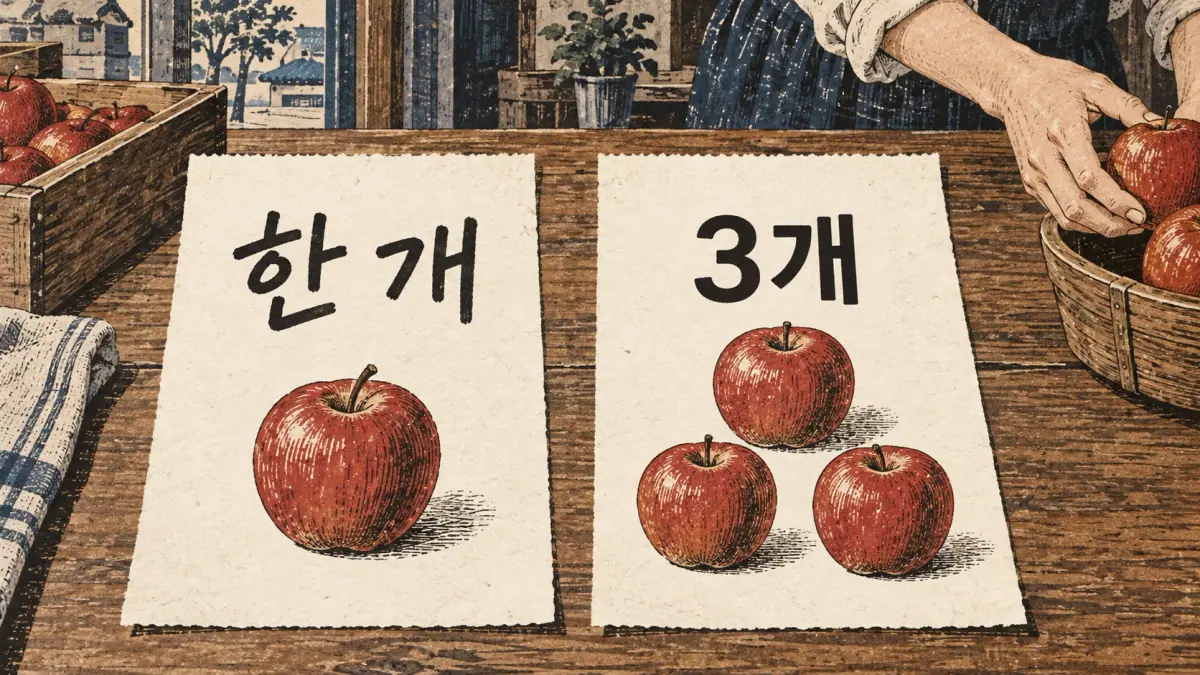
Counters are written as separate words after a number spelled in Hangul, and they may be attached to a number written in Arabic numerals. This follows Article 43 of the Korean spelling rules (한글 맞춤법 제43항) published by the National Institute of Korean Language (국립국어원).
| Writing | Correct form | Note |
|---|---|---|
| Hangul number | 한 개, 세 명, 차 한 대 | space required |
| Arabic numeral | 3개, 10명, 80원 | attaching is allowed |
| Arabic numeral, spaced | 3 개 | also acceptable, but less common in practice |
| Hangul number, attached | 한개 | non-standard in careful writing |
On menus, receipts, signs and phone messages you will mostly see the attached Arabic form: 2인분, 3층, 5,000원. In full sentences written in Hangul, keep the space: 커피 두 잔. The detailed exceptions, such as ordinal uses like 제1과 (Lesson 1), are on the page about counter spacing rules.
Expert insight: spacing does not change pronunciation. 한 개 and 한개 sound identical, so the space is a reading aid for the eye, and Korean readers expect it in Hangul text. Once you can write a counter phrase, you also need to ask about one.
How Do You Ask "How Many?" with a Counter?

To ask "how many?", put 몇 ("how many / what number") in front of the counter: 몇 개 (how many items), 몇 명 (how many people), 몇 살 (how old). The answer uses the same counter with a number.
- 몇 개예요? "How many are there?" Answer: 세 개예요. "Three."
- 몇 명이에요? "How many people?" Answer: 두 명이에요. "Two people."
- 몇 분이세요? A restaurant host's polite "How many in your party?" using the honorific counter 분.
Listen for the sound changes in 몇. In 몇 개 the next consonant becomes tense, roughly [멷깨], and in 몇 명 the final sound becomes nasal, roughly [면명], following the 국립국어원 standard pronunciation rules. Asking is easy when you know the counter; the next section covers what to do when you do not.
What If You Don't Know the Right Counter?
If you don't know the counter, use 개 for objects or say the full native number after the noun with no counter at all. Both are understood, and the second sounds natural for small numbers in casual speech.
- Fallback with 개: for an unfamiliar object, 한 개 or 두 개 works in most shops.
- Bare number: 사과 하나 주세요 ("One apple, please"), 맥주 둘 주세요 ("Two beers, please"). Use the full forms 하나, 둘, 셋, 넷 here, not 한, 두, 세, 네.
- Never for people: 개 cannot count people or animals. Use 명 for people and 마리 for animals, because 학생 두 개 sounds as if the students were objects.
Expert insight (rule of thumb): the bare-number fallback stops sounding natural above about five, and it is not used in writing. Treat it as a speaking shortcut, then learn the real counter for anything you buy or discuss often. The shortcuts help, but the most common errors still need direct correction.
Common Mistakes and Fixes
These seven before-and-after pairs cover most beginner counter errors.
| Mistake | Correct | Why |
|---|---|---|
| 셋 개 | 세 개 | Use the short form before a counter |
| 사과 삼 개 | 사과 세 개 | 개 takes native numbers |
| 세 사과 | 사과 세 개 | Most nouns need a counter |
| 학생 두 개 | 학생 두 명 | People take 명, not 개 |
| 세 층 (for 3층) | 삼 층 | Floor labels take Sino numbers |
| 학생들 세 명 | 학생 세 명 | The number already shows the plural |
| 한개 (in Hangul) | 한 개 | Leave a space after a Hangul number |
Learners often assume English word order works: "three apples" becomes 세 사과. Actually Korean needs both the counter and the noun-first order, because the counter carries the unit and the number modifies the counter, not the noun. Practice turns these corrections into habits.
Practice Set
Try each exercise aloud before you check the answers below.
Exercise A: build the phrase. Write noun + number + counter.
- two cats (고양이, 마리)
- four books (책, 권)
- one bottle of water (물, 병)
- five students (학생, 명)
Exercise B: fix the error. 5. 커피 둘 잔 6. 친구 세 개 7. 물 삼 병 (three bottles of water)
Exercise C: place the particle. Rewrite with the particle after the counter. 8. 책을 두 권 샀어요.
Practice · 8
What is the usual word order for "three apples"?
Show answer
사과 세 개
Put the noun first, then the number, then the counter. Most nouns need a counter, so 세 사과 is wrong.
Fix the error: 커피 둘 잔
Show answer
커피 두 잔
Before a counter, 둘 takes its short form 두, and 잔 takes native numbers.
Fix the error: 친구 세 개
Show answer
친구 세 명
People take 명, not 개, and 명 takes native numbers.
Which phrase means "three bottles of water"?
Show answer
물 세 병
병 takes native numbers, and 셋 shortens to 세 before a counter.
Which counter for food servings takes Sino-Korean numbers?
Show answer
인분
Food counters are usually native, but 인분 takes Sino numbers: 삼겹살 이 인분.
Which phrase is correct for "three students"?
Show answer
학생 세 명
The number already shows the plural, so 들 is dropped, and people take 명.
How do you write "one item" with a Hangul number in a sentence?
Show answer
한 개
After a number spelled in Hangul, the counter is a separate word, so keep the space: 한 개.
How do you ask "How many people?"
Show answer
몇 명이에요?
Put 몇 in front of the counter: 몇 명 asks about people, 몇 개 about items and 몇 살 about age.
Answers: 1. 고양이 두 마리. 2. 책 네 권. 3. 물 한 병. 4. 학생 다섯 명. 5. 커피 두 잔 (short form 두). 6. 친구 세 명 (people take 명). 7. 물 세 병 (병 takes native numbers). 8. 책 두 권을 샀어요.
If you missed items 5 or 6, review the step list and the system table above before moving to single-counter lessons.
What This Lesson Does Not Cover
This lesson covers the shared rules for all counters. It does not teach each counter's full list of objects, the counters for clothing and shoes, or ordinal numbers such as 첫 번째 (first). It also does not cover large numbers above 100 in detail. Each of those topics has its own page in the Korean Counters section.
What to Learn Next
Practise with the 개 counter first, because it counts most everyday objects. Then people: the 명 counter, which also covers the polite 분. When you meet a counter that takes Sino numbers, check the rule on Sino vs native Korean numbers. Knowing how to use Korean counters is the base skill for every counter lesson in this section.
Frequently Asked Questions
Do I have to use counters with all nouns? No, but you need one in most counting phrases. Korean speakers count with a counter whenever a number sits next to a noun: 책 두 권, 학생 세 명. In casual speech small numbers can follow a noun on their own, as in 사과 하나 주세요. Some nouns, such as 사람 and 가지, act as their own counters.
Which Korean counter should I learn first? Learn 개 first, because it counts most everyday objects and appears in shops constantly: 하나 주세요 becomes 한 개 주세요. Learn 명 second, for people. With 개, 명, 잔 (cups) and 병 (bottles) you can handle ordering, shopping and talking about groups at A1 level before adding the rest.
Do counters change in polite or honorific speech? The number stays the same, but some counters have honorific partners. For people, 명 is neutral and 분 is respectful: 손님 세 분 (three guests). A restaurant host will ask 몇 분이세요? (How many in your party?). For age, 살 is neutral, while 연세 is the respectful word for an older person's age.
How many counters does Korean have? Korean dictionaries list well over a hundred unit nouns, but a beginner needs about twenty for daily life. The core set covers things (개), people (명, 분), animals (마리), books (권), cups (잔), bottles (병), sheets (장), machines (대), age (살), floors (층), money (원) and time (시, 분, 달, 년).
Is 개 the same in Korean, Chinese and Japanese? 개 comes from the same Chinese character (個) as Chinese 个 (gè) and Japanese 個 (ko), so the three are related. Their use differs. Korean 개 pairs with native numbers (세 개) and follows the noun: 사과 세 개. Chinese puts the counter phrase before the noun (三个苹果), so do not copy Chinese order into Korean.