What you'll learn
- Say any age from 1 to 99 with 살, using the right native number form.
- Explain why 20 is 스무 살 and not 스물 살.
- Ask and answer 몇 살이에요? at three politeness levels.
- Separate 살 from 세, 개월 and the decade pattern 20대.
Prerequisites: native Korean numbers 1-10. Estimated time: 35 minutes.
Korean Counter Sal: the Essentials

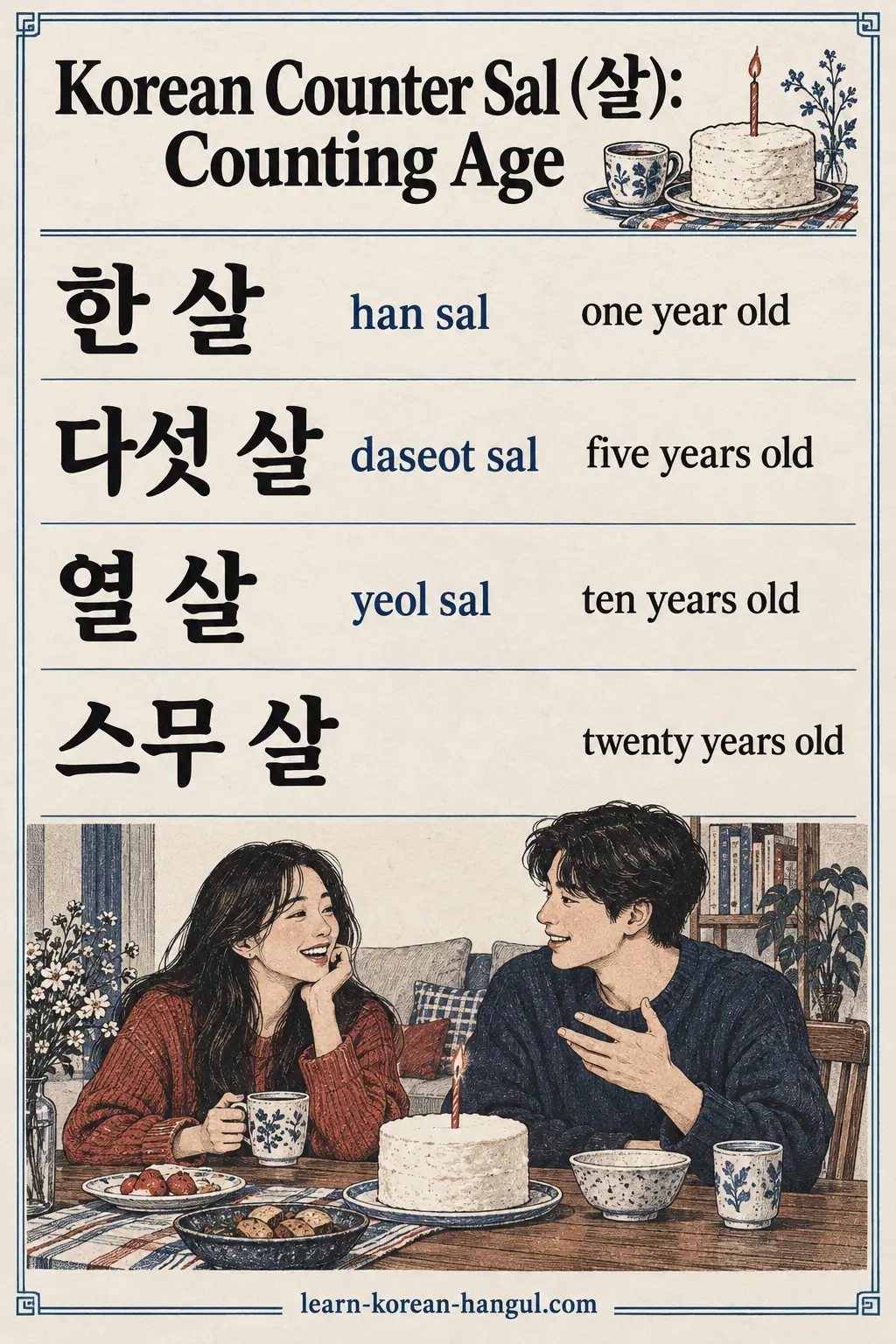
The Korean counter sal (살) is the word that follows a native number when you give someone's age. A counter is a small word that tells you what kind of thing a number counts. Here the thing counted is years of life, so 살 works like "years old" in English: 스무 살 means "twenty years old".
The pattern is: native number + 살, usually followed by 이에요 or 입니다.
| Age | Korean | Meaning |
|---|---|---|
| 1 | 한 살 | one year old |
| 5 | 다섯 살 | five years old |
| 10 | 열 살 | ten years old |
| 20 | 스무 살 | twenty years old |
| 25 | 스물다섯 살 | twenty-five years old |
| 30 | 서른 살 | thirty years old |
Unlike 명 or 마리, the counter 살 almost never appears with a noun in front. You do not say a noun first. The number and counter stand alone as the answer: 저는 스물다섯 살이에요 (I am twenty-five). The next section shows the whole sentence.
How Do You Use 살 in a Sentence?
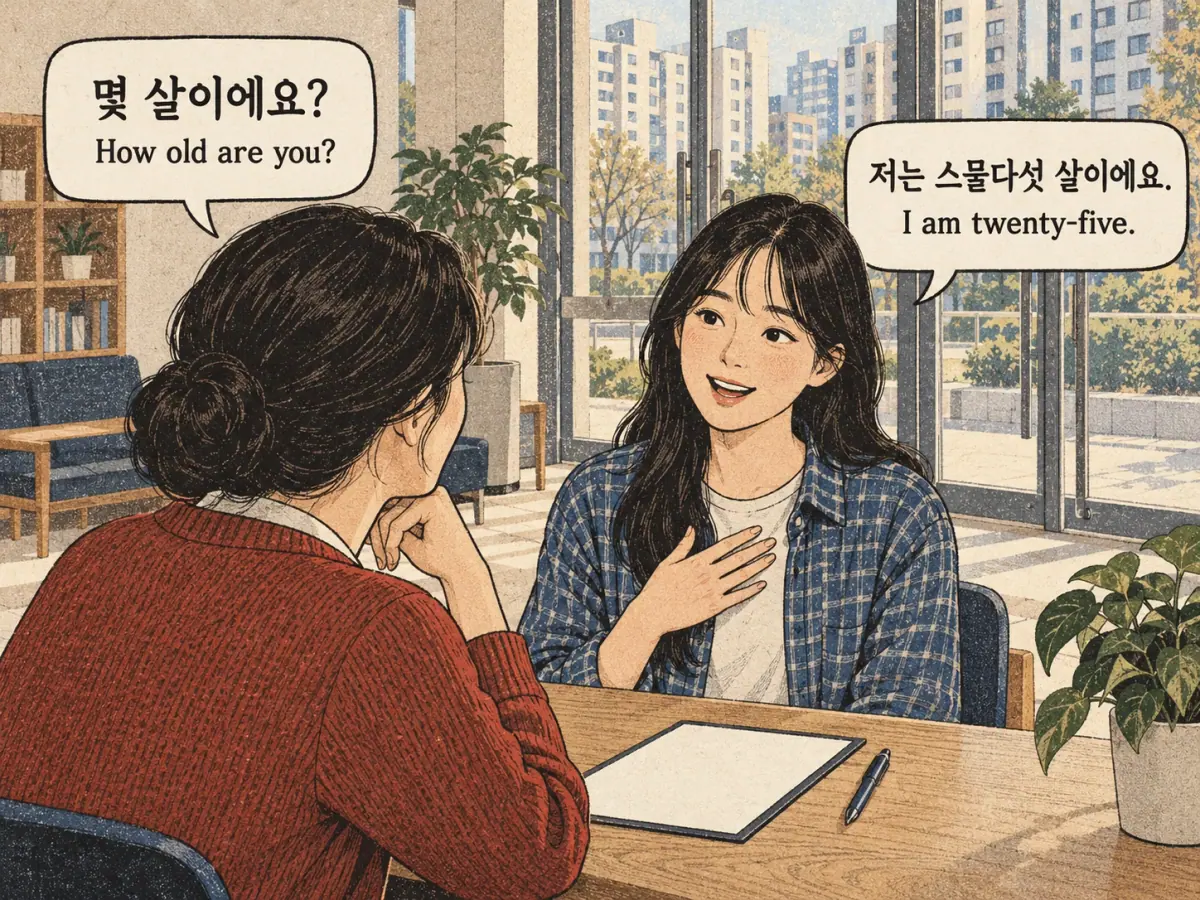
To use 살 in a sentence, state who is the subject, then the native number with 살, then the copula 이에요. The copula 이에요 means "is/am/are" in polite speech. Because the age is the whole point of the sentence, the counter ends the clause.
| Pattern | Example | Meaning |
|---|---|---|
| 저는 + age + 이에요 | 저는 스물다섯 살이에요. | I am twenty-five. |
| 동생은 + age + 이에요 | 동생은 열두 살이에요. | My younger sibling is twelve. |
| 올해 + age + 이에요 | 올해 서른 살이에요. | I am thirty this year. |
| 몇 살이에요? | 몇 살이에요? | How old are you? |
The question word 몇 (how many) plus 살 gives 몇 살 (how old). It is pronounced [멷쌀]: the final ㅊ of 몇 is pronounced [ㄷ], and the ㅅ of 살 after it becomes tense [ㅆ]. You can raise or lower the politeness by changing the ending.
| Politeness | Question | Use with |
|---|---|---|
| Casual | 몇 살이야? | close friends, children |
| Polite | 몇 살이에요? | adults you know a little |
| Formal | 나이가 어떻게 되세요? | strangers, new contacts |
The formal row uses 나이 (age) with the honorific 되세요 and avoids 살 completely. For someone clearly older, such as a grandparent, replace 나이 with the honorific word 연세: 연세가 어떻게 되세요? For the full politeness ladder with dialogues, see how to say age in Korean.
Now that the pattern is clear, you need the numbers.
Which Number Forms Does 살 Use?

The counter 살 takes native Korean numbers from 1 to 99. The five numbers 하나, 둘, 셋, 넷 and 스물 shorten to 한, 두, 세, 네 and 스무 before the counter. All other numbers keep their ordinary form.
| Age | Korean | Spoken | Revised Romanization |
|---|---|---|---|
| 1 | 한 살 | [한 살] | han sal |
| 2 | 두 살 | [두 살] | du sal |
| 3 | 세 살 | [세 살] | se sal |
| 4 | 네 살 | [네 살] | ne sal |
| 5 | 다섯 살 | [다섣쌀] | daseot sal |
| 6 | 여섯 살 | [여섣쌀] | yeoseot sal |
| 7 | 일곱 살 | [일곱쌀] | ilgop sal |
| 8 | 여덟 살 | [여덜살], often [여덜쌀] | yeodeol sal |
| 9 | 아홉 살 | [아홉쌀] | ahop sal |
| 10 | 열 살 | [열살], often [열쌀] | yeol sal |
The spoken column shows a sound change called tensification. After a final consonant pronounced [ㄷ] or [ㅂ], the ㅅ of 살 becomes a tense [ㅆ], so 다섯 살 sounds like [다섣쌀] and 일곱 살 like [일곱쌀]. The National Institute of Korean Language (국립국어원) standard pronunciation rules (표준 발음법, Article 23) describe this change. After ㄹ, as in 열 살 and 여덟 살, many speakers also say [쌀], but no general rule requires it. The spelling never changes, and Revised Romanization ignores tensification, so 다섯 살 is still romanized daseot sal.
For ages 11 to 19, add the ones digit after 열: 열한 살 (11), 열두 살 (12), 열세 살 (13), 열네 살 (14), 열다섯 살 (15), 열여섯 살 (16), 열일곱 살 (17), 열여덟 살 (18), 열아홉 살 (19).
Tens follow their own names, and the ones digit goes on the end.
| Tens | Korean | Example with ones digit |
|---|---|---|
| 20 | 스무 살 | 스물한 살 (21) |
| 30 | 서른 살 | 서른두 살 (32) |
| 40 | 마흔 살 | 마흔세 살 (43) |
| 50 | 쉰 살 | 쉰네 살 (54) |
| 60 | 예순 살 | 예순다섯 살 (65) |
| 70 | 일흔 살 | 일흔여섯 살 (76) |
| 80 | 여든 살 | 여든일곱 살 (87) |
| 90 | 아흔 살 | 아흔아홉 살 (99) |
Notice how the tens rule works. In 스물한 살, the number 스물 (20) keeps its ㄹ because another word follows inside the number. The ㄹ drops only when 스물 stands directly before the counter, which gives 스무 살. For the full list of native numbers, see native Korean numbers 1-100.
Why Is 20 스무 살?
The native number for 20 is 스물, and it becomes 스무 whenever it comes straight before a counter. This is the same shortening that turns 하나 into 한 and 둘 into 두. So 20 years old is 스무 살, and the common phrase 스무 살 also carries a feeling of "the first year of adulthood".
The trap is that 스물 survives inside longer numbers. Twenty-one is 스물한 살, and twenty-five is 스물다섯 살. Only exact twenty becomes 스무. Learners who remember this one pair avoid the most common error in Korean ages.
You now have every form. The next question is what age 살 actually reports.
Which Age Does 살 Mean Today?
In everyday speech, 살 may still follow the traditional counting age (세는나이), where a baby is one year old at birth and everyone adds a year on 1 January. From 28 June 2023, amendments to the Civil Act (민법) and the Framework Act on Public Administration (행정기본법) made international age (만 나이) the default age in South Korean law and administration, so forms and official records use the age counted from the birthday. A few laws, such as the youth protection rules on buying alcohol and tobacco and the military service rules, still use the year age (연 나이).
| System | How it counts | Example for a person born in 2000, in 2026 |
|---|---|---|
| 세는나이 (counting age) | year − birth year + 1 | 스물일곱 살 |
| 연 나이 (year age) | year − birth year | 스물여섯 살 |
| 만 나이 (international age) | years since birth date | 만 스물다섯 살 or 만 스물여섯 살 |
The word 만 (滿) in 만 나이 means "full", as in full years completed. The calculation page, Calculate Korean age, works through these formulas with worked examples, and Korean age abolished explains the 2023 change. Because custom changes slowly, ask 만 나이로 몇 살이에요? (what is your age in international age?) when the system matters.
Treat the 2023 change as the legal default and everyday speech as a mix. The legal details on this page are a summary for learners, not legal advice.
What Does 살 Not Count?
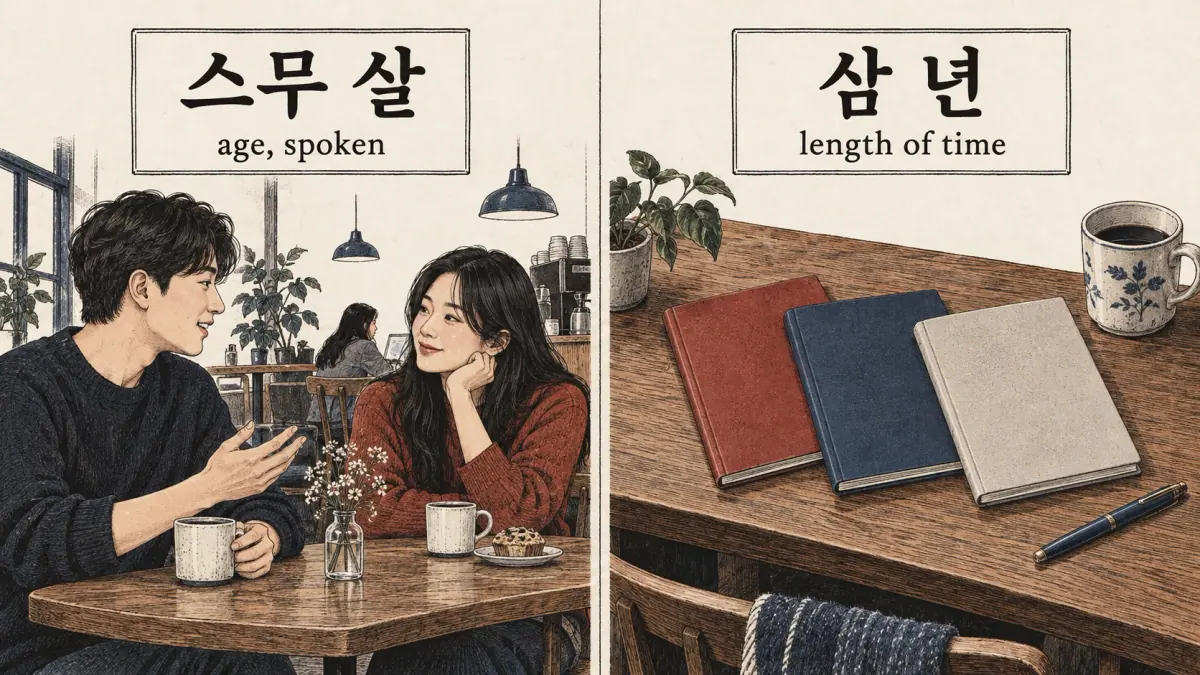
The counter 살 counts the age of a living being and nothing else. Other counters cover babies, time spans and written forms.
| Counter | Counts | Number system | Example |
|---|---|---|---|
| 살 | age, spoken | native | 스무 살 |
| 세 | age, written or formal | Sino-Korean | 이십 세 |
| 개월 | months of a baby's age | Sino-Korean | 생후 육 개월 |
| 년 | length of time | Sino-Korean | 삼 년 |
Babies are the main exception. Until about two years old, parents often give a baby's age in months, not in 살: 생후 6개월 means "six months after birth". After that they switch to 두 살, 세 살 and so on. Read more on the 달 and 개월 counters page.
Also remember that 년 counts a length of time, such as 삼 년 (three years). If you say 삼 살 or 삼 년 for a child who is three years old, the listener will correct you: age needs 살, and duration needs 년.
Tens and Milestone Birthdays
Round birthdays have names that go beyond the number. A traditional 60th birthday is 환갑 (also called 회갑), the 70th is 칠순 and the 80th is 팔순. Families often celebrate these with a dinner. Counting age is the traditional basis, so a 환갑 falls at 61 by counting age, which is 60 by international age. 칠순 and 팔순 traditionally mean 70 and 80 in counting age, and families now differ on which year they celebrate.
| Birthday | Everyday word | Number with 살 |
|---|---|---|
| 60th | 환갑 | 예순 살 |
| 70th | 칠순 | 일흔 살 |
| 80th | 팔순 | 여든 살 |
How Do You Say an Age Range?
To describe a decade of life, use the Sino-Korean number plus 대: 20대 (read 이십 대) means "in your twenties". Add 초반 for early, 중반 for middle and 후반 for late: 20대 초반, 30대 중반, 40대 후반. This pattern does not use 살, because it names a range, not one exact age.
Use 살 for exact ages and 대 for ranges. With the main forms covered, the next step is to avoid the errors that catch most learners.
Age Comparisons and Age Words

Once you can state an age, you can compare ages with 살. Koreans compare ages often, because age affects the speech level and the choice of words such as 형 and 누나. Four patterns cover most comparisons.
| Pattern | Example | Meaning |
|---|---|---|
| person + 보다 + number + 살 + 많아요 | 저보다 두 살 많아요. | He or she is two years older than I am. |
| person + 보다 + number + 살 + 어려요 | 동생은 저보다 세 살 어려요. | My younger sibling is three years younger than I am. |
| 동갑 | 우리는 동갑이에요. | We are the same age. |
| 몇 살 차이 | 몇 살 차이예요? | How many years apart are you? |
The word 동갑 (donggap) names the situation of being the same age, and it works as a noun with 이에요. The question 몇 살 차이예요? is pronounced [멷쌀 차이예요], and in everyday speech 예요 after a vowel is often softened to [에요]: [멷쌀 차이에요]. Notice that the comparing word 많아요 (are many) means older, and 어려요 (are young) means younger. English uses "older" and "younger" for both ideas, but Korean uses an ordinary adjective for each.
A related suffix is 짜리, which turns an age into a description of a person: 다섯 살짜리 아이 means "a five-year-old child". It can follow any native number plus 살, and it is a handy way to describe someone without a full sentence.
These patterns also show why the right form of the number matters. A mistake in 스무 살 or 열두 살 inside a comparison still sounds wrong, even when the grammar around it is perfect.
Misconceptions about 살
Learners often hold three beliefs about this counter that lead them astray, and each has a simple correction.
"Any number plus 살 works." The counter 살 needs a native number, so the Sino-Korean 이십 or 삼십 does not fit. The pairing is a matter of convention, much as English says "three years old" and not "third years old". Treat 살 and native numbers as a single unit.
"스물 살 is a formal way to say twenty." The form 스물 살 is not formal; it is simply wrong. Korean has a different formal way to say the age, which is the counter 세 with Sino-Korean numbers. The formal form of twenty is 이십 세, and a speaker would usually say it in an announcement or on a form.
"Counting age is gone, so 살 must mean international age now." The 2023 legal change set international age as the official standard, but 살 in everyday talk remains flexible. Friends and family may still count years as they always did. When the exact age matters, add 만 or ask which system the speaker means.
Each correction points to the same habit: treat 살 as a fixed unit with a native number, and check the system when the age matters.
Common Mistakes and Fixes
Most errors with 살 come from the wrong number system or the wrong form of 스물. Test each sentence against this list.
- Using Sino-Korean numbers with 살. Wrong: 이십 살, 삼십 살. Right: 스무 살, 서른 살.
- Saying 스물 살. Wrong: 스물 살. Right: 스무 살.
- Using the standalone number form. Wrong: 하나 살, 둘 살, 셋 살. Right: 한 살, 두 살, 세 살.
- Using 살 on forms. Official forms ask for a number with 세: 25세. Write 살 in speech and informal text.
- Counting a baby's age in 살. Under about two years, give months: 6개월.
- Mixing 살 with 년. Wrong: 삼 년이에요 for a three-year-old, which says the child has existed for a duration of three years. Right: 세 살이에요 (age) or 삼 년 (duration).
Limitation: this lesson reports the standard rules. Real speakers sometimes drop 살 when the context makes the counter obvious, as in 열여덟이에요 (I am eighteen). Learn the full pattern first, then recognize the shortcuts.
Practice Set
Answer each item before you read the answer line.
- Say "I am twenty years old."
- Say "My younger sibling is twelve."
- Ask a friend how old they are, casually.
- What is wrong with 이십 살?
- How do you say a baby is six months old?
- Say "in my thirties" in Korean.
Practice · 8
How do you say "I am twenty years old"?
Show answer
저는 스무 살이에요.
스물 shortens to 스무 directly before 살, and 살 takes native numbers.
How do you say "twenty-one years old"?
Show answer
스물한 살
스물 keeps its ㄹ inside a longer number, and 하나 shortens to 한 before 살.
How do you say "twelve years old"?
Show answer
열두 살
Native 12 shortens to 열두 before the counter.
How do you say "in my thirties"?
Show answer
30대
A decade of life uses a Sino number plus 대. 서른 살 and 30세 name one exact age.
What does 동갑 mean?
Show answer
Being the same age
동갑 names the situation of being the same age: 우리는 동갑이에요.
How do you say "He is two years older than I am"?
Show answer
저보다 두 살 많아요.
많아요 means older and 어려요 means younger, and 살 takes the native 두.
Which honorific word replaces 나이 when you ask a grandparent's age?
Show answer
연세
연세 is the honorific word for age: 연세가 어떻게 되세요?
How is age 25 written on an official form?
Show answer
25세
Forms use the Sino-Korean counter 세. 년 counts years of time and 개월 counts months.
Answers:
- 저는 스무 살이에요 (jeoneun seumu sarieyo).
- 동생은 열두 살이에요 (dongsaengeun yeoldu sarieyo).
- 몇 살이야? (myeot sariya?).
- 이십 살 uses a Sino-Korean number with 살. Use the native form 스무 살.
- 육 개월이에요 (yuk gaeworieyo), or 생후 6개월.
- 30대 (samsip dae), read 삼십 대.
Four or more correct means the pattern is secure.
What to Learn Next
You can now use the Korean counter sal for ages from 1 to 99: native number, then 살. Continue in this order:
- Native Korean numbers 1-100 to master the full set that 살 depends on.
- How to say age in Korean for polite questions and the 몇 년생 shortcut.
- Korean age abolished for what the 2023 change means in practice.
- The 달 and 개월 counters for babies and months.
Frequently Asked Questions
Why is 20 스무 살?
The native number for 20 is 스물, but it drops the ㄹ and becomes 스무 before any counter. So 20 years old is 스무 살, and 20 people is 스무 명. The long form 스물 appears only inside longer numbers, as in 스물다섯 살 (25), or when you count without any counter.
Can I say 이십 살?
It is not the standard form. 살 expects native numbers, so a 20-year-old says 스무 살. Sino-Korean numbers belong with the counter 세, as in 이십 세 on forms. A listener will understand 이십 살 from a learner, but it sounds like a mismatch, much like saying a mixed-up unit in English.
How do I say 100 years old?
Say 백 살. Native numbers run to 아흔아홉 (99), so Korean switches to the Sino-Korean 백 (100) for centenarians, and 살 stays the same. In writing and announcements you will also see 백 세. Both are understood, and 백 살 is the natural spoken choice.
How do I say 'in my twenties'?
Say 20대, read 이십 대, which uses a Sino-Korean number plus 대. For 'early twenties' add 초반, as in 20대 초반; for 'mid-twenties' add 중반; for 'late twenties' add 후반. This phrase does not use 살, because it describes an age range, not one exact age.