What you'll learn
- Say and spell any native Korean number from 1 to 99.
- Combine a ten and a ones digit without a space: 스물다섯, 서른둘.
- Use 스무 for exactly 20 before a counter, and 한, 두, 세, 네 for a last digit of 1 to 4.
- Explain why 100 uses Sino-Korean 백.
Prerequisites: native Korean numbers 1-10. Estimated time: 45 minutes.
Native Korean Numbers 1-100: the Essentials
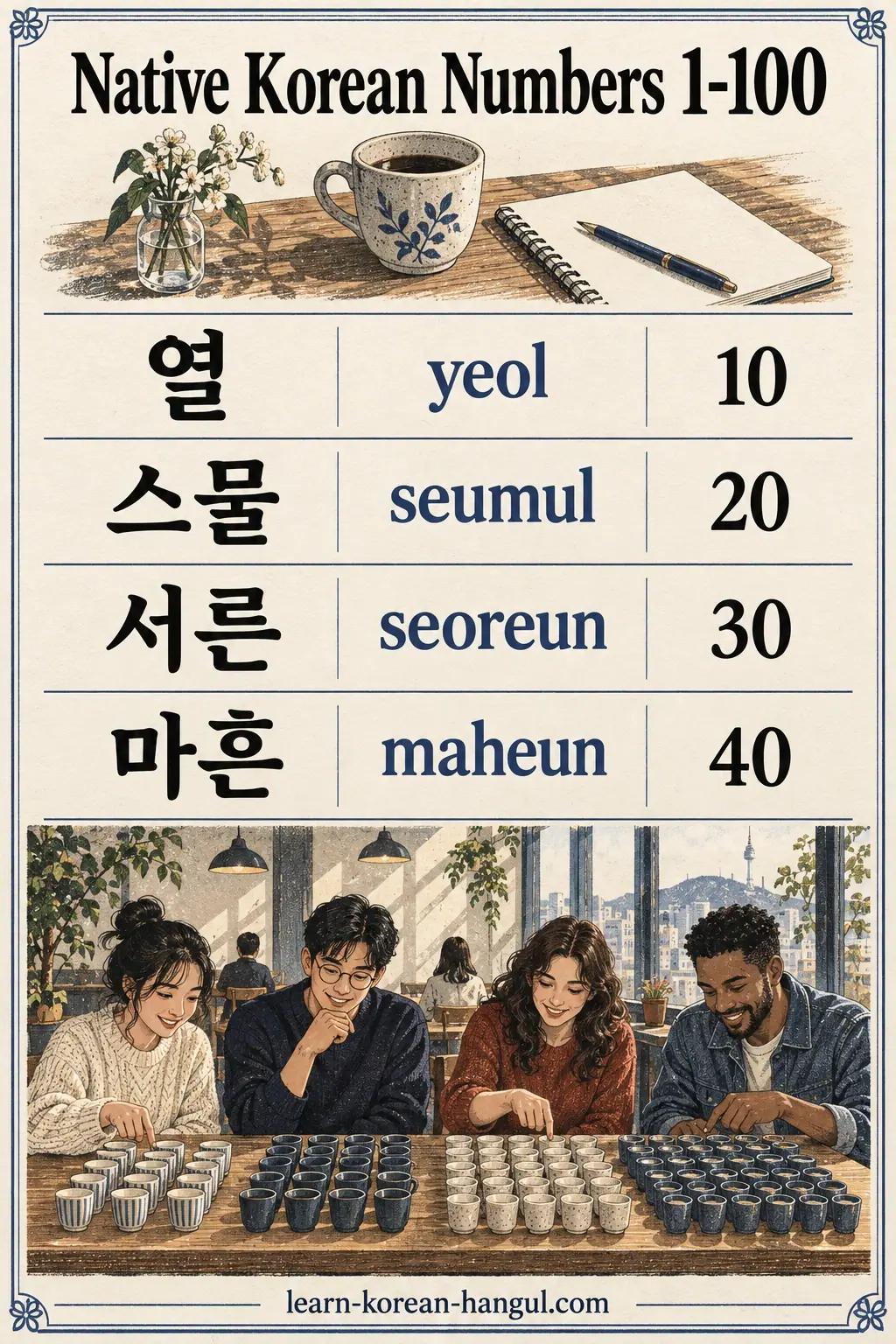
The native Korean numbers above ten are built from nine tens words and the ten words you already know. The tens do not follow one pattern, so each is a separate word to learn. After you know them, every number to 99 is only a ten plus a ones digit.
| Tens | Hangul | Revised Romanization | Memory group |
|---|---|---|---|
| 10 | 열 | yeol | group 1 |
| 20 | 스물 | seumul | group 1 |
| 30 | 서른 | seoreun | group 1 |
| 40 | 마흔 | maheun | group 2 |
| 50 | 쉰 | swin | group 2 |
| 60 | 예순 | yesun | group 2 |
| 70 | 일흔 | ilheun | group 3 |
| 80 | 여든 | yeodeun | group 3 |
| 90 | 아흔 | aheun | group 3 |
Revised Romanization (RR) is the official Latin-letter system of South Korea, shown here only as a learning aid. The memory groups split the nine words into three sets of three: 열, 스물, 서른 first, then 마흔, 쉰, 예순, then 일흔, 여든, 아흔. Learn one group per day, and say each group aloud three times before you add the next.
Every ten from 30 upward ends in the sound ㄴ, which is a useful clue. Three of them, 마흔, 일흔 and 아흔, also share the ending 흔, while 서른, 쉰, 예순 and 여든 have their own shapes.
Next, the rule that turns these tens into every number to 99.
How Do You Combine Tens and Ones?
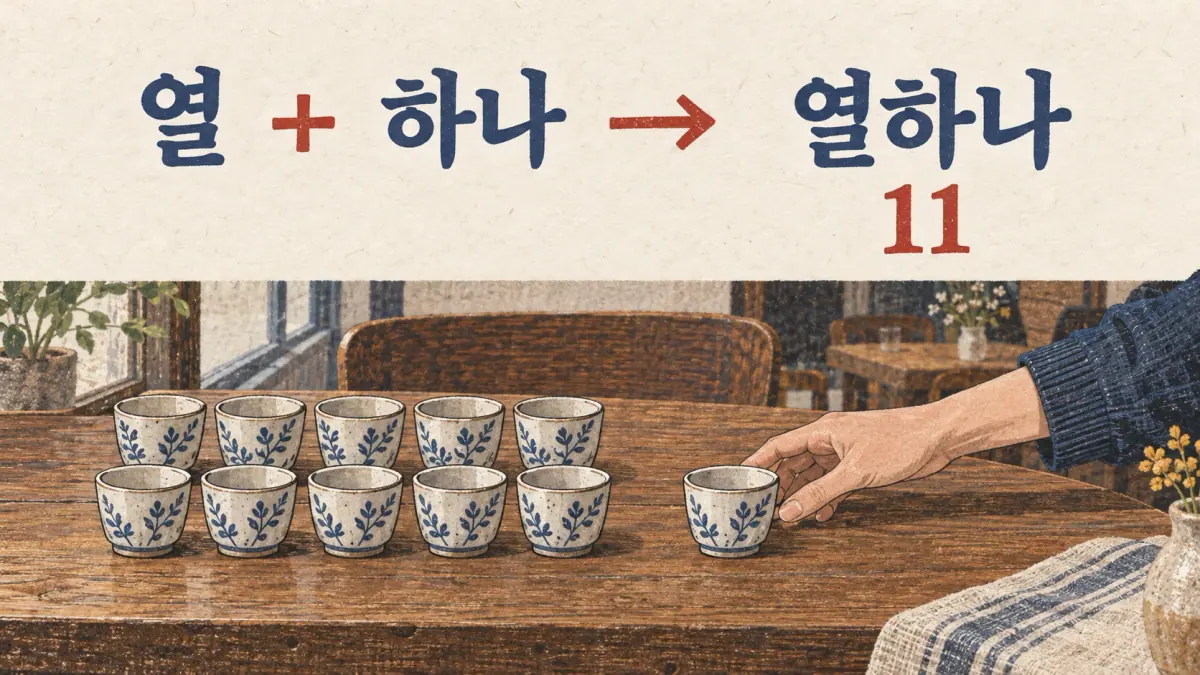
To combine a native ten and a ones digit, write them together as one word, with the ten first: 스물 plus 다섯 gives 스물다섯 (25). There is no space inside the number and no extra word between the two parts. This is the whole rule, and it works from 11 to 99.
| Number | Ten + ones | Hangul |
|---|---|---|
| 11 | 열 + 하나 | 열하나 |
| 21 | 스물 + 하나 | 스물하나 |
| 32 | 서른 + 둘 | 서른둘 |
| 45 | 마흔 + 다섯 | 마흔다섯 |
| 56 | 쉰 + 여섯 | 쉰여섯 |
| 67 | 예순 + 일곱 | 예순일곱 |
| 78 | 일흔 + 여덟 | 일흔여덟 |
| 89 | 여든 + 아홉 | 여든아홉 |
| 99 | 아흔 + 아홉 | 아흔아홉 |
You will know you built a number correctly if you can split it back into a ten and a ones digit: 마흔다섯 is 마흔 and 다섯. Some combinations change sound when they are spoken. The careful form of 스물하나 keeps every sound, [스물하나], but in fast speech the ㅎ between two voiced sounds weakens, so it is often heard as [스무라나]. Treat that as a feature of casual speech, not a spelling or a rule to copy.
A second change appears when the ones digit is 여섯 or 여덟, the two words that begin with a y sound. The standard pronunciation rules (표준 발음법, Article 29) of the National Institute of Korean Language (국립국어원) add an [ㄴ] sound between the parts, and after ㄹ it becomes [ㄹ]. So 열여섯 sounds like [열려섣], 스물여덟 like [스물려덜] and 서른여섯 like [서른녀섣]. You do not write the added sound, but you will hear it. Listen to the audio for these three examples.
Learners often try to place the Sino-Korean 일 or 이 into native numbers, as in 열일 or 스물이. These are mixed-system errors. After a native ten, the ones digit must be a native word.
Why Does 스물 Become 스무?
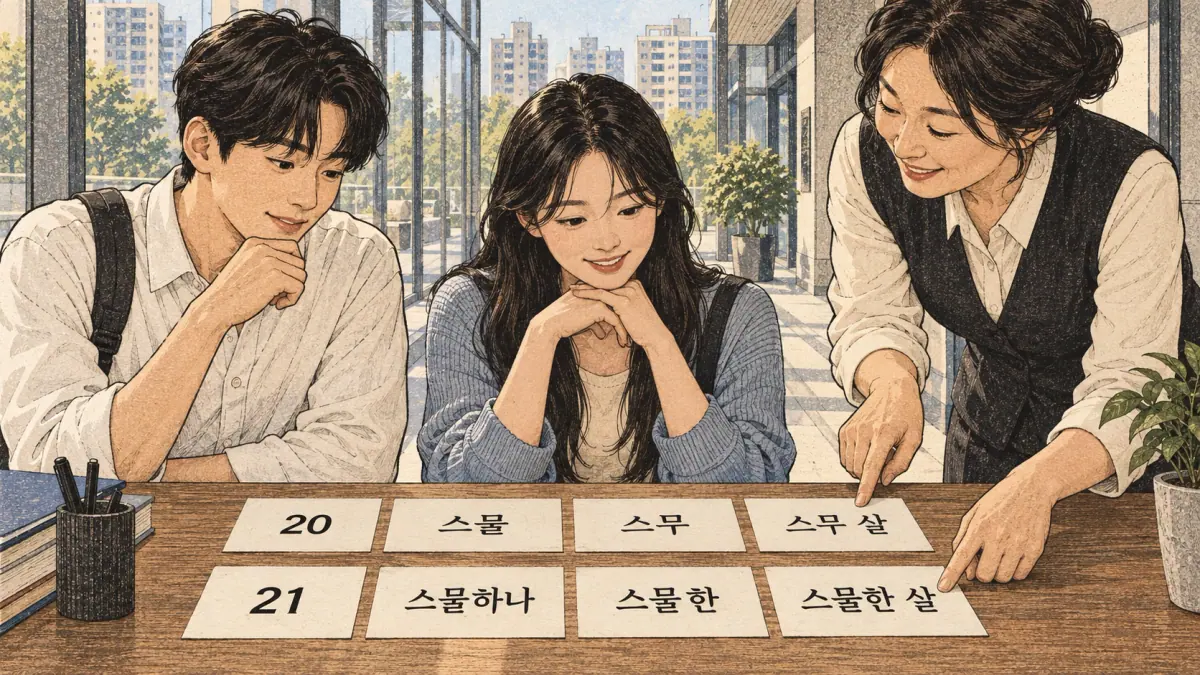
The ten 스물 (20) becomes 스무 when it stands alone directly before a counter, so 20 years old is 스무 살 and 20 things is 스무 개. This is the same kind of shortening that turns 하나 into 한 and 둘 into 두. It is the one special form among the tens.
| Number | Alone | Before a counter | Example |
|---|---|---|---|
| 20 | 스물 | 스무 | 스무 살 |
| 21 | 스물하나 | 스물한 | 스물한 살 |
| 22 | 스물둘 | 스물두 | 스물두 개 |
| 23 | 스물셋 | 스물세 | 스물세 명 |
| 24 | 스물넷 | 스물네 | 스물네 시간 |
| 25 | 스물다섯 | 스물다섯 | 스물다섯 살 |
The rule has two parts. First, exactly 20 uses 스무, and it keeps the long form 스물 whenever a ones digit follows. So 스물 살 is wrong, and so is 스무한 살. Second, the last digit shortens when it is 1, 2, 3 or 4, in the same way as in the 1-10 lesson: 스물한, 스물두, 스물세, 스물네. The other tens do not change: 서른 개 (30 things) and 마흔 명 (40 people) use the same word that is used for counting alone.
Here is the same table for the thirties, to show that the pattern repeats.
| Number | Alone | Before a counter |
|---|---|---|
| 30 | 서른 | 서른 |
| 31 | 서른하나 | 서른한 |
| 32 | 서른둘 | 서른두 |
| 33 | 서른셋 | 서른세 |
| 34 | 서른넷 | 서른네 |
This is the rule behind age. The counter 살 for age takes these forms, so 스물다섯 살이에요 means "I am twenty-five". The lesson on the 살 counter uses this list for every age from 1 to 99.
What Are the Native Numbers 1-99?
The table below lists every native Korean number from 1 to 99 in rows of ten. Find the ten in the first column and the ones digit in the column heading. Each cell is the word for counting alone; use the short forms from the section above before a counter.
| Tens | +0 | +1 | +2 | +3 | +4 | +5 | +6 | +7 | +8 | +9 |
|---|---|---|---|---|---|---|---|---|---|---|
| 0 | 하나 | 둘 | 셋 | 넷 | 다섯 | 여섯 | 일곱 | 여덟 | 아홉 | |
| 10 | 열 | 열하나 | 열둘 | 열셋 | 열넷 | 열다섯 | 열여섯 | 열일곱 | 열여덟 | 열아홉 |
| 20 | 스물 | 스물하나 | 스물둘 | 스물셋 | 스물넷 | 스물다섯 | 스물여섯 | 스물일곱 | 스물여덟 | 스물아홉 |
| 30 | 서른 | 서른하나 | 서른둘 | 서른셋 | 서른넷 | 서른다섯 | 서른여섯 | 서른일곱 | 서른여덟 | 서른아홉 |
| 40 | 마흔 | 마흔하나 | 마흔둘 | 마흔셋 | 마흔넷 | 마흔다섯 | 마흔여섯 | 마흔일곱 | 마흔여덟 | 마흔아홉 |
| 50 | 쉰 | 쉰하나 | 쉰둘 | 쉰셋 | 쉰넷 | 쉰다섯 | 쉰여섯 | 쉰일곱 | 쉰여덟 | 쉰아홉 |
| 60 | 예순 | 예순하나 | 예순둘 | 예순셋 | 예순넷 | 예순다섯 | 예순여섯 | 예순일곱 | 예순여덟 | 예순아홉 |
| 70 | 일흔 | 일흔하나 | 일흔둘 | 일흔셋 | 일흔넷 | 일흔다섯 | 일흔여섯 | 일흔일곱 | 일흔여덟 | 일흔아홉 |
| 80 | 여든 | 여든하나 | 여든둘 | 여든셋 | 여든넷 | 여든다섯 | 여든여섯 | 여든일곱 | 여든여덟 | 여든아홉 |
| 90 | 아흔 | 아흔하나 | 아흔둘 | 아흔셋 | 아흔넷 | 아흔다섯 | 아흔여섯 | 아흔일곱 | 아흔여덟 | 아흔아홉 |
Use the grid as a lookup, not a list to memorise from the top. Pick a number you want, such as 74, and read it off: the row for 70 and the column +4 give 일흔넷. Before a counter, 74 becomes 일흔네, as in 일흔네 살.
The pattern also lets you work backward. If you hear 예순셋, the word 예순 tells you the row (60) and 셋 tells you the column (+3), so the number is 63.
Which Clues Help You Remember the Tens?
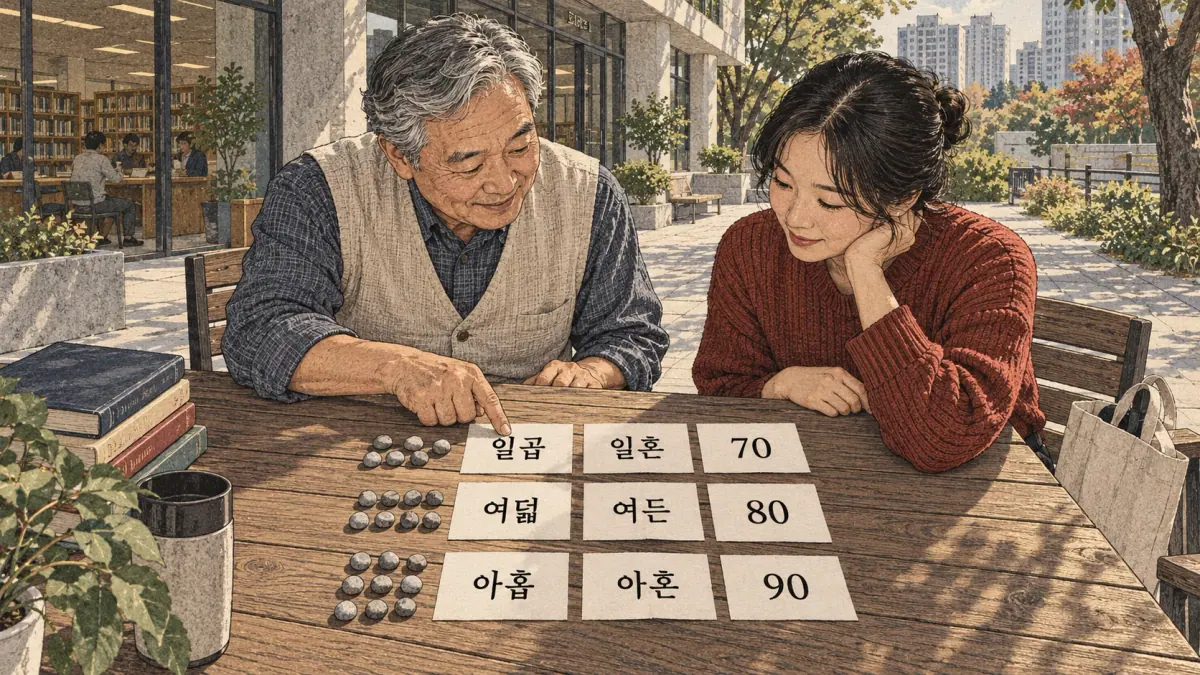
Use sound clues and meaning clues together, because the nine tens have no single pattern. These four clues come from the words themselves, and they help most learners in the first week.
- The ㄴ clue. Every ten from 30 upward ends in ㄴ: 서른, 마흔, 쉰, 예순, 일흔, 여든, 아흔. The first two, 열 and 스물, end in ㄹ.
- The 흔 clue. 마흔 (40), 일흔 (70) and 아흔 (90) share the ending 흔. If a ten ends in 흔, it is one of those three.
- The first-letter clue. 일흔 and 여든 begin with a vowel, and so does 아흔. The three highest tens below 100 are the three that start with 일, 여 and 아. They begin with the same three syllables as 일곱 (7), 여덟 (8) and 아홉 (9).
- The age clue. Link the tens to ages you know: 서른 for 30, 마흔 for 40, 쉰 for 50. The word 서른 often appears in phrases about turning thirty, which helps the sound stick.
The 흔 clue is the strongest, and the first-letter clue gives the order of the last three: 일흔 (70), 여든 (80), 아흔 (90) follow the same order as 일곱 (7), 여덟 (8), 아홉 (9). For a complete schedule that spreads these clues over five days, use how to memorize native Korean numbers.
How Do You Ask How Many?
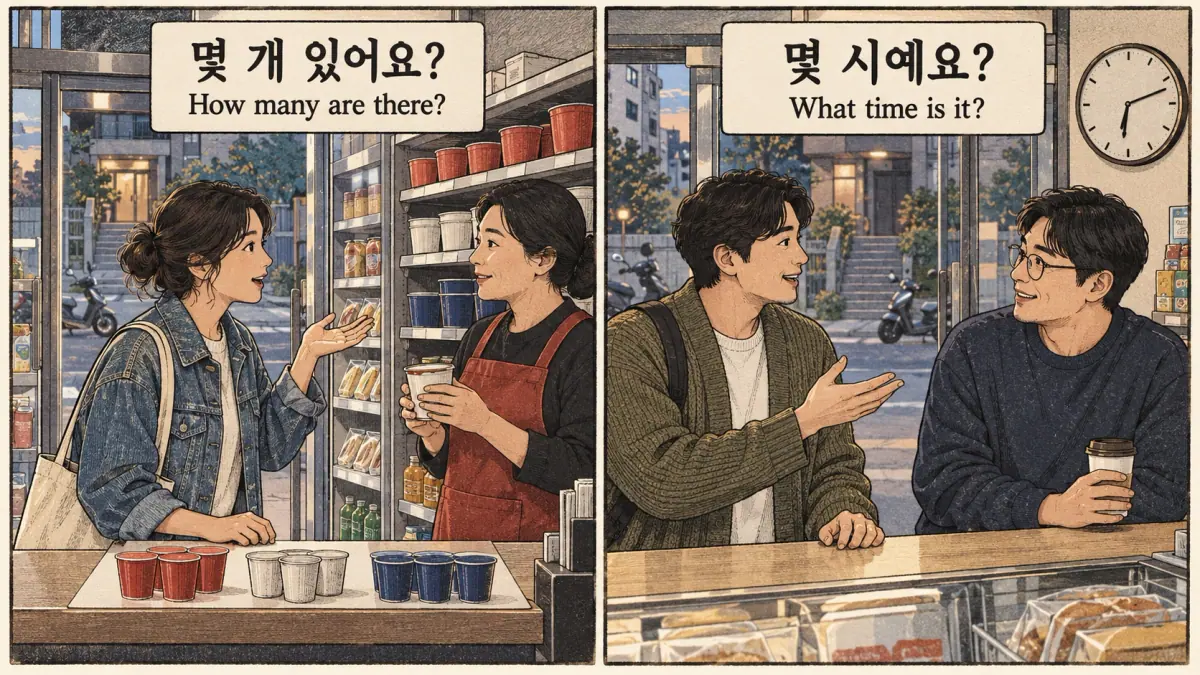
To ask "how many?", put 몇 before the counter: 몇 개, 몇 명, 몇 살. The word 몇 means "how many", and the answer is a native number plus the same counter. This question is the real-life reason to learn the numbers above 10.
| Question | Meaning | Sample answer |
|---|---|---|
| 몇 개 있어요? | How many are there? | 스물세 개 있어요. |
| 몇 명이에요? | How many people? | 서른두 명이에요. |
| 몇 살이에요? | How old are you? | 마흔한 살이에요. |
| 몇 시예요? | What time is it? | 열한 시예요. |
Here is a short exchange about a class. The teacher asks the size and the student answers with a number above 20.
- 선생님: 학생이 몇 명 있어요? (How many students are there?)
- 학생: 스물여덟 명 있어요. (There are twenty-eight.)
학생이 몇 명 있어요?
How many students are there?
스물여덟 명 있어요.
There are twenty-eight.
Notice that the answer uses the long ten 스물, followed by the ones digit 여덟 (8), and that the digit 8 does not shorten because only 1 to 4 do. Compare that with 스물네 명 (24 people), where the final 4 becomes 네.
Worked Examples: Reading Nine Numbers Aloud
Practise on nine numbers that cover every row of the grid and every kind of change. For each one, say the counting form first, then the form before a counter.
| Number | Alone | Before a counter | With a counter |
|---|---|---|---|
| 13 | 열셋 | 열세 | 열세 개 |
| 27 | 스물일곱 | 스물일곱 | 스물일곱 명 |
| 38 | 서른여덟 | 서른여덟 | 서른여덟 살 |
| 42 | 마흔둘 | 마흔두 | 마흔두 마리 |
| 59 | 쉰아홉 | 쉰아홉 | 쉰아홉 권 |
| 64 | 예순넷 | 예순네 | 예순네 장 |
| 73 | 일흔셋 | 일흔세 | 일흔세 잔 |
| 85 | 여든다섯 | 여든다섯 | 여든다섯 병 |
| 96 | 아흔여섯 | 아흔여섯 | 아흔여섯 번 |
Look at the "Before a counter" column. Only the numbers ending in 1, 2, 3 or 4 change (열세, 마흔두, 예순네, 일흔세). Numbers ending in 5 to 9 stay the same, and so do the exact tens from 30 up. That gives a quick check: look at the last digit, and decide whether it is 1 to 4.
What Happens at 100?
At 100, Korean switches to the Sino-Korean 백, so 100 things is 백 개 and 100 years old is 백 살. Native numbers do not continue past 아흔아홉 in modern Korean. There was an old native word for 100, 온, and for 1,000, 즈믄, but they survive only in old writing and a few set expressions, and no one uses them for counting today.
| Quantity | Modern Korean | Note |
|---|---|---|
| 99 things | 아흔아홉 개 | last native number |
| 100 things | 백 개 | Sino-Korean 백 |
| 100 people | 백 명 | Sino-Korean 백 |
| 100 years old | 백 살 | 백 with the native counter 살 |
The last row shows an exception to the "native with native counters" habit. Even though 살 normally takes native numbers, the number 100 is 백, because no native form is in use. The Sino-Korean list is on Sino-Korean numbers 1-100 if you want to compare how the two systems build their numbers.
Which Native Numbers Appear Most in Daily Life?
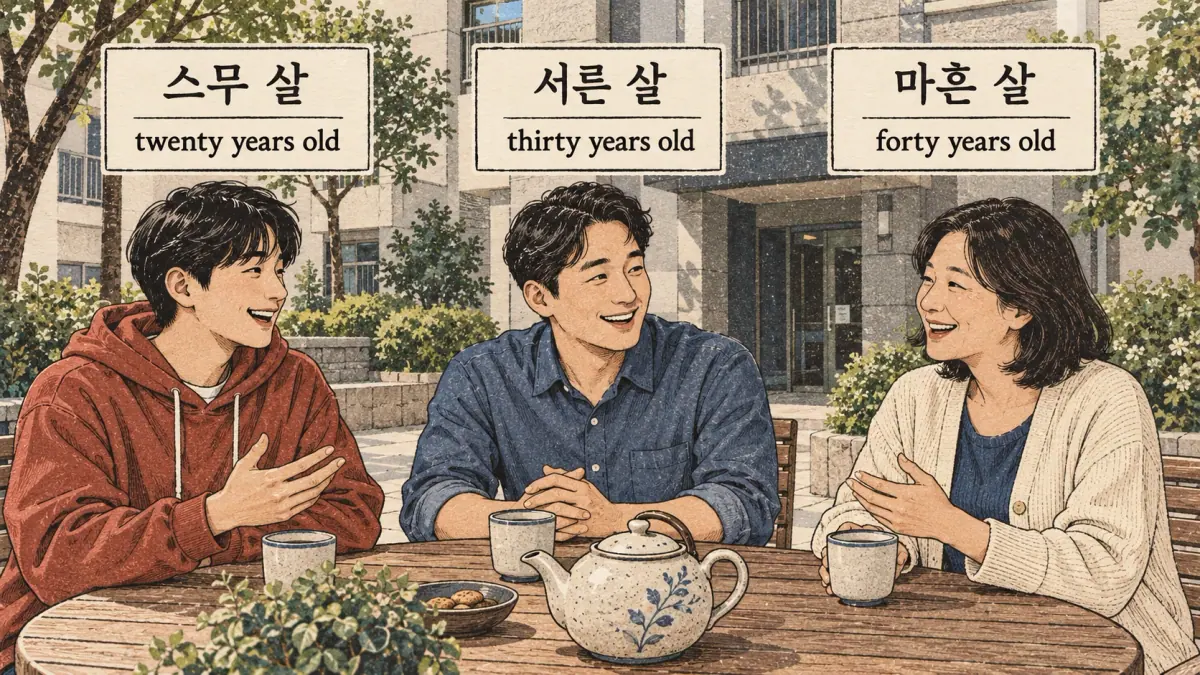
In daily life, the ones you meet most are the ages and the small counts: 스무 살, 서른 살, 마흔 살, and counts of 열 or 스무 people or things. The table shows common uses with the counter each one takes.
| Phrase | Meaning | Where you hear it |
|---|---|---|
| 스무 살 | twenty years old | ages |
| 서른 살 | thirty years old | ages |
| 마흔 살 | forty years old | ages |
| 열두 명 | twelve people | group sizes |
| 스무 개 | twenty things | shop counts |
| 서른 명 | thirty people | classes, events |
Beyond these, the tens from 쉰 up appear mainly in ages of older relatives and in counting larger groups. Learners rarely need 여든 or 아흔 in conversation, but they appear in family talk, as in 할머니는 여든 살이세요 ("My grandmother is eighty"), where the honorific 이세요 shows respect for the grandmother.
Common Mistakes and Fixes
Most errors with native numbers above ten come from the wrong form of 20, a space in the wrong place or a mixed system. Check each of these before you speak.
- Saying 스물 살. Right: 스무 살. Exactly 20 shortens before a counter.
- Saying 스무한 살. Right: 스물한 살. Only exactly 20 uses 스무.
- Leaving a space inside a number. Wrong: 스물 다섯. Right: 스물다섯.
- Saying 열일 for 11. Right: 열하나, or 열한 before a counter.
- Mixing Sino and native. Wrong: 이십하나, 스물오. Right: 이십일 (Sino) or 스물하나 (native).
- Using a native number for 100. Right: 백. There is no everyday native word for 100.
Limitation: this lesson gives the standard forms. Some counters take older variants, such as 석 for 3 in 석 달, and some sound changes vary by speaker. The audio shows careful standard speech.
Practice Set
Answer each item before you read the answer line.
- Say "25 years old" in Korean.
- Say "31 people".
- Say "20 things".
- How do you say 45 on its own?
- What is wrong with 스물 살?
- How do you say 100 things?
Practice · 8
How do you say "20 years old"?
Show answer
스무 살
Exactly 20 shortens from 스물 to 스무 before a counter, and 살 takes native numbers.
How do you say "21 years old"?
Show answer
스물한 살
Only exactly 20 uses 스무; with a ones digit the ten stays 스물, and 하나 shortens to 한 before a counter.
Which native ten means 40?
Show answer
마흔
The tens run 서른 (30), 마흔 (40), 쉰 (50).
How do you write 25 as a native number?
Show answer
스물다섯
The ten and the ones digit are written together with no space, and the ones digit must be native.
How do you say "100 things"?
Show answer
백 개
Native numbers stop at 아흔아홉 (99); from 100 Korean switches to Sino-Korean 백. The old word 온 is no longer used for counting.
Which native ten means 70?
Show answer
일흔
The last three tens, 일흔 (70), 여든 (80), 아흔 (90), follow the order of 일곱, 여덟, 아홉.
How do you say "42 animals" with 마리?
Show answer
마흔두 마리
A last digit of 1 to 4 shortens before a counter, so 마흔둘 becomes 마흔두.
How do you ask someone's age?
Show answer
몇 살이에요?
Put 몇 before the counter: 몇 살 asks how old, while 몇 시 asks the time and 몇 개 asks how many things.
Answers:
- 스물다섯 살 (seumuldaseot sal).
- 서른한 명 (seoreunhan myeong).
- 스무 개 (seumu gae).
- 마흔다섯 (maheundaseot).
- Exactly 20 becomes 스무 before a counter: 스무 살.
- 백 개 (baek gae), with the Sino-Korean 백.
Five or more correct means you have the system.
What to Learn Next
You can now build the native Korean numbers 1-100 up to 99 and use 스무 correctly. Continue in this order:
- How to memorize native Korean numbers for a day-by-day plan that fixes the tens.
- The 살 counter to use these numbers for age.
- Sino vs native Korean numbers to decide which set a situation needs.
- Native Korean numbers 1-10 if the short forms still feel shaky.
Frequently Asked Questions
Why is 20 sometimes 스무 and sometimes 스물?
스물 is the full word for 20, used when counting alone and inside longer numbers such as 스물다섯. 스무 is the short form used when 20 stands directly before a counter, as in 스무 살. The long form returns as soon as a ones digit follows, so 21 is 스물한 살, not 스무한 살.
What is native Korean for 100?
Modern Korean has no native word for 100 in everyday use. An old word, 온, exists in historical writing, but speakers use the Sino-Korean 백 instead, even with native counters. So 100 things is 백 개 and 100 years old is 백 살. Native numbers end at 아흔아홉 (99).
How do I say 11 in native Korean?
Say 열하나. Native Korean builds 11 to 19 from 열 (10) plus a ones digit, with no space. Before a counter use 열한: 열한 개 means 11 things. Do not say 열일, which mixes the native ten with the Sino-Korean 일. The same pattern gives 열둘, 열셋 and 열다섯.
Is there a native word for 1000?
There was an old native word, 즈믄, but it is archaic and not used in modern speech. For 1,000 and above, Korean uses the Sino-Korean numbers 천 (1,000), 만 (10,000) and 억 (100,000,000). Native numbers are for counting up to 99 only.
What are 예순 and 일흔 in numbers?
예순 is 60 and 일흔 is 70. They are two of the nine native tens: 열 10, 스물 20, 서른 30, 마흔 40, 쉰 50, 예순 60, 일흔 70, 여든 80 and 아흔 90. Before a counter they do not change, so 예순 살 means 60 years old and 일흔 살 means 70.