What you'll learn
- Count one to ten objects with 개, using the correct native number forms.
- Ask 몇 개 and answer it in a short shop dialogue.
- Recognise the nouns that need 명, 마리, 권 or 대 instead of 개.
- Spot and fix five common counting mistakes.
Prerequisites: native Korean numbers 1-10. Estimated time: 30 minutes.
Korean Counter Gae: the Essentials

The Korean counter gae (개) is a short word that follows a number and means "item" when you count. A counter is a word that tells you what kind of thing a number refers to. English has a few, such as "two sheets of paper" or "three glasses of water". Korean needs one almost every time, and 개 is the general one for objects that have no special counter of their own.
The pattern is: noun + number + 개.
| Noun | Number + 개 | Meaning |
|---|---|---|
| 사과 (sagwa) | 사과 세 개 | three apples |
| 계란 (gyeran) | 계란 여섯 개 | six eggs |
| 사탕 (satang) | 사탕 다섯 개 | five candies |
| 문제 (munje) | 문제 열 개 | ten questions on a test |
The word 개 comes from the Chinese character 個, but it takes native Korean numbers (하나, 둘, 셋), not the Sino-Korean ones (일, 이, 삼). So 두 개 is correct and 이 개 is not. The next sections show the full set of forms and the word order.
Because 개 is the default, it also counts abstract items that you can enumerate: 질문 두 개 (two questions), 문제 세 개 (three problems), 계획 한 개 (one plan). The rule of thumb is simple. If a noun has its own counter, use that one. If it does not, use 개.
How Do You Use 개 in a Sentence?

To use 개 in a sentence, place the noun first, then the native number, then 개: 사과 세 개를 샀어요 (I bought three apples). In English the number comes before the noun ("three apples"). In Korean the counter phrase usually comes after the noun, and the counter is an extra word that English does not need.
There are three word orders, and all are correct.
| Order | Example | Where it is common |
|---|---|---|
| Noun + number + 개 | 사과 세 개를 샀어요. | Neutral, most common |
| Number + 개 + noun-modifying 의 | 세 개의 사과를 샀어요. | Writing, formal speech |
| Noun + particle + number + 개 | 사과를 세 개 샀어요. | Everyday speech |
Notice that the particle 을/를 or 이/가 attaches to the noun in the first and third patterns, and to the counter phrase in the second. You never put a particle between the number and 개. Writing 세를 개 is always wrong.
Here are more sentences that you can hear and repeat.
- 냉장고에 계란이 여섯 개 있어요. (There are six eggs in the fridge.)
- 시험 문제가 열 개예요. (The test has ten questions.)
- 질문이 두 개 있어요. (I have two questions.)
Now you can build a sentence. Next comes the number rule that makes the counter work.
Which Number System Does It Take?
The counter 개 takes native Korean numbers from 1 to 99, and Sino-Korean numbers from 100 upward. Five native numbers shorten before any counter, and learning those five forms once covers every counter in the language.
| Number | Before 개 | Spoken | Revised Romanization | Meaning |
|---|---|---|---|---|
| 1 | 한 개 | [한 개] | han gae | one item |
| 2 | 두 개 | [두 개] | du gae | two items |
| 3 | 세 개 | [세 개] | se gae | three items |
| 4 | 네 개 | [네 개] | ne gae | four items |
| 5 | 다섯 개 | [다섣깨] | daseot gae | five items |
| 6 | 여섯 개 | [여섣깨] | yeoseot gae | six items |
| 7 | 일곱 개 | [일곱깨] | ilgop gae | seven items |
| 8 | 여덟 개 | [여덜개] | yeodeol gae | eight items |
| 9 | 아홉 개 | [아홉깨] | ahop gae | nine items |
| 10 | 열 개 | [열개] | yeol gae | ten items |
Look at the "Spoken" column for 5, 6, 7 and 9. A final ㅅ or ㅂ is said as a plain stop ([ㄷ] or [ㅂ]), and that stop makes the ㄱ of 개 tense, so you hear [ㄲ]. This is tensification, Article 23 of the National Institute of Korean Language (국립국어원) standard pronunciation rules (표준 발음법). After ㄹ, as in 여덟 개 and 열 개, the standard form is plain [ㄱ], though some speakers say [깨]. The same effect gives 몇 개 the sound [멷깨]. You do not have to think about it when you speak, because the mouth does it on its own.
Which Forms Shorten before 개?
Five numbers shorten before 개: 하나 becomes 한, 둘 becomes 두, 셋 becomes 세, 넷 becomes 네 and 스물 becomes 스무. These short forms are numeral determiners (수 관형사): they stand in front of the counter the way an adjective stands in front of a noun.
| Full number | Counting form | Example with 개 |
|---|---|---|
| 하나 (1) | 한 | 한 개 |
| 둘 (2) | 두 | 두 개 |
| 셋 (3) | 세 | 세 개 |
| 넷 (4) | 네 | 네 개 |
| 스물 (20) | 스무 | 스무 개 |
The shortening applies at the end of any larger number too: 열한 개 (11), 열두 개 (12), 스물한 개 (21), 서른두 개 (32). Round tens keep their full form: 서른 개 (30), 마흔 개 (40), 쉰 개 (50), 예순 개 (60), 일흔 개 (70), 여든 개 (80), 아흔 개 (90).
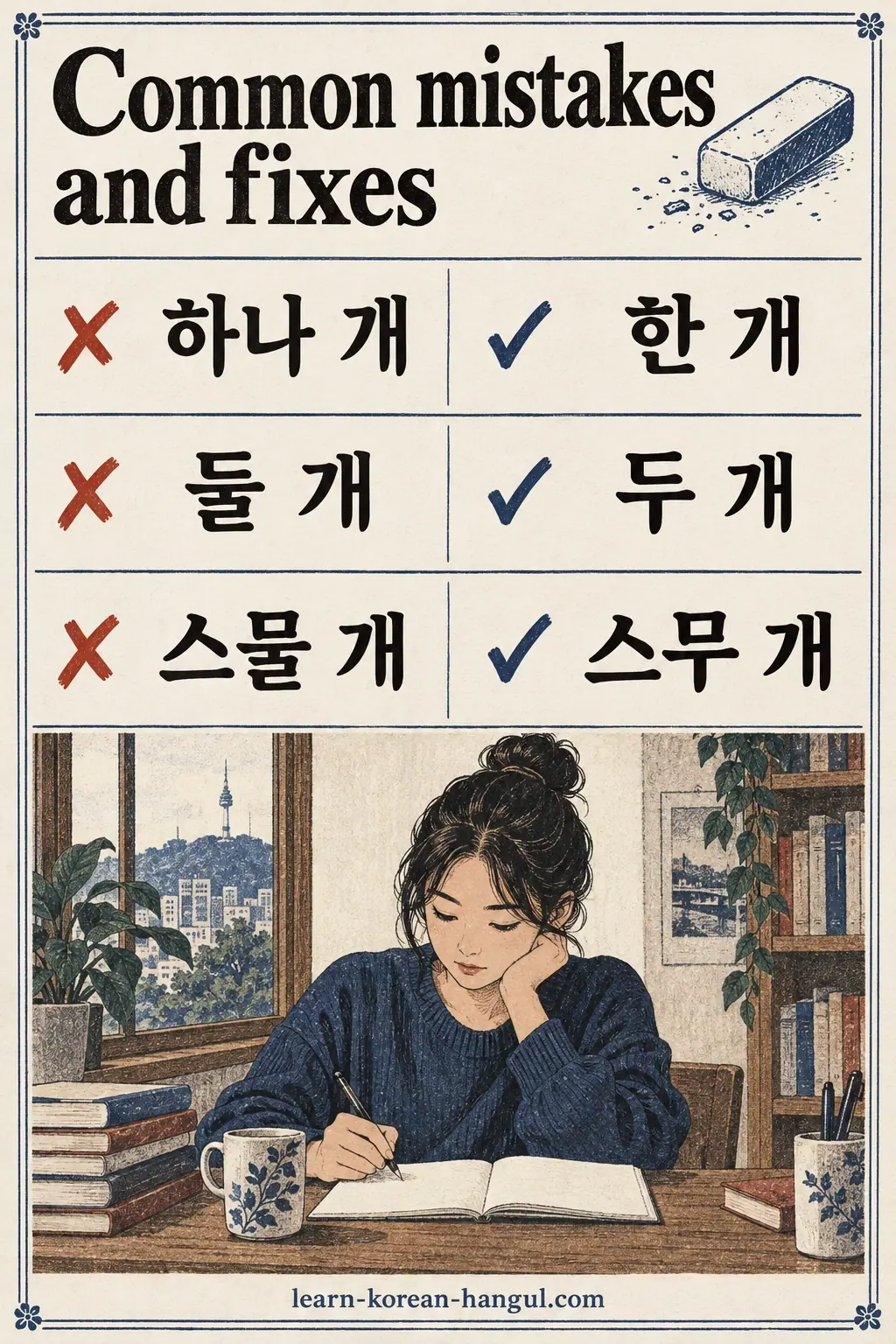
Expert tip: if you remember only one short form, remember 스무. Learners often say 스물 개, which sounds wrong to Korean ears. The same trap appears with ages, where 스무 살 means twenty years old.
What Happens at 100 and Above?
From 100 upward, 개 takes Sino-Korean numbers: 백 개 (100), 이백 개 (200), 천 개 (1,000) and 만 개 (10,000). Native numbers stop at 아흔아홉 (99) in everyday counting. A warehouse that holds 오백 개 of something uses the Sino form, never a native one.
When you write with digits, attach the counter without a space: 3개, 12개, 100개. The 한글 맞춤법 제43항 (spelling rule 43) allows this, and it is how you see prices and quantities on packaging. When you write the number in Hangul, keep a space: 세 개, not 세개.
You can now count any pile. Next is the question that asks for the count.
How Do You Ask How Many with 몇 개?

To ask how many items there are, say 몇 개예요? The word 몇 means "how many", so 몇 개 means "how many items". It is pronounced [멷깨] because the final ㅊ of 몇 is said as [ㄷ], which tenses the ㄱ.
| Situation | Question | Answer |
|---|---|---|
| Asking a friend | 몇 개예요? | 세 개예요. |
| Asking about eggs | 계란이 몇 개 있어요? | 계란이 여섯 개 있어요. |
| Asking about a test | 문제가 몇 개예요? | 문제가 열 개예요. |
| Offering help in a shop | 몇 개 필요하세요? | 두 개 필요해요. |
The answer always repeats the same pattern: number + 개 + 예요/이에요 or a verb. After a vowel-final counter phrase you add 예요, which is why 세 개예요 ends in 예요.
Shopping Dialogue
The dialogue below uses 개 the way a real shop does. The customer uses the bare pointing word 이거 (this one) and a number-counter phrase.
- 손님: 이거 두 개 주세요. (Two of these, please.)
- 직원: 네. 더 필요하세요? (Yes. Do you need more?)
- 손님: 아니요. 이거 몇 개 들어 있어요? (No. How many are in this?)
- 직원: 한 봉지에 열 개 들어 있어요. (There are ten in one bag.)
The customer uses plain 개 in a polite request. Unlike 명, which has the honorific partner 분, 개 has no honorific form, so respect shows in the verb ending (주세요) instead.
Many shop phrases follow the same frame, and you can see more of them in Korean shopping phrases. First, you need to know where 개 stops working.
What Does It Not Count?

The counter 개 does not count people, animals, books or vehicles and machines. Korean has a dedicated counter for each of these groups, and using 개 for them marks you as a beginner or, for people, sounds disrespectful.
| What you count | Correct counter | Example | Not |
|---|---|---|---|
| People | 명 | 학생 세 명 | 학생 세 개 |
| Animals | 마리 | 고양이 두 마리 | 고양이 두 개 |
| Books and volumes | 권 | 책 네 권 | 책 네 개 |
| Cars and machines | 대 | 자동차 한 대 | 자동차 한 개 |
Each of these has its own lesson. The 명 counter covers people, the 마리 counter covers animals, the 권 counter covers books, and the 대 counter covers machines.
Other special counters exist for flat items (장), pairs of shoes (켤레), cups and glasses (잔) and bottles (병). If a noun belongs to a group like these, use the group counter. Native speakers will still understand 개, but they will correct you, or smile.
A Fallback Rule That Rarely Fails
When you do not know the right counter, 개 is a safe fallback for inanimate objects. A Korean listener will understand 물 두 개 for two glasses of water, even though 물 두 잔 is the natural form. Do not use this fallback for living things. For people and animals the wrong counter changes the feeling of the sentence, not just its precision.
Daily-Life Phrases with 개

Most real uses of 개 fall into a few daily scenes: buying, cooking, studying and asking for things. Learn these phrases as whole chunks, because the number and counter then come out together without thinking.
| Scene | Phrase | Meaning |
|---|---|---|
| Cafe | 쿠키 세 개 주세요. | Three cookies, please. |
| Kitchen | 계란 두 개만 넣으세요. | Add just two eggs. |
| Class | 단어를 열 개 외웠어요. | I memorized ten words. |
| Delivery | 택배가 두 개 왔어요. | Two parcels arrived. |
| Phone shop | 충전기 한 개 필요해요. | I need one charger. |
| Plans | 약속이 세 개 있어요. | I have three appointments. |
The particle 만 in 두 개만 means "only", and it attaches to the counter phrase, not to the noun. Here 만 sits directly after 개, in the same slot that 을/를 takes in 사과 세 개를. The sentence 두 개만 넣으세요 therefore means "put in only two", and 두 개를 넣으세요 would mean "put in two" without the limit.
Native speakers also shift between counters in this kind of speech. A bakery may count cookies with 개, and a delivery company counts parcels with 건, while ordinary people say 택배 두 개. Both are understood, and 개 is never wrong for these items.
Misconceptions about 개
Learners often assume that 개 is only for round objects, or that it means "dog". Both ideas are wrong, and this section clears them up.
Misconception 1: 개 means "item" only for small round things. 개 counts shapes of every kind: 사과 (round), 책상 (a desk), 질문 (an idea). Its range is set by what has no special counter, not by shape.
Misconception 2: 개 the counter is the same word as 개 the dog. The two share a sound and a spelling, but they are different words. The counter comes from the character 個, while the animal word 개 (dog) is native Korean. A dog is therefore counted with 마리: 개 한 마리, not 개 한 개. Context and position tell them apart, because the counter always follows a number.
Misconception 3: 하나 and 한 are different numbers. They are two forms of the same number. 하나 stands alone, and 한 sits before a counter or noun.
Common Mistakes and Fixes
Five errors account for most wrong uses of 개. Read the wrong form first, then the fix.
- Using Sino-Korean numbers. Wrong: 일 개, 이 개, 삼 개. Fix: 한 개, 두 개, 세 개. Native numbers belong here until 99.
- Using the full number form. Wrong: 하나 개, 둘 개, 스물 개. Fix: 한 개, 두 개, 스무 개.
- Counting people with 개. Wrong: 친구 두 개. Fix: 친구 두 명.
- Putting a particle inside the phrase. Wrong: 사과 세를 개. Fix: 사과를 세 개, or 사과 세 개를.
- Dropping the space. Wrong: 세개, 두개 when written in Hangul. Fix: 세 개, 두 개. Digits are the exception: 3개 is correct.
Honest limits. In casual speech Koreans sometimes drop 개 completely and use the bare number: 사과 셋 (three apples) or 사과 하나. They also use 개 loosely with items that have a more exact counter, such as 책 두 개 for books. Both habits are normal in conversation, but they are not a reason to skip the dedicated counters in your own writing or exams.
Practice Set
Answer each item before you read the answer line.
- Say "five candies" in Korean.
- Say "twenty eggs" in Korean.
- Ask how many questions there are on a test.
- A shop worker asks 몇 개 필요하세요? Answer for three items.
- Correct the mistake: 사과 이 개.
- Which is wrong, and why: 계란이 스무 개 있어요 or 계란이 스물 개 있어요?
Answers:
- 사탕 다섯 개 (satang daseot gae).
- 계란 스무 개 (gyeran seumu gae), not 스물 개.
- 문제가 몇 개예요? (munjega myeot gaeyeyo?)
- 세 개 필요해요. (se gae piryohaeyo.)
- 사과 두 개. Replace the Sino-Korean 이 with the native 두.
- 스물 개 is wrong. 개 needs the shortened form 스무.
If you got four or more, you are ready to move on.
What to Learn Next
You now know how to use the Korean counter gae for objects: native number, then 개, with special counters for people, animals, books and machines. Continue in this order:
- How Korean counters work for the full rules of word order, spacing and number systems that every counter shares.
- The 명 counter for people, because 개 never counts them.
- The 권 counter for books and volumes.
- Native Korean numbers 1-10 if the forms in the table still feel unsteady.
- Counting Things for the full set of counters for objects.
Frequently Asked Questions
Can I use 개 for people?
No. Counting a person with 개 treats the person as an object and sounds rude or comical. Use 명 for people, as in 학생 세 명, and the honorific 분 when you want to show respect. Korean has no polite way to count a person with 개, so always switch counters.
Is 개 impolite or too casual?
No. 개 is neutral and works in every speech level, from a market stall to a formal request. You only change the verb ending to adjust politeness: 두 개 주세요 is polite, and 두 개 줘 is casual. Politeness problems come from counting the wrong kind of noun, not from using 개 itself.
Why 한 개 and not 하나 개?
하나 is the number one standing alone. Before a counter, Korean uses the shortened determiner form 한, which works like an adjective in front of the counter. So you say 한 개, 두 개, 세 개. The full forms 하나, 둘 and 셋 appear when no counter follows, as in 사과 하나 주세요.
What is the difference between 하나 and 한 개?
Both mean one. 하나 is the bare number, so it can end a phrase on its own: 사과 하나 (one apple). 한 개 is determiner plus counter, and it names the unit explicitly: 사과 한 개. In shops and daily speech they are interchangeable for small objects, but only 한 개 can sit in front of a noun.