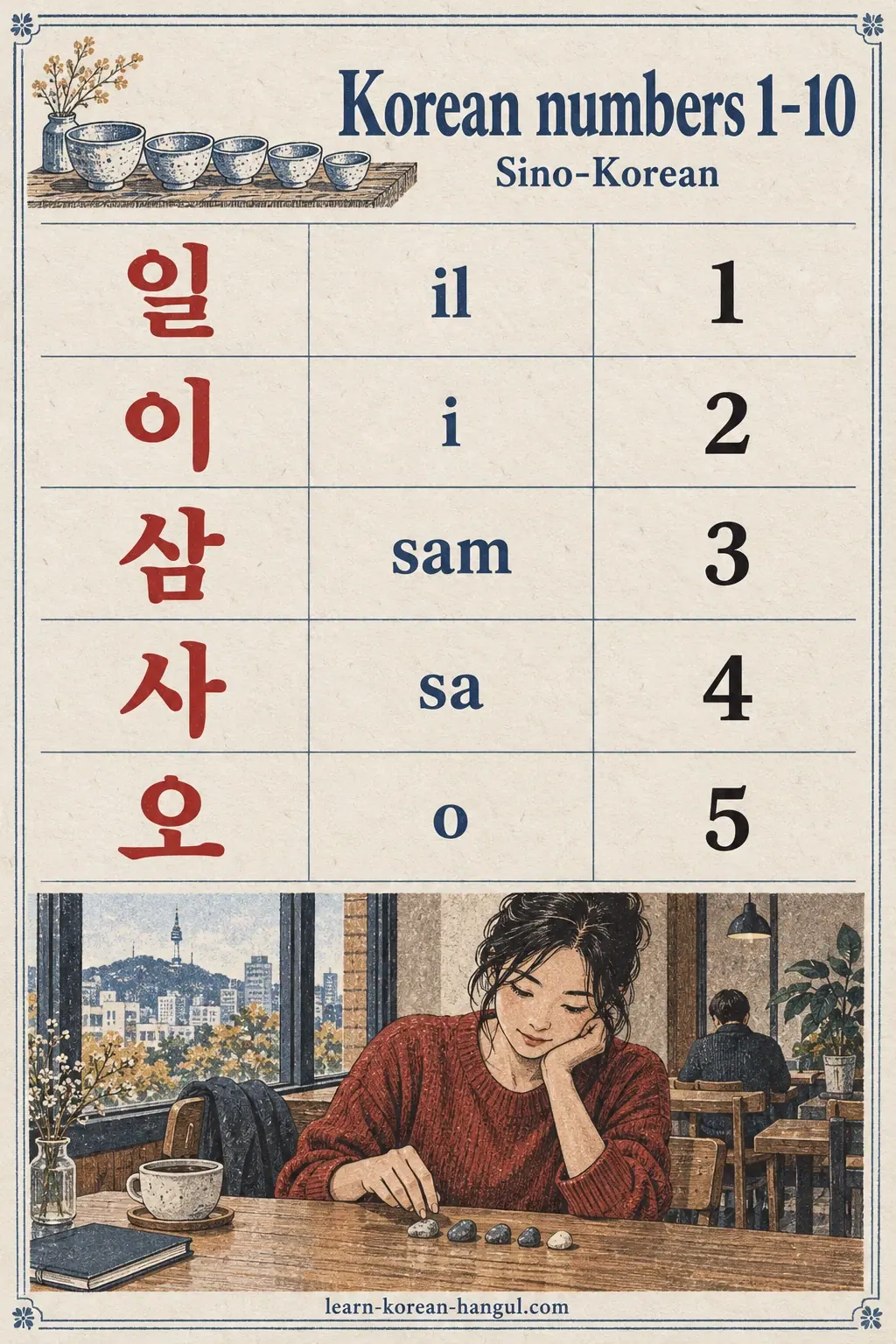
What you'll learn
- Say 1 to 10 in both Sino-Korean and native Korean.
- Pick the right set for a phrase: 3 o'clock, 3 apples, 3 minutes.
- Look up any single digit, such as 7 or 10, in both systems.
- Pronounce 육 and 십 and recognise their sound changes.
Prerequisites: reading basic Hangul syllables. Estimated time: 30 minutes.
What Are Korean Numbers 1-10 in Both Systems?
Korean numbers 1-10 are the ten words you need to count from one to ten, and Korean has two full sets of them. Sino-Korean numbers come from Chinese and are used for reading labels, minutes, dates, money and phone numbers. Native Korean numbers are original Korean words and are used for counting objects, people and hours.
| Number | Sino-Korean | RR | Native | RR |
|---|---|---|---|---|
| 1 | 일 | il | 하나 | hana |
| 2 | 이 | i | 둘 | dul |
| 3 | 삼 | sam | 셋 | set |
| 4 | 사 | sa | 넷 | net |
| 5 | 오 | o | 다섯 | daseot |
| 6 | 육 | yuk | 여섯 | yeoseot |
| 7 | 칠 | chil | 일곱 | ilgop |
| 8 | 팔 | pal | 여덟 | yeodeol |
| 9 | 구 | gu | 아홉 | ahop |
| 10 | 십 | sip | 열 | yeol |
Sino-Korean first, listen to each word in turn.
Now the native set.
Revised Romanization (RR) is the official Latin-letter system of South Korea, and it is shown only as a learning aid. The Hangul is the real spelling. Each Sino-Korean word is one syllable, which is why they are quick to say. The native words are longer and several are not said exactly as written, which the pronunciation section explains.
Before you memorise both lists, find out when each one is needed.
Which Set Is Used When?
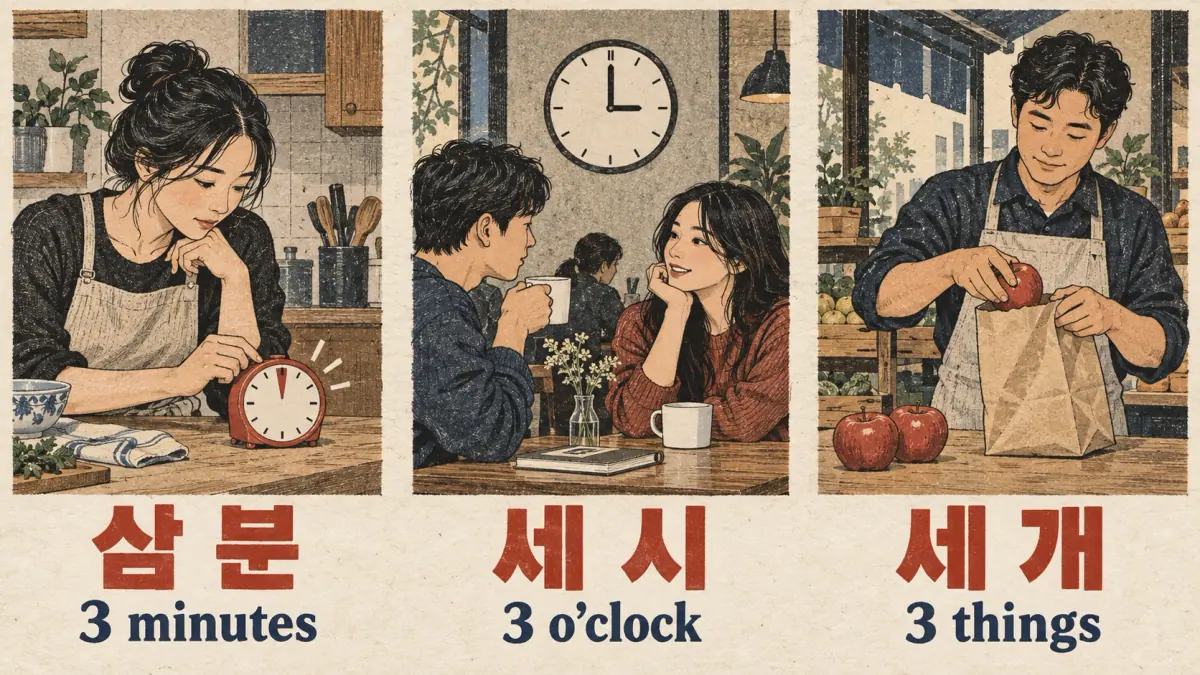
Use native numbers when you can ask "how many things?" and Sino-Korean numbers when you read a label, a calendar or a price. The quickest way to see the difference is to take one quantity, 3, and put it in eight common phrases.
| Phrase | Meaning | Set | Korean |
|---|---|---|---|
| 3 minutes | 3분 | Sino | 삼 분 |
| 3 o'clock | 3시 | Native | 세 시 |
| 3 things | 3개 | Native | 세 개 |
| March | 3월 | Sino | 삼월 |
| 3 people | 3명 | Native | 세 명 |
| 3rd floor | 3층 | Sino | 삼 층 |
| 3 times | 3번 | Native | 세 번 |
| 3 years old | 3살 | Native | 세 살 |
The same digit becomes 삼 or 세, depending on what follows. Notice that 세 is the short form of the native 셋 that appears before a counter. A counter is a small word that follows a number and says what kind of thing is counted. The first four native numbers shorten before a counter: 하나 becomes 한, 둘 becomes 두, 셋 becomes 세 and 넷 becomes 네.
A rule of thumb works for most cases. If you can count it one by one, such as apples, people, cups or hours of the clock, it is native. If you read it from a label, such as a minute, a month, a floor or a price, it is Sino-Korean. The complete rule, with the exceptions, is on Sino vs native Korean numbers.
Both Systems in One Phrase: the Time
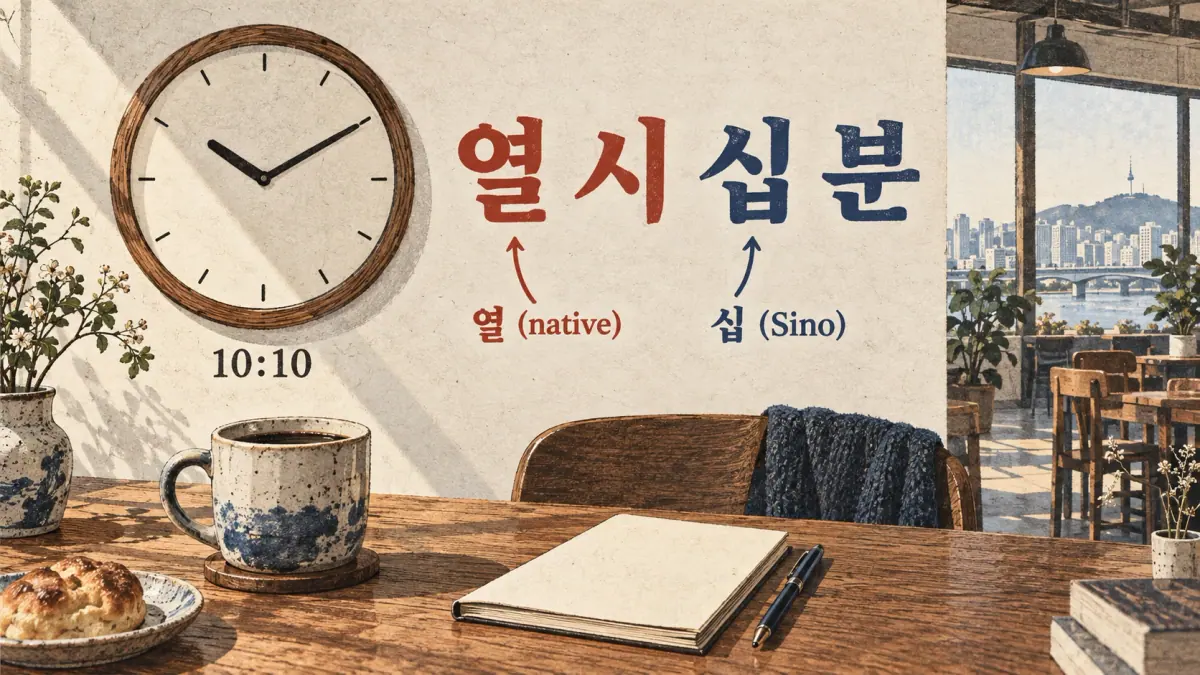
Telling the time uses both systems in a single phrase: the hour is native and the minutes are Sino-Korean. This is the cleanest place to see the two sets work together, and it gives you the reason to learn both.
| Clock | Korean | Hour | Minutes |
|---|---|---|---|
| 1:01 | 한 시 일 분 | 한 (native) | 일 (Sino) |
| 2:05 | 두 시 오 분 | 두 (native) | 오 (Sino) |
| 4:07 | 네 시 칠 분 | 네 (native) | 칠 (Sino) |
| 6:09 | 여섯 시 구 분 | 여섯 (native) | 구 (Sino) |
| 10:10 | 열 시 십 분 | 열 (native) | 십 (Sino) |
If you hear 시, the number before it is native. If you hear 분, the number before it is Sino-Korean. The full time lesson is on how to tell time in Korean, and the page on saying the hour with 시 covers the hour in depth.
How Do You Say a Single Number Like 7 or 10?
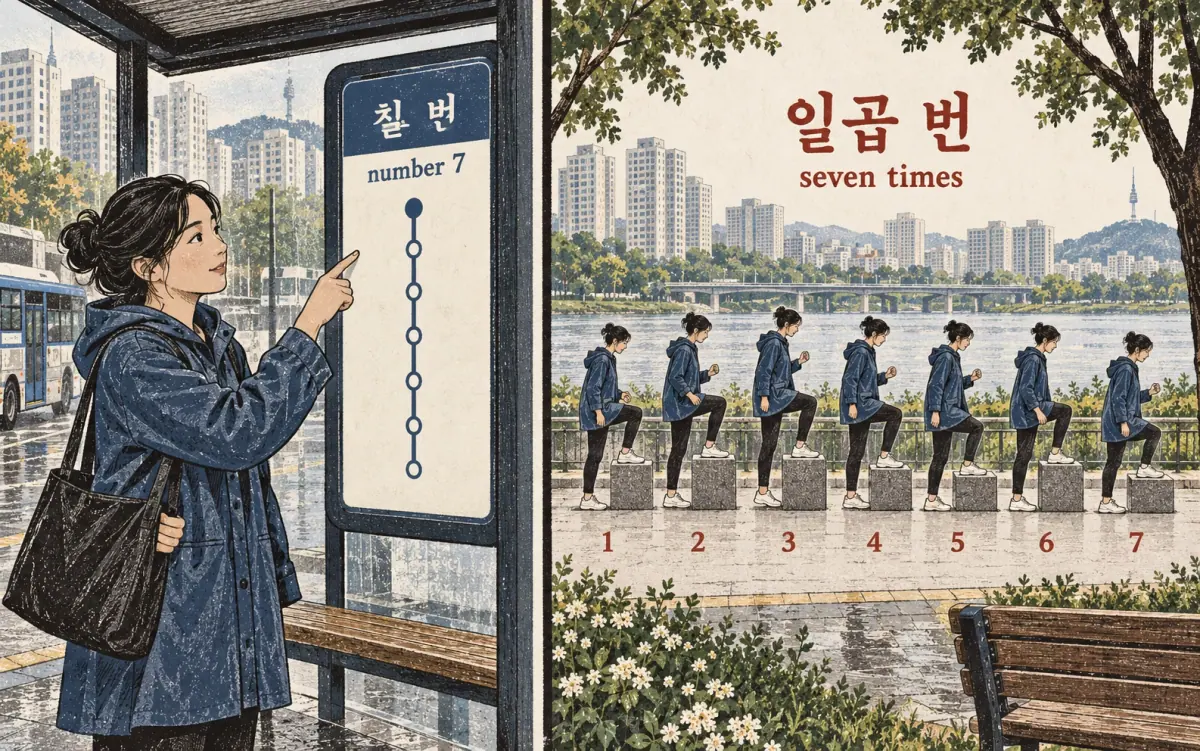
To say one number on its own, choose the set by purpose: Sino-Korean for naming or reading a digit, and native for counting up. People who search for "7 in Korean" or "1 in Korean" want one of these two answers, and the lookup below gives both.
| Digit | Reading a label | Counting up | Example |
|---|---|---|---|
| 1 | 일 | 하나 | 일 번 (number 1), 하나 둘 셋 |
| 2 | 이 | 둘 | 이 번 (number 2) |
| 3 | 삼 | 셋 | 삼 번 (number 3) |
| 4 | 사 | 넷 | 사 번 (number 4) |
| 5 | 오 | 다섯 | 오 번 (number 5) |
| 6 | 육 | 여섯 | 육 번 (number 6) |
| 7 | 칠 | 일곱 | 칠 번 (number 7) |
| 8 | 팔 | 여덟 | 팔 번 (number 8) |
| 9 | 구 | 아홉 | 구 번 (number 9) |
| 10 | 십 | 열 | 십 번 (number 10) |
The example column uses 번 as "number" (as in "bus number 7"). The same character also means "times", as in 한 번 (once), where it takes native numbers. The meaning changes with the number system: 칠 번 is "number 7", while 일곱 번 is "seven times".
Zero has two words, 영 and 공. Use 영 in maths and for temperatures and scores of nothing, and use 공 when reading phone numbers, as in 공일공 for 010. Both are Sino-Korean in origin; there is no native word for zero.
Pronunciation of the Numbers 1-10
Each Sino-Korean number is one syllable and is said as it is written, except that final consonants are light. Native numbers have a few spoken forms that differ from the spelling. Seoul Korean has no word tones like Chinese, so you do not learn a pitch for each number; the meaning comes from the vowels and consonants alone.
| Written | Said as | Note |
|---|---|---|
| 육 | [육] | ends with a ㄱ sound that is not released |
| 칠, 팔 | [칠], [팔] | the final ㄹ is a light l, with the tongue tip held behind the upper teeth |
| 십 | [십] | the final ㅂ is closed and not released |
| 셋, 넷 | [섣], [넫] | final ㅅ sounds like [ㄷ] |
| 다섯, 여섯 | [다섣], [여섣] | the same rule |
| 여덟 | [여덜] | ㅂ is silent at the end |
Two sound changes are worth hearing early, because they appear in the numbers you use next. Following the standard pronunciation rules (표준 발음법) of the National Institute of Korean Language (국립국어원), 십육 (16) is said [심뉵]: an [ㄴ] sound is added before 육, and the ㅂ of 십 changes to [ㅁ] before that [ㄴ]. Also, 십일 (11) is said [시빌], because the final ㅂ moves across to the next syllable.
Two months have special spellings. June is 유월 and October is 시월. They would be 육월 and 십월 if they followed the usual pattern, but the final sounds of 육 and 십 are dropped in these two names, and you learn them as a pair.
Ten Everyday Sentences with Both Sets
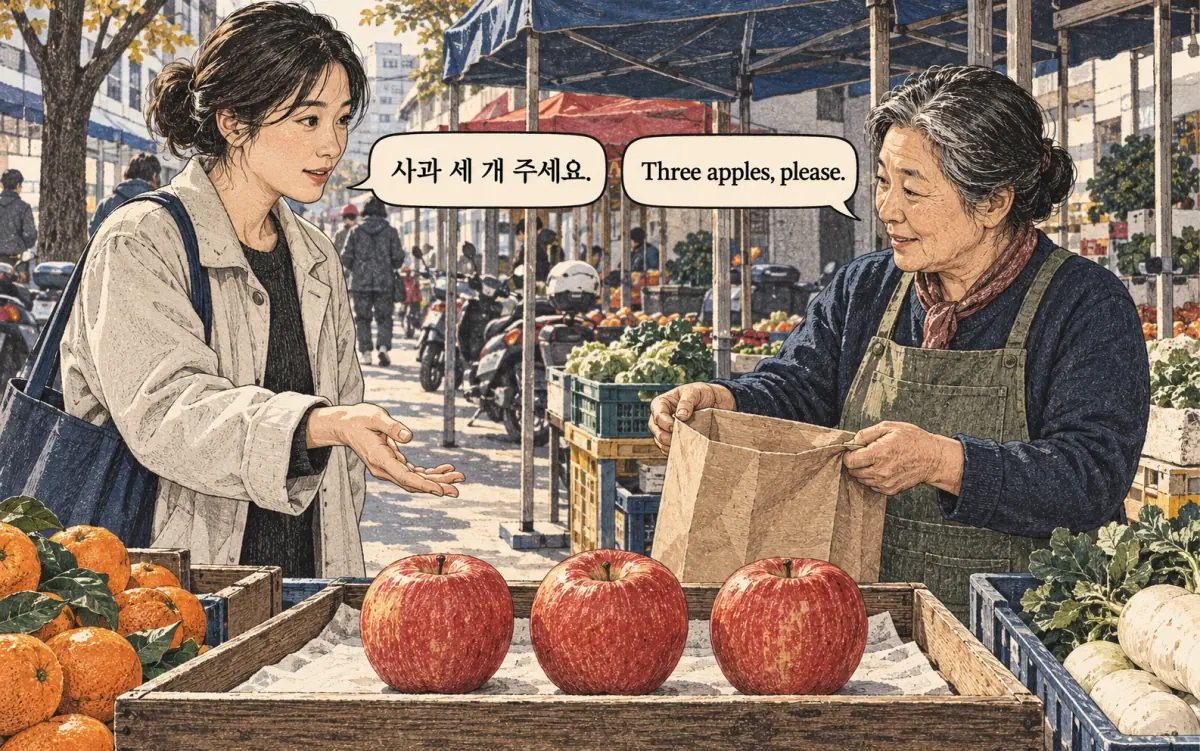
Short sentences show how the two sets sit side by side in real speech. Each sentence below uses one or two numbers from 1 to 10, and the last column names the set that the sentence needs.
| Korean | Meaning | Set |
|---|---|---|
| 사과 세 개 주세요. | Three apples, please. | native |
| 칠 번 버스를 타요. | I take bus number 7. | Sino |
| 두 시에 만나요. | Let's meet at 2 o'clock. | native |
| 오 분 후에 만나요. | Let's meet in 5 minutes. | Sino |
| 팔 층이에요. | It is the 8th floor. | Sino |
| 일곱 명이에요. | There are seven people. | native |
| 십 분 걸려요. | It takes 10 minutes. | Sino |
| 한 번 더 말해 주세요. | Please say it one more time. | native |
| 유월에 와요. | I am coming in June. | Sino |
| 아홉 살이에요. | I am nine years old. | native |
One row needs care: June is 유월 and not 육월, so the month in the ninth sentence is not built with the regular pattern. The audio shows the form that speakers actually use.
Read the table once with the Meaning column covered and ask, for each sentence, whether the counter or unit after the number is native or Sino. The units 개, 시, 명, 번 (times) and 살 take native numbers; 번 (number), 분, 층 and 월 take Sino-Korean numbers.
How Do You Read Digits One at a Time?
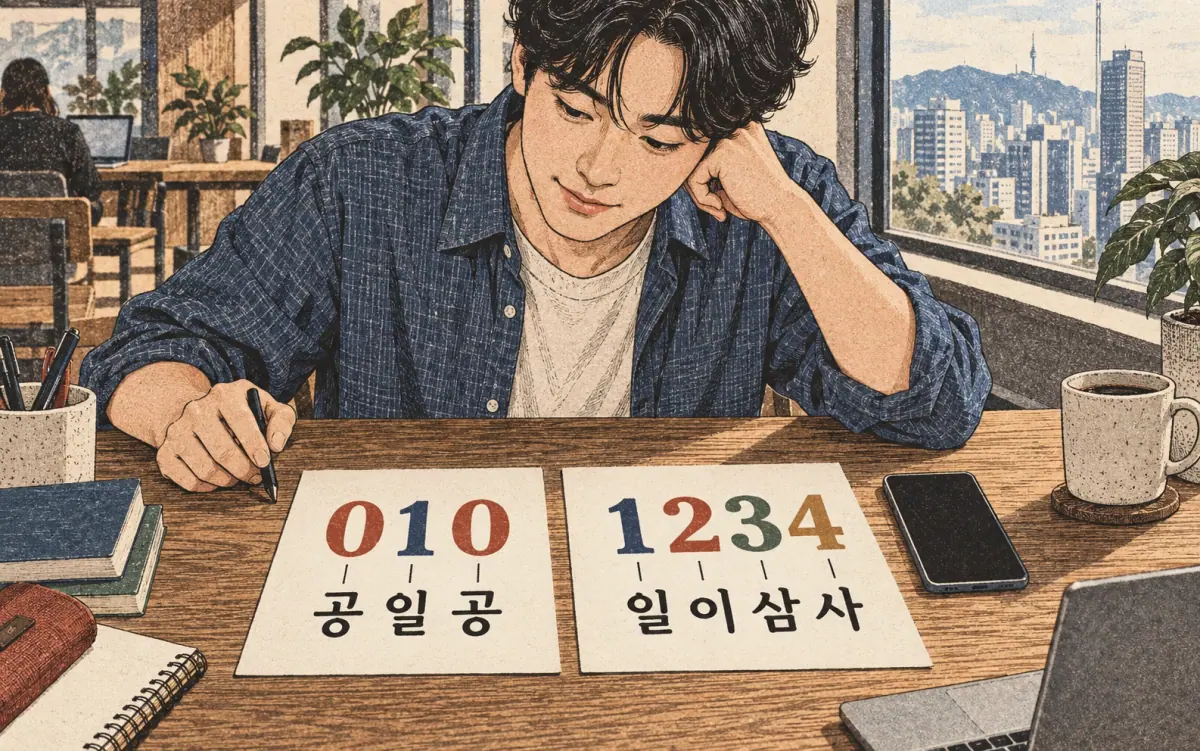
When you read digits one at a time, such as a phone number or a PIN, use the Sino-Korean set with 공 for zero. Each digit is a single syllable, and you say them in order without pauses between the digits of a group. This is the most common use of the Sino-Korean set for a digit by itself.
| Written | Spoken | Use |
|---|---|---|
| 010 | 공일공 | the start of a mobile number |
| 1234 | 일이삼사 | a group of four digits |
| 5678 | 오육칠팔 | a group of four digits |
| 9012 | 구공일이 | a PIN code |
Because the numbers are read digit by digit, you can use only the ten words from the first table. The full method for phone numbers, including area codes and the +82 prefix, is on how to say a phone number in Korean.
What Comes after 10?
After 10, the two systems build new numbers in different ways. Sino-Korean joins 십 with a digit (십일, 십이) and native Korean joins 열 with a digit (열하나, 열둘). Learn the pattern for 11 to 20 and you have the key to the next lessons.
| Number | Sino-Korean | Native Korean |
|---|---|---|
| 11 | 십일 | 열하나 |
| 12 | 십이 | 열둘 |
| 13 | 십삼 | 열셋 |
| 14 | 십사 | 열넷 |
| 15 | 십오 | 열다섯 |
| 16 | 십육 | 열여섯 |
| 17 | 십칠 | 열일곱 |
| 18 | 십팔 | 열여덟 |
| 19 | 십구 | 열아홉 |
| 20 | 이십 | 스물 |
The Sino-Korean column follows a rule you can state in one line: the tens digit, then 십, then the ones digit, so 20 is 이십 and 25 is 이십오. The native column has no such rule and needs the separate tens words. This difference is why many courses teach Sino-Korean numbers to 100 first and native numbers to 99 afterwards.
How Should You Study the Two Sets Together?
Study the two sets in pairs, not in two separate lists, because each digit has two forms and the situation decides which one you need. A three-step routine keeps the load small.
- Say the pair. For each digit, say the Sino and native word together: 일, 하나; 이, 둘; 삼, 셋. Do this with the audio until the pairs come without a pause.
- Attach a situation. For each pair, link a native phrase and a Sino phrase from the table above, such as 세 개 and 삼 분.
- Test from English. Cover the Korean and say the right set for "3 o'clock", "3 minutes", "3 people" and "3rd floor".
You will know the routine works when you stop translating the digit and start choosing the set from the situation. The first two steps take about ten minutes a day, and the third is a fast check you can do on a bus.
Why Is the Number 4 Sometimes Avoided?
The Sino-Korean 사 (4) sounds the same as the Chinese-origin word 死 (sa), which means "death". Because of this, some people avoid the number, in the same way that some Western buildings skip the 13th floor. Some Korean buildings label the fourth floor F instead of 4, and some lifts omit it.
This is a habit, not a rule. Most people use 사 in daily life without any concern, and the native 넷 or 네 is never affected. The page on Korean number slang explains this and other number associations, such as why 1004 means "angel".
Common Mistakes and Fixes
Most mistakes with Korean numbers 1-10 come from using one set where the other is needed. Check each of these before you speak.
- Using 일 for one apple. Wrong: 사과 일 개. Right: 사과 한 개. Counting objects takes the native set.
- Using 하나 for one minute. Wrong: 하나 분. Right: 일 분. Minutes take the Sino-Korean set.
- Using the counting form before a counter. Wrong: 셋 개. Right: 세 개.
- Using Sino-Korean for the hour. Wrong: 삼 시. Right: 세 시.
- Writing 육월 and 십월. Right: 유월 and 시월.
- Reading 010 as 영일영. Right: 공일공 in phone numbers.
Limitation: this page covers 1 to 10 only and the standard forms. The numbers above ten, and the exceptions among them, are in the 1-100 lessons, and the rule for the whole system is on the Sino vs native page.
Practice Set
Answer each item before you read the answer line.
- Say "3 minutes".
- Say "3 o'clock".
- Say "three cups" with the counter 잔.
- Say "June" in Korean.
- How do you read 010 in a phone number?
- What is wrong with 하나 분?
Practice · 8
How do you say "3 minutes"?
Show answer
삼 분
Minutes are read from a label, so they take Sino-Korean numbers: 삼 분.
How do you say "3 o'clock"?
Show answer
세 시
The hour takes native numbers, and 셋 shortens to 세 before a counter.
How do you say "June" in Korean?
Show answer
유월
June drops the final sound of 육 and is spelled 유월.
How do you read 010 at the start of a phone number?
Show answer
공일공
Phone numbers are read digit by digit with Sino-Korean numbers, and zero is 공.
What does 칠 번 mean?
Show answer
number 7
With Sino-Korean numbers 번 means "number", as in bus number 7; seven times is 일곱 번.
How do you say "one apple"?
Show answer
사과 한 개
Counting objects takes the native set, and 하나 shortens to 한 before a counter.
Which native number is 7?
Show answer
일곱
칠 is the Sino-Korean 7; the native 7 is 일곱, and 여덟 is 8.
How do you say 10:10 on the clock?
Show answer
열 시 십 분
The hour is native (열 시) and the minutes are Sino-Korean (십 분), so one phrase uses both sets.
Answers:
- 삼 분 (sam bun).
- 세 시 (se si).
- 세 잔 (se jan).
- 유월 (yuwol).
- 공일공 (gong-il-gong).
- Minutes use Sino-Korean numbers, so the form is 일 분.
Five or more correct means you can choose between the two sets.
What to Learn Next
You can now say Korean numbers 1-10 in both systems and choose between them. Continue in this order:
- Sino-Korean numbers 1-100 to build every number to 100 from the Sino set.
- Native Korean numbers 1-10 for the full native lesson, including the short forms.
- Korean numbers 1-100 for both sets on one chart.
- Sino vs native Korean numbers for the complete decision rule.
Frequently Asked Questions
What is 1 in Korean?
It depends on the use. 일 is the Sino-Korean one, used for labels, minutes, dates and money, as in 일 분 and 일 번. 하나 is the native one, used for counting, and it becomes 한 before a counter, as in 한 개. Both mean the number 1 and both are correct in their own setting.
How do you count from 1 to 10 in Korean?
When counting objects aloud, use the native set: 하나, 둘, 셋, 넷, 다섯, 여섯, 일곱, 여덟, 아홉, 열. When reciting digits or reading a list, use the Sino-Korean set: 일, 이, 삼, 사, 오, 육, 칠, 팔, 구, 십. Learn both, because Korean uses both every day.
Which set do I use for 4 in Korean?
Use 넷 (and 네 before a counter) for counting things, as in 네 개. Use 사 for labels, minutes, months and floors, as in 사 분 and 사월. Some people avoid 사 because it sounds like 死, the Chinese-origin word for death, but it is used normally in daily life.
How do I say 0?
Say 영 in maths and for temperatures, and say 공 when reading phone numbers, as in 공일공 for 010. Both words are Sino-Korean in origin. Native Korean has no everyday word for zero. If you mix them up, listeners will still understand you.
Is 사 considered unlucky?
For some people, yes, because 사 sounds the same as 死 (death). Some buildings label the fourth floor F, and some people avoid 4 in gifts. This varies by person and age, and most people use the number without concern. The native number 넷 does not carry this association.